 សទ្ទានុក្រម · Forex ជាអ្វី?
Over-the-counter (OTC) market
ខ្លឹមសារនេះមានតែជាភាសាអង់គ្លេសសិន។
In an over-the-counter (OTC) market, traders deal directly with no central exchange. Spot forex works this way: dealer banks quote prices to each other and to brokers, so there is no single official price at any moment.
Shares of a large company usually trade on one exchange, through one order book that everyone can see. Spot forex has no such centre. It is an over-the-counter market.
The what is forex lesson shows how the layers of that market fit together.
How an OTC market works
In an OTC market each trade is a private deal between two parties. Large banks act as dealers: they quote a buy and a sell price, and trade with each other and with their own clients over electronic networks.
Firms that stream those prices to brokers are called liquidity providers. A retail broker builds its quotes from theirs, and your trade is a contract with the broker.
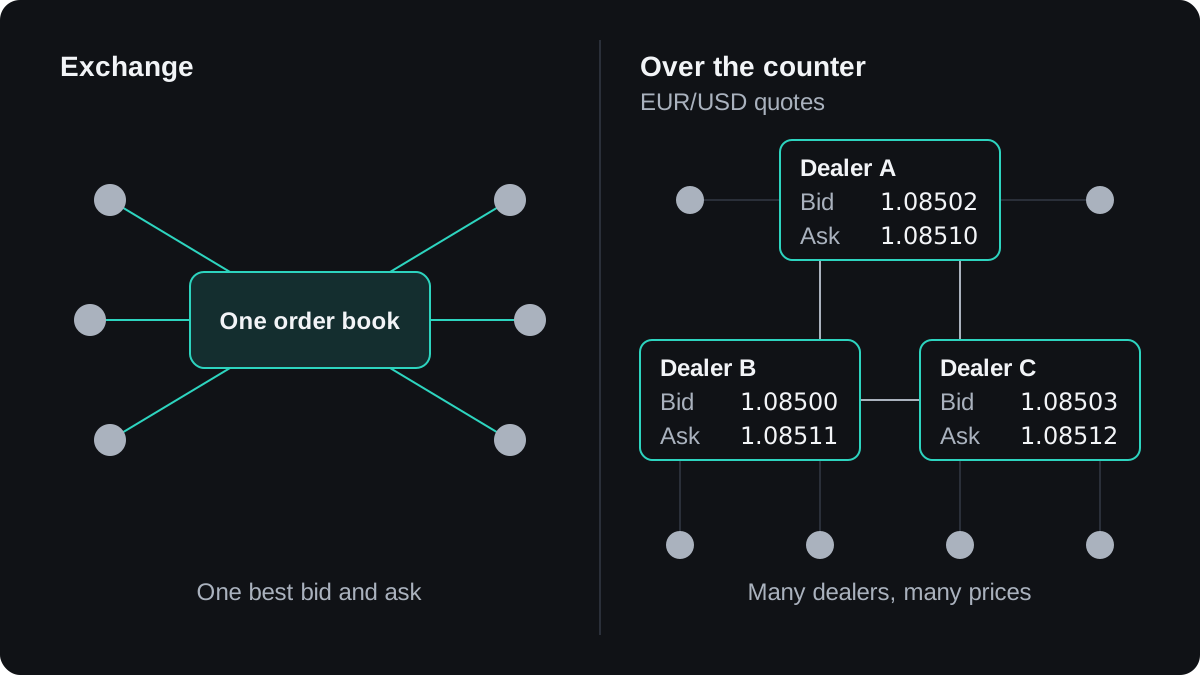
Currency futures do trade on exchanges. The spot forex market, and the forex contracts retail brokers offer on MetaTrader, are OTC.
What OTC means for your quotes
With no central exchange there is no single official price. Two brokers can show slightly different quotes in the same second, and each sets its own spread per account type.
An illustrative example: at the same moment, broker A shows EUR/USD at 1.10000 bid and 1.10008 ask, while broker B shows 1.10002 and 1.10012. A is 0.8 pip wide and B is 1.0 pip.
That gap is why comparing brokers is worth the effort. The Spread Checker reads typical spreads from each broker's own MT5 servers.
សំណួរ
Is forex traded on an exchange?
Spot forex is not. It trades over the counter between banks, other dealers, brokers and their clients, although currency futures are listed on exchanges.
Does OTC mean unregulated?
No: OTC describes how the market is built, not who supervises it. Brokers are licensed by financial regulators where they operate, so check the licence of the entity that holds your account.
ពាក្យផ្សេងទៀតក្នុងជំពូកនេះ
 Currency pairA currency pair is the price of one currency in terms of another, such as EUR/USD. The first is the base currency, the second is the quote currency, and the price is how much of the quote currency buys one unit of the base.
 Base currencyThe base currency is the first currency in a currency pair, the one whose price is quoted. In EUR/USD it is the euro, so a price of 1.10000 means one euro costs 1.10000 US dollars. Buying the pair means buying the base currency.
 Quote currencyThe quote currency is the second currency in a pair, the one the price is counted in. In EUR/USD it is the US dollar, so 1.10000 means one euro costs 1.10000 dollars. Pip value and profit on the pair are worked out in the quote currency first.
 Exchange rateAn exchange rate is the price of one currency in terms of another. EUR/USD at 1.10000 means one euro exchanges for 1.10000 US dollars. On a trading platform every rate comes as two prices: a bid you can sell at and a higher ask you can buy at.
 Long and short positionsLong and short positions are the two directions a trade can take. Going long means buying a currency pair to profit if its price rises. Going short means selling it to profit if the price falls. In forex you can sell a pair as easily as you buy it.
 LiquidityLiquidity is how easily you can buy or sell an amount without moving the price much. In a liquid market many quotes with real volume sit near the current price, so spreads are tight and orders fill close to the price you see.
រៀនលម្អិតក្នុងមេរៀន
ពាក្យពាក់ព័ន្ធ