Is your forex broker regulated? How to check a licence.
A regulated forex broker holds a licence from a government authority such as the UK's FCA or Australia's ASIC. To check it, find the legal company name and licence number on the broker's site, then search them on the regulator's own register and confirm the website and contact details match.
هذا المحتوى متاح حاليًا باللغة الإنجليزية فقط.

A broker's website can say regulated in large letters and still leave you with little protection. The word only means something once you have found the licence on the regulator's own website and confirmed it belongs to the company holding your money.
What does it mean for a broker to be regulated?
A regulated broker is a company that a government-backed authority has licensed to offer trading to the public. The authority sets rules, inspects the firm and can fine it or withdraw its licence.
The licence belongs to a legal entity, a registered company with its own name and number. A brand name or a logo holds no licence on its own.
The previous lesson showed that a broker holds your deposit and fills your orders. Regulation is the outside check on how it handles both.
Which regulators supervise retail forex?
Each country decides who may offer leveraged trading to its residents. A few regulators are well known among retail traders, and each one keeps a public register you can search.
| Where | Regulator | Number to look for |
|---|---|---|
| United Kingdom | Financial Conduct Authority (FCA) | Firm reference number (FRN) |
| United States | CFTC and National Futures Association (NFA) | NFA ID, searched in NFA BASIC |
| Australia | Australian Securities and Investments Commission (ASIC) | AFS licence number |
| Cyprus | Cyprus Securities and Exchange Commission (CySEC) | CIF licence number |
Inside the European Union, a firm licensed in one member state can usually offer its services in the others through passporting. The home regulator, such as CySEC for a Cyprus firm, stays responsible for supervising it.
Many brokers also hold licences in smaller financial centres, such as Seychelles or Mauritius. Rules there on client money, compensation and leverage are usually lighter, so read what that authority requires before you rely on it.
Some places register companies without supervising their trading business at all. A company registration number is a different thing from a licence to deal with clients.
What does a licence protect, and what does it leave out?
Rules differ by country, so check each of these for the regulator that covers your account. Strong regimes tend to include most of them.
- Your deposits are kept in bank accounts apart from the broker's own money, a rule called client money segregation, so the firm cannot spend them on its bills.
- Some countries run a compensation scheme that can pay eligible clients, up to a set limit, if a firm fails and client money is missing. The UK's FSCS and Cyprus's Investor Compensation Fund are two examples.
- Many regulators require a formal complaints process, and some give clients access to an independent dispute service.
- Under current rules, retail clients trading CFDs in the UK and the EU have negative balance protection, shown in the example below.
A worked example: a weekend gap
Say your balance is $1,000 and you hold a buy of 0.50 lot of EUR/USD over the weekend. Each pip is worth 50,000 × 0.0001 = $5.
On Monday the market opens 260 pips below Friday's close. Your stop out cannot fill at prices that never traded, so the trade closes at the first available price.
- The loss is 260 pips × $5 = $1,300.
- The balance after the loss is $1,000 − $1,300 = −$300.
- With negative balance protection, the broker resets the balance to $0, so your loss stops at the $1,000 in the account.
- Without it, the broker can ask you to pay the missing $300.
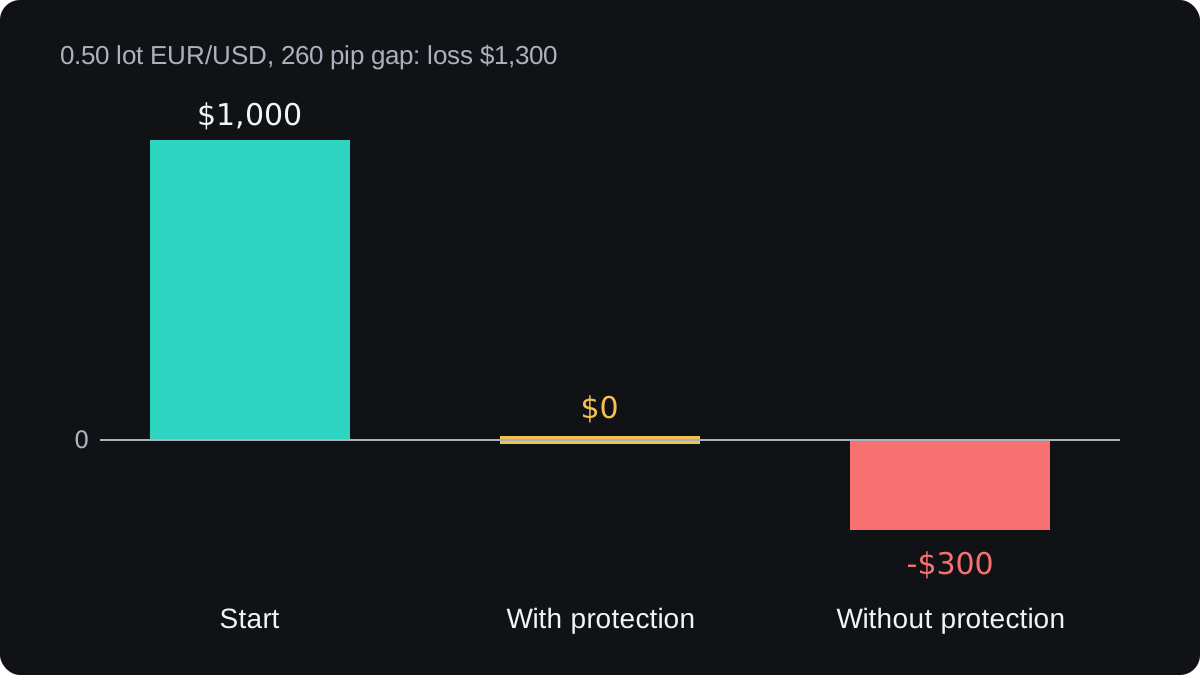
The numbers are illustrative. Gaps this large are rare on EUR/USD, though sudden events have moved some pairs much further in a single jump.
Some brokers outside the UK and the EU offer the same protection as company policy. Look for it in the client agreement, because that document is what binds the broker.
A licence does not cover losses from your own trading decisions. It also says little about cost, so a regulated broker can still charge wide spreads or widen them in fast markets.
Which company is your account really with?
A broker brand often runs a group of companies. One might hold a UK licence, another a Cyprus licence and a third an offshore licence, all sharing one logo and one website.
When you sign up, the group decides which company opens your account, often based on where you live. Your protections are those of that company's regulator, whatever the homepage says about the group.
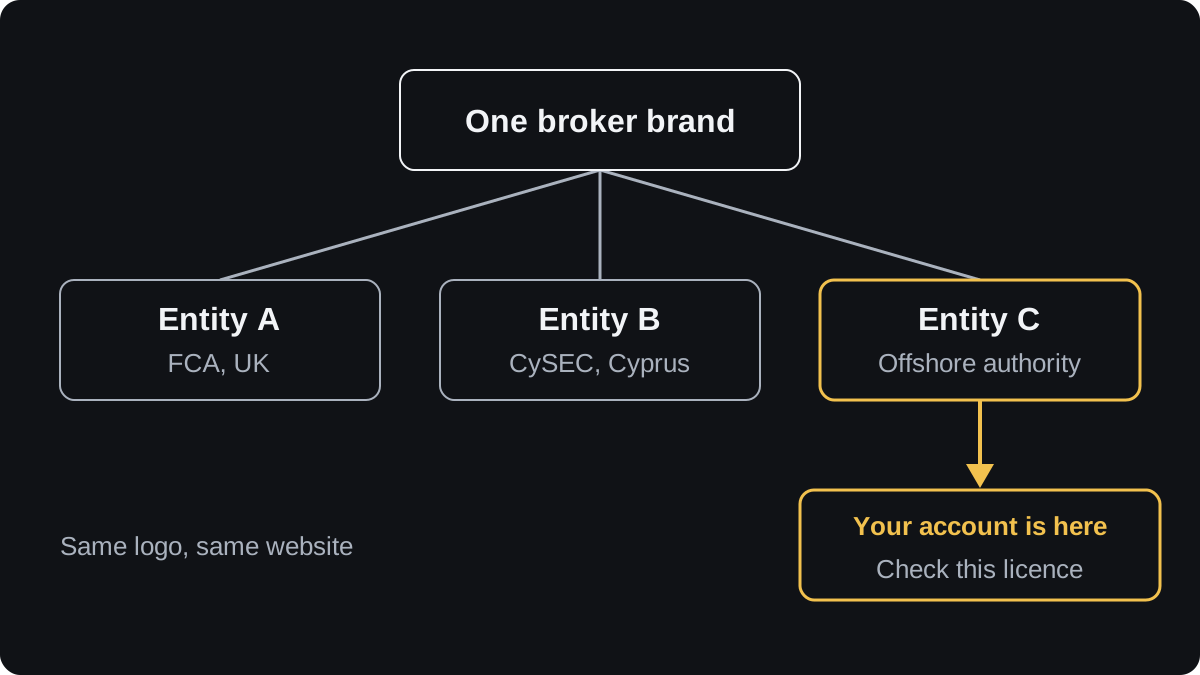
To find out which company you have, open the client agreement or the account opening documents. The legal name there, often ending in Ltd or LLC, is the one you look up on the register.
This matters when you compare brokers too. The guide to choosing a broker treats the licence of your own entity as the first filter.
How do you check a licence on the register?
The check takes a few minutes. Do it before your first deposit, and again if the broker asks you to move your account to another company in its group.
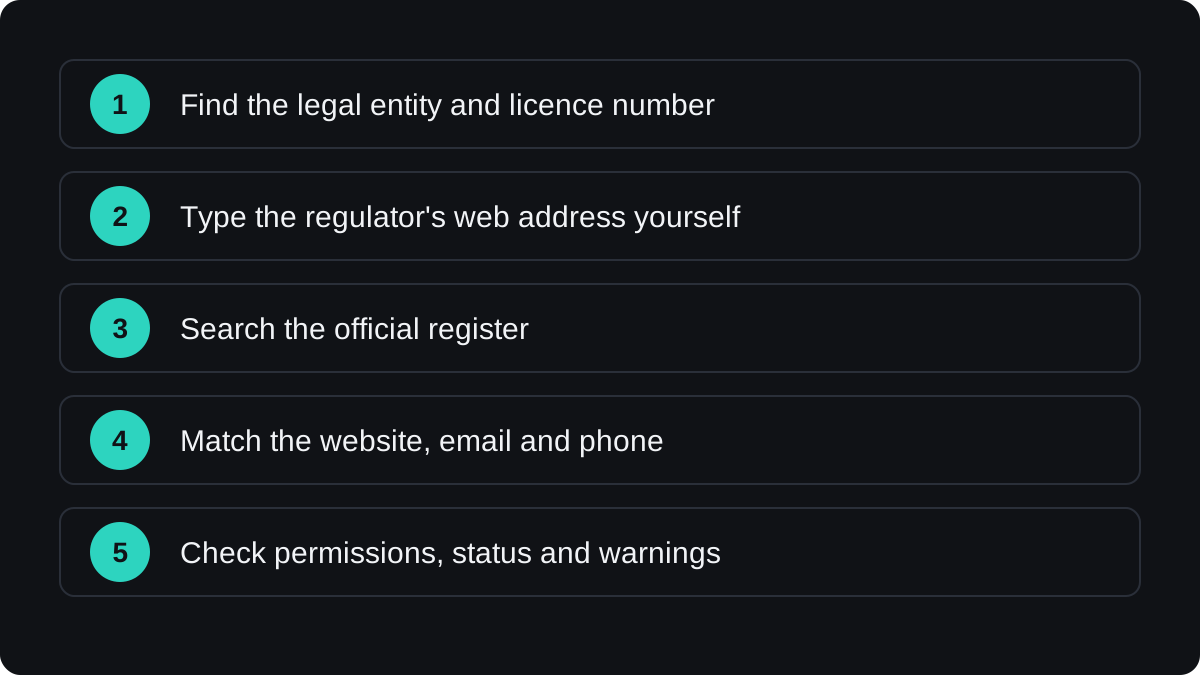
- Find the legal entity name and licence number in the website footer or the client agreement.
- Type the regulator's web address yourself, or find it through a search engine. A link supplied by the broker could lead to a copied page that only looks official.
- Search the official register by licence number, then by company name.
- Match the website, email and phone on the register with the ones the broker uses.
- Check the permissions, the current status and any warnings. A firm can be listed yet no longer authorised, or authorised only for professional clients.
Use this table for steps 4 and 5, where every row should agree.
| Detail | Where the broker shows it | What the register shows |
|---|---|---|
| Legal name | Footer, client agreement | Firm name and trading names |
| Licence number | Footer | Reference or licence number |
| Website | The address in your browser | Listed web addresses |
| Phone and email | Contact page | Listed contact details |
| Permissions | Product and account pages | Permitted activities and client types |
| Status | Regulated badge | Current status and past actions |
The web address and contact details are the strongest test. A fraudster can copy the name and number of a real firm, but the website listed on the register still leads to the genuine company.
What if the details do not match?
A scam that copies the details of a licensed company is called a clone firm. The FCA uses this term and publishes warnings about clone firms it knows of.
If the website or phone number differs from the register, contact the licensed firm through the details on the register. Ask whether the site you found is theirs before you send any money.
Also search the regulator's warnings list, where many regulators name unlicensed firms targeting their residents. IOSCO, the international body of securities regulators, gathers such alerts from many countries in one searchable portal called I-SCAN.
If a broker gives no licence number, or the number leads to a different company, treat it as unregulated. The lesson on red flags and the guide to common forex scams cover other warning signs.
أسئلة شائعة
How do I know if my forex broker is regulated?
Find the legal company name and licence number in the footer or the client agreement, then search for them on the regulator's own website. The web address and contact details on the register should match the site you use.
Is an offshore licence good enough?
It is a real licence, but the protections are usually weaker than in places such as the UK or Australia. Read what that regulator requires on client money, compensation and negative balance protection before you decide.
Does regulation protect me from trading losses?
No. It covers how the firm handles your money and treats you as a client, and losses from price moves remain yours.
What is a clone firm?
A clone firm copies the name, licence number or address of a real licensed company. You can catch one by checking that the website and phone on the register match the ones you are using.
Can a broker be regulated in one country and not another?
Yes. Each company in a broker group has its own licence, so check the one named in your client agreement.
تابع التعلّم
 الفصل 1How to choose a forex broker.To choose a forex broker, check four things before you deposit. Confirm the licence on the regulator's own register, work out the full cost of a trade from spread, commission and swap, test how orders are filled, and make a small withdrawal to see how payouts work. A broker that fails the licence check needs no further study.
 الفصل 1What does a forex broker actually do?A forex broker opens your trading account, streams buy and sell prices, accepts your orders and fills them, either with outside liquidity providers or by taking the other side itself. It also holds your deposit, sets aside margin while trades are open, applies leverage, charges or pays swap and closes positions at stop out.
 الفصل 1Red flags of a fake or unsafe forex broker.A fake or unsafe forex broker usually shows itself in a few ways: no licence or a cloned one, promises of guaranteed profit, pressure to deposit, payments to personal or unrelated accounts, bonus terms that lock your money, and withdrawals that stall or need a fee paid first. Check the regulator's register and test a small withdrawal.
 الفصل 1Who is on the other side of your forex trade?In retail forex, the other side of your trade is usually your broker. Spot forex has no central exchange, so deals are made over the counter, and your trade is most often a cash-settled CFD with the broker. The broker may keep that risk, hedge it with a liquidity provider, or match it against other clients.
 الفصل 1How forex brokers make money.Forex brokers earn from the spread, the gap between the buy and sell price, often widened by a markup they keep. Many also charge commission per lot and add a margin to overnight swap. A broker that takes the other side of your trade can also profit when you lose.
 الفصل 1A-book and B-book brokers explained.An A-book broker passes your trade to an outside liquidity provider and earns from a markup or commission, so your win or loss does not change its income. A B-book broker takes the other side itself, so it gains when you lose and pays when you win. Many brokers use both.
 الفصل 1How A-book brokers earn, and what limits them.A pure A-book broker passes each client trade to a liquidity provider, so it earns nothing from your losses. Its income is a markup on the spread, a commission per lot, swap markups and fees. Income per lot is small after routing costs, so the broker needs high volume, and it can only offer the prices its providers quote.
 الفصل 1STP and ECN execution explained.STP, straight-through processing, means your broker passes your order automatically to outside liquidity providers and usually earns by widening the spread. ECN, electronic communication network, means your order meets prices from many participants in a shared order book, usually with a raw spread plus a commission. Both are labels, so check how your broker actually routes orders.
 الفصل 1Internalisation: how brokers net client orders.Internalisation is when a broker offsets client buy orders against client sell orders inside its own books. Opposite trades cancel, so only the leftover net position is left to hedge or keep. This cuts the broker's outside costs and risk, while each client's contract stays with the broker, who remains the counterparty.
 الفصل 1Hybrid brokers and the C-book.A hybrid broker sends some client trades to liquidity providers (A-book) and keeps others in house, taking the other side itself (B-book). Routing usually depends on account results, trade size, style and total exposure. C-book has no fixed definition; it most often means splitting one trade, hedging part and keeping the rest.
 الفصل 1Your broker's hedging policy and why it matters.A broker's hedging policy decides whether you can hold a buy and a sell on the same pair in one account, and how much margin that pair uses. Hedging accounts keep both positions open; netting accounts close or shrink the first one. Margin on a hedged pair can be full, one leg or zero.
 الفصل 1Where your broker's prices come from.Your broker's prices start as quotes streamed by liquidity providers, mostly banks and non-bank trading firms. An aggregator keeps the highest bid and lowest ask from these streams, and the broker usually adds a markup before the price reaches your platform. Different providers, markups and timing mean two brokers can show different prices at the same moment.
 الفصل 1How to judge a broker's order execution.Good order execution means your trades fill quickly, close to the price you asked for, with few requotes or rejections. To judge it, log the requested and filled price of every market order over dozens of trades. Slippage should run in both directions, with some fills better than requested, and news-time orders kept separate.

