A-book and B-book brokers explained.
An A-book broker passes your trade to an outside liquidity provider and earns from a markup or commission, so your win or loss does not change its income. A B-book broker takes the other side itself, so it gains when you lose and pays when you win. Many brokers use both.
Ce contenu n'existe pour l'instant qu'en anglais.

When you press buy on one lot of EUR/USD, somebody has to sell it to you. That somebody is either a firm out in the wider market or your broker itself. The two answers are called the A-book and the B-book.
Both names describe who carries the market risk of your trade, the chance of losing money when the price moves.
Where does your order go after you click buy?
Every retail trade first lands at your broker. From there it can take one of two paths.
On the A-book, the broker passes the risk on. It opens a matching trade with a liquidity provider, such as a bank or a large trading firm, so a price move hits that firm and leaves the broker flat.
On the B-book, the broker keeps the trade. It becomes the other side of your position, so when you gain the broker loses the same amount, and when you lose the broker gains it.
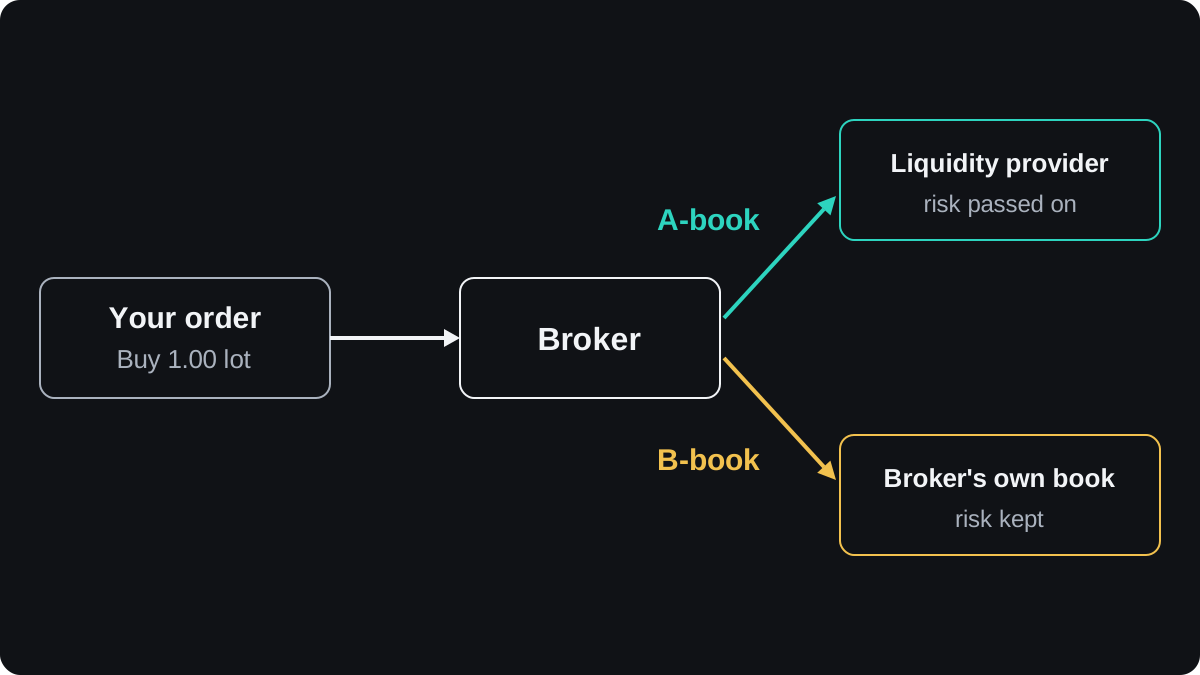
Your platform looks the same on either path. You see a price and a fill, and nothing on the screen says where the order went.
How does each model make money on one trade?
The lesson on how forex brokers make money covered spreads and commissions. One worked trade shows how differently they land in each book. All prices here are illustrative.
You buy 1.00 lot of EUR/USD. Your platform shows a bid of 1.10000 and an ask of 1.10010, a spread of 1.0 pip. On one standard lot, 100,000 euros, one pip is worth $10.
- You open at the ask, 1.10010.
- In case one, the bid later reaches 1.10210 and you close. The result is 1.10210 − 1.10010 = 0.00200, which is 20 pips, or +$200.
- In case two, the bid falls to 1.09810 and you close. The result is 1.09810 − 1.10010 = −0.00200, which is −20 pips, or −$200.
Start with the A-book broker. Say its liquidity provider quotes 1.10004 and 1.10006 at your entry, a spread of 0.2 pip around the same middle price, 1.10005.
- The broker buys from the provider at 1.10006 and sells to you at 1.10010. That 0.4 pip markup is 0.4 × $10 = $4.
- When you close, it takes the same 0.4 pip on the bid side. In case one the provider bids 1.10214 and you get 1.10210. In case two the provider bids 1.09814 and you get 1.09810. Either way that is another $4.
- The broker's trade with the provider offsets the price move, the $200 either way. The broker keeps $4 + $4 = $8 in both cases.
The B-book broker has no provider in the middle. It holds the opposite position, so its result is your result with the sign flipped.
- In case one you make $200 and the broker loses $200.
- In case two you lose $200 and the broker gains $200.
Your $200 loss already includes the 1.0 pip spread you paid, so the B-book broker needs no separate line for it.
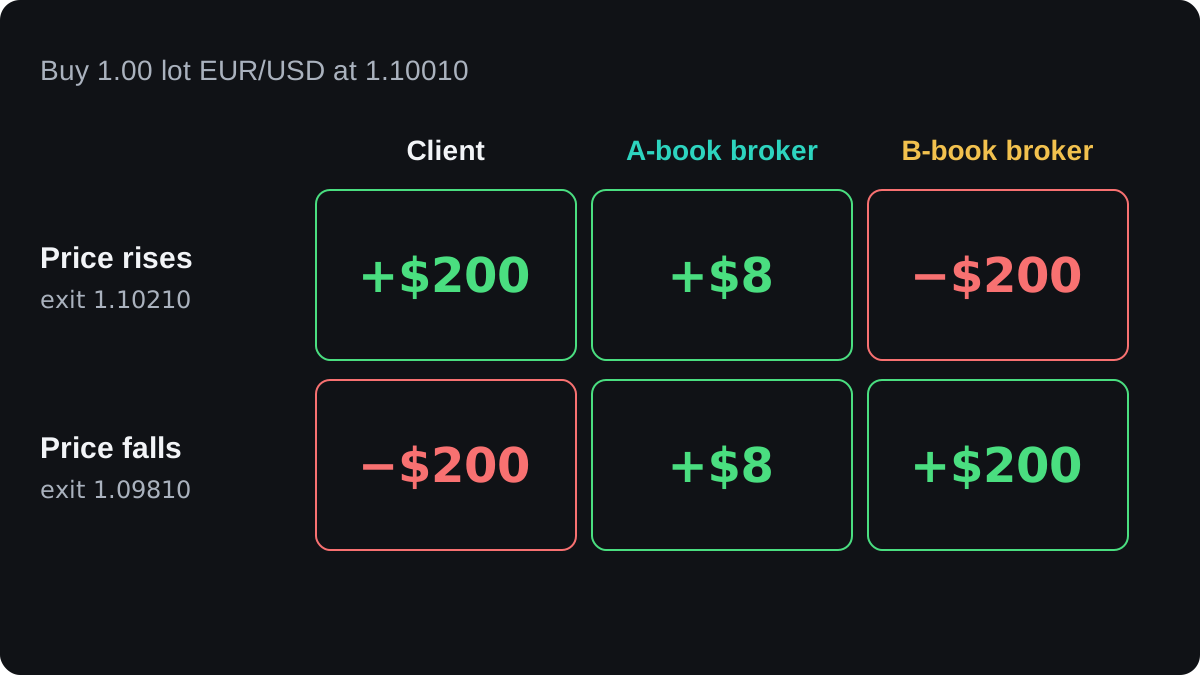
The A-book broker earns the same whether you win or lose, so its income grows with how much you trade. The B-book broker earns from your losses, so on each single trade its interest runs against yours.
Why would a broker keep your trade in house?
Sending every small trade to a provider costs money and adds a step. Many retail orders are small, and clients often trade in opposite directions at the same moment.
Say Client A buys 3.00 lots of EUR/USD while Client B sells 2.00 lots, and the broker fills both itself. The 2.00 lots on each side cancel, leaving the clients net long 1.00 lot and the broker short 1.00 lot.
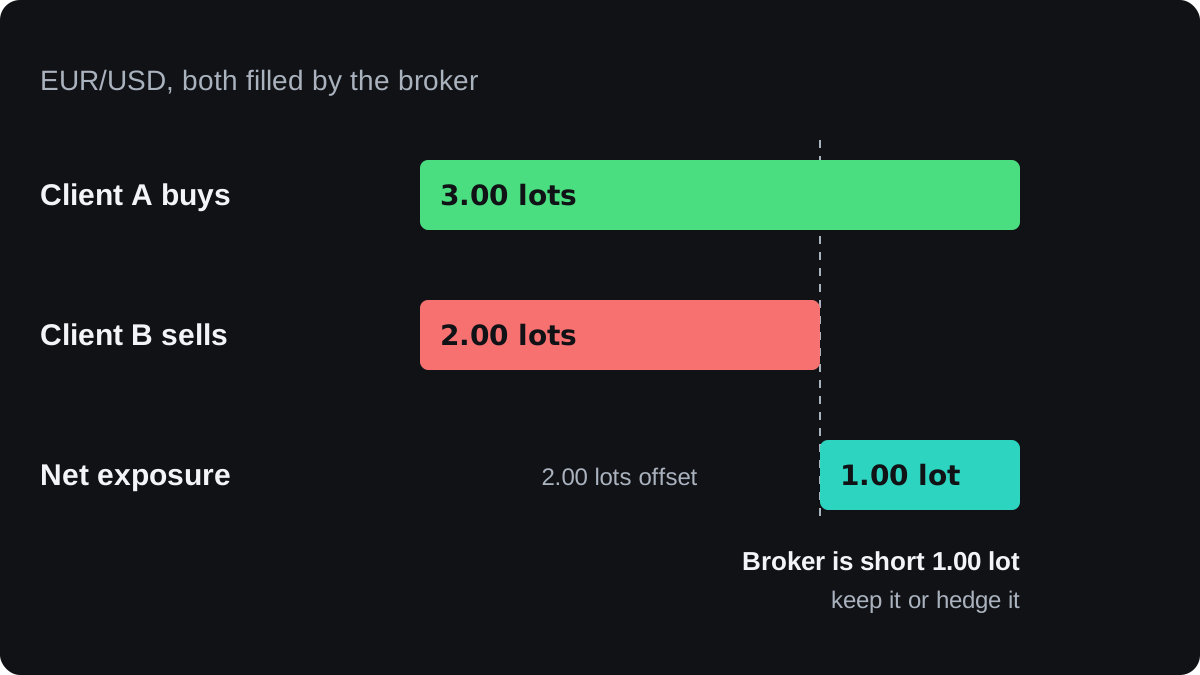
Together the two clients hold 5.00 lots, worth $50 per pip. The broker's own exposure is the net 1.00 lot, worth $10 per pip. It can keep that lot as risk or hedge it with a provider.
Matching clients against each other like this is called internalisation, and it is one reason a B-book can fill small orders quickly and cheaply.
When clients as a group lose more than they win, the B-book pays the broker on top of the spread. When many clients win at once, for example in a strong move most of them caught, the broker pays out of its own capital.
That risk is why some brokers run both books. They may keep small accounts on the B-book and route large or steadily profitable ones to the A-book, a mix covered in the lesson on hybrid brokers.
Where does the conflict of interest show up?
A B-book broker gains when you lose. That alone is no proof of cheating, and many licensed brokers run a B-book within the rules. The incentive is real, though, so the warning signs are worth knowing:
- Requotes or rejected orders that appear mostly when the price has moved your way.
- Slippage that nearly always goes against you and almost never in your favour.
- Spikes on your chart that a second price feed does not show at the same time.
- Withdrawal delays or account reviews that start after a run of winning trades.
Regulation and reputation limit this behaviour. Many regulators require brokers to have an order execution policy and give it to clients, and you can complain to the regulator if a broker breaks its rules.
The lesson on checking a licence shows how to confirm who supervises your broker.
In some places, including the EU and the UK, brokers offering CFDs to retail clients must show the share of their retail accounts that lose money.
That figure on the broker's own site tells you how its clients tend to fare, which is the side a B-book profits from.
The A-book has its own pull. It earns on volume, so it benefits when you trade often, and its markup is a cost you pay on every trade whether it helps you or not.
How can you tell which model your broker uses?
Brokers rarely write B-book in their marketing. The legal documents tell you more than the homepage.
- Read the client agreement and order execution policy. Wording such as acting as principal or as your counterparty means the broker can take the other side.
- Watch the labels. Market maker usually points to a B-book, while STP and ECN describe orders passed on to other firms.
- Treat account type as a weak clue. Commission-based raw accounts are often routed outside, but the name alone proves nothing.
- Ask support in writing whether the broker acts as counterparty to trades on your account type.
One answer may not stay true. A broker that runs both books can move a client from one to the other, and nothing on your screen changes when it does.
Does the model change your results?
The model changes who profits from your trades. The price maths stays the same: a 20 pip move on 1.00 lot of EUR/USD is $200 on either book.
What you can measure is your cost per trade, the quality of your fills and how smoothly withdrawals arrive. A well-run B-book with tight spreads and clean fills can cost you less than an A-book with a wide markup.
The lesson on judging order execution shows how to test fills yourself. The next lesson looks at how A-book brokers earn and what limits that income.
Questions fréquentes
Is a B-book broker a scam?
No. Taking the other side of client trades is a legal model for licensed brokers in many countries. The risk lies in how a broker behaves, so check its licence and watch how your orders are filled.
Does an A-book broker want me to win?
It has no direct stake in whether a single trade wins or loses. It earns from markup or commission, so it benefits when you trade more, whatever the result.
Is a market maker the same as a B-book broker?
In retail use, mostly yes. A market maker quotes its own prices and takes the other side of trades, though it may still hedge part of that risk with a provider.
Can I choose an A-book account?
Some brokers offer account types that route orders to outside providers, often with a commission. Read the execution policy for that account, because the account name alone does not guarantee where your orders go.
How do I know if my broker is A-book or B-book?
Read the client agreement for words such as principal or counterparty, and ask support in writing. Remember that a broker can run both models and move accounts between them.
Continuer à apprendre
 Chapitre 1How to choose a forex broker.To choose a forex broker, check four things before you deposit. Confirm the licence on the regulator's own register, work out the full cost of a trade from spread, commission and swap, test how orders are filled, and make a small withdrawal to see how payouts work. A broker that fails the licence check needs no further study.
 Chapitre 1What does a forex broker actually do?A forex broker opens your trading account, streams buy and sell prices, accepts your orders and fills them, either with outside liquidity providers or by taking the other side itself. It also holds your deposit, sets aside margin while trades are open, applies leverage, charges or pays swap and closes positions at stop out.
 Chapitre 1Is your forex broker regulated? How to check a licence.A regulated forex broker holds a licence from a government authority such as the UK's FCA or Australia's ASIC. To check it, find the legal company name and licence number on the broker's site, then search them on the regulator's own register and confirm the website and contact details match.
 Chapitre 1Red flags of a fake or unsafe forex broker.A fake or unsafe forex broker usually shows itself in a few ways: no licence or a cloned one, promises of guaranteed profit, pressure to deposit, payments to personal or unrelated accounts, bonus terms that lock your money, and withdrawals that stall or need a fee paid first. Check the regulator's register and test a small withdrawal.
 Chapitre 1Who is on the other side of your forex trade?In retail forex, the other side of your trade is usually your broker. Spot forex has no central exchange, so deals are made over the counter, and your trade is most often a cash-settled CFD with the broker. The broker may keep that risk, hedge it with a liquidity provider, or match it against other clients.
 Chapitre 1How forex brokers make money.Forex brokers earn from the spread, the gap between the buy and sell price, often widened by a markup they keep. Many also charge commission per lot and add a margin to overnight swap. A broker that takes the other side of your trade can also profit when you lose.
 Chapitre 1How A-book brokers earn, and what limits them.A pure A-book broker passes each client trade to a liquidity provider, so it earns nothing from your losses. Its income is a markup on the spread, a commission per lot, swap markups and fees. Income per lot is small after routing costs, so the broker needs high volume, and it can only offer the prices its providers quote.
 Chapitre 1STP and ECN execution explained.STP, straight-through processing, means your broker passes your order automatically to outside liquidity providers and usually earns by widening the spread. ECN, electronic communication network, means your order meets prices from many participants in a shared order book, usually with a raw spread plus a commission. Both are labels, so check how your broker actually routes orders.
 Chapitre 1Internalisation: how brokers net client orders.Internalisation is when a broker offsets client buy orders against client sell orders inside its own books. Opposite trades cancel, so only the leftover net position is left to hedge or keep. This cuts the broker's outside costs and risk, while each client's contract stays with the broker, who remains the counterparty.
 Chapitre 1Hybrid brokers and the C-book.A hybrid broker sends some client trades to liquidity providers (A-book) and keeps others in house, taking the other side itself (B-book). Routing usually depends on account results, trade size, style and total exposure. C-book has no fixed definition; it most often means splitting one trade, hedging part and keeping the rest.
 Chapitre 1Your broker's hedging policy and why it matters.A broker's hedging policy decides whether you can hold a buy and a sell on the same pair in one account, and how much margin that pair uses. Hedging accounts keep both positions open; netting accounts close or shrink the first one. Margin on a hedged pair can be full, one leg or zero.
 Chapitre 1Where your broker's prices come from.Your broker's prices start as quotes streamed by liquidity providers, mostly banks and non-bank trading firms. An aggregator keeps the highest bid and lowest ask from these streams, and the broker usually adds a markup before the price reaches your platform. Different providers, markups and timing mean two brokers can show different prices at the same moment.
 Chapitre 1How to judge a broker's order execution.Good order execution means your trades fill quickly, close to the price you asked for, with few requotes or rejections. To judge it, log the requested and filled price of every market order over dozens of trades. Slippage should run in both directions, with some fills better than requested, and news-time orders kept separate.
Courtiers partenaires

