Common forex scams.
Common forex scams include fake or cloned brokers that block withdrawals, signal sellers with unverifiable records, strangers who offer to manage your account, and schemes that pay fixed monthly returns from new deposits. They share one promise: steady profit with little risk. Recovery scams then target people who have already lost money.
Ce contenu n'existe pour l'instant qu'en anglais.

Forex is a real market and a very large one, which makes it an easy story to wrap around a fraud. Most forex scams take one of a few familiar shapes.
There is the broker that is not really a broker, the seller of signals with an invented record, the stranger who offers to trade for you, and the fund that pays returns out of other people's deposits.
Why is forex a common cover for scams?
Retail forex is sold online, across borders, often to people who have never traded. A newcomer cannot easily tell a licensed firm from a website built last week.
The trading itself happens on a screen the firm controls. Prices move every second, so an invented profit or an invented loss looks normal, and a scammer always has an excuse when a balance disappears.
The promise is the common thread. Steady monthly returns with no losing months do not match how trading results look, as the lesson on whether you can get rich trading forex explains.
Fake brokers and clone firms
A fake broker is a website with a trading platform where your deposit never reaches a real market. The balance you see is a number in the operator's database, and it can show any profit the operator likes.
A clone firm copies the name, address or licence number of a real, regulated company. The website may look identical, while the bank details and contact email lead to someone else.
You catch a clone by searching the regulator's own register and then contacting the firm only through the details listed there. The licence check lesson walks through the steps.
The pattern usually shows when you ask for your money. Here is a typical version, with round illustrative numbers:
- You deposit $1,000.
- Within weeks the dashboard shows a balance of $5,000.
- You ask to withdraw. Support says you must first pay a release fee, tax or insurance of 20% of the balance: 20% × $5,000 = $1,000.
- You pay it. The withdrawal is still blocked, and a new fee appears.
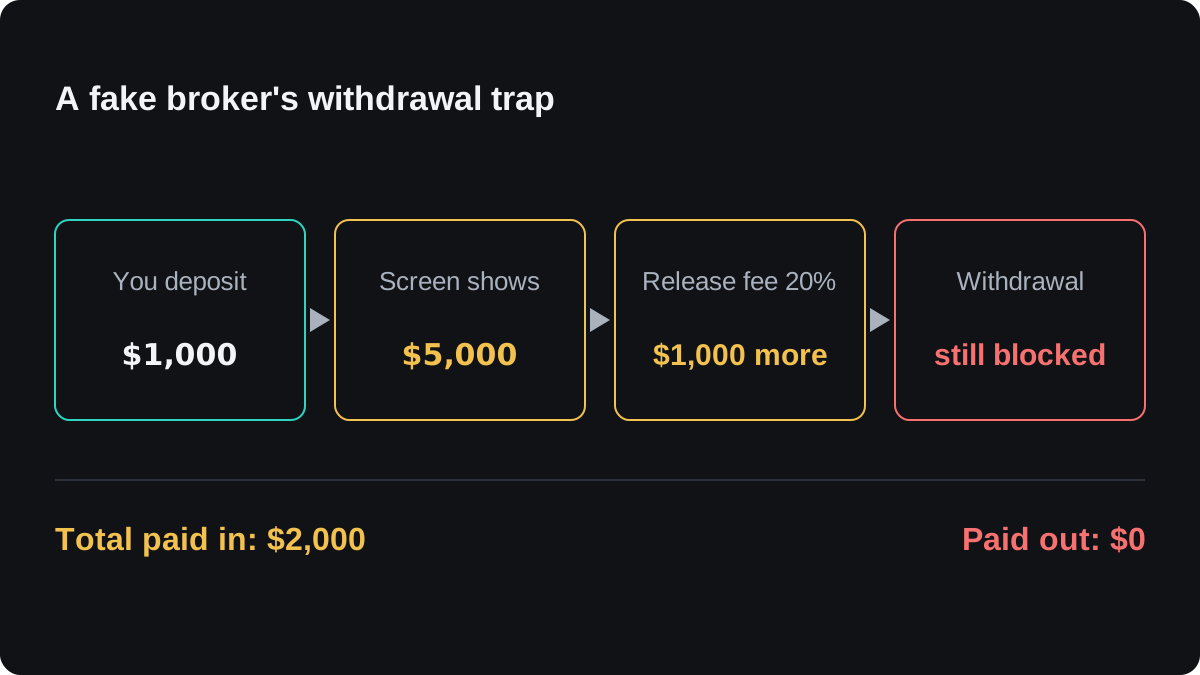
You have now paid in $2,000 and received nothing. A genuine broker that charges for withdrawals normally takes the fee from the amount withdrawn, under terms it published before you deposited.
A demand for fresh money before you can reach your own balance suggests the balance does not exist. The lesson on red flags of a fake broker lists more signs to check.
Signal sellers and income gurus
A signal seller charges a fee to tell you when to buy or sell. Some are open about their losses. Others post screenshots of winning trades and a headline such as a 90% win rate, with nothing else.
A win rate on its own says little. Take ten trades, with round illustrative numbers:
- Nine trades each win 10 pips: 9 × 10 = +90 pips.
- One trade loses 100 pips.
- The net result is 90 − 100 = −10 pips.
- The win rate is 9 ÷ 10 = 90%, and the account still lost money.
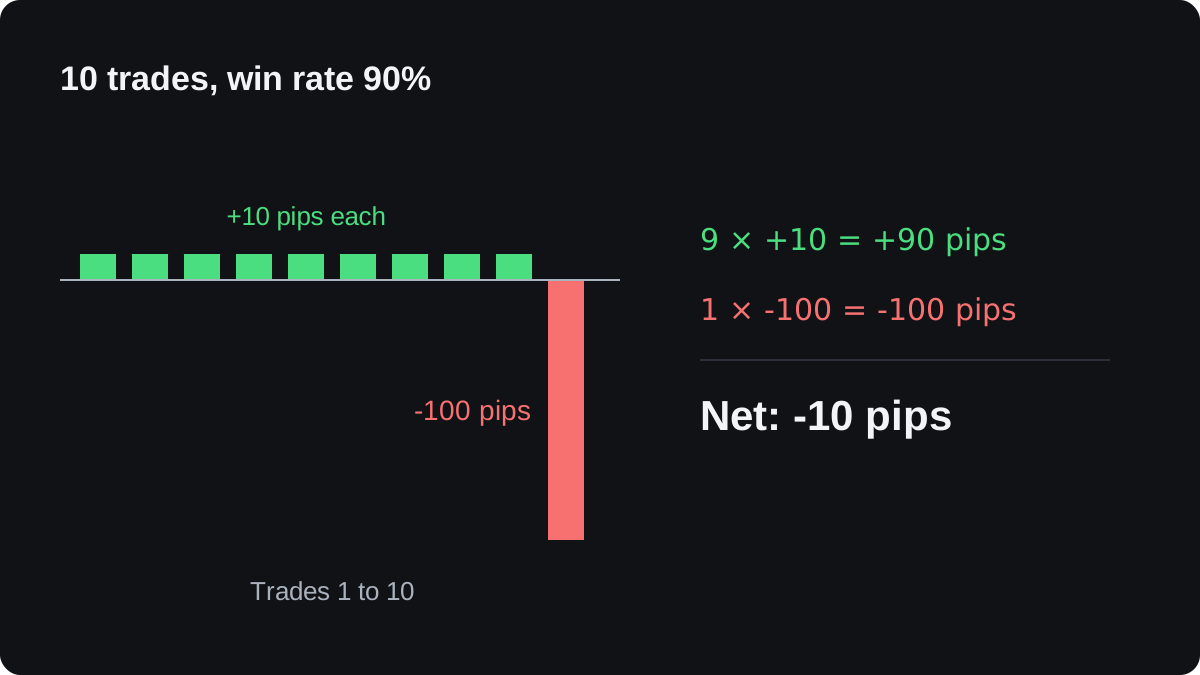
What you need is the size of the losses next to the wins, over many trades, in a record you can check. The risk-reward lesson shows how win rate and trade size combine.
Screenshots are easy to fake, and demo results can be passed off as live ones. A seller can also run several channels, keep whichever one happened to do well, and quietly close the rest.
Third-party sites that connect to a live account make faking harder, though they still show past results only.
Courses deserve the same scrutiny when the main product is a lifestyle shown in photos, with income claims but no audited record behind them.
Account managers who offer to trade for you
A stranger messages you on social media or a dating app and builds a friendship over weeks. Then they mention how well they do from trading, and offer to show you or to trade your account for you.
The request that follows is for your login and trading password, or for money sent to their own account or a crypto wallet. Once they have either one, they control the money.
Genuine managed accounts exist. The firm running one usually needs a licence for managing client money, and the money sits with a regulated broker or custodian in your name.
A private person who wants your password, or wants you to send funds to them, is outside all of that. No legitimate broker or service needs your trading password to help you.
Some offers promise a fixed split, such as you keep 70% of the profits. Profit sharing can be real in a licensed arrangement, but no licensed firm can promise that there will be profits to share.
Investment schemes that pay from new deposits
A Ponzi scheme pays its early investors with money from later ones. It may call itself a forex fund, a trading club or an automated trading bot, and it usually pays a fixed return every month.
A worked example with round illustrative numbers shows how long the money lasts:
- Ten people each deposit $1,000, so the pool holds $10,000.
- The scheme promises 10% a month: $100 per person, $1,000 a month in total.
- No trading happens. After one month the pool holds 10,000 − 1,000 = $9,000.
- After ten months it holds $0. Each investor has received 10 × $100 = $1,000, exactly what they put in.
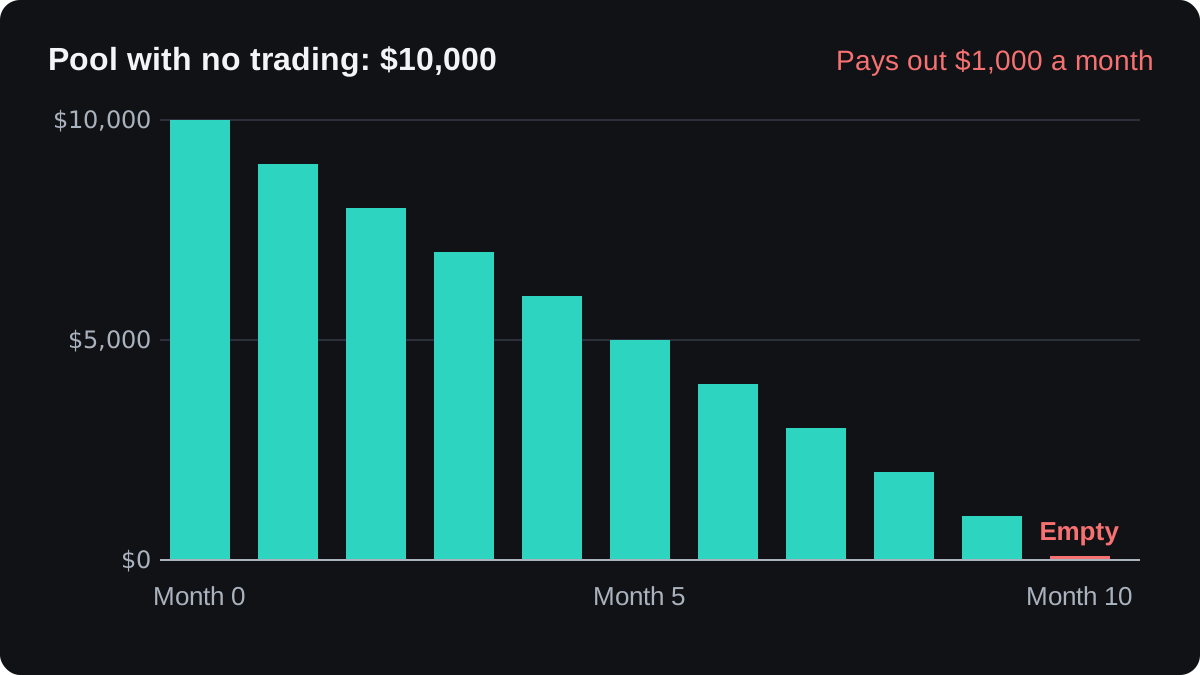
From month 11, payments can continue only if new deposits arrive. That is why these schemes reward recruiting and collapse when recruiting slows.
If the operator keeps $2,000 at the start, the remaining $8,000 covers only eight months of payouts.
Many schemes push you to reinvest so the return compounds on screen. At 10% a month, $1,000 shows as $3,138.43 after 12 months (1,000 × 1.1, repeated 12 times), while no cash has left the pool.
Every dollar reinvested is a dollar the scheme does not pay out, so it lasts longer and collects more deposits. Everyone who never withdrew loses the whole amount when it stops.
A pyramid scheme is a close relative in which income comes mainly from recruitment fees. A signals or education package that pays a large commission for each new member signed up can work this way.
Recovery scams target people who have already lost
After a loss, a second contact often arrives. It may be a recovery agent, a lawyer or someone claiming to work for a regulator, offering to get your money back for an upfront fee.
This is a recovery scam, and it takes a second payment from the same victim. A genuine regulator or police force does not ask you for a fee to pursue your case.
Real routes, such as your bank, card issuer or the police, are covered in what to do if you have been scammed. Turning these patterns into checks you can run before you deposit is the subject of how to spot a forex scam.
Questions fréquentes
Is forex trading itself a scam?
No. Currency trading is a real market with regulated brokers. Scams borrow its language, and trading with a regulated firm can still lose money.
How can I check if a forex broker is real?
Search the broker's name and licence number on the regulator's own website, then contact the firm through the details the register lists. Matching details on a website prove little, because clone firms copy them.
Why can't I withdraw money from my forex account?
A real broker may delay a withdrawal for identity checks. If you are asked to pay a new fee, tax or deposit before you can withdraw, treat it as a strong sign of a fake broker and stop paying.
Are forex signal groups scams?
Some are honest, but a win rate or a set of screenshots proves little. Ask for a verified live record that shows losses as well as wins over many months.
Can money lost to a forex scam be recovered?
Sometimes, through your bank, card issuer or the police, depending on how you paid. Be wary of anyone who contacts you offering recovery for an upfront fee.
Continuer à apprendre
 Chapitre 2How to spot a forex scam.A forex scam usually shows itself through a few shared signs: a guaranteed or fixed return, pressure to pay before you can check, a stranger who contacted you first, payments to personal accounts or to crypto wallets sent in a chat, and new fees before any withdrawal. Check every firm on the regulator's own register before sending money.
 Chapitre 2What to do if you have been scammed.If you have been scammed, stop sending money at once and call your bank or card provider, because speed often decides whether a payment can be stopped or disputed. Save all evidence, report to the police and your financial regulator, and ignore anyone who offers to recover your money for a fee.
Courtiers partenaires

