What to do if you have been scammed.
If you have been scammed, stop sending money at once and call your bank or card provider, because speed often decides whether a payment can be stopped or disputed. Save all evidence, report to the police and your financial regulator, and ignore anyone who offers to recover your money for a fee.

If you think a broker, an "account manager" or an online contact has taken your money, the next few hours matter most. Acting fast gives your bank the best chance to help, and staying calm keeps you from losing more.
The module began with common forex scams and how to spot a forex scam. This lesson is for after the money has gone: what to do, in order, and how to recognise the second scam that often follows the first.
What should you do in the first hour?
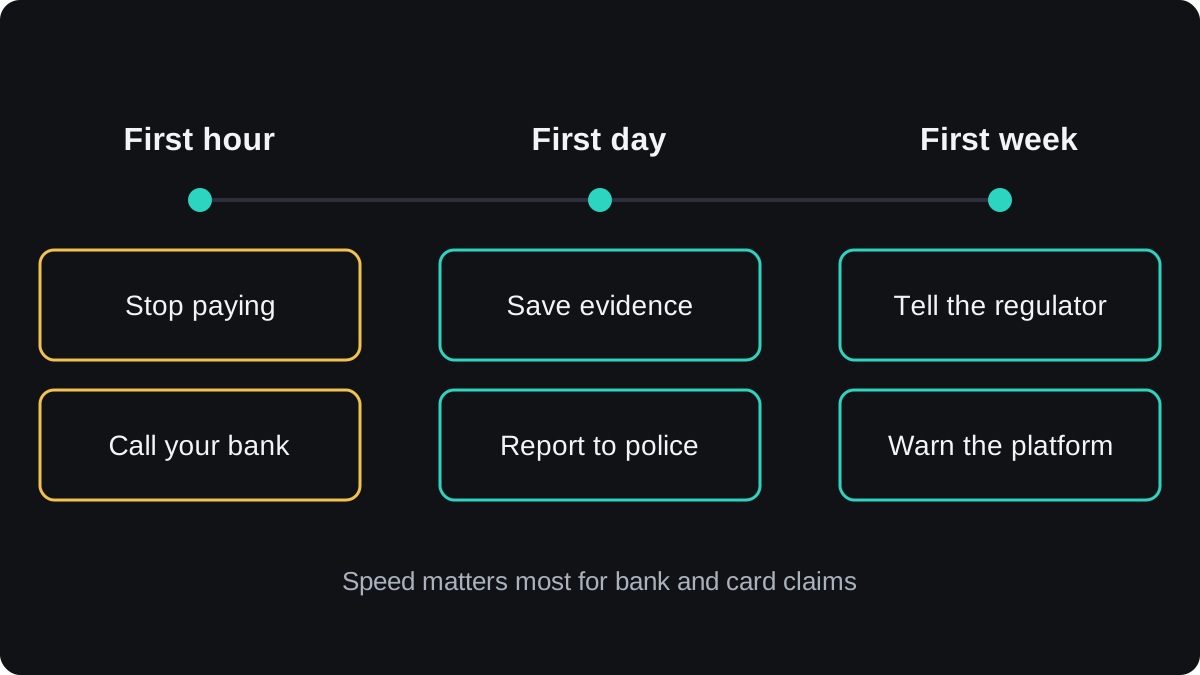
Stop sending money. That includes any "withdrawal fee", "tax", "insurance" or "verification deposit" the platform asks for before it will release your balance. A request for new money before you can withdraw is a common sign of fraud.
Then call your bank or card provider on the number printed on your card or shown on its official website. Say the payment went to a suspected scam and ask what they can do.
A fraud team may be able to stop a payment that has not yet settled, so make this call before anything else on the list.
If you gave the scammers remote access to your computer or phone, disconnect the device from the internet and remove the app they asked you to install.
From a different, clean device, change the passwords for your email, bank and any crypto exchange account. Turn on two-step login where it is offered.
A rough plan helps after that. Deal with the money first, then save the evidence and report to the police within a day, then tell the regulator and the platforms where you met the scammer within the week.
How do you keep the evidence?
Scam websites and chat accounts often vanish once a victim stops paying. Save everything now, before you reply to the scammers or close any account.
Make screenshots or copies of:
- the website, including its address and any licence number it shows
- your account dashboard, balance and trade history
- chats, emails and call logs, with names and phone numbers
- bank statements, card receipts and payment confirmations
- crypto wallet addresses and transaction IDs, also called hashes
Then write a short timeline in your own words. Note how you were contacted, what you were promised, each payment with its date and amount, and when withdrawals were refused.
Police and banks can act faster from one clear page. Do not tell the scammers you are reporting them, because they may delete their accounts or start pressuring you.
Can your bank or card company reverse the payment?
That depends on how the money left you. Take an illustrative case: you sent $10,000 in total, $2,000 by card, $3,000 by bank transfer and $5,000 in crypto. Each route has a different place to ask and a different chance of a refund.
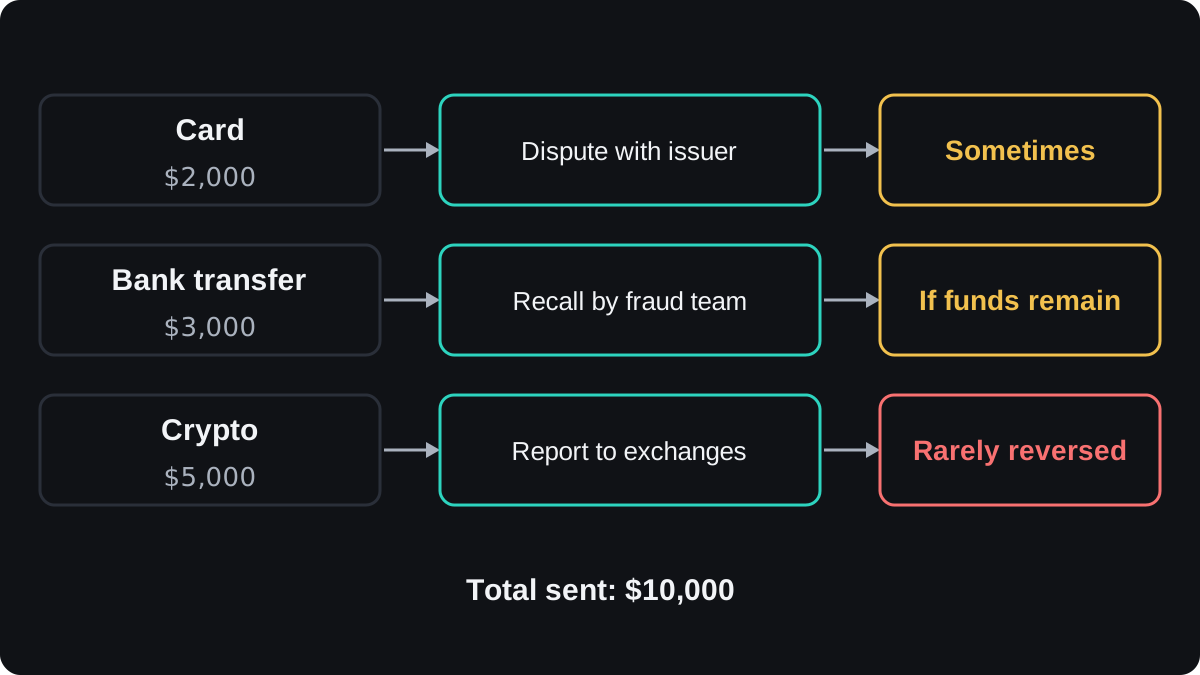
A card dispute, called a chargeback, asks the card issuer to reverse a payment. Disputes have time limits set by the card network and your issuer, so ask about them on the first call. The issuer judges each case and can refuse it.
A bank transfer is hard to recover once the scammer has moved the money on, which can happen within hours. Your bank's fraud team can try to recall it while the funds are still in the receiving account.
In some countries, banks follow rules or codes that refund certain fraud victims, so ask whether any apply to you.
Crypto sent to someone else's wallet is final on the blockchain, and you cannot undo the transfer. Report it anyway to the exchange you sent from and, if you know it, the exchange that received it.
Exchanges can sometimes freeze funds that land in an account they control. That is why the transaction IDs you saved matter.
In this example, the realistic best case is getting back part of the card and bank money. Plan for the $5,000 in crypto to stay lost unless police later trace and seize it.
Who should you report the scam to?
Start with the police, in person or through an online fraud service if your police force has one. Ask for a crime reference number, since banks and card issuers often want it.
Next, report the firm to the financial regulator in your country. Regulators usually publish a register of licensed firms and a warning list of unlicensed ones, and they accept reports from the public.
The licence check lesson explains how to find your regulator and search its register.
If the scammers used the name of a real, licensed firm, you met a clone firm, a fake copy of a real one. Tell the real firm too, using contact details from the regulator's register, never from the scam site.
Many countries also have a national fraud reporting centre or a consumer protection agency. Search for "report fraud" with your country's name, and check that the result is an official government website before you use it.
Finally, report the accounts to the platforms where you met the scammer, such as a social network, messaging app, dating site or ad network. That can stop the same people reaching someone else.
A report creates a record and can help police link cases together. Money sent overseas or in crypto is still often hard to recover, so do not count on a refund when you plan your finances.
How do recovery scams work?
Weeks after the loss, a message arrives. A "recovery agent", a lawyer, a hacker or even someone claiming to be a regulator says they can get your money back. They may know the scam's name and exactly how much you lost.
Sometimes they know because they are the same people. Victim details can also be shared between scam groups. Either way, the offer is a second scam aimed at someone already hurt.
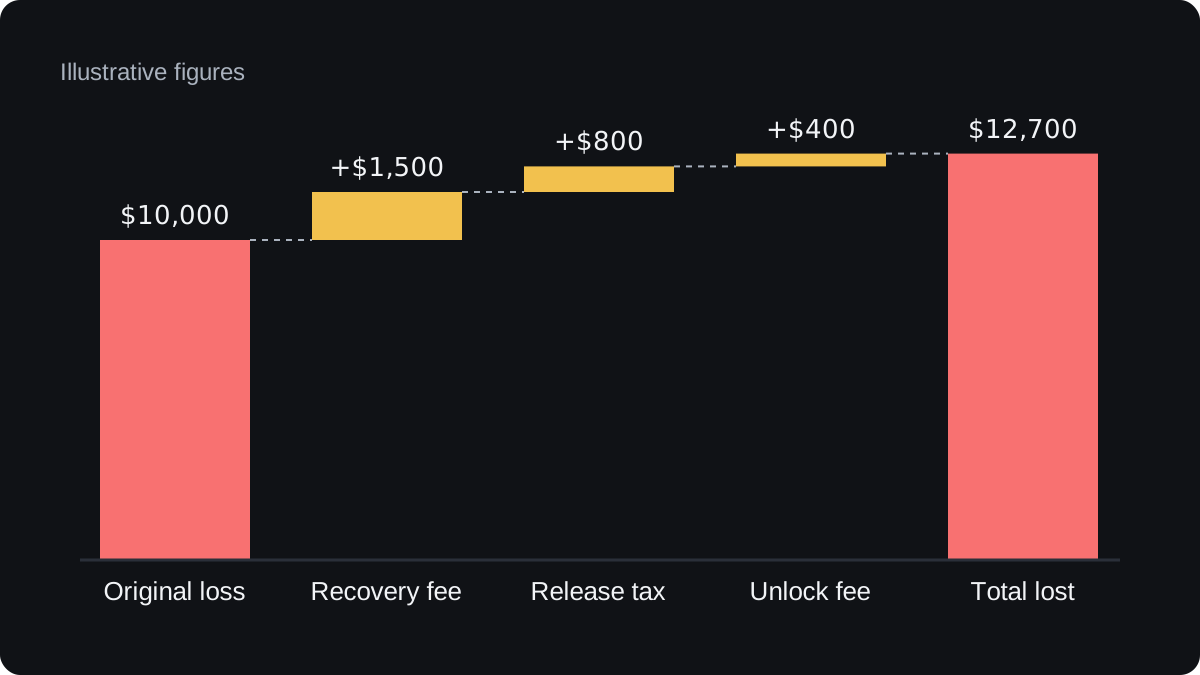
Here is how the illustrative $10,000 loss can grow:
- The "agent" says it has found your $10,000 and asks for a 15% fee first: 10,000 × 0.15 = $1,500.
- Next comes a "release tax" of $800 before the funds can move.
- Then an "unlock fee" of $400 for the wallet.
- Nothing arrives. The extra loss is 1,500 + 800 + 400 = $2,700, and the total is 10,000 + 2,700 = $12,700.
A recovery offer fits the scam pattern when:
- they contacted you first
- they want a fee before any money comes back
- they guarantee success
- they ask for payment in crypto or gift cards
- they want remote access to your device
- they claim to be police or a regulator and ask you to pay
Police and financial regulators do not charge victims a fee to return stolen money.
If you want a lawyer, find one yourself through your country's bar association or law society. Get the fees in writing and be wary of anyone who promises a result.
How do you protect yourself after a scam?
If you sent copies of your passport, ID card or utility bills, assume they could be misused. Watch your bank accounts closely, and use credit reports or a credit freeze where your country offers them.
Expect more contact. Block the numbers, ignore links in follow-up messages and do not install any app you are asked to install.
Talk to someone you trust. Scammers use practised scripts on people of every age and background, and keeping quiet only helps them. Police can often point you to victim support services where they exist.
If you trade again, check any broker against its regulator's register before you deposit. How to choose a forex broker and the red flags of an unsafe broker list what to check.
The next lesson covers the most common beginner mistakes, the ones that cost money even with an honest broker.
Questions
Can I get my money back from a forex scam?
Sometimes, mainly when you paid by card or bank transfer and acted fast. Money sent in crypto or moved overseas is rarely returned, so report it and never pay anyone who promises recovery.
Should I pay a fee to withdraw my money from a broker?
Treat any request for new money before a withdrawal as a warning sign. Stop paying, save the evidence and call your bank.
Are fund recovery companies legit?
Firms that contact you first, charge upfront and guarantee results match the pattern of recovery scams. If you want legal help, find a lawyer yourself through your country's bar association or law society.
How do I report a fake forex broker?
Report it to the police, to the financial regulator in your country and to the platform where you found it. Keep every reference number you are given.
Can crypto sent to a scammer be traced?
Most blockchain transfers are public, so investigators can often follow the funds. Getting them back is harder and usually needs an exchange to freeze them and police to act.
Keep learning
 Chapter 2Common forex scams.Common forex scams include fake or cloned brokers that block withdrawals, signal sellers with unverifiable records, strangers who offer to manage your account, and schemes that pay fixed monthly returns from new deposits. They share one promise: steady profit with little risk. Recovery scams then target people who have already lost money.
 Chapter 2How to spot a forex scam.A forex scam usually shows itself through a few shared signs: a guaranteed or fixed return, pressure to pay before you can check, a stranger who contacted you first, payments to personal accounts or to crypto wallets sent in a chat, and new fees before any withdrawal. Check every firm on the regulator's own register before sending money.

