What is leverage in forex?
Leverage lets you control a position much larger than your deposit. At 1:100, every $1 of margin holds $100 of currency, so a $110,000 position needs $1,100. Leverage decides how much margin is locked, not how much a pip is worth. Your real risk comes from the position size you choose.

Without leverage, one standard lot of EUR/USD would need more than $100,000 in your account. With it, a few hundred dollars can open the same trade. That is the whole appeal, and the whole danger.
How does leverage work?
Leverage is written as a ratio such as 1:100. It means each $1 you put up as margin controls $100 of position. The broker holds that margin as a deposit while the trade is open.
Take 0.10 lot of EUR/USD at an illustrative 1.10000. The position is worth 10,000 × 1.10000 = $11,000. At 1:100 you need $11,000 ÷ 100 = $110 of margin to open it.
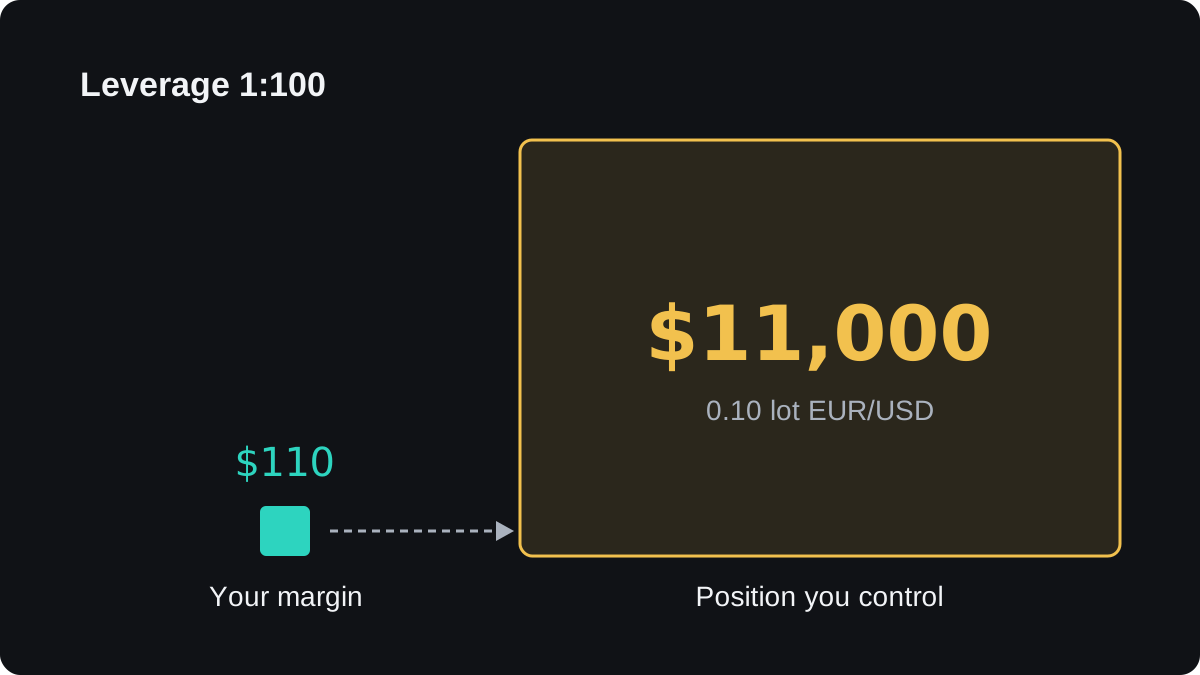
You never receive the other $10,900. Retail forex trades are settled in cash, so only the profit or loss moves in or out of your account.
Leverage, margin and position size
Three numbers are tied together by one formula:
Margin = position value ÷ leverage
The margin rate is therefore 100 ÷ leverage, as a percentage. At 1:100 the broker asks for 1% of the position, and at 1:500 it asks for 0.2%.
Here is what one standard lot of EUR/USD at 1.10000, worth $110,000, needs at different settings:
| Leverage | Margin rate | Margin for 1.00 lot |
|---|---|---|
| 1:30 | 3.33% | $3,666.67 |
| 1:100 | 1% | $1,100 |
| 1:500 | 0.2% | $220 |
| 1:2000 | 0.05% | $55 |
Your account setting is not always the leverage you get. Many brokers apply lower leverage to very large positions, to some instruments, or in the hours around major news and the weekend.
The leverage calculator runs these numbers for any pair, size and account currency. What margin is, and what happens when it runs short, is the subject of margin and stop out.
Leverage does not change what a pip is worth
This is the part most beginners miss. One lot of EUR/USD moves $10 per pip whether your leverage is 1:30 or 1:2000. Leverage only changes how much margin is locked while the trade is open.
Your profit and loss come from the lot size. Higher leverage lets you open a bigger lot with the same money, and that is where the danger starts.
Effective leverage: the number that matters
Effective leverage compares what you have open with what you own:
Effective leverage = total position value ÷ account equity
Say you hold $1,000 and buy 0.50 lot of EUR/USD at 1.10000. The position is worth $55,000, so your effective leverage is 55,000 ÷ 1,000 = 55:1, whatever your account setting says.
At 55:1, a 1% move in price costs 55% of your account. A 1% move from 1.10000 is 110 pips, and 110 pips × $5 per pip = $550.
Moves like that are not rare. On 29 October 2026, by 16:35 UTC, EUR/USD had already traded between 1.11152 and 1.11710 that day, a range of about 0.5%.
The chart shows the same $1,000 account facing the same 50 pip move against it, at four position sizes.
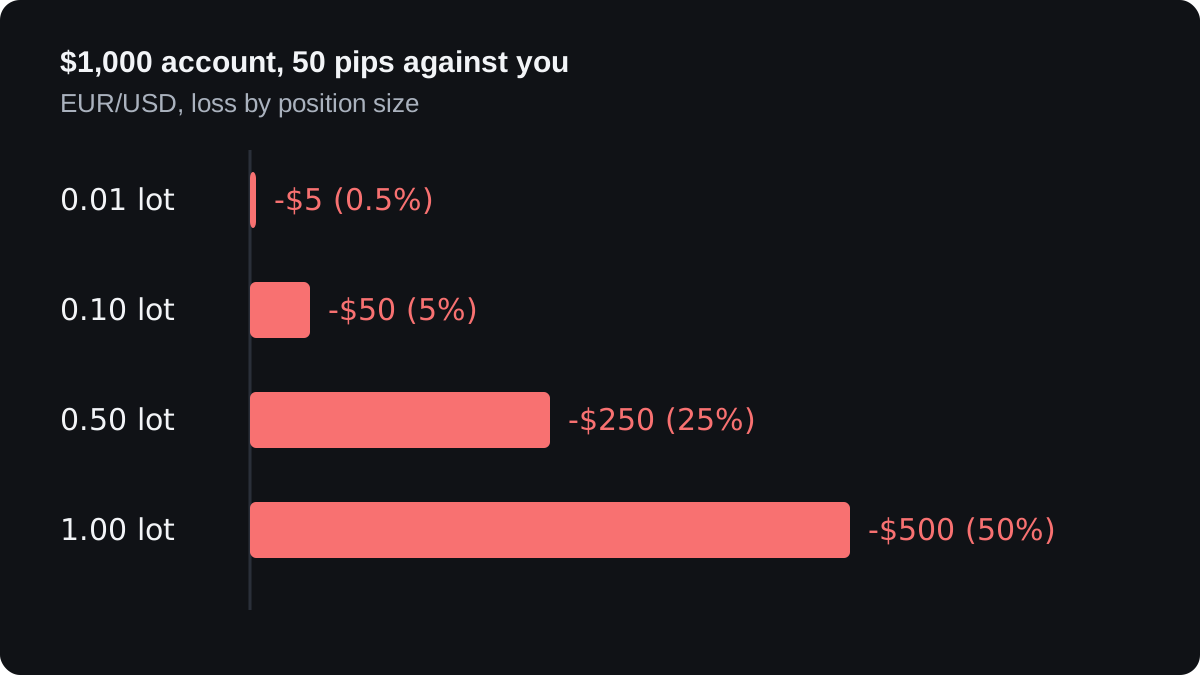
Note the last bar. At 1:100, 1.00 lot would need $1,100 of margin, more than the account holds. Only a much higher setting makes that trade possible at all.
Why is leverage risky?
Leverage magnifies losses in exactly the same proportion as gains. A position too large for the account can lose a big share of it on an ordinary move.
In a fast market a stop loss can also fill at a worse price than its level, which is called slippage. The bigger the position, the more each extra pip of slippage costs.
Some regulators cap leverage for retail clients for this reason. In the European Union, for example, retail leverage on major currency pairs is limited to 1:30, and in the United States to 1:50.
Many brokers outside those regions offer far higher settings. Ask about negative balance protection as well: where it applies, your losses cannot exceed the money in your account.
How to choose your leverage setting
Treat leverage as a ceiling, not a target. Size each trade from your risk first, then check that the margin it needs leaves plenty of free margin.
Here is how that looks with numbers. A $1,000 account risks 1%, or $10, with a 25 pip stop on EUR/USD, so the size is $10 ÷ (25 × $10) = 0.04 lot.
At 1.10000 that trade locks $44 of margin at 1:100, or $8.80 at 1:500. In both cases the stop loses exactly $10. Leverage changed the margin, not the risk.
Higher leverage locks up less margin for the same trade, which leaves more room to absorb a losing run. The trouble only begins when that room is used to open bigger positions.
A practical habit: keep effective leverage low and know your stop out level before you open anything. The margin calculator shows what a trade will lock up before you place it.
Questions
What does 1:500 leverage mean?
Each $1 of margin controls $500 of position. One standard lot of EUR/USD at 1.10000, worth $110,000, would need $220 of margin.
Is higher leverage more risky?
Not by itself, because pip value depends on lot size, not leverage. It becomes riskier when the extra room tempts you into positions larger than your account can carry.
What leverage should a beginner use?
There is no single right setting. What protects you is low effective leverage, meaning positions that are small compared with your equity, plus a stop loss on every trade.
Can I lose more than I deposit?
It depends on your broker and where you live. With negative balance protection your account cannot go below zero; without it, a sharp price gap could leave a negative balance you owe.
Keep learning
 Chapter 6What is margin trading?Margin trading means opening a position worth more than the money in your account. The broker sets aside part of your balance, the margin, as a deposit while the trade is open. Profit and loss are counted on the full position size, so small price moves change your balance much faster than the margin suggests.
 Chapter 6What is account balance in forex?Your account balance is the money in your trading account from deposits, withdrawals and closed trades, after booked costs such as commission and swap. It does not include open positions. While a trade is open the balance stays the same, and the floating profit or loss shows up in your equity instead.
 Chapter 6What is floating (unrealized) profit and loss?Floating profit and loss is the result your open trades would show if you closed them at the current price. It changes with every tick and moves your equity, while your balance stays the same. It becomes realized, and is added to or taken from your balance, only when the trade closes.
 Chapter 6What are margin, margin level and stop out in forex?Margin is the part of your money a broker locks as a deposit while a leveraged trade is open. Margin level is equity divided by used margin, times 100%. When it falls to the broker's margin call level your account is flagged, and at the stop out level the broker starts closing your positions automatically.
 Chapter 6What is used margin?Used margin is the total amount your broker sets aside to keep all your open positions open. Each position's margin is its notional value divided by your leverage, and used margin adds them up. It is not a fee: the money returns to free margin when you close the trades.
 Chapter 6What is equity in a trading account?Equity is your account balance plus or minus the floating profit or loss of your open trades. It shows what the account would be worth if you closed everything at current prices. With no trades open, equity equals balance. Brokers use it to work out free margin, margin level and stop outs.
 Chapter 6What is free margin?Free margin is the money in your trading account that is not locked up as margin for open trades. It equals equity minus used margin. You need free margin to open new positions, and it falls as open trades lose and rises as they gain. At zero, your margin level is 100%.
 Chapter 6What is margin level?Margin level is your equity divided by your used margin, multiplied by 100 and shown as a percentage. It tells you how much cushion your open trades have. At 100%, equity equals used margin and free margin is zero. Brokers set their margin call and stop out levels on this number, and the levels differ between brokers.
 Chapter 6What is a margin call?A margin call is your broker's warning that your margin level, equity divided by used margin, has fallen to a set threshold such as 100%. You usually cannot open new trades from that point. The call closes nothing by itself. If losses continue, the broker's stop out level is where positions start to be closed for you.
 Chapter 6What is a stop out level?The stop out level is the margin level at which your broker starts closing your open positions automatically, often beginning with the largest loss. If your stop out level is 50%, closing begins when equity falls to half your used margin. It is meant to stop your account sinking further, though a price gap can still push it below zero.
 Chapter 6Margin call example: margin call at 100% with no separate stop out.When a broker sets the margin call and the stop out both at 100%, the warning and the forced close happen at the same moment. In this example, a $1,000 account buys 0.50 lot of EUR/USD with $550 of margin at 1:100, and the trade is closed after a 90 pip fall, a $450 loss.
 Chapter 6Margin call and stop out example: 100% and 50%.In this example a $2,000 account buys 1 lot of EUR/USD at 1.10000 with $1,100 of used margin. The margin call at 100% arrives when equity falls to $1,100, 90 pips lower at 1.09100. The stop out at 50% closes the trade when equity reaches $550, at 1.08550, a loss of $1,450.
 Chapter 6What happens if you trade forex with $100?With $100 and 1:100 leverage, 0.01 lot of EUR/USD at 1.10000 uses $11 of margin and can move about 890 pips against you before a 100% margin call. At 0.05 lot the margin call comes after 90 pips, and 0.10 lot cannot be opened at all. Trade size decides how much room you have.
 Chapter 6Why margin call and stop out levels differ between brokers.Margin call and stop out levels are set by each broker, often per account type, within any rules from the regulator that licenses the account. In this lesson's example, one trade is closed after 90 pips at one broker and after 178 pips at another, so look up your own levels before you trade.
 Chapter 6Margin cheat sheet.Balance is the cash from deposits, withdrawals and closed trades. Equity is balance plus the floating profit or loss on open trades. Used margin is the deposit your open trades hold, and free margin is equity minus used margin. Margin level is equity divided by used margin, times 100. A margin call warns; a stop out closes trades.
 Chapter 6How can you avoid a margin call?Margin level is your equity divided by your used margin, and a margin call comes when it falls to your broker's threshold. To stay clear, keep positions small compared with your equity, set stop losses that close losing trades long before that point, and leave plenty of free margin unused.

