What is equity in a trading account?
Equity is your account balance plus or minus the floating profit or loss of your open trades. It shows what the account would be worth if you closed everything at current prices. With no trades open, equity equals balance. Brokers use it to work out free margin, margin level and stop outs.

Open a trade and your balance does not change. The number that moves with every tick is your equity. It tells you what your account would be worth if you closed everything at the current price.
What does equity mean in a trading account?
Say your account holds $2,000 and you have no trades open. Your balance is $2,000, and your equity is $2,000 too.
Now you open a trade, and it shows a floating profit of $40. Your balance is still $2,000, because nothing has been closed. Your equity is $2,040.
Equity is your account balance plus or minus the floating profit or loss of your open trades:
Equity = balance + floating profit or loss
A floating loss is a negative number, so it pulls equity below the balance. With a $60 floating loss, the same account has equity of $2,000 − $60 = $1,940.
When no trades are open, nothing is floating, so equity and balance are equal.
How does equity move during one trade?
Here is one trade with round illustrative prices. Your balance is $2,000, and you buy 0.50 lot of EUR/USD at the ask of 1.10000.
- Work out the pip value. A pip on EUR/USD is 0.0001, and 0.50 lot is 50,000 euros, so one pip is 50,000 × 0.0001 = $5.
- Just after you open, the bid is 1.09990. A long trade is valued at the bid, so you are 1 pip down: a floating loss of $5, and equity of $1,995.
- Later the bid reaches 1.10300. That is 1.10300 − 1.10000 = 0.00300, or 30 pips, and 30 × $5 = +$150. Equity is $2,150.
- Later still the bid falls to 1.09600. That is 0.00400 below your entry, or −40 pips, and −40 × $5 = −$200. Equity is $1,800.
| Bid | Pips from entry | Floating P/L | Balance | Equity |
|---|---|---|---|---|
| 1.09990 | −1 | −$5 | $2,000 | $1,995 |
| 1.10300 | +30 | +$150 | $2,000 | $2,150 |
| 1.09600 | −40 | −$200 | $2,000 | $1,800 |
Through all of this the balance never moved. It changes when a trade closes, and some brokers also book costs such as commission to it straight away.
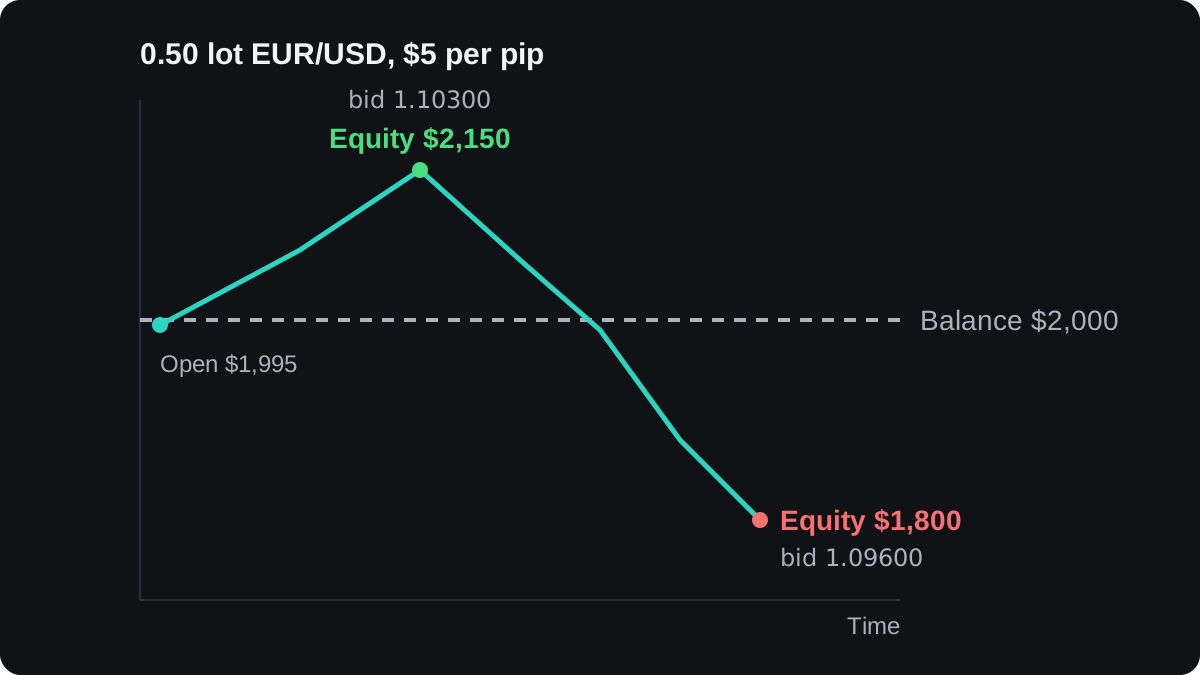
If you closed the trade at a bid of 1.10300, the $150 would become realised profit. The balance would rise to $2,150, nothing would be floating, and equity would also be $2,150.
How do you work out equity with several trades open?
Add up the floating results of every open trade first, then add that total to the balance. A profit on one trade offsets a loss on another.
Say your balance is $2,000. Your EUR/USD long shows +$150, and a USD/JPY short you also hold shows −$90. The net floating result is $150 − $90 = +$60, so equity is $2,060.
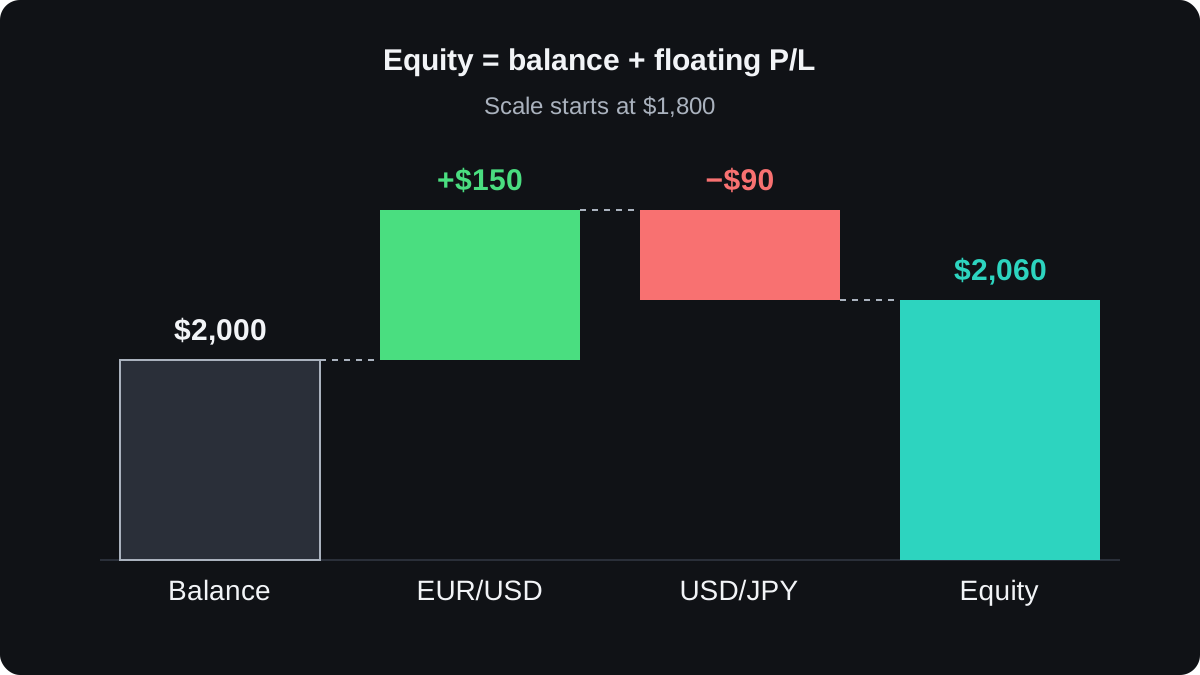
The platform does this sum for you. In MetaTrader, equity appears in the account line of the Trade tab, next to balance, margin and free margin.
Swap built up on a trade held overnight also counts toward equity before the trade closes. Your platform may show it in its own column, apart from the price profit.
If a broker adds a bonus as credit, MetaTrader counts that credit inside equity as well. Bonus credit usually cannot be withdrawn, so read the bonus terms before you rely on it.
Why does your broker watch equity?
Equity is the money that would be left if every trade closed now, so your broker builds its margin checks on it.
- Free margin is equity minus used margin.
- Margin level is equity divided by used margin, times 100.
Go back to the EUR/USD trade. With leverage of 1:100, used margin on 0.50 lot at 1.10000 is 50,000 × 1.10000 ÷ 100 = $550. Assume it stays at $550 while the trade is open.
| Equity | Used margin | Free margin | Margin level |
|---|---|---|---|
| $2,150 | $550 | $1,600 | 390.9% |
| $1,800 | $550 | $1,250 | 327.3% |
Used margin stayed the same, yet free margin and margin level both fell because equity fell. A losing trade therefore shrinks your room to open new ones.
Many brokers set a margin call level and a stop out level as margin level percentages. The levels differ between brokers, so treat 100% and 50% here as illustrative.
With used margin of $550, a 100% margin level means equity of $550. A 50% level means equity of $275.
For equity to reach $550, the floating loss must be $2,000 − $550 = $1,450. At $5 per pip that is 1,450 ÷ 5 = 290 pips, a bid of 1.07100.
For equity to reach $275, the loss must be $1,725. That is 1,725 ÷ 5 = 345 pips, a bid of 1.06550.
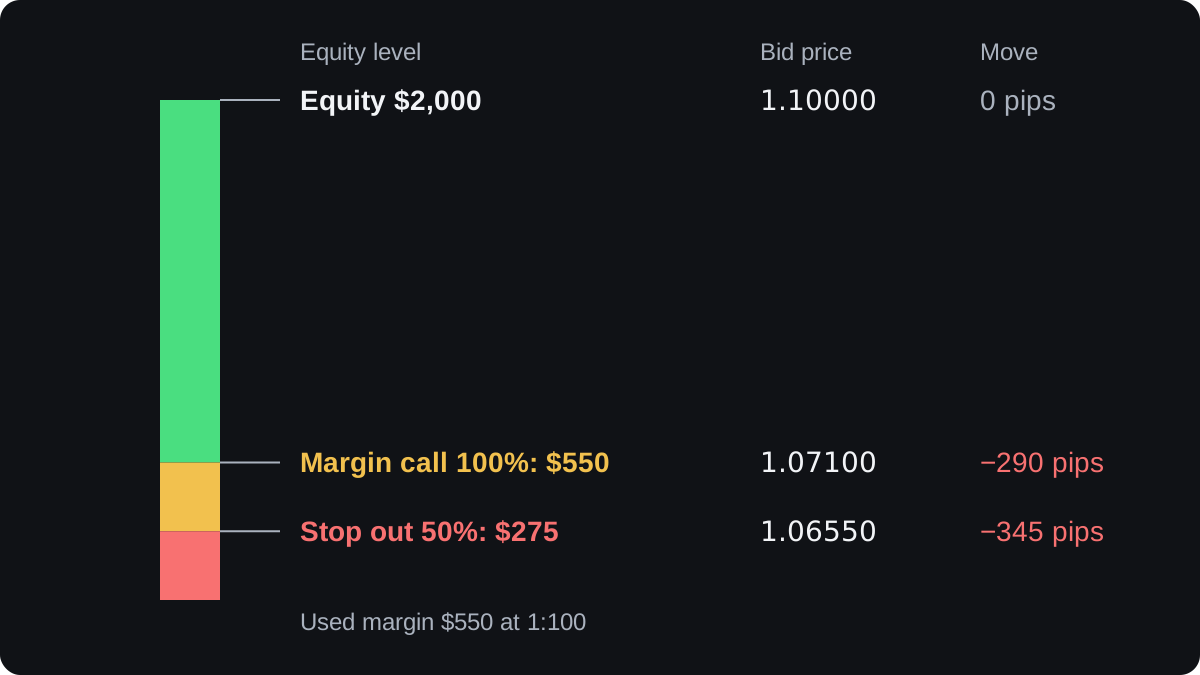
The margin calculator works out used margin for other pairs, trade sizes and leverage settings.
Balance or equity: which number matters more?
Balance records what has already happened. Equity shows where you stand right now, so it is the better guide whenever trades are open.
A large balance can hide a weak account. With a $2,000 balance and a $1,500 floating loss, your equity is $500, and that $500 is what the margin rules see.
Equity also moves when you are not watching. Prices can jump on a news release or over a weekend, so equity on Monday can open far from where it closed on Friday.
Drawdown, the fall from a peak, can be measured on either number. Measured on equity, it includes losses you are still sitting in, which balance alone does not show.
Questions
Is equity the same as balance?
Only when no trades are open. With open trades, equity is the balance plus or minus their floating profit or loss.
Can equity be higher than balance?
Yes. When your open trades are in profit overall, equity is above the balance by the size of that profit.
Can equity go below zero?
In a very fast move, a stop out can close trades at worse prices than its level, so equity can fall below zero. Whether you must cover a negative balance depends on your broker's terms, so check whether it offers negative balance protection.
Can I withdraw my equity?
Floating profit cannot be withdrawn until the trade closes and the profit reaches your balance. With trades open, brokers usually limit withdrawals so enough margin stays in the account.
Does swap affect equity?
Yes. Swap on a trade held overnight counts toward equity, so it raises or lowers equity before the trade closes.
Keep learning
 Chapter 6What is margin trading?Margin trading means opening a position worth more than the money in your account. The broker sets aside part of your balance, the margin, as a deposit while the trade is open. Profit and loss are counted on the full position size, so small price moves change your balance much faster than the margin suggests.
 Chapter 6What is account balance in forex?Your account balance is the money in your trading account from deposits, withdrawals and closed trades, after booked costs such as commission and swap. It does not include open positions. While a trade is open the balance stays the same, and the floating profit or loss shows up in your equity instead.
 Chapter 6What is floating (unrealized) profit and loss?Floating profit and loss is the result your open trades would show if you closed them at the current price. It changes with every tick and moves your equity, while your balance stays the same. It becomes realized, and is added to or taken from your balance, only when the trade closes.
 Chapter 6What are margin, margin level and stop out in forex?Margin is the part of your money a broker locks as a deposit while a leveraged trade is open. Margin level is equity divided by used margin, times 100%. When it falls to the broker's margin call level your account is flagged, and at the stop out level the broker starts closing your positions automatically.
 Chapter 6What is used margin?Used margin is the total amount your broker sets aside to keep all your open positions open. Each position's margin is its notional value divided by your leverage, and used margin adds them up. It is not a fee: the money returns to free margin when you close the trades.
 Chapter 6What is free margin?Free margin is the money in your trading account that is not locked up as margin for open trades. It equals equity minus used margin. You need free margin to open new positions, and it falls as open trades lose and rises as they gain. At zero, your margin level is 100%.
 Chapter 6What is margin level?Margin level is your equity divided by your used margin, multiplied by 100 and shown as a percentage. It tells you how much cushion your open trades have. At 100%, equity equals used margin and free margin is zero. Brokers set their margin call and stop out levels on this number, and the levels differ between brokers.
 Chapter 6What is a margin call?A margin call is your broker's warning that your margin level, equity divided by used margin, has fallen to a set threshold such as 100%. You usually cannot open new trades from that point. The call closes nothing by itself. If losses continue, the broker's stop out level is where positions start to be closed for you.
 Chapter 6What is a stop out level?The stop out level is the margin level at which your broker starts closing your open positions automatically, often beginning with the largest loss. If your stop out level is 50%, closing begins when equity falls to half your used margin. It is meant to stop your account sinking further, though a price gap can still push it below zero.
 Chapter 6Margin call example: margin call at 100% with no separate stop out.When a broker sets the margin call and the stop out both at 100%, the warning and the forced close happen at the same moment. In this example, a $1,000 account buys 0.50 lot of EUR/USD with $550 of margin at 1:100, and the trade is closed after a 90 pip fall, a $450 loss.
 Chapter 6Margin call and stop out example: 100% and 50%.In this example a $2,000 account buys 1 lot of EUR/USD at 1.10000 with $1,100 of used margin. The margin call at 100% arrives when equity falls to $1,100, 90 pips lower at 1.09100. The stop out at 50% closes the trade when equity reaches $550, at 1.08550, a loss of $1,450.
 Chapter 6What happens if you trade forex with $100?With $100 and 1:100 leverage, 0.01 lot of EUR/USD at 1.10000 uses $11 of margin and can move about 890 pips against you before a 100% margin call. At 0.05 lot the margin call comes after 90 pips, and 0.10 lot cannot be opened at all. Trade size decides how much room you have.
 Chapter 6Why margin call and stop out levels differ between brokers.Margin call and stop out levels are set by each broker, often per account type, within any rules from the regulator that licenses the account. In this lesson's example, one trade is closed after 90 pips at one broker and after 178 pips at another, so look up your own levels before you trade.
 Chapter 6What is leverage in forex?Leverage lets you control a position much larger than your deposit. At 1:100, every $1 of margin holds $100 of currency, so a $110,000 position needs $1,100. Leverage decides how much margin is locked, not how much a pip is worth. Your real risk comes from the position size you choose.
 Chapter 6Margin cheat sheet.Balance is the cash from deposits, withdrawals and closed trades. Equity is balance plus the floating profit or loss on open trades. Used margin is the deposit your open trades hold, and free margin is equity minus used margin. Margin level is equity divided by used margin, times 100. A margin call warns; a stop out closes trades.
 Chapter 6How can you avoid a margin call?Margin level is your equity divided by your used margin, and a margin call comes when it falls to your broker's threshold. To stay clear, keep positions small compared with your equity, set stop losses that close losing trades long before that point, and leave plenty of free margin unused.

