What are margin, margin level and stop out in forex?
Margin is the part of your money a broker locks as a deposit while a leveraged trade is open. Margin level is equity divided by used margin, times 100%. When it falls to the broker's margin call level your account is flagged, and at the stop out level the broker starts closing your positions automatically.

Margin is where leverage meets your real account. Learn the handful of numbers at the bottom of your MetaTrader terminal and you will always know how close you are to a forced close.
Margin is a deposit, not a fee
When you open a leveraged trade, the broker sets aside part of your money as margin. It is not spent. You get it back when the trade closes, plus or minus the trade's result.
The required margin follows from the size of the position and your leverage:
Required margin = position value ÷ leverage
An example with round illustrative prices: a $1,000 account at 1:100 buys 0.50 lot of EUR/USD at 1.10000. The position is worth $55,000, so the margin is $55,000 ÷ 100 = $550.
Balance, equity and free margin
The terminal shows several numbers that sound alike but mean different things:
- Balance is your money from closed trades, deposits and withdrawals. It ignores open trades.
- Equity is balance plus the floating profit or loss of open trades: what the account is worth right now.
- Margin is the amount locked by open positions, also called used margin.
- Free margin is equity minus margin. It funds new trades and absorbs losses on open ones.
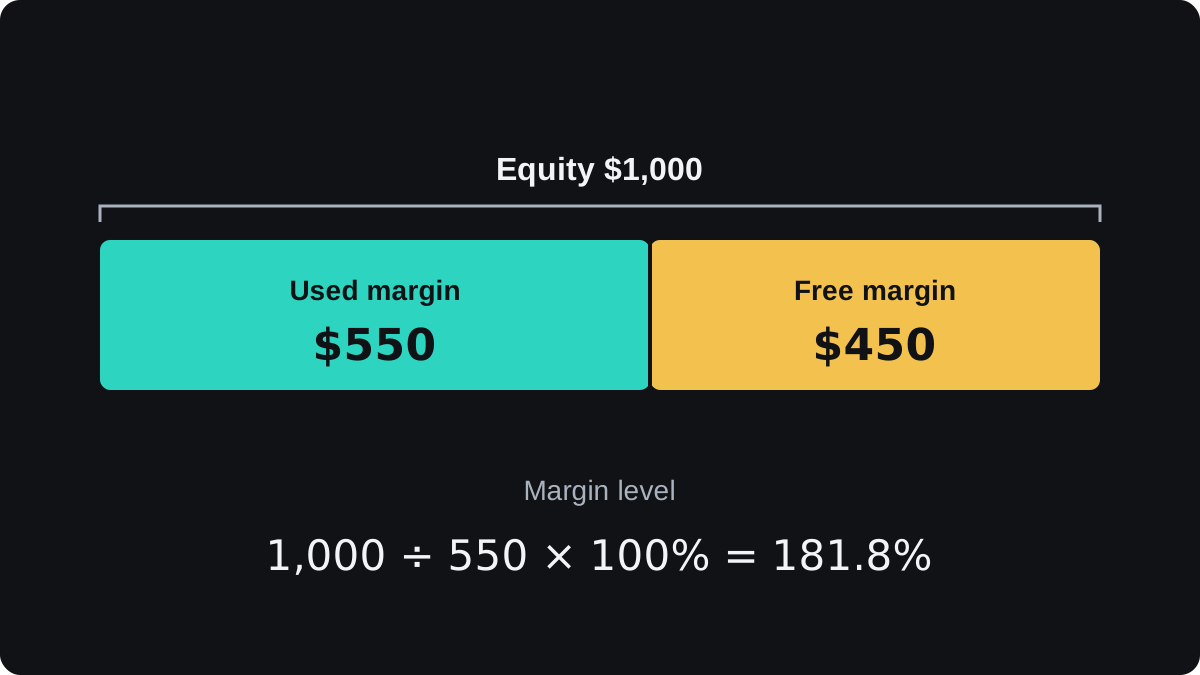
Right after opening the trade above, before price moves, balance and equity are both $1,000. Margin is $550, so free margin is $1,000 minus $550 = $450.
What is margin level?
Margin level tells you how well your open trades are covered. MetaTrader shows it as a percentage:
Margin level = equity ÷ margin × 100%
In the example, $1,000 ÷ $550 × 100% = 181.8%. The higher the number, the more room you have. With no trades open, there is no margin level to show.
Margin call and stop out
Brokers set two thresholds on margin level. Each broker and account type has its own figures, listed in the account terms. This lesson uses 100% and 50% only as examples.
- Margin call is a warning level. The account is flagged and the broker may contact you. At 100%, free margin has reached zero, so nothing is left for new trades.
- Stop out is where the broker's system acts. Pending orders are deleted and open positions are closed, normally starting with the one that has the largest loss, until the level recovers.
Now follow the example as EUR/USD falls. The 0.50 lot position loses $5 per pip. To keep the maths clean, margin is held at $550; on a real platform it shifts slightly as the euro price moves.
| EUR/USD | Pips against you | Floating loss | Equity | Margin level |
|---|---|---|---|---|
| 1.10000 | 0 | $0 | $1,000 | 181.8% |
| 1.09500 | 50 | $250 | $750 | 136.4% |
| 1.09100 | 90 | $450 | $550 | 100% (margin call) |
| 1.08550 | 145 | $725 | $275 | 50% (stop out) |
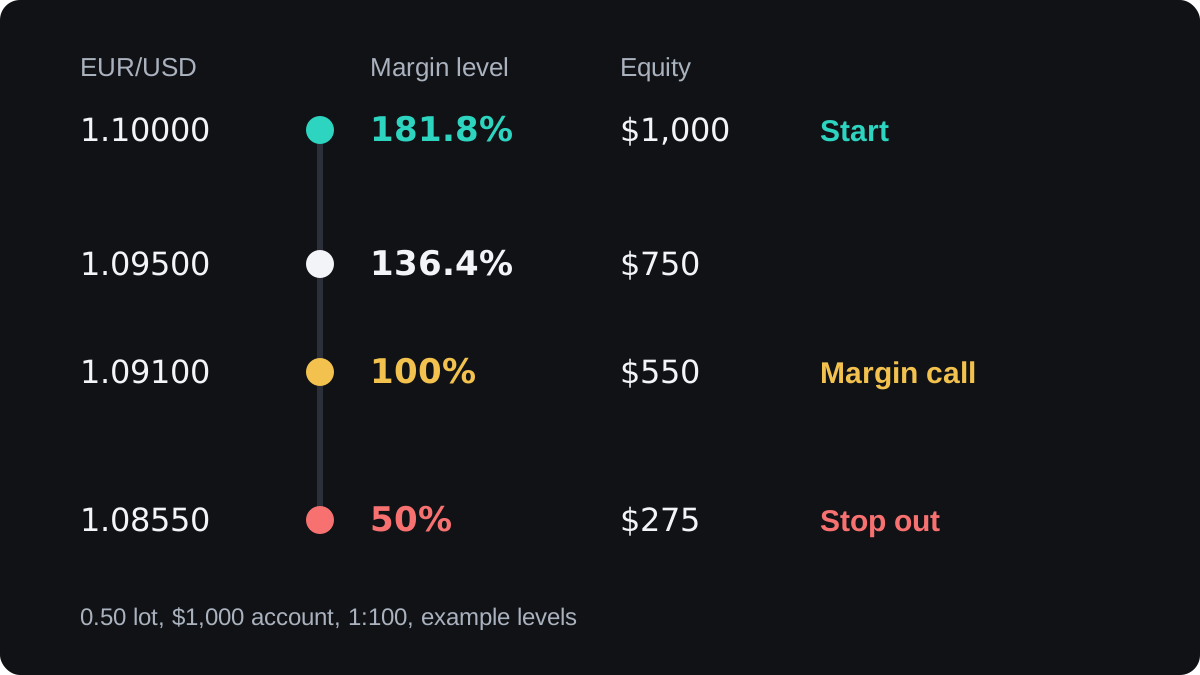
A fall of 145 pips, about 1.3%, is enough to close the trade. The trader loses $725 and is left with $275.
How far can price move before a stop out?
You can work this out before you trade, using the pip value of your position:
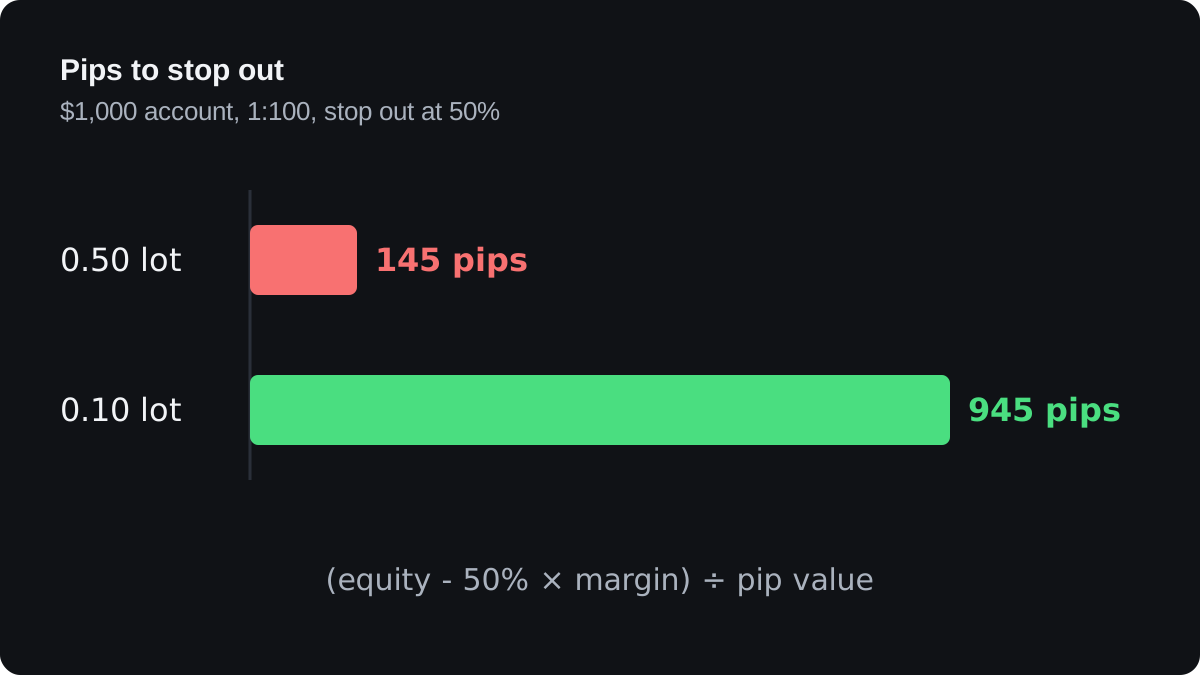
Pips to stop out = (equity minus stop out level × margin) ÷ pip value
For the example: ($1,000 minus 50% × $550) ÷ $5 = $725 ÷ $5 = 145 pips. That matches the table.
Run the same sum for 0.10 lot instead. Margin is $110 and a pip is worth $1, so ($1,000 minus $55) ÷ $1 = 945 pips. A smaller position buys a huge amount of breathing room.
This is also why higher leverage on its own is not the danger. At 1:500 the 0.50 lot trade would lock only $110, and the stop out would sit 189 pips away instead of 145.
The danger is opening a bigger position because the margin looks cheap.
How to stay well away from stop out
- Size each trade from a stop loss, as in the lot size lesson, so a normal stop costs a small part of the account.
- Watch margin level, not only profit. Several open trades add their margins together.
- Expect spreads to widen around rollover and news. A wider spread lowers equity on every open trade at once.
- Look up your broker's margin call and stop out levels before you need them.
- Avoid adding to a losing trade to average down. It uses more margin while equity falls.
The margin calculator shows what a trade will lock up for any pair, size and leverage before you place it.
Questions
What is a good margin level?
There is no official target. The higher it is, the more room your trades have, and a level just above your broker's margin call leaves almost none.
What happens at stop out?
The broker's system deletes pending orders and closes open positions at market, usually the biggest loser first, until margin level is back above the stop out level. The loss then becomes part of your balance.
Is margin a fee?
No. Margin is a deposit that is locked while a trade is open and released when it closes. The costs of trading are the spread, commission and swap.
Can a stop loss prevent a stop out?
Usually, if the stop is placed sensibly and the position is sized from it. In a fast market or a weekend gap, price can jump past both, so a stop is a plan, not a guarantee.
Keep learning
 Chapter 6What is margin trading?Margin trading means opening a position worth more than the money in your account. The broker sets aside part of your balance, the margin, as a deposit while the trade is open. Profit and loss are counted on the full position size, so small price moves change your balance much faster than the margin suggests.
 Chapter 6What is account balance in forex?Your account balance is the money in your trading account from deposits, withdrawals and closed trades, after booked costs such as commission and swap. It does not include open positions. While a trade is open the balance stays the same, and the floating profit or loss shows up in your equity instead.
 Chapter 6What is floating (unrealized) profit and loss?Floating profit and loss is the result your open trades would show if you closed them at the current price. It changes with every tick and moves your equity, while your balance stays the same. It becomes realized, and is added to or taken from your balance, only when the trade closes.
 Chapter 6What is used margin?Used margin is the total amount your broker sets aside to keep all your open positions open. Each position's margin is its notional value divided by your leverage, and used margin adds them up. It is not a fee: the money returns to free margin when you close the trades.
 Chapter 6What is equity in a trading account?Equity is your account balance plus or minus the floating profit or loss of your open trades. It shows what the account would be worth if you closed everything at current prices. With no trades open, equity equals balance. Brokers use it to work out free margin, margin level and stop outs.
 Chapter 6What is free margin?Free margin is the money in your trading account that is not locked up as margin for open trades. It equals equity minus used margin. You need free margin to open new positions, and it falls as open trades lose and rises as they gain. At zero, your margin level is 100%.
 Chapter 6What is margin level?Margin level is your equity divided by your used margin, multiplied by 100 and shown as a percentage. It tells you how much cushion your open trades have. At 100%, equity equals used margin and free margin is zero. Brokers set their margin call and stop out levels on this number, and the levels differ between brokers.
 Chapter 6What is a margin call?A margin call is your broker's warning that your margin level, equity divided by used margin, has fallen to a set threshold such as 100%. You usually cannot open new trades from that point. The call closes nothing by itself. If losses continue, the broker's stop out level is where positions start to be closed for you.
 Chapter 6What is a stop out level?The stop out level is the margin level at which your broker starts closing your open positions automatically, often beginning with the largest loss. If your stop out level is 50%, closing begins when equity falls to half your used margin. It is meant to stop your account sinking further, though a price gap can still push it below zero.
 Chapter 6Margin call example: margin call at 100% with no separate stop out.When a broker sets the margin call and the stop out both at 100%, the warning and the forced close happen at the same moment. In this example, a $1,000 account buys 0.50 lot of EUR/USD with $550 of margin at 1:100, and the trade is closed after a 90 pip fall, a $450 loss.
 Chapter 6Margin call and stop out example: 100% and 50%.In this example a $2,000 account buys 1 lot of EUR/USD at 1.10000 with $1,100 of used margin. The margin call at 100% arrives when equity falls to $1,100, 90 pips lower at 1.09100. The stop out at 50% closes the trade when equity reaches $550, at 1.08550, a loss of $1,450.
 Chapter 6What happens if you trade forex with $100?With $100 and 1:100 leverage, 0.01 lot of EUR/USD at 1.10000 uses $11 of margin and can move about 890 pips against you before a 100% margin call. At 0.05 lot the margin call comes after 90 pips, and 0.10 lot cannot be opened at all. Trade size decides how much room you have.
 Chapter 6Why margin call and stop out levels differ between brokers.Margin call and stop out levels are set by each broker, often per account type, within any rules from the regulator that licenses the account. In this lesson's example, one trade is closed after 90 pips at one broker and after 178 pips at another, so look up your own levels before you trade.
 Chapter 6What is leverage in forex?Leverage lets you control a position much larger than your deposit. At 1:100, every $1 of margin holds $100 of currency, so a $110,000 position needs $1,100. Leverage decides how much margin is locked, not how much a pip is worth. Your real risk comes from the position size you choose.
 Chapter 6Margin cheat sheet.Balance is the cash from deposits, withdrawals and closed trades. Equity is balance plus the floating profit or loss on open trades. Used margin is the deposit your open trades hold, and free margin is equity minus used margin. Margin level is equity divided by used margin, times 100. A margin call warns; a stop out closes trades.
 Chapter 6How can you avoid a margin call?Margin level is your equity divided by your used margin, and a margin call comes when it falls to your broker's threshold. To stay clear, keep positions small compared with your equity, set stop losses that close losing trades long before that point, and leave plenty of free margin unused.

