What are the bid and ask prices in forex?
Every forex quote has two prices. The bid is the price at which you can sell, and the ask is the higher price at which you can buy. The gap between them is the spread. You buy at the ask and close at the bid, so every new trade starts slightly behind by the size of the spread.
Open any trading platform and each pair shows two prices side by side. That is not a delay or a glitch. They are the two sides of the market, and knowing which one applies to you explains many early surprises.
The two prices on every quote
The bid is the price at which you can sell. The ask, sometimes called the offer, is the price at which you can buy. The ask is always the higher of the two.
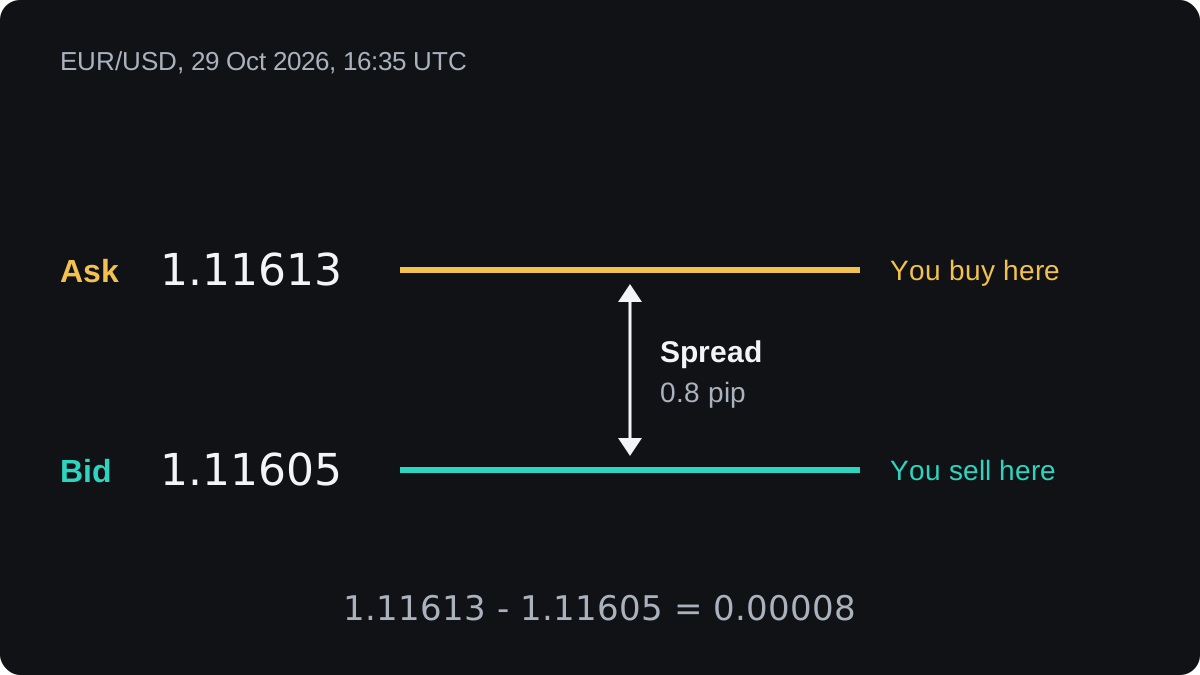
Here is a real quote. On 29 October 2026 at 16:35 UTC, an Exness Standard account showed EUR/USD at 1.11605 bid and 1.11613 ask.
The price halfway between the two is called the mid price. News sites and many currency converters show the mid, so their number will not match the price you can actually trade at.
Why you buy at the ask and sell at the bid
Think of a currency exchange booth. It buys your euros at one rate and sells euros to you at a slightly worse one. The difference pays for the booth.
A broker quoting forex works the same way. When you buy, you take the price the market will sell at, which is the ask. When you sell, you take the price the market will pay, which is the bid.
Trading platforms such as MetaTrader apply this rule to every order. It covers closing a trade as well as opening one, which is the part beginners tend to miss.
The spread is the gap between them
The difference between the ask and the bid is the spread. Using the real quote above:
- Spread = ask minus bid = 1.11613 minus 1.11605 = 0.00008.
- On EUR/USD one pip is 0.0001, so 0.00008 is 0.8 pip.
- On one standard lot a pip is worth $10, so the spread costs 0.8 × $10 = $8.
- On 0.10 lot the same spread costs $0.80.
In the same minute, gold (XAU/USD) was quoted at 4012.928 bid and 4013.168 ask. That is a gap of $0.24 per ounce, or $24 on one lot of 100 ounces.
Spreads get a full lesson in the trading costs chapter: what a spread is. If the pip maths went too fast, read what a pip is first.
When you trade through an introducing broker, part of that cost can come back to you per lot. That is what a forex rebate is.
Why a new trade starts slightly negative
Say you buy 1 lot of EUR/USD at the ask, 1.11613. Your platform values an open buy at the bid, because that is the price you could close it at.
With the bid at 1.11605, the trade shows -$8 the moment it opens. To break even, the bid has to rise to your entry price of 1.11613, a move of the full spread.
A sell trade mirrors this. You open at the bid and close by buying back at the ask, so the ask has to fall below your entry before you profit.
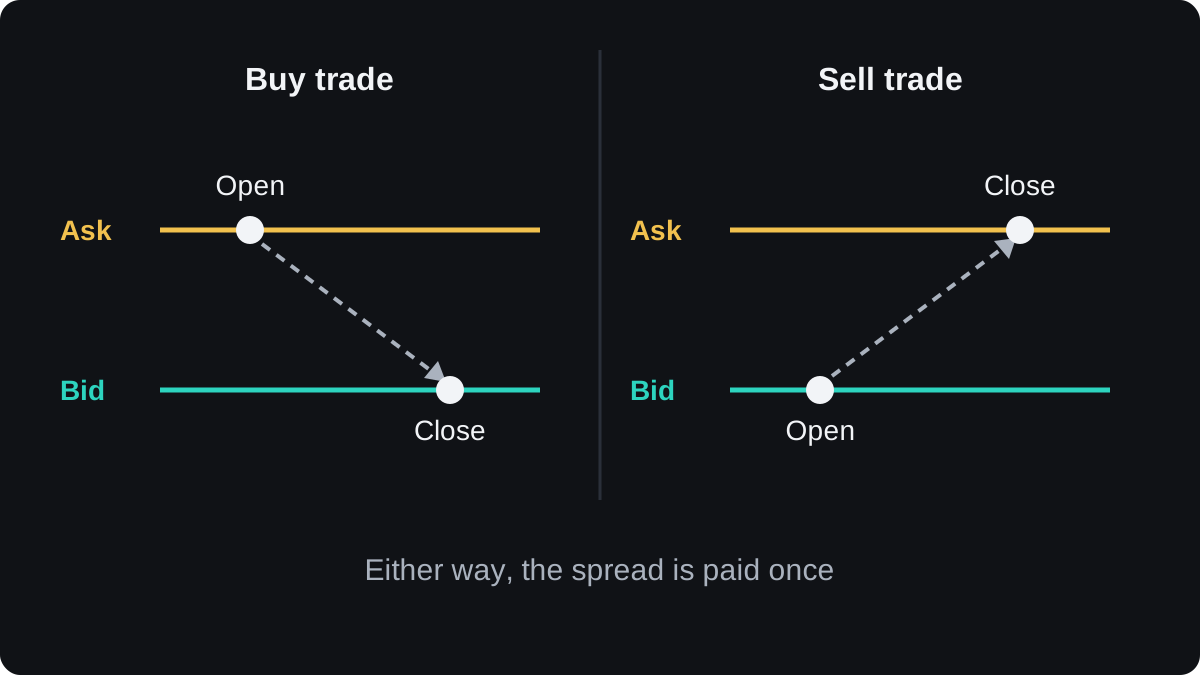
You pay the spread once per round trip, not once on entry and again on exit. The profit and loss calculator lets you check a trade with both prices.
Which price does your chart show?
On MetaTrader, forex candles are drawn from bid prices. You can switch on an ask line in the chart settings to see both prices at once.
This matters for stop orders. A stop loss on a buy trade is checked against the bid. A stop loss on a sell trade is checked against the ask, which the candles do not show.
So a sell trade can be stopped out while the candles never touch your stop. If the spread widens, the ask can reach your stop even though the bid stays below it.
A simple habit helps. When you place a stop on a sell trade from a level you see on the chart, add the pair's usual spread to it.
When does the spread get wider?
On most accounts the spread is not fixed. It widens when fewer banks are quoting, or when everyone turns cautious at once. Typical moments:
- Around the daily rollover near 17:00 New York time, when many liquidity providers pause.
- In the minutes around major economic data and central bank decisions.
- At the weekly open on Sunday evening, when few participants are trading.
- On exotic pairs during quiet hours in their home market.
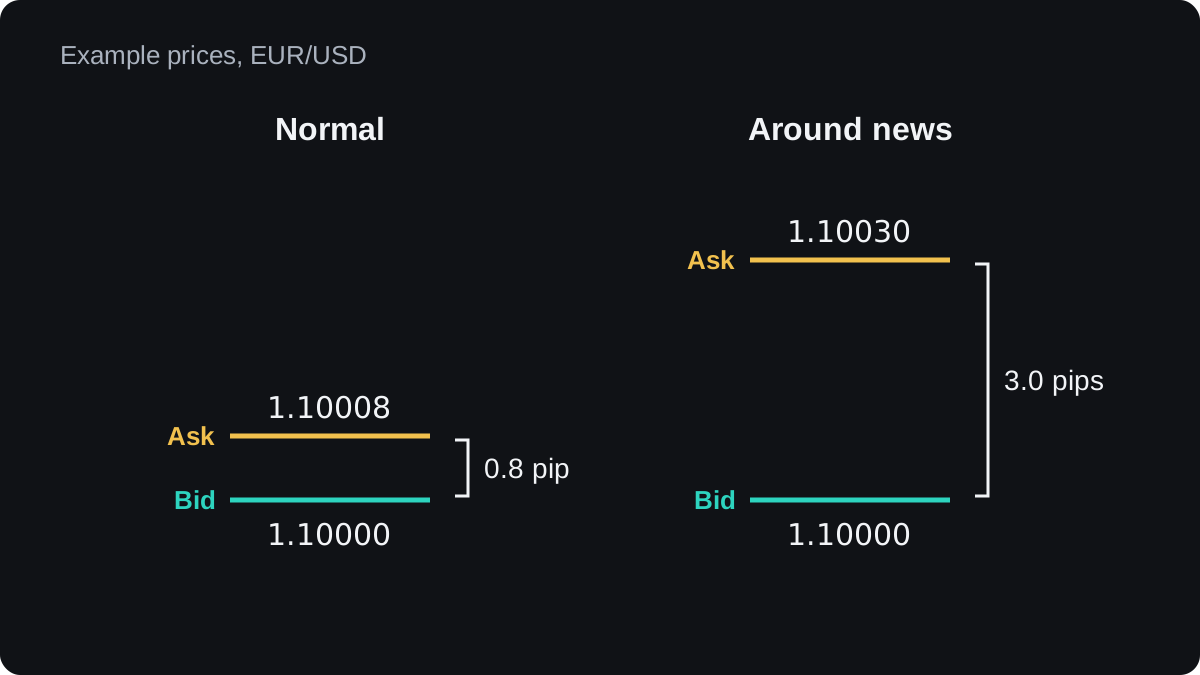
A wider spread costs more on entry and can trigger a sell stop early.
If you trade often, account type matters as well: Standard and Raw accounts charge for the spread in different ways.
On a raw spread account the gap can shrink to zero for moments, and the broker charges a commission per lot instead.
Questions
Is the bid or the ask price higher?
The ask is higher. You buy at the ask and sell at the bid, and the gap between the two is the spread.
Why does my trade show a loss as soon as I open it?
A buy opens at the ask but is valued at the bid. The loss you see on entry equals the spread, and the bid has to rise by that much before you break even.
Which price does the MetaTrader chart use?
MetaTrader draws forex charts from bid prices. You can add an ask line in the chart settings to see both.
Why was my sell trade stopped out when the chart never reached my stop?
A stop loss on a sell trade triggers on the ask, while the chart shows the bid. If the spread widened, the ask could touch your stop while the bid stayed below it.
Keep learning
 Chapter 2How does a forex trade make or lose money?A forex trade makes money when the pair moves in your direction by more than the trade costs, and loses when it moves against you. A buy gains as the price rises and a sell gains as it falls. Profit is the price change times trade size, less commission and swap.
 Chapter 2When do you buy or sell a currency pair?You buy a currency pair when you expect the first currency, the base, to strengthen against the second, and you sell when you expect it to weaken. If your view is about one currency, find which side of the pair it sits on: a weaker quote currency pushes the pair up, so you buy.
 Chapter 2What is a pip in forex?A pip is the standard step traders use to measure price moves. On most currency pairs it is 0.0001, the fourth decimal place, and on pairs quoted in Japanese yen it is 0.01. A pipette is one tenth of a pip. On one standard lot of EUR/USD, each pip is worth $10.
 Chapter 2What is a lot in forex?A lot is the unit used to set the size of a forex trade. One standard lot is 100,000 units of the base currency, a mini lot is 10,000 and a micro lot is 1,000. On EUR/USD that makes each pip worth $10, $1 and $0.10. Other instruments, such as gold, use their own contract size.
 Chapter 2What is the spread in forex?The spread is the gap between the bid price you can sell at and the ask price you can buy at. You pay it on every trade, the moment you open it. On EUR/USD it is often one or two pips or less, and it widens around the daily rollover, the weekly open and big news.
 Chapter 2Forex terms you will hear every day.The everyday words of forex describe what a trade is doing and what it costs. Long means you bought, short means you sold. A pip is the standard price step, a lot is the trade size, the spread is the gap between bid and ask, and margin is the deposit your broker holds while a trade is open.
 Chapter 2What types of orders can you place in forex?A market order buys or sells straight away at the current price. A pending order waits for a price you choose: a limit order waits for a better price, and a stop order joins a move once price breaks a level. Stop loss and take profit orders close an open trade at prices you set in advance.
 Chapter 2Forex order types cheat sheet.A market order fills now at the current price. A limit order waits for a better price: a buy limit below the market, a sell limit above it. A stop order waits for a worse price: a buy stop above, a sell stop below. Buy orders trigger on the ask, sell orders on the bid.
 Chapter 2What is a forex demo account, and how should you use it?A forex demo account is a practice account funded with virtual money. You trade on the broker's platform with live or near-live prices, so you can learn orders, stops and margin without risking your own cash. Set it up with the balance and leverage you would really use, and expect live fills and feelings to differ.
 Chapter 2Can you get rich trading forex?A few people make large sums trading forex, but the loss figures that EU and UK brokers must publish show that most retail CFD accounts at those brokers lose money. Getting rich would need a large starting balance and years of steady returns. Small accounts chasing big targets usually take risks large enough to wipe them out.
 Chapter 2Forex basics cheat sheet: pairs, pips, lots, leverage and margin.This cheat sheet sums up the forex basics chapter on one page. Each idea gets a short summary, its formula and a link to the full lesson. The quick reference tables let you check pip sizes, pip values, contract sizes and margin before you place a trade, and one worked trade ties everything together.

