Forex basics cheat sheet: pairs, pips, lots, leverage and margin.
This cheat sheet sums up the forex basics chapter on one page. Each idea gets a short summary, its formula and a link to the full lesson. The quick reference tables let you check pip sizes, pip values, contract sizes and margin before you place a trade, and one worked trade ties everything together.
Keep this page open while you practise. Prices are round illustrative examples, and every money figure assumes an account held in US dollars.
The market and its prices
Forex is the over-the-counter market for swapping one currency for another. It runs from Sunday 17:00 to Friday 17:00 New York time. Full lesson: what is forex.
Currency pair: the price of one unit of the base currency, counted in the quote currency. EUR/USD at 1.10000 means one euro costs 1.10000 dollars. Full lesson: currency pairs.
Bid and ask: you sell at the bid and buy at the higher ask. The spread is ask minus bid, and you pay it once per trade. Full lesson: bid and ask prices.
Pips and lots
Pip: the standard price step. It is 0.0001 on most pairs, 0.01 on yen pairs, and 0.01 on gold in this site's calculators. A pipette is one tenth of a pip. Full lesson: what is a pip.
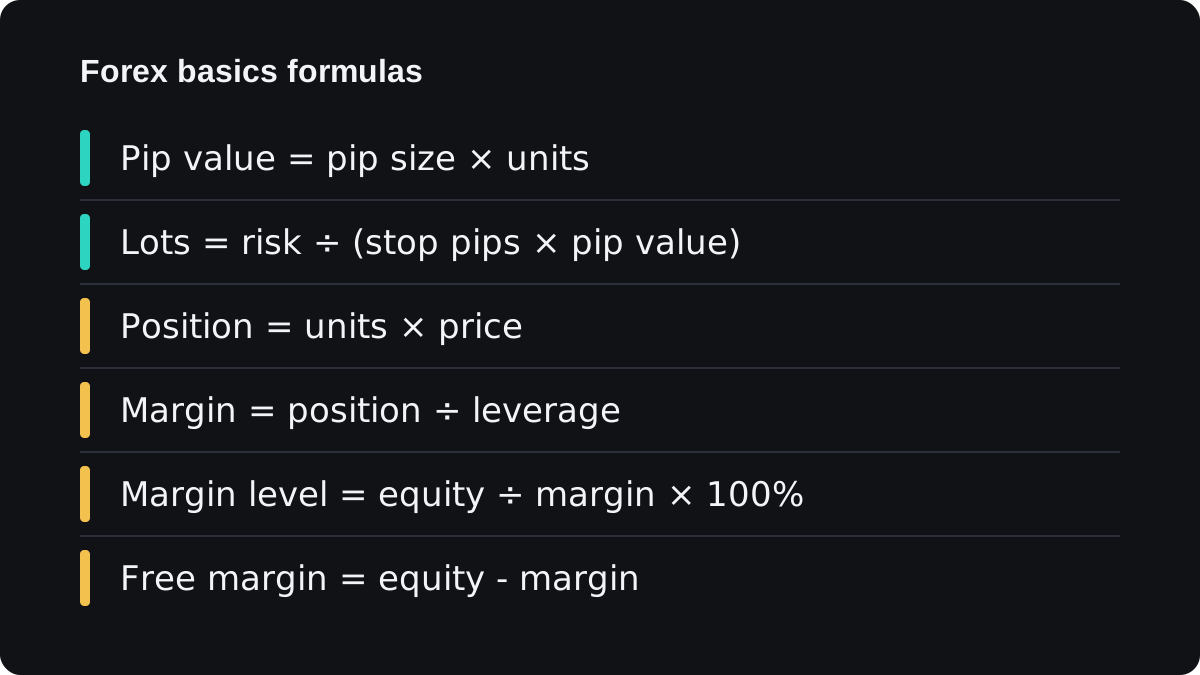
Pip value = pip size × units, in the quote currency, then converted to your account currency.
Lot: the unit of trade size. 1.00 lot is 100,000 units of a currency pair, or 100 ounces of gold on most accounts. Full lesson: lot size.
Lots = money at risk ÷ (stop in pips × pip value per lot), always rounded down.
Leverage and margin
Leverage: the ratio between your position and the margin it needs. At 1:100, $1 of margin holds $100 of position. Leverage does not change pip value. Full lesson: leverage.
Margin = position value ÷ leverage, and free margin = equity minus margin.
Margin level = equity ÷ margin × 100%. At the broker's margin call level the account is flagged, and at the stop out level positions start to close. Full lesson: margin and stop out.
Quick reference tables
Pip size and pip value for one lot, with example prices:
| Instrument | Pip size | 1.00 lot | Pip value per 1.00 lot |
|---|---|---|---|
| EUR/USD, GBP/USD, AUD/USD | 0.0001 | 100,000 base units | $10.00 |
| USD/JPY at 150.00 | 0.01 | 100,000 USD | $6.67 |
| XAU/USD (gold) | 0.01 | 100 oz | $1.00 |
| XAG/USD (silver) | 0.01 | 5,000 oz | $50.00 |
Lot sizes on EUR/USD at 1.10000:
| Volume | Units | Pip value | Position value | Margin at 1:100 |
|---|---|---|---|---|
| 1.00 | 100,000 | $10.00 | $110,000 | $1,100 |
| 0.10 | 10,000 | $1.00 | $11,000 | $110 |
| 0.01 | 1,000 | $0.10 | $1,100 | $11 |
Leverage and the margin rate it implies:
| Leverage | 1:30 | 1:50 | 1:100 | 1:500 | 1:1000 |
|---|---|---|---|---|---|
| Margin rate | 3.33% | 2% | 1% | 0.2% | 0.1% |
One trade, start to finish
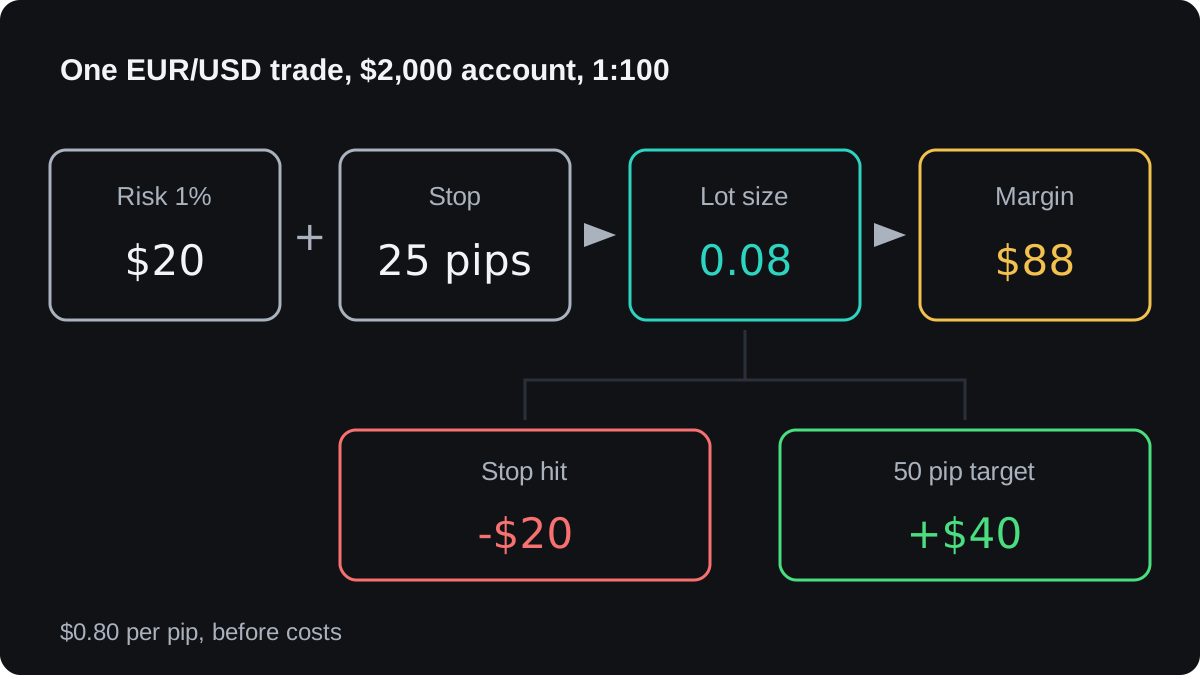
This example uses every formula on the page:
- A $2,000 account at 1:100 risks 1%, or $20, on EUR/USD with a 25 pip stop.
- Lot size: $20 ÷ (25 × $10) = 0.08 lot, worth $0.80 per pip.
- Position value at 1.10000: 8,000 × 1.10000 = $8,800.
- Margin: $8,800 ÷ 100 = $88. Free margin: $2,000 minus $88 = $1,912.
- Margin level: $2,000 ÷ $88 × 100% = 2,272.7%.
- If the stop is hit: 25 × $0.80 = $20 lost. If a 50 pip target is hit: 50 × $0.80 = $40 gained, before costs.
Run the same steps with your own numbers in the lot size calculator.
Questions
What are the most important forex terms for a beginner?
Pair, bid and ask, spread, pip, lot, leverage and margin. With those you can read a quote, size a trade and see how close you are to a stop out.
How do I work out pip value quickly?
For pairs quoted in US dollars, one standard lot is $10 per pip, a mini lot $1 and a micro lot $0.10. For other pairs, multiply pip size by units and convert to your account currency.
What is the difference between margin and leverage?
Leverage is the ratio a broker allows, such as 1:100. Margin is the money locked for a specific trade, worked out as position value divided by leverage.
Keep learning
 Chapter 2How does a forex trade make or lose money?A forex trade makes money when the pair moves in your direction by more than the trade costs, and loses when it moves against you. A buy gains as the price rises and a sell gains as it falls. Profit is the price change times trade size, less commission and swap.
 Chapter 2When do you buy or sell a currency pair?You buy a currency pair when you expect the first currency, the base, to strengthen against the second, and you sell when you expect it to weaken. If your view is about one currency, find which side of the pair it sits on: a weaker quote currency pushes the pair up, so you buy.
 Chapter 2What is a pip in forex?A pip is the standard step traders use to measure price moves. On most currency pairs it is 0.0001, the fourth decimal place, and on pairs quoted in Japanese yen it is 0.01. A pipette is one tenth of a pip. On one standard lot of EUR/USD, each pip is worth $10.
 Chapter 2What is a lot in forex?A lot is the unit used to set the size of a forex trade. One standard lot is 100,000 units of the base currency, a mini lot is 10,000 and a micro lot is 1,000. On EUR/USD that makes each pip worth $10, $1 and $0.10. Other instruments, such as gold, use their own contract size.
 Chapter 2What is the spread in forex?The spread is the gap between the bid price you can sell at and the ask price you can buy at. You pay it on every trade, the moment you open it. On EUR/USD it is often one or two pips or less, and it widens around the daily rollover, the weekly open and big news.
 Chapter 2What are the bid and ask prices in forex?Every forex quote has two prices. The bid is the price at which you can sell, and the ask is the higher price at which you can buy. The gap between them is the spread. You buy at the ask and close at the bid, so every new trade starts slightly behind by the size of the spread.
 Chapter 2Forex terms you will hear every day.The everyday words of forex describe what a trade is doing and what it costs. Long means you bought, short means you sold. A pip is the standard price step, a lot is the trade size, the spread is the gap between bid and ask, and margin is the deposit your broker holds while a trade is open.
 Chapter 2What types of orders can you place in forex?A market order buys or sells straight away at the current price. A pending order waits for a price you choose: a limit order waits for a better price, and a stop order joins a move once price breaks a level. Stop loss and take profit orders close an open trade at prices you set in advance.
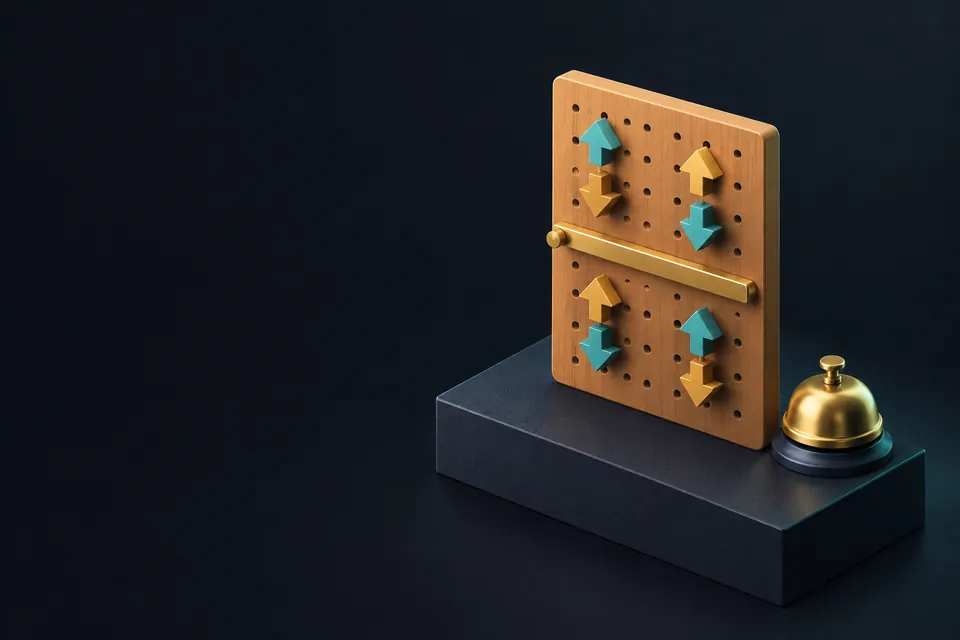 Chapter 2Forex order types cheat sheet.A market order fills now at the current price. A limit order waits for a better price: a buy limit below the market, a sell limit above it. A stop order waits for a worse price: a buy stop above, a sell stop below. Buy orders trigger on the ask, sell orders on the bid.
 Chapter 2What is a forex demo account, and how should you use it?A forex demo account is a practice account funded with virtual money. You trade on the broker's platform with live or near-live prices, so you can learn orders, stops and margin without risking your own cash. Set it up with the balance and leverage you would really use, and expect live fills and feelings to differ.
 Chapter 2Can you get rich trading forex?A few people make large sums trading forex, but the loss figures that EU and UK brokers must publish show that most retail CFD accounts at those brokers lose money. Getting rich would need a large starting balance and years of steady returns. Small accounts chasing big targets usually take risks large enough to wipe them out.

