Standard vs Raw spread account: which costs less?
A standard account charges everything through a wider spread. A raw or zero account shows a spread close to the market's own and adds a commission per lot. Neither is cheaper by default. Convert both to dollars per lot on your symbol, subtract any rebate, and the cheaper one becomes clear.

Most brokers offer two families of account. One shows a wider spread and no commission. The other shows a spread close to zero and charges a fee per lot.
The account name tells you how the cost is split, not how big it is. This lesson compares the two with figures measured on 29 October 2026.
Two ways to charge for the same trade
Standard accounts build their whole charge into the spread. What you see on the quote is what you pay.
Many brokers run several variants. Exness lists Standard, Standard Cent, Standard Plus and Pro. XM lists Standard and Ultra Low Standard, with no commission on either.
Raw and zero accounts pass on a spread close to the market's own and add a commission per lot. Exness calls them Raw Spread and Zero.
The real numbers on gold
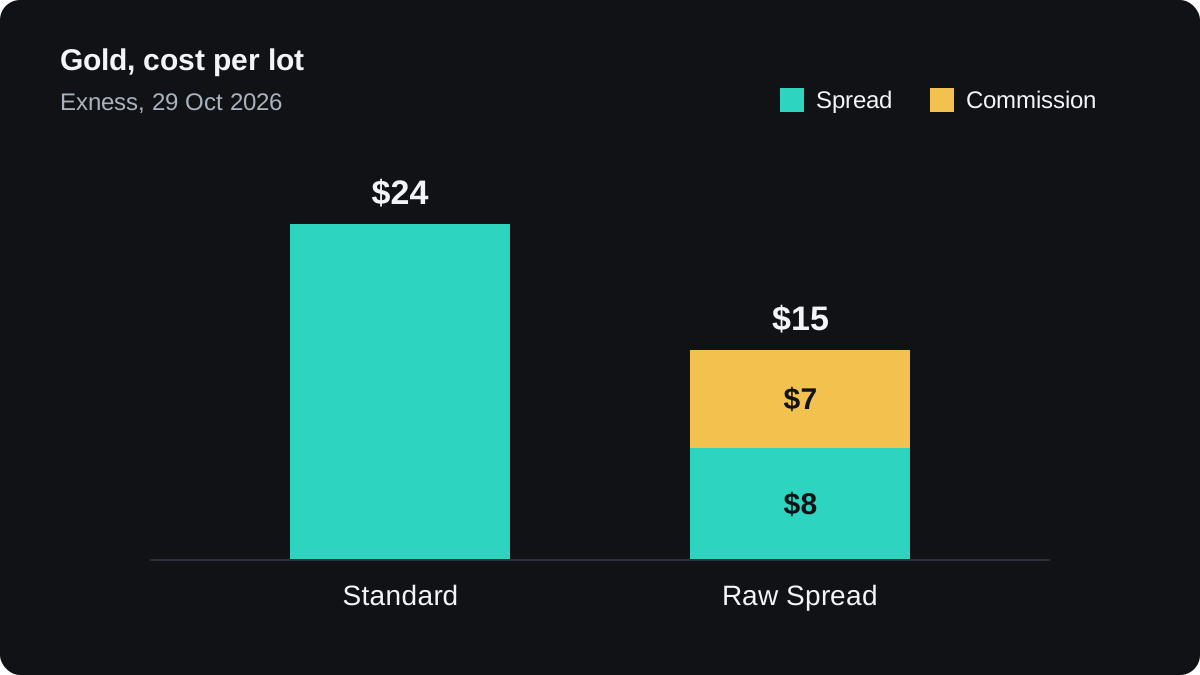
AutoFXRebate's Exness and XM pages list the typical spread and the commission for each account on gold (XAU/USD). These were read on 29 October 2026.
One gold lot is 100 ounces, so each $0.01 of spread is $1 per lot.
| Account | Typical spread | Commission | Cost per lot |
|---|---|---|---|
| Exness Zero | $0.04 | $11.00 | $15.00 |
| Exness Raw Spread | $0.08 | $7.00 | $15.00 |
| Exness Pro | $0.168 | none | $16.80 |
| Exness Standard | $0.24 | none | $24.00 |
| XM Ultra Low Standard | $0.26 | none | $26.00 |
| Exness Standard Plus | $0.36 | none | $36.00 |
| XM Standard | $0.55 | none | $55.00 |
On gold that day, both commission accounts cost less per lot than every account without commission. Pro came closest at $16.80.
EUR/USD: a closer race
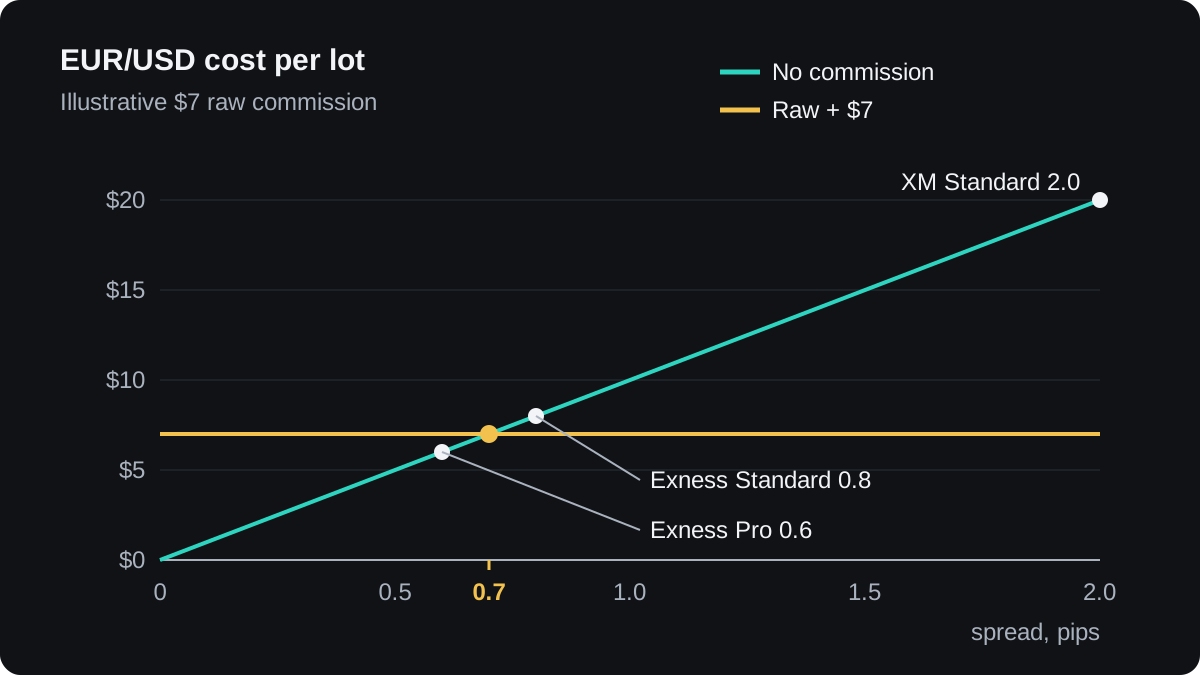
On EUR/USD the median spreads for the 24 hours to 16:39 UTC on 29 October 2026 were 0.6 pip on Exness Pro, 0.8 on Exness Standard, 2.0 on XM Standard and 0.0 on Exness Raw Spread.
A pip on one lot of EUR/USD is $10 with a USD account. So Pro cost $6 per lot, Standard $8 and XM Standard $20.
The source pages do not list a EUR/USD commission for Raw Spread, so take an illustrative $7 round turn. Raw then costs 0.0 × $10 + $7 = $7 per lot.
That is $1 cheaper than Standard and $1 dearer than Pro. On this pair the account choice moves the cost by a dollar or two, not by half.
The break-even rule
A commission account is cheaper when: standard spread × pip value > raw spread × pip value + commission.
With a 0.0 pip raw spread and $7 commission, the line sits at 0.7 pip. Any standard account above 0.7 pip costs more than raw, and any below it costs less.
How a rebate changes the picture
Rebates are set per account type, so they can reorder the table. On the AutoFXRebate pages, Exness pays 40% of the spread back on Standard and 25% on Pro, and a fixed amount per lot on Raw Spread and Zero.
XM pays a fixed amount per lot on both its accounts. On gold, XM Standard has the largest rebate in the table, $18 per lot, and also the highest cost, $55. Its net cost is still $37.
Net figures for every account are worked through in comparing broker costs. The short version: compare what you pay after the rebate, not the rebate itself.
Which account suits which trader
The cost per lot is one input. How you trade decides how much it matters.
- Frequent, short trades such as scalping or many automated strategies: cost per lot is a big share of each target, so the cheapest all-in account usually wins.
- Few trades held for days: a dollar or two per lot is small next to swap and the price move. A standard account keeps the arithmetic simple.
- Small accounts and practice: cent accounts such as Exness Standard Cent trade a hundredth of the size, so the cost in dollars shrinks with it.
Execution can differ as well. Exness lists market execution on Raw Spread and instant execution on Pro, which changes how slippage and requotes behave.
Check it on your own symbol
Gold and EUR/USD gave different answers, and other symbols will too. The Spread Checker shows the typical spread and cost per lot on each account.
Then run your own volume through the trading calculator to see the cost of a whole trade, swap included.
Questions
Is a raw spread account better for beginners?
Not automatically. It is often cheaper per lot, but you must add commission to every sum. A standard account is easier to read while you learn.
Why does a raw account show a spread of 0.0?
The broker passes on the market spread, which on liquid pairs is sometimes zero for a moment. The broker earns from the commission instead.
Is Standard Plus cheaper than Standard at Exness?
Not on the figures read on 29 October 2026. Standard Plus had the wider gold spread, $36 per lot against $24, and its larger rebate did not close the gap.
Can I switch account type at the same broker?
Usually you open an additional account of the other type in the broker's client area, rather than converting the one you have.
Keep learning
 Chapter 1How does commission per lot work in forex?Commission is a fixed fee per lot that raw and zero spread accounts charge on top of a thin spread. Brokers quote it per side, for opening or for closing, or per round turn, for both. To compare it with a spread, divide it by the pip value: $7 per lot on EUR/USD is 0.7 pip.
 Chapter 1What is swap in forex, and why is Wednesday triple?Swap, or rollover, is the interest you pay or earn for holding a forex position past 17:00 New York time. It comes from the gap between the two currencies' interest rates, plus the broker's markup. Most forex pairs charge three nights on Wednesday to cover the weekend.
 Chapter 1What is slippage in forex trading?Slippage is the difference between the price you expected and the price your order filled at. It happens when the market moves between your click and the execution, most often around news, the daily rollover and the weekly open. Market and stop orders can slip; limit orders fill at your price or better, but may not fill.
 Chapter 1How much does one forex trade cost?The cost of one forex trade is the spread plus any commission plus any swap, each turned into money for your volume. Slippage can add to it and a rebate takes part of it back. A 0.5 lot EUR/USD trade at a 0.8 pip spread with no commission costs $4.00 before swap.
 Chapter 1How do you compare trading costs between brokers fairly?To compare brokers fairly, use the same symbol, the same time window and the typical (median) spread, not the advertised minimum. Add commission, turn everything into dollars per lot, and include swap if you hold overnight. Then subtract any rebate to see the net cost you actually pay.
 Chapter 1Trading costs cheat sheet.Every forex trade pays some mix of spread, commission and swap, and can lose a little more to slippage. A rebate gives part of it back. This page puts the formulas, a table of measured spreads and one worked example in one place, with a link to the full lesson on each cost.

