How do you compare trading costs between brokers fairly?
To compare brokers fairly, use the same symbol, the same time window and the typical (median) spread, not the advertised minimum. Add commission, turn everything into dollars per lot, and include swap if you hold overnight. Then subtract any rebate to see the net cost you actually pay.

"Spreads from 0.0 pips" tells you about the best second of the day. It does not tell you what your trades cost.
A fair comparison takes the same trade to each broker and prices it the same way. Four rules cover it.
Rule 1: the same symbol, in dollars per lot
Compare one symbol at a time, in dollars per lot. Pips can mislead: brokers count gold pips in different ways, and a pip on USD/JPY is not worth the same as a pip on EUR/USD.
Check names and contract sizes too. Some accounts add a suffix to symbol names, and a cent account trades lots a hundred times smaller. Make sure one lot means the same contract on both sides.
Rule 2: the same hours, and the median
Spreads change through the day. A figure taken at the rollover and one taken in the London afternoon describe two different trades. Compare the hours you actually trade, over the same window for every account.
Then use the median rather than the minimum or the average. The minimum is the number in the advert, and a few spikes pull the average up.
The median is the middle reading: half of all readings were at or below it.
Here are the EUR/USD readings for the 24 hours to 16:39 UTC on 29 October 2026, from the data behind the Spread Checker. All figures are in pips.
| Account | Minimum | Median | Average | Maximum |
|---|---|---|---|---|
| Exness Raw Spread | 0.0 | 0.0 | 0.05 | 1.7 |
| Exness Pro | 0.6 | 0.6 | 0.67 | 3.0 |
| Exness Standard | 0.8 | 0.8 | 0.90 | 4.7 |
| XM Standard | 1.6 | 2.0 | 2.16 | 6.9 |
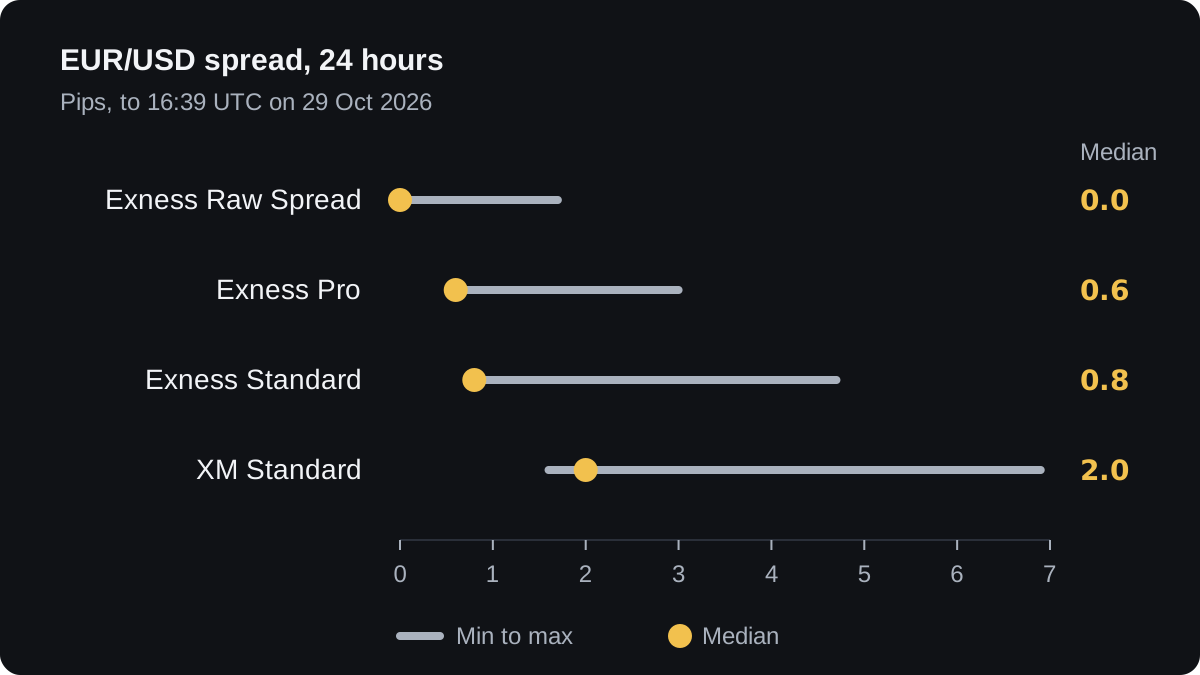
"From 0.0" was true for the raw account that day. It is still only half the story, because that account charges commission as well.
Rule 3: count commission and swap
Add commission to the spread before you rank anything; commission per lot shows how to turn it into dollars or pips. An account with the lowest spread can still be the dearer one.
If you hold positions overnight, add swap at the rates in each broker's MT5 Specification. Swap rates differ between brokers too, and on long holds they can outweigh the spread.
Then reduce the total to one number per lot, as in the cost of one trade.
Rule 4: subtract the rebate last
A rebate is paid per lot, so it comes off the cost per lot. Compare net costs, not rebates, because the biggest rebate often sits on the account with the widest spread.
Gold shows it clearly. These are the cost and rebate per lot at typical spreads, as listed on the AutoFXRebate pages for Exness and XM, read on 29 October 2026:
| Account | Cost per lot | Rebate | Net cost |
|---|---|---|---|
| Exness Raw Spread | $15.00 | $3.00 | $12.00 |
| Exness Zero | $15.00 | $3.00 | $12.00 |
| Exness Pro | $16.80 | $4.20 | $12.60 |
| Exness Standard | $24.00 | $9.60 | $14.40 |
| XM Ultra Low Standard | $26.00 | $9.00 | $17.00 |
| Exness Standard Plus | $36.00 | $14.40 | $21.60 |
| XM Standard | $55.00 | $18.00 | $37.00 |
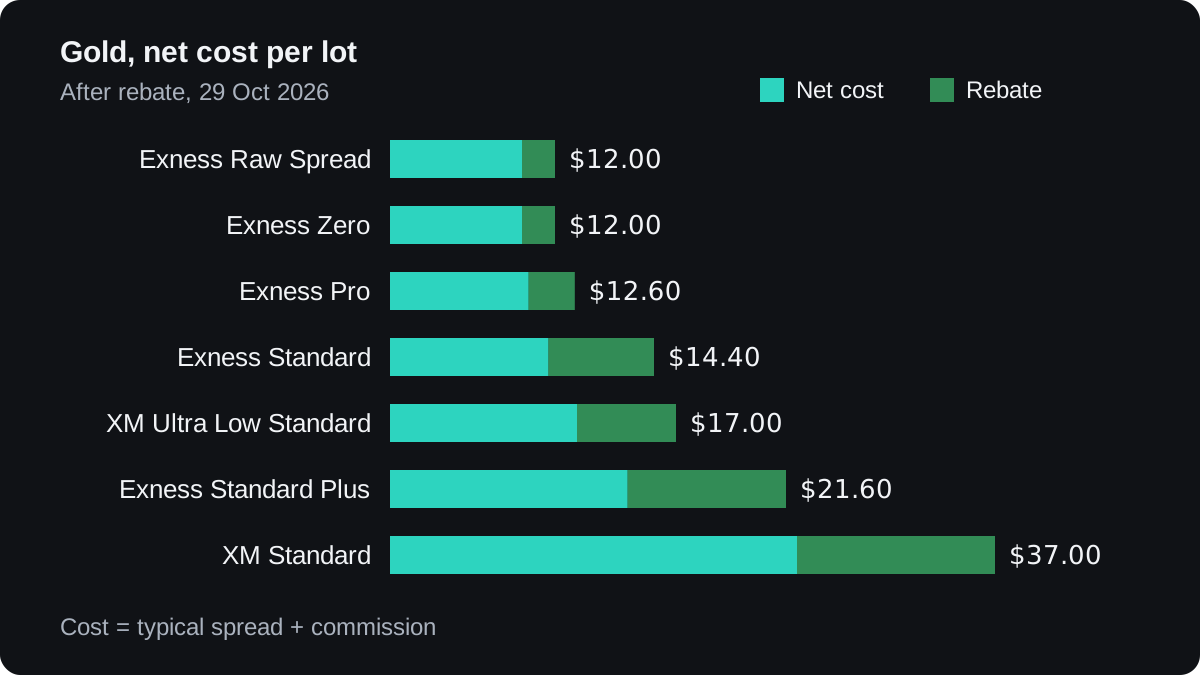
XM Standard pays the most back, $18 per lot, and still has the highest net cost. Exness Raw Spread and Zero pay $3 back and come out lowest.
For context, AutoFXRebate passes on 100% of the introducing commission at Exness and 90% at XM. The broker pays it straight into the trading account.
A worked comparison on EUR/USD
Here are the accounts without commission, at the 24-hour medians above and the rebates listed on 29 October 2026. A pip is $10 per lot.
| Account | Median spread | Cost per lot | Rebate | Net cost |
|---|---|---|---|---|
| Exness Pro | 0.6 pip | $6.00 | ≈ $1.50 | $4.50 |
| Exness Standard | 0.8 pip | $8.00 | ≈ $3.20 | $4.80 |
| Exness Standard Plus | 1.1 pips | $11.00 | ≈ $4.40 | $6.60 |
| XM Ultra Low Standard | 1.1 pips | $11.00 | $3.15 | $7.85 |
| XM Standard | 2.0 pips | $20.00 | $8.10 | $11.90 |
The ≈ marks rebates that Exness pays as a share of the spread, so they move with it. Raw Spread is left out because the source does not list its EUR/USD commission. Its rebate there is $0.87 per lot.
On this pair the net gap between the cheapest and dearest account is $7.40 per lot. At twenty lots a month, that is $148.
A short checklist
Before you decide, run through these in order. The trading costs cheat sheet keeps every formula on one page.
- Same symbol, same contract size, same account currency.
- Same time window, in your trading hours, using the median spread.
- Spread plus commission, in dollars per lot.
- Swap for the number of nights you usually hold.
- Net of any rebate, from the broker's or IB's own published rates.
- Then the things a price table cannot show: regulation, execution quality and withdrawals.
Questions
Why not compare the advertised spreads?
Advertised spreads are usually the lowest reading, often "from 0.0". Your trades pay the spread at the moment you trade, so the median over your hours is the fairer figure.
Should I pick the account with the biggest rebate?
Not on that alone. Compare the net cost per lot after the rebate. On gold, the largest rebate measured was on the account with the highest net cost.
How often do spreads and rebates change?
Spreads change every second, and the typical figure drifts over weeks. Rebate rates change when a broker changes its partner terms, so check again before you switch.
Where does the Spread Checker get its data?
It reads each broker's own MT5 servers, read-only, about every five minutes. The typical spread it shows is the median of the last 12 hours.
Keep learning
 Chapter 1How does commission per lot work in forex?Commission is a fixed fee per lot that raw and zero spread accounts charge on top of a thin spread. Brokers quote it per side, for opening or for closing, or per round turn, for both. To compare it with a spread, divide it by the pip value: $7 per lot on EUR/USD is 0.7 pip.
 Chapter 1What is swap in forex, and why is Wednesday triple?Swap, or rollover, is the interest you pay or earn for holding a forex position past 17:00 New York time. It comes from the gap between the two currencies' interest rates, plus the broker's markup. Most forex pairs charge three nights on Wednesday to cover the weekend.
 Chapter 1What is slippage in forex trading?Slippage is the difference between the price you expected and the price your order filled at. It happens when the market moves between your click and the execution, most often around news, the daily rollover and the weekly open. Market and stop orders can slip; limit orders fill at your price or better, but may not fill.
 Chapter 1Standard vs Raw spread account: which costs less?A standard account charges everything through a wider spread. A raw or zero account shows a spread close to the market's own and adds a commission per lot. Neither is cheaper by default. Convert both to dollars per lot on your symbol, subtract any rebate, and the cheaper one becomes clear.
 Chapter 1How much does one forex trade cost?The cost of one forex trade is the spread plus any commission plus any swap, each turned into money for your volume. Slippage can add to it and a rebate takes part of it back. A 0.5 lot EUR/USD trade at a 0.8 pip spread with no commission costs $4.00 before swap.
 Chapter 1Trading costs cheat sheet.Every forex trade pays some mix of spread, commission and swap, and can lose a little more to slippage. A rebate gives part of it back. This page puts the formulas, a table of measured spreads and one worked example in one place, with a link to the full lesson on each cost.

