What is slippage in forex trading?
Slippage is the difference between the price you expected and the price your order filled at. It happens when the market moves between your click and the execution, most often around news, the daily rollover and the weekly open. Market and stop orders can slip; limit orders fill at your price or better, but may not fill.
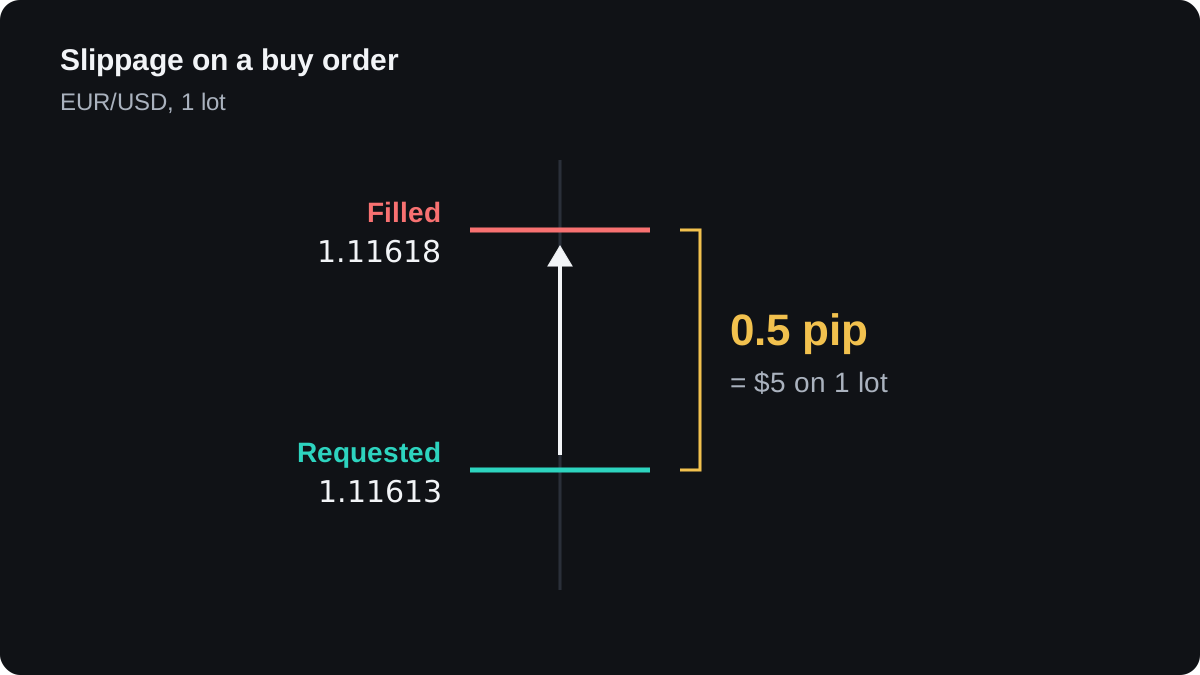
You click buy at 1.11613 and the trade opens at 1.11618. Half a pip went missing between your click and the fill.
That gap is slippage. Unlike the spread, you cannot see it on the quote before you trade.
What slippage is
Slippage is the difference between the price you requested and the price at which your order was filled. It is measured in pips, like the spread, and costs money the same way: pips × pip value × lots.
It can go both ways. Negative slippage fills you at a worse price and positive slippage at a better one. Traders tend to remember only the bad fills.
In the example above, 1.11618 - 1.11613 = 0.00005, which is 0.5 pip. On 1 lot of EUR/USD that is 0.5 × $10 = $5.
The 1.11613 ask is a real Exness Standard quote from 16:35 UTC on 29 October 2026. The fill price is illustrative.
Why orders slip
Forex prices change many times a second. Between your click and the broker filling the order, the best available price can move. The faster the market, the further it moves in that short window.
Liquidity matters as much as speed. Each price on offer has a limited volume behind it.
A large order can use up the volume at the best price and fill the rest at the next one, which is slippage too. A slow connection does not help either: it gives the price more time to move.
Market, limit and stop orders
The order type decides whether slippage can hurt you.
Market orders
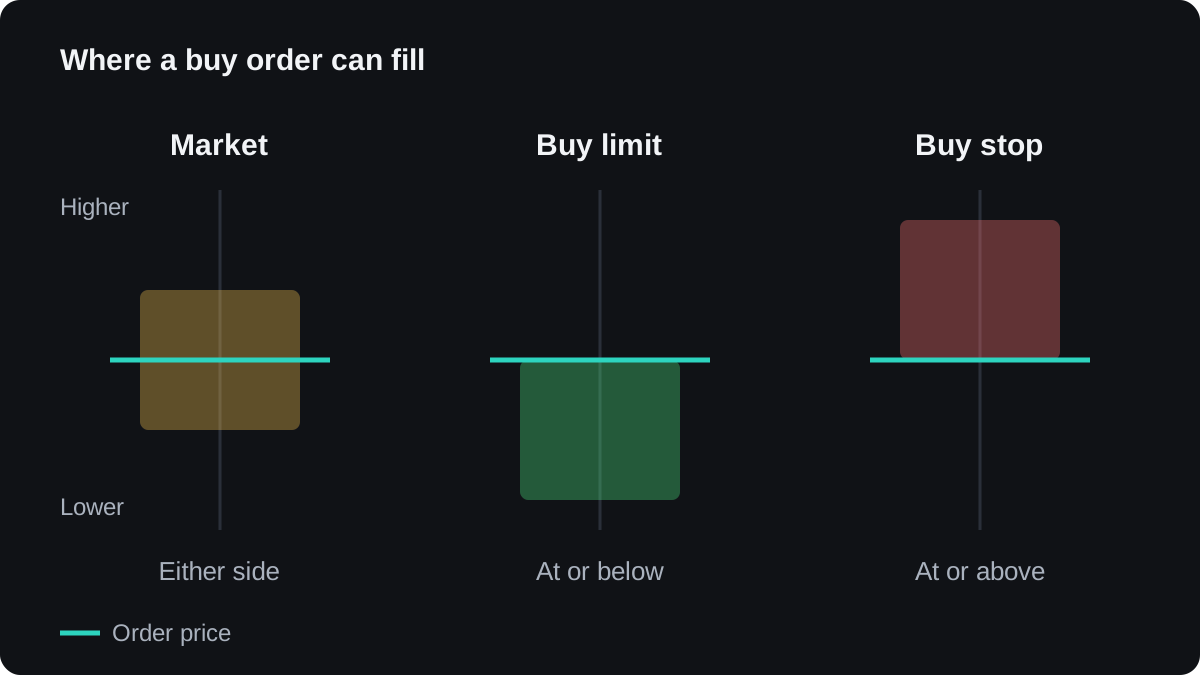
A market order says "fill me now". On a market execution account, sending the order means you accept the price the broker fills at, so it can slip either way.
On an instant execution account, MT5 has a Deviation setting: the largest price change you accept. If the price moves further, you get a requote instead of a fill.
Limit orders
A buy limit or sell limit fills at your price or better, so it has no negative slippage. The cost is certainty: if the price touches your level and runs away, the order may not fill at all.
Stop orders, including stop losses
A stop order becomes a market order when its price is reached. It then fills at the next available price, which can be worse than the stop level. Your stop loss is a stop order, so it can slip too.
When slippage is most likely
The moments that widen spreads also cause slippage, because both come from thin or fast markets.
- Major news releases. Prices can jump several pips between two quotes. The economic calendar shows when releases are due.
- The daily rollover, around 17:00 New York time. On 28 October 2026 the measured Exness Standard EUR/USD spread rose from 0.8 to as much as 4.7 pips in that hour, a sign of how thin the market was.
- The weekly open. The price on Sunday evening can open well away from Friday's close.
- Large orders, especially on less traded pairs or outside the main sessions.
You can see the rollover jump in the chart in what the spread is.
A worked example: a stop loss in a gap
All prices here are illustrative. You buy 1 lot of EUR/USD at 1.11450 with a stop loss at 1.11300, a planned risk of 15 pips.
The market closes on Friday at 1.11420. Unexpected news breaks over the weekend, and the market reopens on Sunday at 1.11200. The first price available is below your stop, so the stop fills there.
- Planned loss: 1.11450 - 1.11300 = 0.00150, or 15 pips × $10 = $150.
- Actual fill: 1.11200.
- Actual loss: 1.11450 - 1.11200 = 0.00250, or 25 pips × $10 = $250.
- Slippage: 25 - 15 = 10 pips, or $100 more than planned.
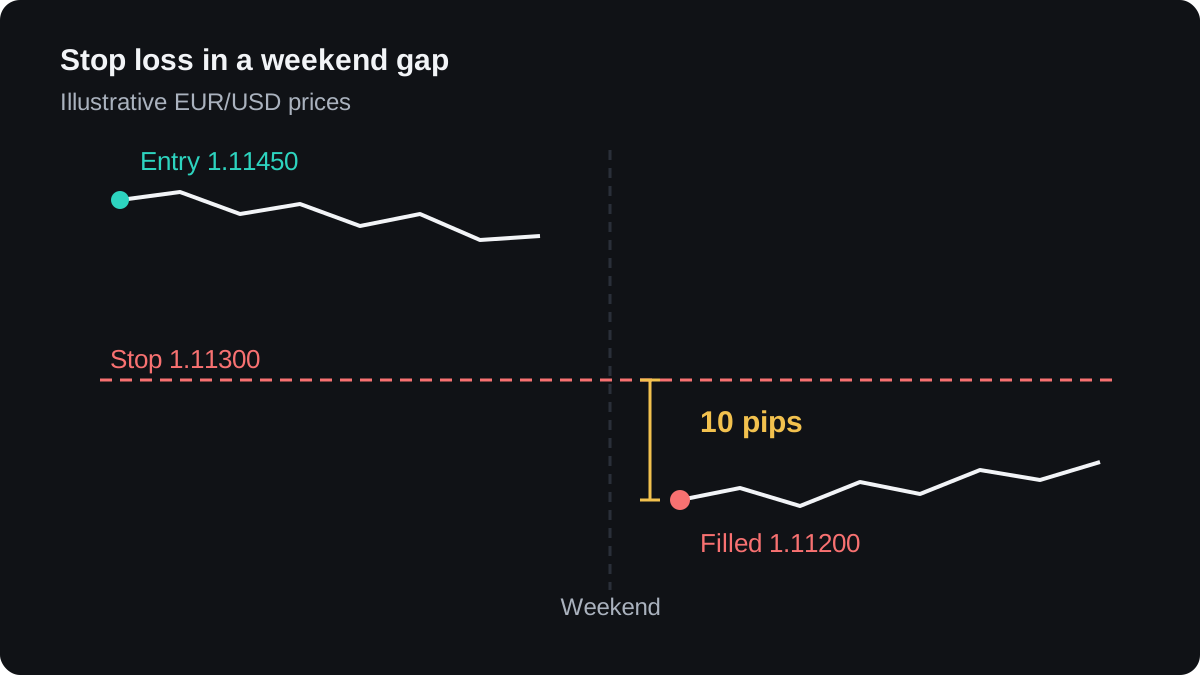
A stop loss limits the loss in normal markets. In a gap it fills at the next price, wherever that is. The profit/loss calculator lets you test a gap like this on your own pair and size.
How to keep slippage small
- Enter with a limit order when the exact price matters more than getting in.
- Avoid opening trades in the first minutes after major news and around the daily rollover.
- Check your trading hours on the Spread Checker. Hours with wide spreads are usually hours with thin liquidity.
- Split very large orders, or trade them in the busiest sessions.
- Compare requested and filled prices in your MT5 history from time to time. That is your real slippage.
Slippage is not part of the spread or the commission, and it does not change a rebate, which is counted per lot. It is still part of the cost of one trade.
Questions
Is slippage a sign that my broker is cheating?
Not by itself, since slippage is normal in fast markets. If you only ever get negative slippage, even in quiet hours, ask the broker about its execution.
Can a limit order slip?
A limit order fills at your price or better, so it has no negative slippage. It may not fill at all if the price moves away first.
Why did my stop loss fill worse than its price?
A stop becomes a market order when triggered and fills at the next available price. In a gap or a fast move, that price can be several pips past the stop.
What does the Deviation setting in MT5 do?
On instant execution accounts, Deviation is the largest price change you accept. If the price moves more than that, MT5 shows a requote instead of filling the order.
Keep learning
 Chapter 1How does commission per lot work in forex?Commission is a fixed fee per lot that raw and zero spread accounts charge on top of a thin spread. Brokers quote it per side, for opening or for closing, or per round turn, for both. To compare it with a spread, divide it by the pip value: $7 per lot on EUR/USD is 0.7 pip.
 Chapter 1What is swap in forex, and why is Wednesday triple?Swap, or rollover, is the interest you pay or earn for holding a forex position past 17:00 New York time. It comes from the gap between the two currencies' interest rates, plus the broker's markup. Most forex pairs charge three nights on Wednesday to cover the weekend.
 Chapter 1Standard vs Raw spread account: which costs less?A standard account charges everything through a wider spread. A raw or zero account shows a spread close to the market's own and adds a commission per lot. Neither is cheaper by default. Convert both to dollars per lot on your symbol, subtract any rebate, and the cheaper one becomes clear.
 Chapter 1How much does one forex trade cost?The cost of one forex trade is the spread plus any commission plus any swap, each turned into money for your volume. Slippage can add to it and a rebate takes part of it back. A 0.5 lot EUR/USD trade at a 0.8 pip spread with no commission costs $4.00 before swap.
 Chapter 1How do you compare trading costs between brokers fairly?To compare brokers fairly, use the same symbol, the same time window and the typical (median) spread, not the advertised minimum. Add commission, turn everything into dollars per lot, and include swap if you hold overnight. Then subtract any rebate to see the net cost you actually pay.
 Chapter 1Trading costs cheat sheet.Every forex trade pays some mix of spread, commission and swap, and can lose a little more to slippage. A rebate gives part of it back. This page puts the formulas, a table of measured spreads and one worked example in one place, with a link to the full lesson on each cost.

