 Glossary · How do you trade forex?
Market order
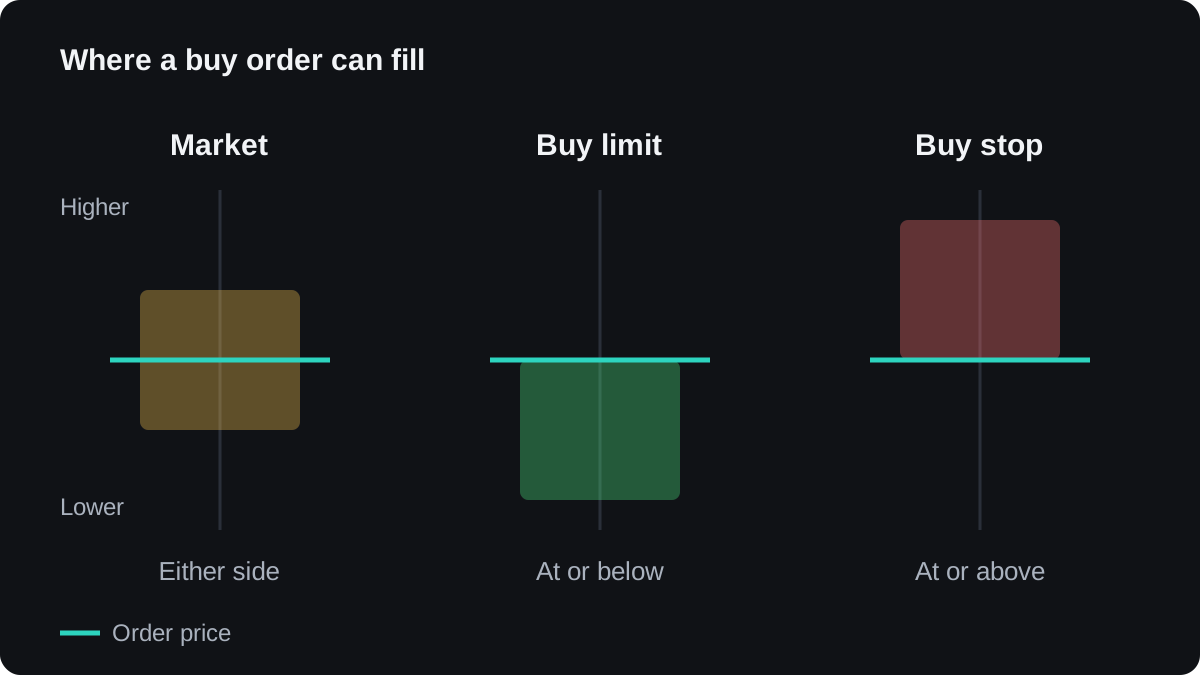
A market order is an instruction to buy or sell straight away at the best price available. A buy fills at the ask and a sell at the bid. You get a fast fill but not a guaranteed price, so in a fast market the fill can slip.
Clicking Buy or Sell in your platform sends a market order. You are asking for a trade now, at whatever price the market offers.
The slippage lesson compares market orders with limit and stop orders.
How a market order fills
A market buy fills at the ask price, the higher side of the quote. A market sell fills at the bid. You do not set a price; you accept the next one available.
If the price moves between your click and the fill, the trade opens somewhere else. That difference is slippage, and it can go for or against you.
On instant execution accounts, MetaTrader lets you set a maximum deviation. If the price moves further, you get a requote instead of a fill. On market execution accounts, the order fills at the broker's price.
A worked example
Prices are illustrative. EUR/USD shows 1.10000 bid and 1.10008 ask. You send a market order to buy 1 lot and expect 1.10008.
The market jumps, and the order fills at 1.10010. That is 0.2 pip of slippage, worth 0.2 × $10 = $2 on 1 lot. Had you sold instead, you would have filled near the bid of 1.10000.
When a set price matters more than speed, use a pending order such as a limit.
Questions
What is the difference between a market order and a limit order?
A market order fills now at the next available price. A limit order waits for your price or better, so it may never fill.
Can a market order be rejected?
Yes. It can be rejected when free margin is too low or the market is closed, and on instant execution a requote replaces the fill when price moves past your deviation.
Leverage multiplies losses as well as gains; only trade money you can afford to lose.
More terms in this chapter
 Bid priceThe bid price is the price at which you can sell a currency pair right now. It is the lower of the two prices in every forex quote. You open a sell trade at the bid, and you close a buy trade at the bid.
 PipA pip is the standard unit for measuring a change in a forex price. On most currency pairs it is 0.0001, the fourth decimal place, and on pairs quoted in Japanese yen it is 0.01. One tenth of a pip is called a pipette.
 PipetteA pipette is one tenth of a pip, shown as the extra last digit of most forex quotes. On EUR/USD it is 0.00001, the fifth decimal, and on yen pairs such as USD/JPY it is 0.001. Traders also call it a fractional pip.
 Pip valuePip value is the amount of money a one pip move adds to or takes from a position. It equals the pip size times the units traded, counted in the quote currency. On one standard lot of EUR/USD in a US dollar account it is $10.
 LotA lot is the standard unit of trade size in forex. One standard lot is 100,000 units of the base currency, a mini lot is 10,000 and a micro lot is 1,000. MetaTrader shows these sizes as volumes of 1.00, 0.10 and 0.01.
 Stop lossA stop loss is an order that closes your trade at a set price to cap the loss. It turns into a market order when price reaches it, so in a fast market or a gap it can fill at a worse price.
Related terms