How is the forex market structured?
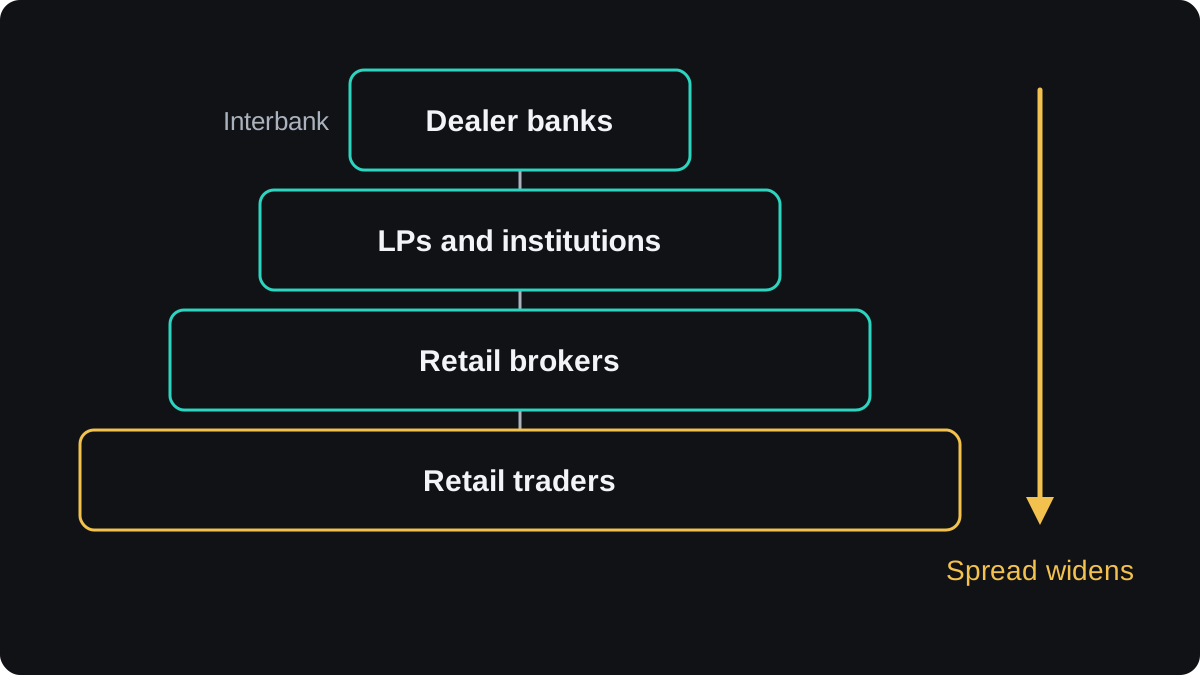
Forex has no central exchange. It is an over-the-counter market: large dealer banks trade with each other at the top, liquidity providers and institutions deal with those banks, and retail brokers connect individual traders at the bottom. With no shared venue there is no single official price, and each layer down usually pays a slightly wider spread.
Ce contenu n'existe pour l'instant qu'en anglais.
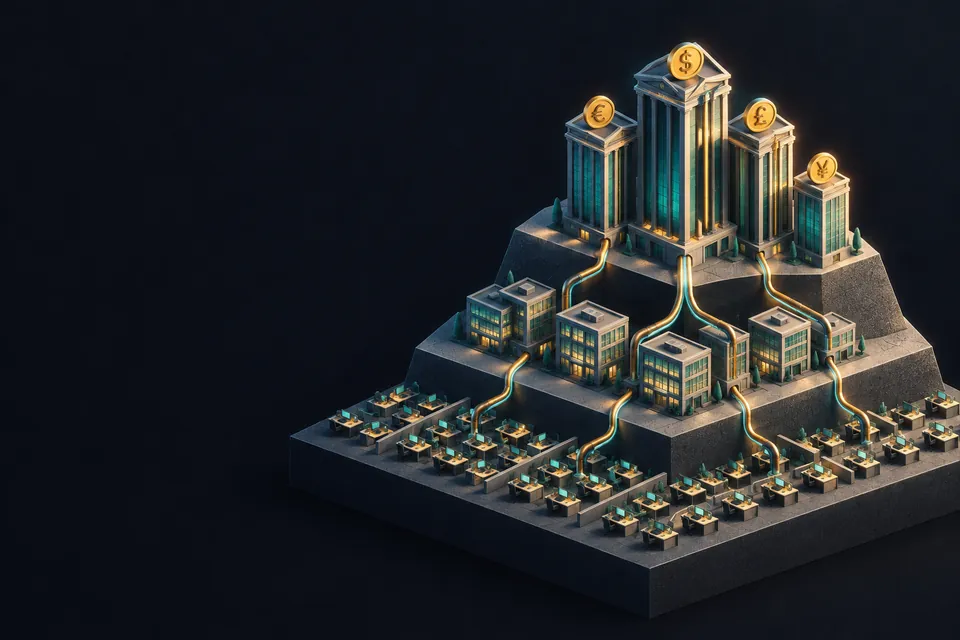
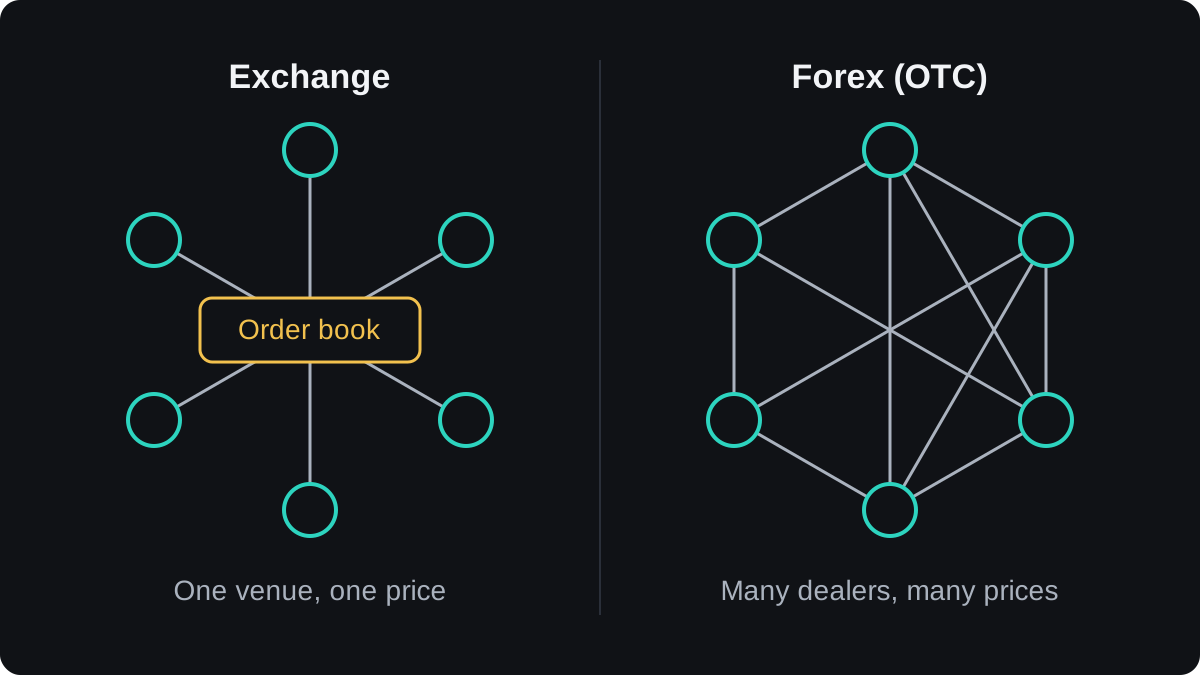
When you buy a share in a listed company, your order goes to a stock exchange, where it meets other orders in one central book. Currencies do not work like that. No single exchange collects every forex deal.
Banks, funds, brokers and traders deal with each other directly, through a chain of business relationships. The chain runs from a small group of large dealer banks at the top down to your trading account.
Why does forex have no central exchange?
Forex is an over-the-counter (OTC) market: two parties agree a trade directly, and the deal is a private contract between them. No exchange stands in the middle to match orders or publish an official price.
Each firm chooses whom it will trade with, and on what terms.
The market grew out of banks paying for international trade on behalf of their customers. It formed as a network of banks dealing by telephone, and later through screens, so no exchange ever sat in the middle.
Currency futures are the exception. They trade on exchanges with a central order book, and the forex vs futures lesson compares the two.
On an exchange, every participant connects to the same order book. In spot forex, each firm connects only to the firms it has chosen to deal with.
Who sits at the top of the forex market?
At the top is a group of large dealer banks. A dealer quotes a bid and an ask to other firms and stands ready to trade at those prices.
Trading between these banks is called the interbank market. They deal with each other directly, through interdealer brokers who match banks anonymously, and on electronic platforms built for dealers.
Trade sizes here are large, and in busy hours the spread on a major pair such as EUR/USD can be a fraction of a pip.
Access rests on credit. Most spot trades settle two business days after they are agreed, so each side trusts the other to deliver the money.
For that reason, two banks deal only when each has set a credit limit for the other.
Settlement is one place where the market does have shared plumbing. Many large trades in major currencies settle through CLS, a system that releases both currencies at the same time so neither side pays without being paid.
Who trades in the middle tier?
Below the dealer banks sits a wide group of large firms:
- Non-bank market makers, electronic trading firms that quote prices to others using their own capital.
- Smaller and regional banks.
- Hedge funds and asset managers.
- Companies that need foreign currency to pay suppliers or bring profits home.
A smaller firm can reach many dealers through prime brokerage. A large bank lends the firm its name and credit, so other dealers trade as if facing that bank, and the bank charges a fee.
Some firms also use multi-dealer platforms, where several dealers compete to fill the same request.
Any firm that streams tradable prices to others is called a liquidity provider (LP). Dealer banks and non-bank market makers are both LPs. The next lesson on market participants looks at each group in turn.
Where do retail brokers and traders fit?
A retail trade is tiny by these standards. A 0.01 lot of EUR/USD is 1,000 euros, far below the sizes dealers quote to each other.
A retail broker bridges that gap. It collects prices from several LPs, combines them into one feed, adds its markup and streams the result to your platform.
When you trade, the broker passes your order on to an LP, takes the other side itself, or does some of each. The A-book and B-book lesson explains those models.
Either way, your contract is with your broker. You never trade in the interbank market yourself, and the price you see is your broker's price, built on the prices it receives.
Where your broker's prices come from follows that feed step by step.
Put together, the market looks like a ladder with four rungs. Each rung down trades smaller amounts and usually pays a wider spread than the one above.
How does the spread grow down the chain?
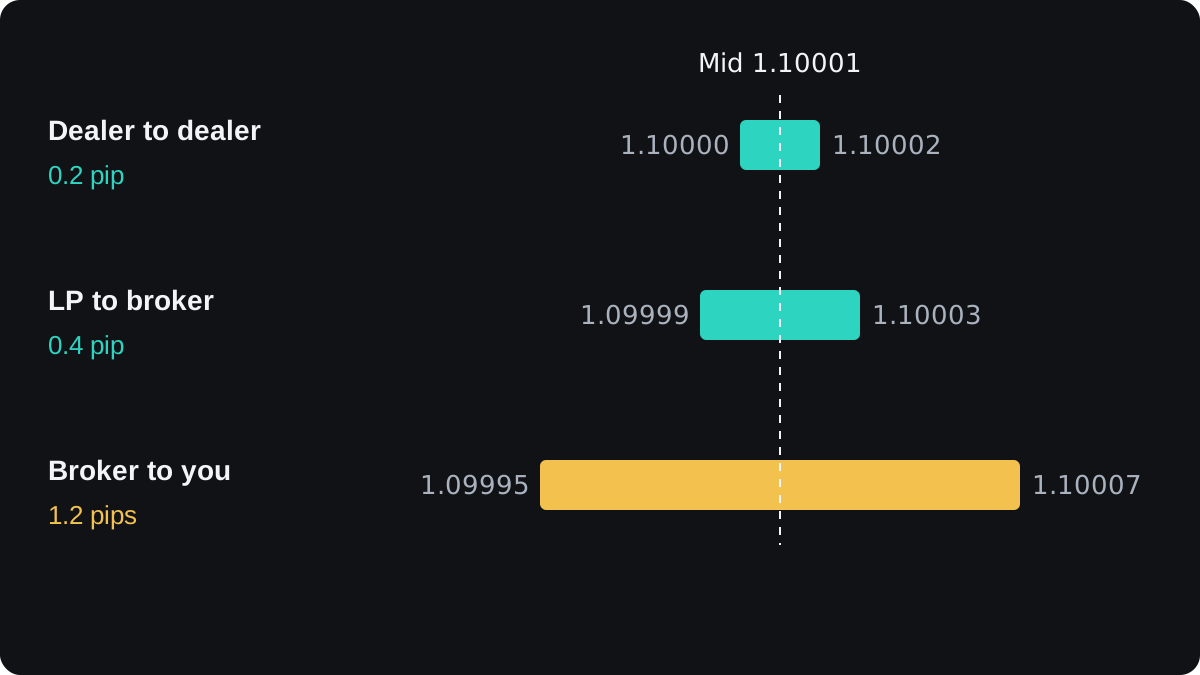
Each layer has costs and wants to earn something, so prices usually widen a little at every step. The numbers below are illustrative, chosen to show the mechanism on EUR/USD.
| Layer | Bid | Ask | Spread |
|---|---|---|---|
| Dealer to dealer | 1.10000 | 1.10002 | 0.2 pip |
| LP to broker | 1.09999 | 1.10003 | 0.4 pip |
| Broker to you | 1.09995 | 1.10007 | 1.2 pips |
Here is what that means for your trade in a US dollar account, assuming prices do not move while you are in it:
- Your spread is 1.10007 minus 1.09995 = 0.00012. A pip on EUR/USD is 0.0001, so that is 1.2 pips.
- On one standard lot of 100,000 euros, a pip is worth $10. The spread costs 1.2 × $10 = $12 for a round trip.
- On 0.10 lot the same spread costs 1.2 × $1 = $1.20.
- Suppose the broker covers every trade with its LP. You buy at 1.10007 and the broker buys from the LP at 1.10003, keeping 0.4 pip.
- You later sell at 1.09995 and the broker sells to the LP at 1.09999, keeping another 0.4 pip.
- That is 0.8 pip in total, or 0.8 × $10 = $8 on one lot, the broker's gross income from the markup. The other 0.4 pip, $4, is the LP's spread, which the broker paid.
Drawn on one price scale, all three quotes share the same middle price of 1.10001. Only the width of the gap changes.
Real spreads vary by pair, time of day and broker, and they widen in quiet hours and around news. The spread lesson covers those causes.
Some accounts show a spread close to the LP's and charge a commission per lot instead. That changes how the broker is paid, while you still pay for the layers above you.
What does a decentralised market mean for you?
The first effect is that there is no single correct price. At the same moment, one broker might quote EUR/USD at 1.09995 and 1.10007 while another shows 1.09997 and 1.10006, a spread of 0.9 pip.
Both are real quotes, built from different groups of LPs and different markups.
The market also runs around the clock on weekdays. With no exchange to open or close, activity passes between financial centres, from Monday morning in the Asia-Pacific region to Friday afternoon in New York.
The trading sessions lesson maps those hours. London has been the largest trading centre in recent central bank surveys.
Nobody sees total volume in real time. The best picture comes from a survey of dealers that central banks run every three years through the Bank for International Settlements, covered in the market size lesson.
The volume bar on your platform usually counts price updates in your broker's own feed, which is a much narrower measure than the market's turnover.
No single global regulator oversees forex either. Each country licenses the firms in its own territory, so your protections depend on where your broker is licensed.
How to check a licence shows where to look. Many large dealers have also signed up to the FX Global Code, a voluntary set of conduct principles.
Questions fréquentes
Is forex traded on an exchange?
Spot forex is not. It is an over-the-counter market where firms trade directly with each other. Currency futures are the exception, since they trade on exchanges.
What is the interbank market?
It is the top tier of forex, where large dealer banks quote prices to each other and trade in large sizes. Spreads there are the tightest in the market.
Do retail traders trade in the interbank market?
No. Your trade is a contract with your broker, which may pass it to a liquidity provider or keep it. The broker's price is built from the prices those providers send it.
Why do two brokers show different prices for the same pair?
Each broker gets prices from its own group of liquidity providers and adds its own markup. With no central exchange, there is no single official price to copy.
Continuer à apprendre
 Chapitre 4Who are the main players in the forex market?The forex market's main players are dealer banks and non-bank liquidity providers, which quote prices, plus central banks, funds, companies and retail traders. Each trades for its own reason: dealers earn the spread, central banks pursue policy, companies hedge real payments, funds invest or speculate, and retail traders speculate in small sizes through brokers.
 Chapitre 4How did retail forex trading begin?Retail forex began in the late 1990s, when internet brokers started offering currency trading to individuals. Before that, currencies were traded mainly between banks and large firms in amounts of millions. Floating exchange rates from 1973, electronic dealing, small lot sizes and leverage made it possible to trade 1,000 units from a home computer, and later a phone.
Courtiers partenaires

