Who are the main players in the forex market?
The forex market's main players are dealer banks and non-bank liquidity providers, which quote prices, plus central banks, funds, companies and retail traders. Each trades for its own reason: dealers earn the spread, central banks pursue policy, companies hedge real payments, funds invest or speculate, and retail traders speculate in small sizes through brokers.

When you buy a currency pair on your phone, you join a market where the other traders include central banks and the treasury desks of global companies. They all trade the same currencies, each for a different reason.
Knowing who these players are, and why they trade, helps you understand who sets the prices you see and what can make them jump.
The previous lesson on how the forex market is structured showed its layers. This one puts names and motives on the firms and people inside them.
Who makes the prices in forex?
Prices start with firms that are willing to buy and sell at any moment. These are the market makers: they quote a bid, the price they pay, and an ask, the price they charge, at the same time.
Dealer banks
A dealer bank is a large bank that makes markets in currencies for its clients and for other banks. A fairly small group of global banks handles much of this business.
The bank earns the gap between its two prices, the spread, as long as the price does not move against it before it can offset the deal.
Say a bank quotes EUR/USD at 1.10000 bid and 1.10010 ask, a spread of 1 pip. These are round illustrative prices.
- Client A sells 10,000,000 euros to the bank at the bid, 1.10000. The bank pays $11,000,000.
- Minutes later, Client B buys 10,000,000 euros at the ask, 1.10010. The bank receives $11,001,000.
- The bank's euro holding is back to zero, and it keeps $11,001,000 minus $11,000,000 = $1,000.
- Check it in pips: 0.00010 × 10,000,000 = $1,000.
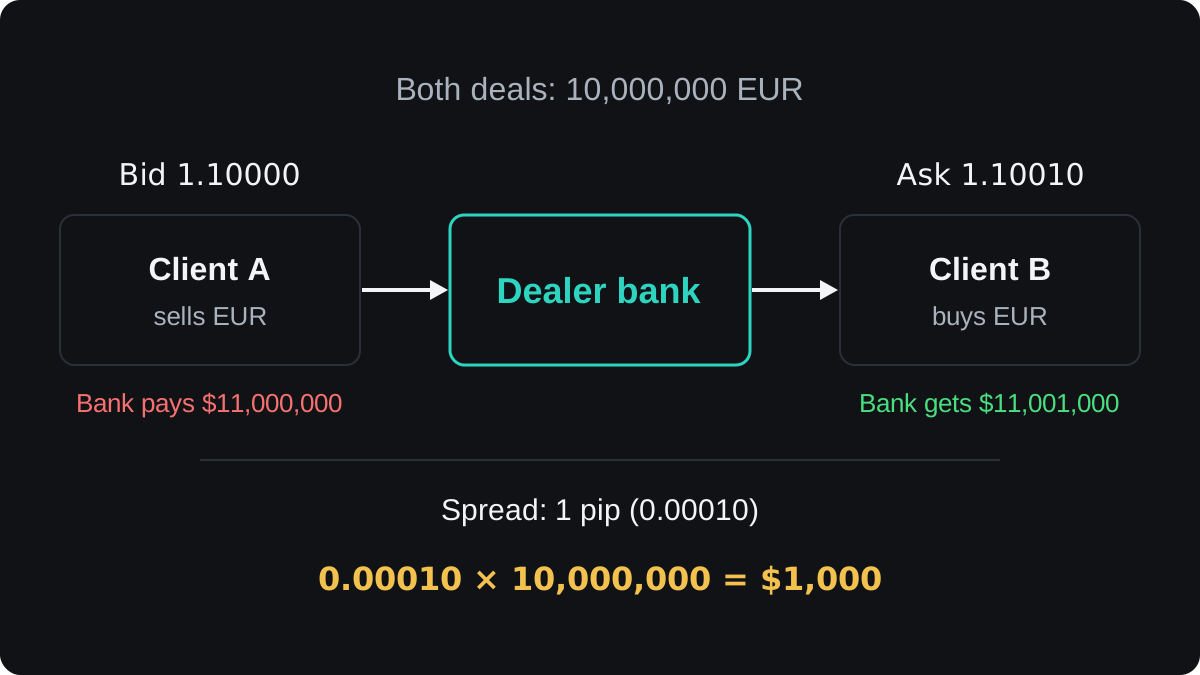
The risk sits between steps 1 and 2. If the price fell 5 pips while the bank held those euros, it would lose 0.00050 × 10,000,000 = $5,000, as much as the spread earns on five such round trips.
Non-bank liquidity providers
Since currency trading moved onto electronic platforms, specialist trading firms that are not banks also quote prices. They are called non-bank liquidity providers, and they use computer models to update their quotes very quickly.
A liquidity provider of either kind usually has no duty to keep quoting. In a sudden shock, some pull back or widen their spreads, which is one reason spreads jump around big news.
Many retail brokers take prices from a mix of banks and these firms. The lesson on where your broker's prices come from follows that path step by step.
Why do central banks trade currencies?
A central bank manages a country's money. It rarely trades for profit, and its currency deals usually support a policy goal such as stable prices or a stable exchange rate.
Most of its effect on forex comes through interest rates. When a central bank raises its rate, holding that currency tends to pay more, which can attract buyers. The lesson on interest rates and currencies explains the link.
Central banks also hold foreign exchange reserves, large pools of other currencies, and adjust them over time. Now and then a central bank buys or sells its own currency directly to push the rate, which is called currency intervention.
For a retail trader, the practical difference is timing. Rate decisions are scheduled and appear on the economic calendar, while intervention often comes with little or no warning and can move a pair sharply within minutes.
What do funds and asset managers want?
Funds trade currencies for two quite different reasons: investing abroad and betting on price moves.
An asset manager, such as a pension fund or an insurer, that buys foreign shares or bonds must first buy the foreign currency. A fund in Japan buying US bonds sells yen and buys dollars.
Many asset managers also hedge part of that currency exposure, which means more currency deals later.
A hedge fund is an investment fund that takes active positions to profit from price moves. Its currency trades follow a view on the economy or a computer model, so they can be closed quickly when that view changes.
Sovereign wealth funds, investment funds owned by a state, also move large sums across borders, usually with a long horizon.
Large funds often split a big order into smaller pieces over hours or days, so their buying or selling does not push the price against them all at once.
How do companies use the forex market?
Companies trade currencies because their business needs them. An exporter is paid in foreign money, and an importer pays foreign suppliers.
Most companies care more about certainty than about profiting from the rate. So they hedge: they fix a future exchange rate today with a forward contract from their bank. The lesson on ways to trade forex explains forwards.
A company in Germany sells machines to a US buyer and will be paid $1,000,000 in three months. Its costs are in euros, so it needs to know how many euros it will receive.
- Today EUR/USD is 1.10000. The bank offers a three month forward at 1.10500. A forward rate differs a little from today's rate because of the interest rate gap between the two currencies.
- With the forward, the company receives $1,000,000 ÷ 1.10500 = €904,977, whatever happens to the rate.
- Without a hedge, if EUR/USD rises to 1.15000, it receives $1,000,000 ÷ 1.15000 = €869,565. That is €35,412 less than the forward.
- If EUR/USD falls to 1.06000 instead, the unhedged company receives $1,000,000 ÷ 1.06000 = €943,396. That is €38,419 more than the forward.
All rates are illustrative, and the euro amounts are rounded to the nearest euro.
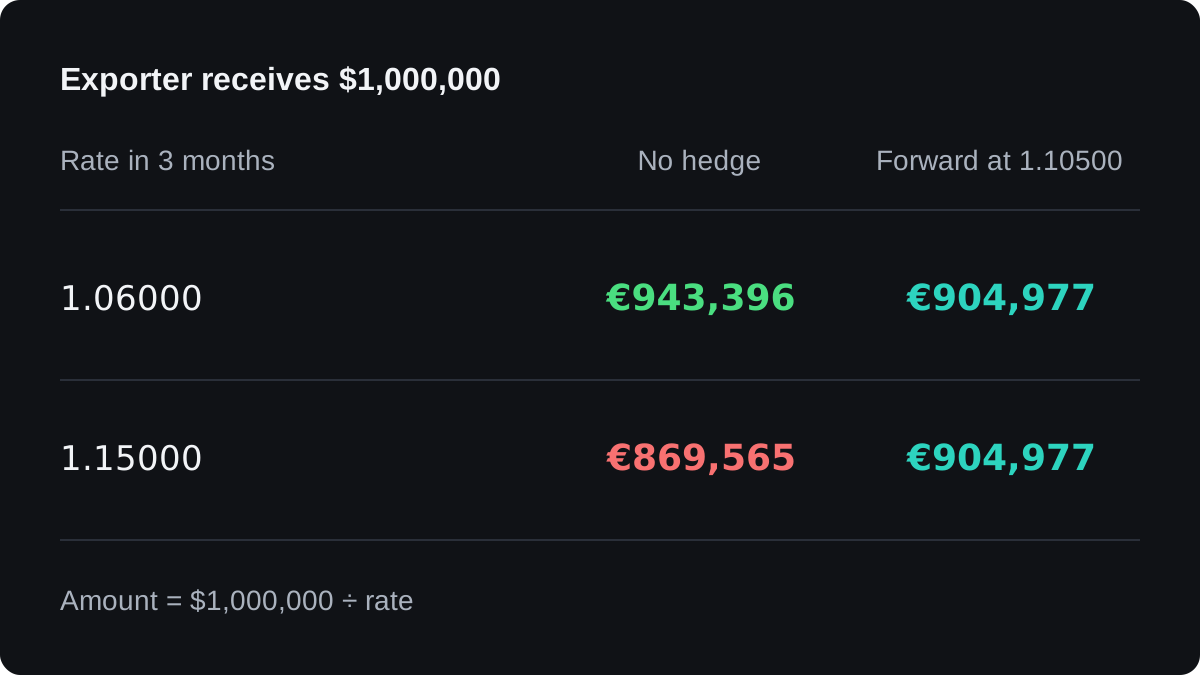
The company gave up a possible gain to remove a possible loss. A speculator wants the reverse, so a hedger and a speculator can easily sit on opposite sides of the same deal.
Company payments tend to bunch around certain dates, such as the end of a month, when many invoices fall due.
Where do retail traders fit?
A retail trader is an individual trading their own money through a broker, usually with leverage and in small sizes. A 0.10 lot of EUR/USD is 10,000 euros, one thousandth of the bank deal in the first example.
Retail trading is a small slice of total forex turnover. One retail order does not move a major pair, so you take the prices that larger players set.
Your broker decides what happens to your order. It may pass the order to a liquidity provider, or keep it and net it against other clients' orders, which is called internalisation.
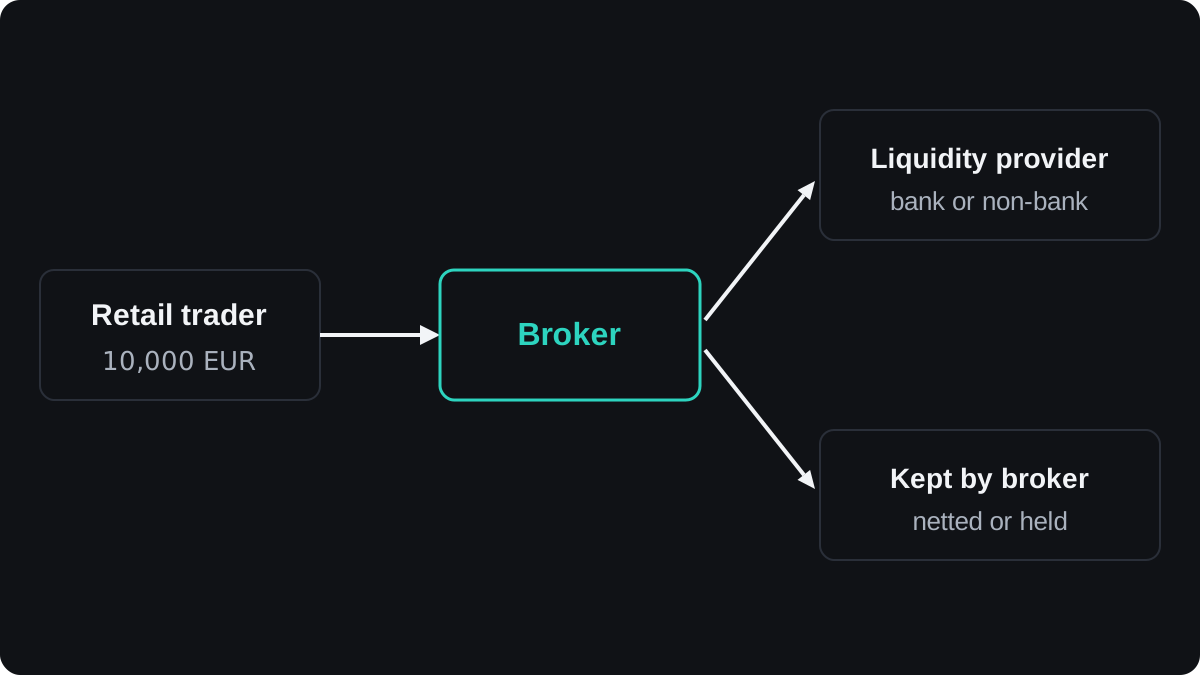
The lesson on who is on the other side of your trade covers both routes in detail.
This chain explains why your cost is usually higher than the prices banks quote each other: the broker adds a markup to the spread or charges a commission.
When liquidity providers widen their quotes around news, your broker's spread widens too.
Retail forex as an industry is fairly young, and it grew with online trading platforms. The next lesson covers how retail forex trading began.
Questions
Who controls the forex market?
No single player sets prices in a freely floating currency. Dealer banks and non-bank liquidity providers quote most prices, and central banks influence rates through policy, intervention or, for some currencies, a fixed peg.
Do banks trade against retail traders?
Most retail traders never deal with a bank directly. Your broker is usually your counterparty, and it may keep your trade or pass it to a bank or non-bank liquidity provider.
What is a liquidity provider in forex?
A liquidity provider is a firm that stands ready to buy and sell a currency pair by quoting both a bid and an ask. Dealer banks and specialist electronic trading firms both do this.
Can retail traders move currency prices?
A single retail order is far too small to move a major pair. Retail orders can matter when added together, which is why some brokers publish data on how their clients are positioned.
Why do companies trade forex if they do not want to speculate?
They need foreign currency to pay suppliers or to receive payment from customers abroad. Many hedge with forwards to fix the rate in advance, so their costs and revenue are known.
Keep learning
 Chapter 4How is the forex market structured?Forex has no central exchange. It is an over-the-counter market: large dealer banks trade with each other at the top, liquidity providers and institutions deal with those banks, and retail brokers connect individual traders at the bottom. With no shared venue there is no single official price, and each layer down usually pays a slightly wider spread.
 Chapter 4How did retail forex trading begin?Retail forex began in the late 1990s, when internet brokers started offering currency trading to individuals. Before that, currencies were traded mainly between banks and large firms in amounts of millions. Floating exchange rates from 1973, electronic dealing, small lot sizes and leverage made it possible to trade 1,000 units from a home computer, and later a phone.

