How did retail forex trading begin?
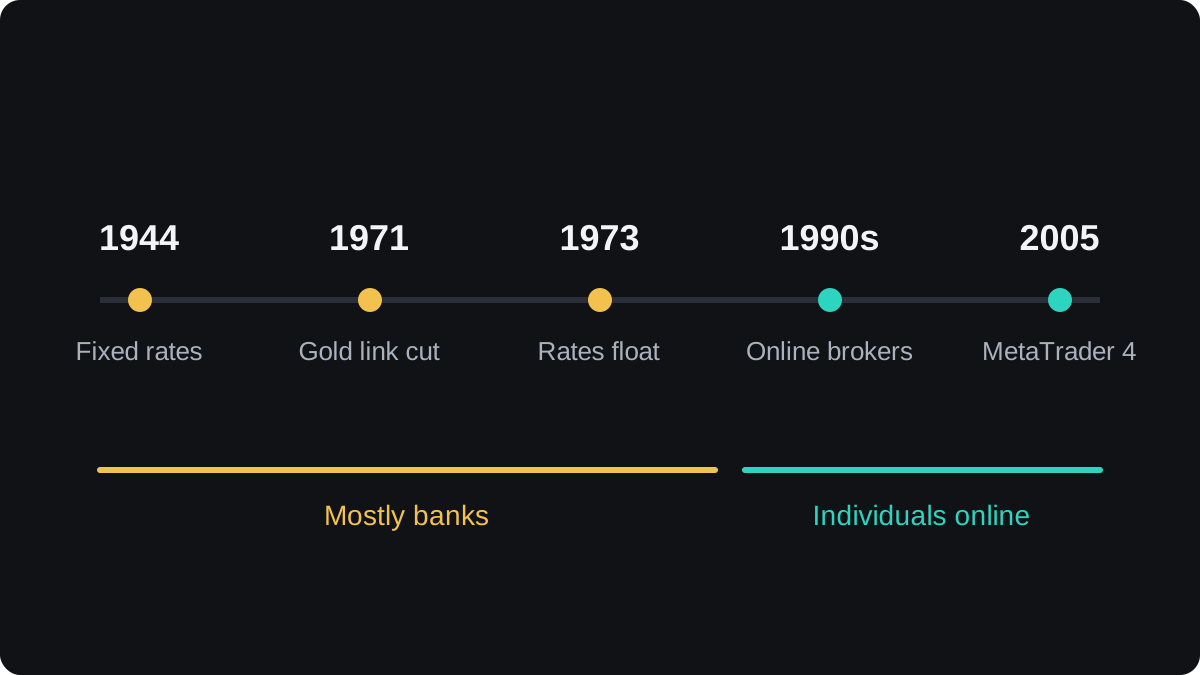
Retail forex began in the late 1990s, when internet brokers started offering currency trading to individuals. Before that, currencies were traded mainly between banks and large firms in amounts of millions. Floating exchange rates from 1973, electronic dealing, small lot sizes and leverage made it possible to trade 1,000 units from a home computer, and later a phone.

Until the 1990s, an ordinary person could swap cash at a bank before a holiday, but trading currencies for profit was mostly work for banks and large firms. Today you can open a position on EUR/USD from a phone with a small deposit.
That change came in stages. The lesson on market players covered who trades forex now, and this one traces how individual traders got in.
What did the currency market look like before 1971?
After the Second World War, most major currencies were fixed to the US dollar under the Bretton Woods system, agreed in 1944. Foreign governments could, in turn, exchange dollars for gold at $35 an ounce.
Fixed rates moved only inside narrow bands, and a bigger change needed a government decision. With little day-to-day movement, there was far less to speculate on than today.
Currency dealing was mostly banks moving money for clients who traded goods or invested abroad. Dealers agreed trades by telephone and telex, in amounts far beyond any household budget.
How did floating exchange rates create a trading market?
In August 1971 the United States suspended the conversion of dollars into gold. Attempts to rebuild fixed rates did not last, and by 1973 the major currencies were floating, with prices set by supply and demand.
A floating rate changes all day. Companies now carried currency risk they had to manage, and banks began quoting and trading currencies actively, so the interbank market grew.
Individuals got a new, limited route in 1972, when the Chicago Mercantile Exchange launched currency futures. These contracts came in fixed, fairly large sizes and traded through futures brokers, so most small savers stayed out.
How did technology bring forex to individuals?
Through the 1980s and 1990s, banks moved much of their dealing from telephones to screens. Systems from Reuters, and later EBS, let dealers see prices and trade electronically.
In the second half of the 1990s, the internet made a new business possible. Firms began offering currency trading to individuals through websites and downloadable software, showing their own prices on screen.
Trading software then became standardised. MetaTrader 4, released by MetaQuotes in 2005, was licensed by many brokers, so a trader could change broker without learning a new platform.
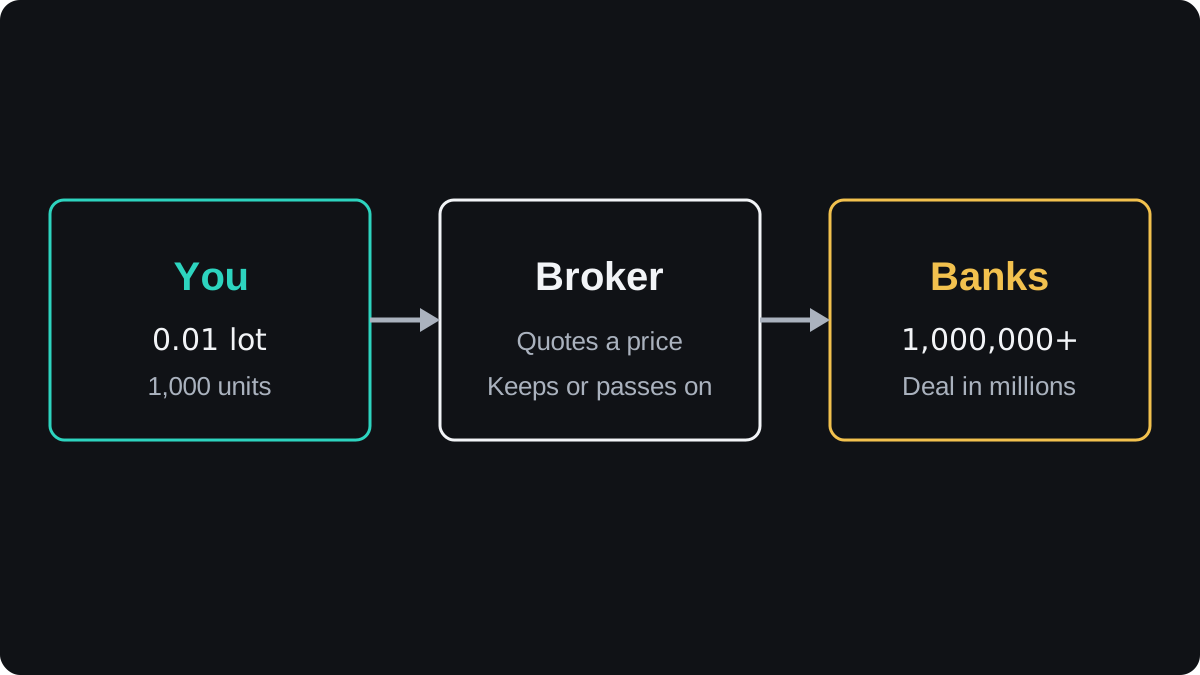
The firms that grew from this are retail forex brokers. A broker takes your small order and quotes you a price, then either keeps the other side of the trade or passes the risk on to banks.
The lesson on who is on the other side of your trade explains both models in detail.
What made small trades possible?
Banks commonly deal in millions of the base currency. A broker can offer much smaller sizes because it groups many client orders together, or offsets buyers against sellers, before it deals with a bank.
Brokers settled on fixed sizes. A standard lot is 100,000 units of the base currency, a mini lot is 10,000 and a micro lot is 1,000, shown as 0.01 lot on most platforms.
Here is the gap in numbers, using an illustrative EUR/USD price of 1.10000:
- A bank deal of 1,000,000 euros has a notional of 1,000,000 × 1.10000 = $1,100,000.
- Each pip on that deal is 0.0001 × 1,000,000 = $100.
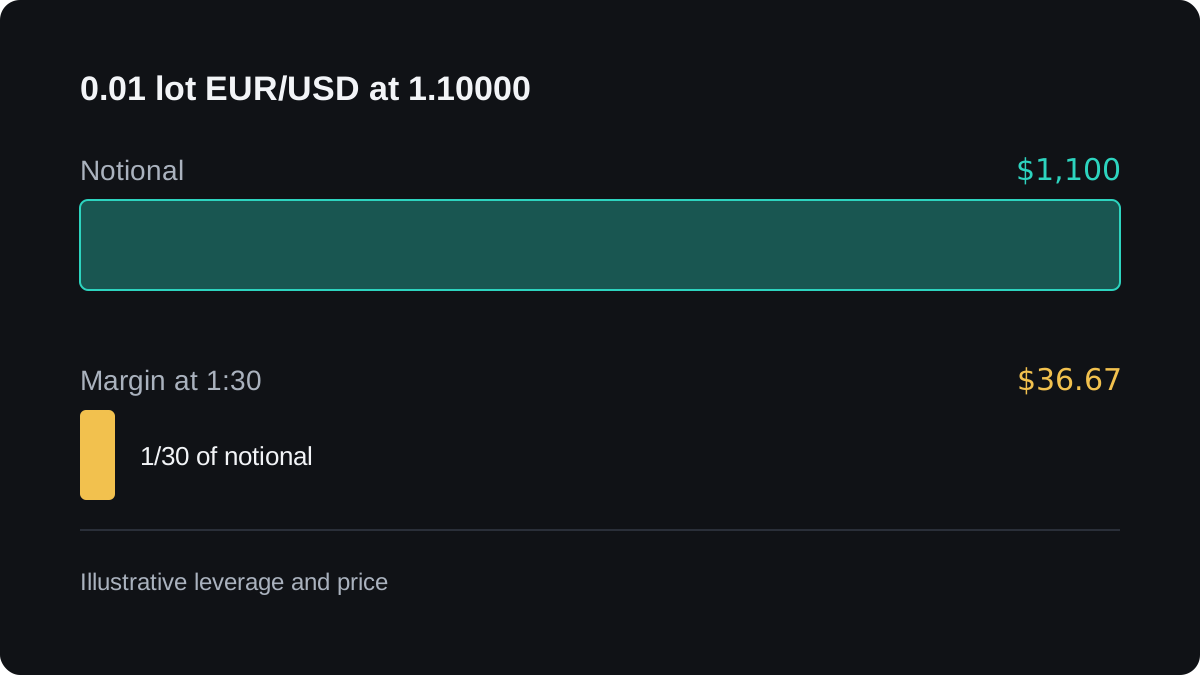
- One micro lot is 1,000 euros, a notional of 1,000 × 1.10000 = $1,100.
- Each pip on the micro lot is 0.0001 × 1,000 = $0.10.
- The micro lot is 1,000,000 ÷ 1,000 = 1,000 times smaller than the bank deal.
| Trade size | Units of EUR | Notional at 1.10000 | Value of 1 pip |
|---|---|---|---|
| Bank deal of 1 million | 1,000,000 | $1,100,000 | $100.00 |
| 1 standard lot | 100,000 | $110,000 | $10.00 |
| 1 mini lot (0.10) | 10,000 | $11,000 | $1.00 |
| 1 micro lot (0.01) | 1,000 | $1,100 | $0.10 |
Even $1,100 is a lot to commit to one trade. Brokers also offered leverage: you put up a fraction of the notional as margin, and the position controls the full amount.
At an illustrative leverage of 1:30, one micro lot of EUR/USD at 1.10000 needs $1,100 ÷ 30 = $36.67 of margin. Leverage limits differ by country and broker, so check your own account terms.
The same leverage magnifies losses. A 100 pip move against that micro lot costs 100 × $0.10 = $10, more than a quarter of the $36.67 margin. The margin calculator repeats this sum for other pairs and sizes.
What went wrong as retail forex grew?
Easy access also attracted bad actors. Some early firms worked without a licence or refused to pay out withdrawals, and fraud cases pushed regulators to act.
From the 2000s, regulators in several major markets introduced rules for retail forex firms. These covered capital, the handling of client money and, in many places, maximum leverage.
You can check a broker's licence on the regulator's public register.
On 15 January 2015, the Swiss National Bank dropped its minimum rate of 1.20 francs per euro, and the franc rose sharply within minutes.
Many stop losses could not be filled near their levels, because almost no prices traded in between. Some traders ended with negative balances, and at least one retail broker went into administration.
In 2018, ESMA, the EU securities regulator, brought in measures for retail CFD trading, which covers most retail forex in the EU. They limited leverage and required negative balance protection.
Negative balance protection means a retail client cannot lose more than the money in the account. The same measures made brokers display the share of their retail accounts that lose money, a figure worth reading before you open an account.
What does retail access look like today?
You can now open an account online, fund it with a small sum and trade from a phone. Your broker supplies the prices, sourced from banks and other liquidity providers or set by the broker itself.
Most retail forex is a cash-settled contract with a broker, such as a CFD or a rolling spot position. No currency is delivered to you, as the lesson on ways to trade forex explains.
Wider access left the arithmetic unchanged. A small trader pays a spread on every trade and faces the same price swings as a bank, with far less capital to absorb them.
Why people pick forex over other markets, and what that choice involves, is the subject of the next lesson.
Questions
When did retail forex trading start?
Individuals could trade currency futures from 1972, but online retail forex began in the second half of the 1990s. It spread widely in the 2000s with platforms such as MetaTrader 4.
Could ordinary people trade forex before the internet?
Only in a limited way. They could buy currency futures through a futures broker or deal through a bank, usually in large minimum sizes.
Why was there little forex trading under fixed exchange rates?
Rates were held inside narrow bands and rarely changed, so there was little movement to profit from. Active trading grew once major currencies began to float in the early 1970s.
Do retail traders trade on the interbank market?
Not directly. Your order goes to a broker, which either takes the other side or passes the risk on to banks and other liquidity providers.
What is a micro lot?
A micro lot is 1,000 units of the base currency, shown as 0.01 lot. On EUR/USD each pip on a micro lot is worth $0.10.
Keep learning
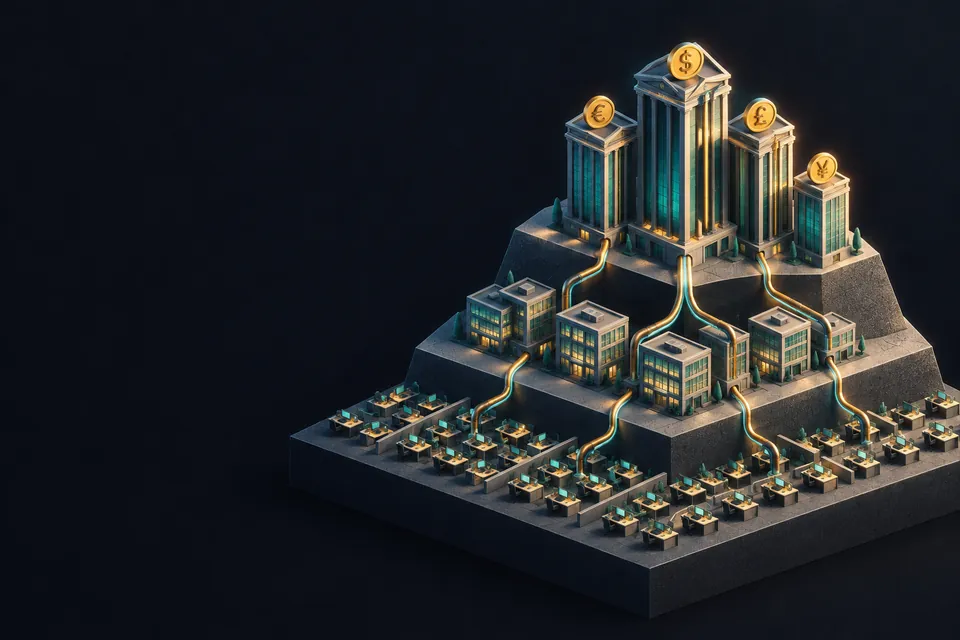 Chapter 4How is the forex market structured?Forex has no central exchange. It is an over-the-counter market: large dealer banks trade with each other at the top, liquidity providers and institutions deal with those banks, and retail brokers connect individual traders at the bottom. With no shared venue there is no single official price, and each layer down usually pays a slightly wider spread.
 Chapter 4Who are the main players in the forex market?The forex market's main players are dealer banks and non-bank liquidity providers, which quote prices, plus central banks, funds, companies and retail traders. Each trades for its own reason: dealers earn the spread, central banks pursue policy, companies hedge real payments, funds invest or speculate, and retail traders speculate in small sizes through brokers.

