Interest rates and currencies.
A currency tends to rise when its interest rates are expected to go up, because higher rates draw in money looking for a better return. Prices move on expectations, so a hike the market already expected may change little. Inflation and fear can also break the link.
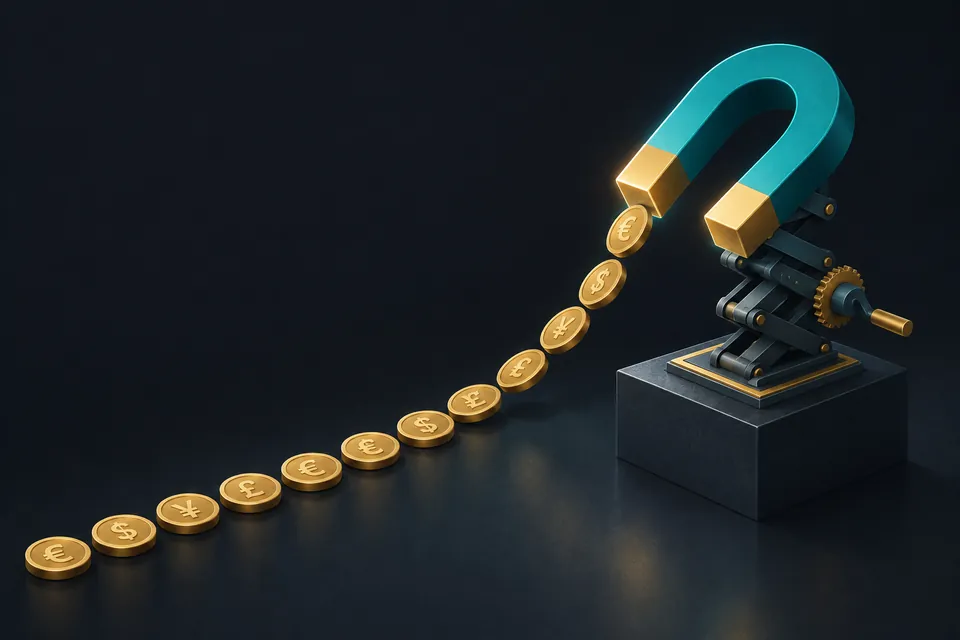
Imagine you hold 100,000 in savings and two banks in two countries offer to keep it. One pays 4% a year and the other pays 1%.
If nothing else differed, you would pick the 4% bank, and to use it you would first need that country's currency.
Large investors make that same choice with far bigger sums, and it is the basic reason interest rates matter in forex. The lesson on what moves exchange rates placed rates among several forces that push a currency up or down.
Why do higher interest rates attract money?
Every currency has a short-term interest rate, set or steered by its central bank. That rate shapes what banks pay on deposits and what short-term government bonds yield in that currency.
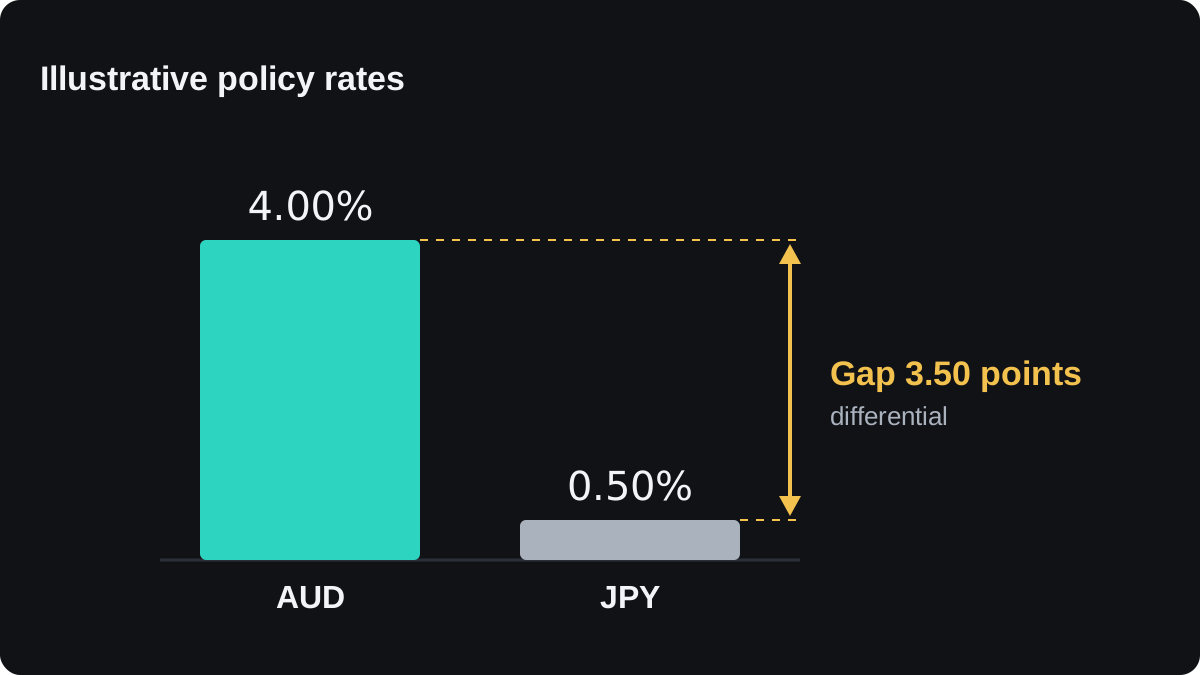
Take round illustrative numbers. Australia pays 4.00% and Japan pays 0.50%. A fund holding 100,000 Australian dollars for a year earns 4,000 AUD, while money held in yen earns 0.50%, one eighth of that return.
To earn the higher rate, the fund must first buy Australian dollars. When many investors do this at once, demand for the currency grows and its price tends to rise.
The gap between the two rates is the interest rate differential. Here it is 4.00 minus 0.50, which is 3.50 percentage points. A pair always sets one currency against another, so traders watch this gap more closely than either rate alone.
Why do expectations matter more than today's rate?
Currency markets trade on what investors expect to happen. If they are confident a central bank will raise its rate next month, they tend to buy the currency now, before the higher rate arrives.
By the day of the decision, much of the move may already have happened. Traders say such a move is priced in. A currency can climb for weeks before a hike and then barely react when the hike is announced.
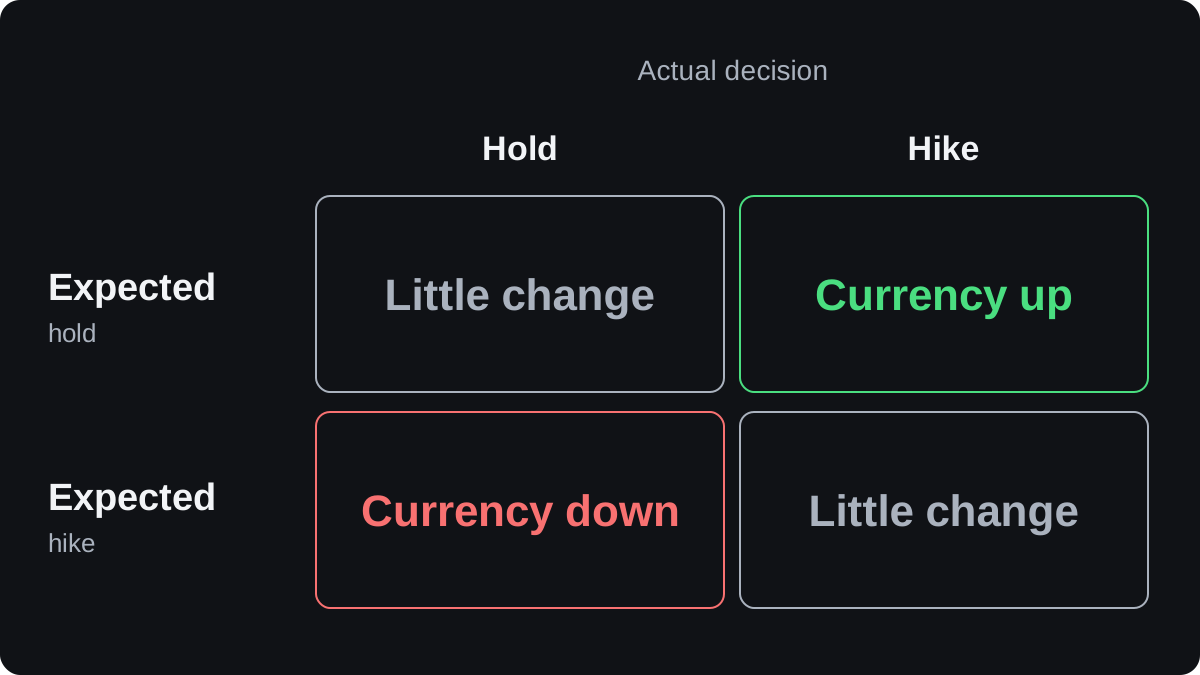
What moves the price on the day is the gap between what was expected and what happened. Suppose the market expects a central bank to hold its rate at 3.00%.
If the bank raises the rate to 3.25% instead, that quarter point is a surprise and the currency tends to jump. If the bank holds as expected, the price usually changes little.
The surprise can run the other way. If the market expected a hike to 3.25% and the bank holds at 3.00%, the currency tends to fall.
The bank's statement can matter as much as the decision. A bank that raises rates but hints that it has finished can see its currency fall, because the expected path of future rates has just come down.
How central banks set and signal their rates is the subject of the next lesson, how central banks move currencies.
How can you see what the market expects?
Market prices show what traders expect. Short-term government bond yields, such as the two-year yield, tend to rise when traders expect higher policy rates and fall when they expect cuts.
Futures and swaps tied to short-term rates are used to estimate the odds of a move at the next meeting. Financial news services often publish these implied odds. They are market estimates and can change within hours.
For a pair, compare both sides. If euro area two-year yields rise while US two-year yields stay flat, the yield gap has moved in the euro's favour. The lesson on bond yields and currencies covers this link in more depth.
The economic calendar shows when rate decisions and major data releases are due, which is when expectations get tested.
How does the rate gap reach your trading account?
The differential shows up as swap, the interest paid or charged when you hold a position overnight. Roughly, a long position earns the base currency's rate and pays the quote currency's rate. A short does the reverse.
Here is the raw arithmetic for a long position of one standard lot of AUD/JPY, using the same illustrative rates:
- One standard lot is 100,000 units of the base currency, so the position is 100,000 AUD.
- The differential is 4.00 minus 0.50, which is 3.50 percentage points, or 0.035.
- The yearly interest gap is 100,000 × 0.035 = 3,500 AUD.
- Per day it is 3,500 ÷ 365 = 9.59 AUD.
- A short position of the same size would pay about 9.59 AUD a day instead.
Your broker's swap will differ from this. Brokers use their own benchmark rates and add a charge, so a long on a positive gap can earn less than the raw figure, or even pay.
Check the swap in your broker's contract specification, or estimate it with the swap calculator. Holding a pair mainly to collect this interest is called a carry trade.
When does the rate link break down?
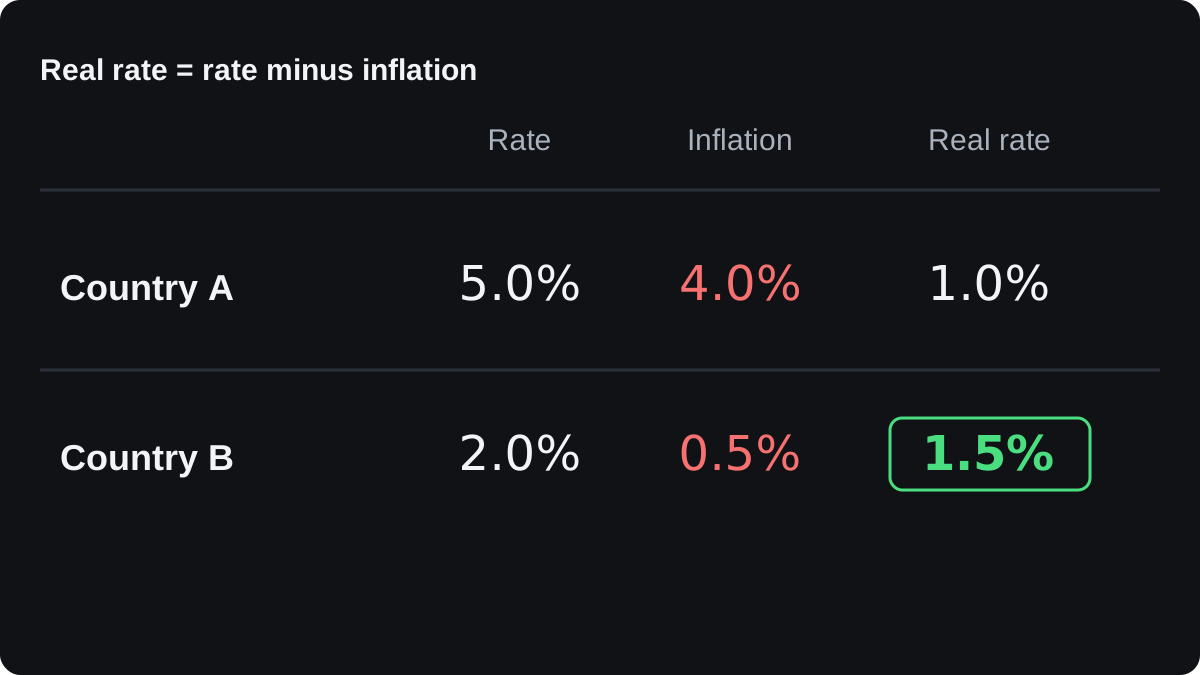
The first problem is inflation. A high rate means little if prices rise almost as fast. The real interest rate is the nominal rate minus inflation, and it measures what an investor actually gains in buying power.
Work it through with illustrative numbers:
- Country A pays 5.0% and has inflation of 4.0%. Its real rate is 5.0 minus 4.0 = 1.0%.
- Country B pays 2.0% and has inflation of 0.5%. Its real rate is 2.0 minus 0.5 = 1.5%.
- Country B pays less on paper but gives the better real return.
The lesson on inflation and currencies explains why high inflation can weaken a currency even while its rates rise.
Fear is the second problem. In a market sell-off, investors often pull money out of high-yield currencies and into currencies seen as safe, such as the yen and the Swiss franc, even when rate gaps have not changed. See risk-on and risk-off.
The reason for a hike matters as well. A bank that raises rates to defend a falling currency, or to fight runaway inflation, may not draw money in if investors fear for the economy.
Economic theory points the other way from the simple story. A model called uncovered interest parity says a high-rate currency should, on average, lose about as much in value as it pays in extra interest.
Research over several decades has often found that high-yield currencies did not fall as much as that model predicts. Those currencies can still drop sharply within days and erase years of interest, so the research is no promise of profit.
Questions
Does a rate hike always make a currency stronger?
It does not always. If the hike was expected, much of the move may have happened before the decision, and a hike paired with a signal of no further hikes can even see the currency fall.
Why did a currency fall after its central bank raised rates?
Usually the market expected more, either a larger hike or more hikes to come. Price reacts to the gap between expectations and the decision, plus what the bank says about the future.
What is an interest rate differential?
It is the gap between the interest rates of the two currencies in a pair. With illustrative rates of 4.00% and 0.50%, the differential is 3.50 percentage points.
Do rate cuts weaken a currency?
They often do when they come larger or earlier than expected. A cut the market fully expected may already be in the price.
Can you earn interest by holding a currency pair?
A position on the side of a positive rate gap can earn swap, but brokers set their own swap rates and the credit may be small or negative. A modest price move can also outweigh months of interest.
Keep learning
 Chapter 1What moves exchange rates?Exchange rates move when demand for one currency changes against another. In normal markets, the driver that moves prices most often is the expected gap in interest rates between two countries. Growth and inflation matter mainly through what they imply for rates. Risk appetite can take over in a crisis, and trade balances work slowly, over years.
 Chapter 1How central banks move currencies.Central banks move currencies mainly through interest rates. A higher policy rate, or a signal that one is coming, tends to attract money and lift a currency, and a lower one tends to weigh on it. Prices react most to the gap between what the bank does and what markets expected, and guidance and bond buying also move them.
 Chapter 1Inflation and currencies.Inflation moves a currency mainly through interest rate expectations. When an inflation report comes in above forecast, traders expect the central bank to raise rates or keep them higher, so the currency often rises. A figure below forecast often weakens it. Over many years, high inflation that is not controlled tends to erode a currency's value.

