What is a carry trade?
A carry trade buys a currency with a higher interest rate against one with a lower rate and holds the position to collect the difference. In retail forex the carry arrives as a daily swap credit, minus the broker's markup. The risk is the exchange rate: a modest price move can erase months of interest.

Interest rates differ from one country to the next. If you hold a currency that earns a high rate and owe one that charges a low rate, you collect the gap for every day the position stays open.
That gap is the carry. In retail forex it reaches your account as a daily swap credit or charge.
Why does holding a currency pair earn or cost interest?
Each currency has a short-term interest rate, set mostly by its central bank. When you buy a pair, you hold the base currency and owe the quote currency, so you earn interest on one and pay it on the other.
A carry trade is a position that is long a currency with a higher interest rate against one with a lower rate, held mainly to collect the difference. The low-rate side is called the funding currency.
The Japanese yen has often been a funding currency, because Japan kept its interest rates close to zero for long stretches. The high-yield side changes as central banks raise and cut rates.
The lesson on interest rates and currencies explains why those rate decisions also move exchange rates.
How much interest does one lot collect?
The rates and price below are round illustrative numbers. Today's figures will differ.
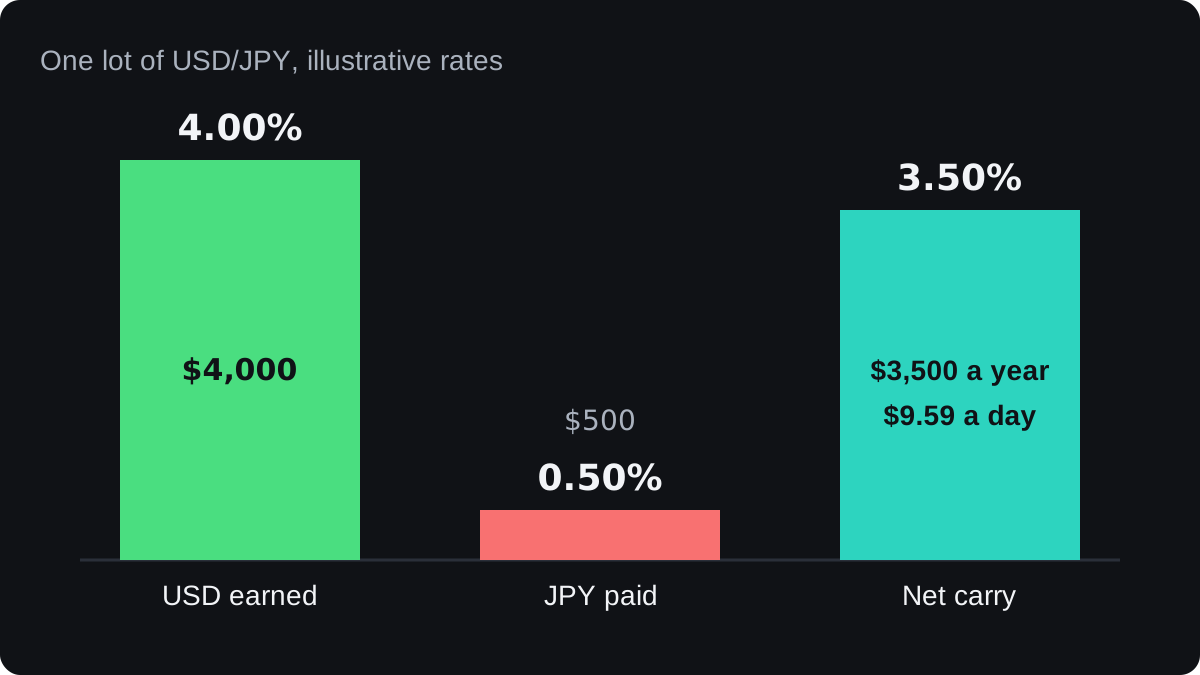
Suppose the US dollar rate is 4.00%, the yen rate is 0.50% and USD/JPY trades at 150.00. You have a US dollar account and buy one standard lot.
- One standard lot is 100,000 units of the base currency, so you hold $100,000.
- Paying for them in yen means you owe 100,000 × 150.00 = ¥15,000,000.
- Interest earned on the dollars: $100,000 × 4.00% = $4,000 a year.
- Interest paid on the yen: ¥15,000,000 × 0.50% = ¥75,000, which is ¥75,000 ÷ 150.00 = $500.
- Net carry: $4,000 minus $500 = $3,500 a year, the same as $100,000 × 3.50%.
- Per day, using a 365-day year for simplicity: $3,500 ÷ 365 = $9.59.
Over a 30-day month that adds up to $3,500 × 30 ÷ 365 = $287.67, provided both rates stay where they are.
Selling the same pair reverses the sums. You would owe dollars at 4.00% and hold yen at 0.50%, so the position would pay about $9.59 a day before any broker charges.
Why is your broker's swap smaller than the rate gap?
The figures above are the textbook carry. Your broker sets its own swap rates, which include a markup, so the long side earns less than the full gap and the short side pays more than it.
When two rates sit close together, the markup can be bigger than the gap. Then both directions have a negative swap, and that pair offers no carry at that broker.
Swap is booked at the broker's daily rollover, usually around 17:00 New York time, and many brokers book three days on one weekday to cover the weekend. The swap lesson explains that timing.
Before you hold a pair for its carry, read its long and short swap in your platform's contract specification, or test the numbers in the swap calculator.
The next lesson, how carry shows up in your swap, turns rate gaps into the swap figures your platform shows.
How big a price move cancels the carry?
The carry builds slowly, while the exchange rate can move against you in a single day.
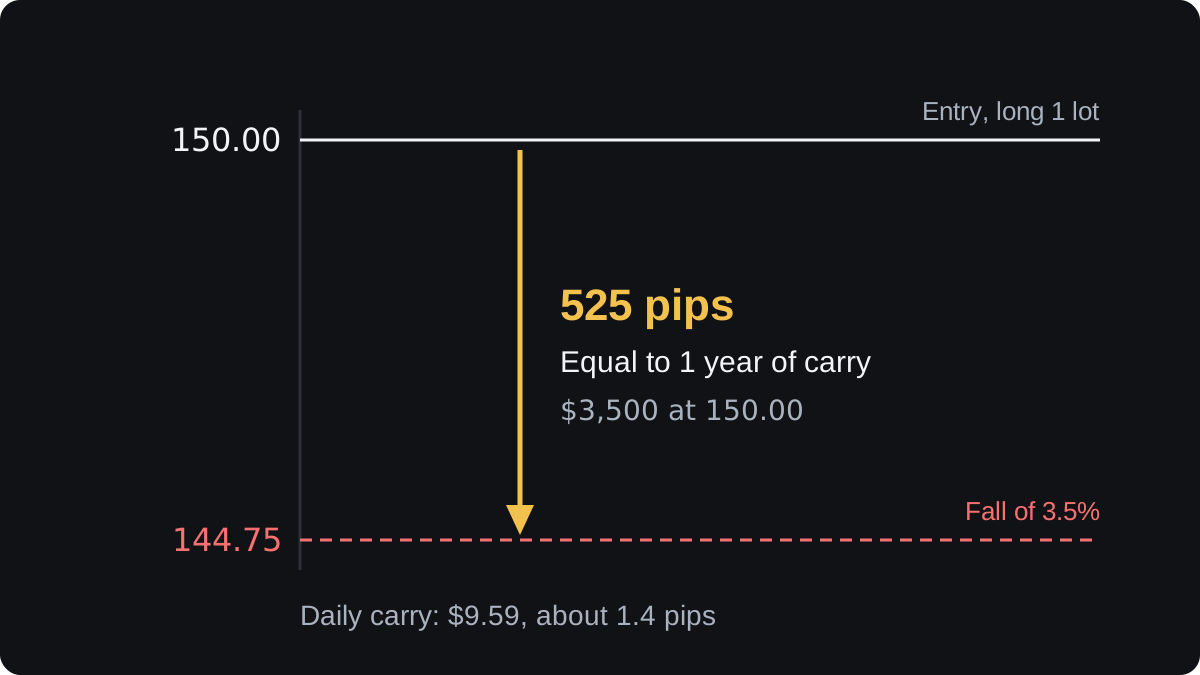
On USD/JPY a pip is 0.01, so on one lot each pip is worth 100,000 × 0.01 = ¥1,000. At 150.00 that is ¥1,000 ÷ 150.00 = $6.67, so the daily carry of $9.59 equals about 1.4 pips.
A full year of carry, $3,500, is $3,500 × 150.00 = ¥525,000. At ¥1,000 per pip, that is 525 pips.
So a fall from 150.00 to 144.75, a drop of 3.5%, would cancel roughly a year of interest. The match is rough because a yen loss is worth slightly more in dollars once the rate has fallen.
Moves of a few percent within a year are common for major pairs, and much larger ones happen in stressed markets.
What does leverage do to a carry trade?
Say your account holds $10,000 and carries the one lot above, a notional of $100,000. Your effective leverage is 100,000 ÷ 10,000 = 10 times.
The year's carry of $3,500 is then 35% of the account. A 3.5% fall to 144.75 costs ¥525,000, which is $3,626.94 at that rate, about 36% of the account.
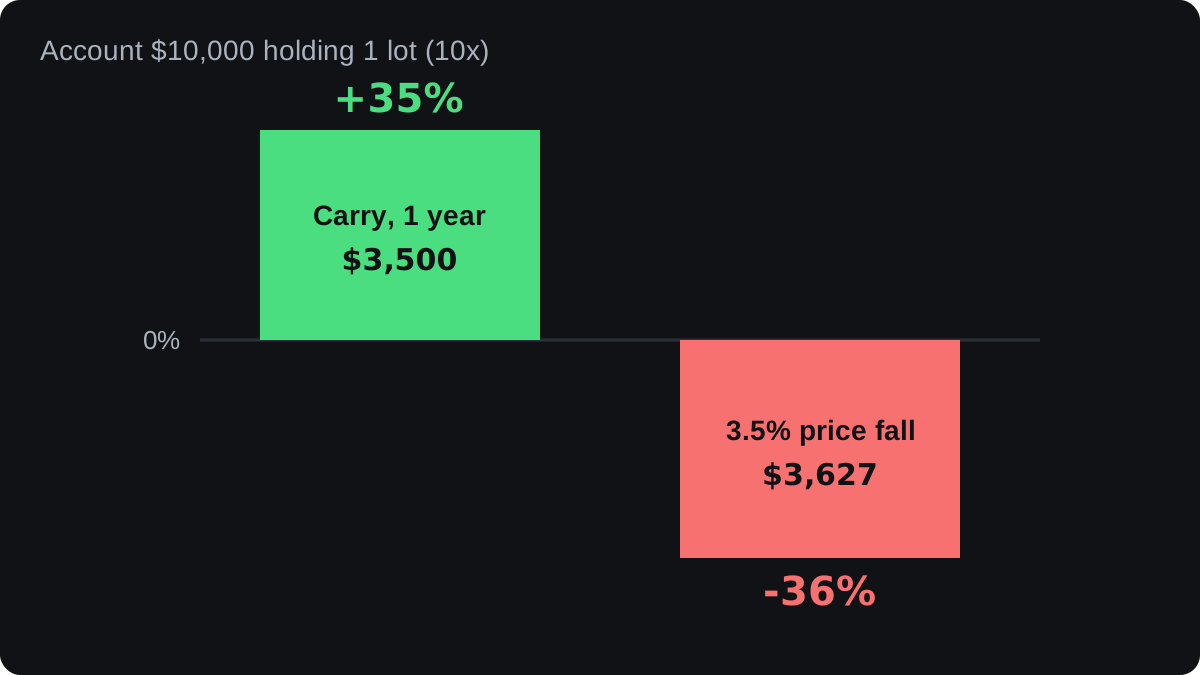
Leverage makes the carry look large against your deposit, and it makes the price risk large by the same factor. It cannot change the ratio between the two.
When does the carry trade go wrong?
In theory the edge should vanish. Uncovered interest parity is the idea that a high-yield currency should, on average, fall by about the rate gap, leaving a carry trader with nothing.
Studies of long histories of exchange rates have often found that high-yield currencies did not fall that much on average, so carry positions earned money over some long periods. The shape of those returns matters as much as the average.
Gains tended to build slowly, and losses arrived in sharp bursts, usually when investors moved out of risky assets and closed carry positions at the same time. The risk-on and risk-off lesson describes that switch.
The 2008 financial crisis is a well-known case, when the yen rose sharply against higher-yielding currencies as these trades were closed. The lesson on when the carry trade unwinds looks at such episodes.
Rates also change. If the high-yield central bank cuts or the funding central bank raises, the gap narrows, and the exchange rate often moves on the expectation before your swap changes.
Past carry returns do not predict future ones, and a positive swap on its own is a weak reason to hold a position.
Questions
Is a carry trade profitable?
It can earn a steady swap credit, yet a price move against you can cancel months of interest in days. Past carry returns are no guarantee of future ones.
Which currencies are used for carry trades?
Any pair with a wide interest gap. The funding side has often been a low-rate currency such as the Japanese yen or the Swiss franc, and the high-yield side changes as central banks move rates.
Do I earn carry if I close the trade the same day?
Only if the position is still open at the broker's daily rollover. A trade opened and closed between two rollovers earns or pays no swap.
Why is my swap negative on both sides?
Your broker adds a markup to each side. When the interest gap between the two currencies is small, the markup is larger than the gap, so both the long and the short pay.
Keep learning
 Chapter 6How carry shows up in your swap.The swap is the daily interest you earn or pay for holding a currency position overnight. In theory it equals the interest rate gap between the two currencies, which is the carry. In practice your broker subtracts a markup from both sides, so a positive swap shrinks and a negative one grows.
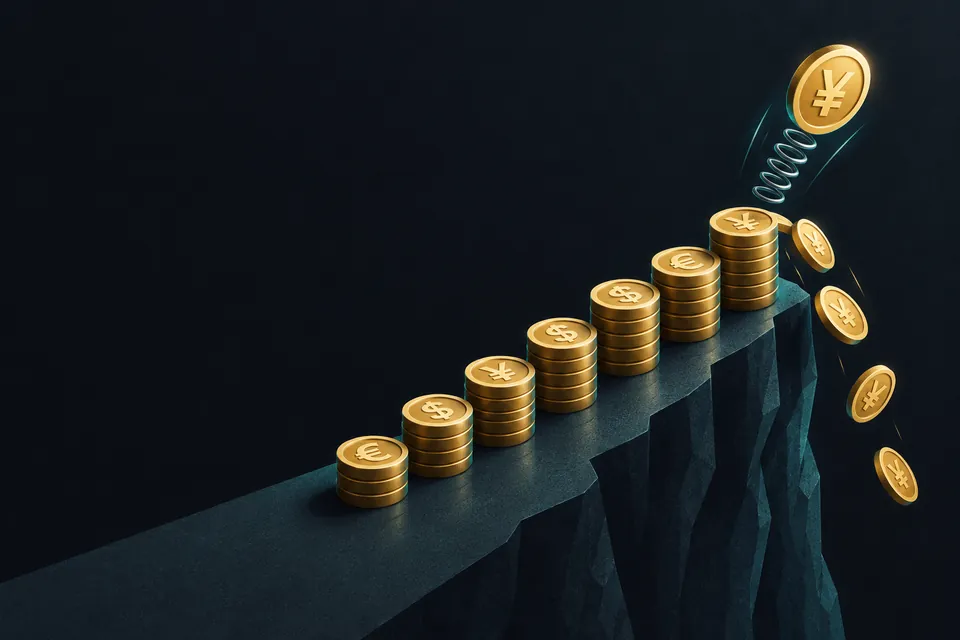 Chapter 6When the carry trade unwinds.A carry trade unwinds when many holders close it at once, usually after a risk-off shock or a change in interest rate expectations. The low-yield funding currency, such as the yen, jumps, and the carry pair can fall in days by more than the trade earned in months or years of swap.

