Effective leverage versus account leverage.
Account leverage is the most your broker lets you use, such as 1:500. It sets your margin and the largest position you can open. Effective leverage is what you use: the total value of your open positions divided by your equity. It decides how much a price move changes your account, so it is the number to watch.

You open a $2,000 account with 1:500 leverage and buy 0.10 lot of EUR/USD. The account page says 1:500, yet your position is worth only 5.5 times your money.
The first number is a limit your broker sets. The second is what your trade really uses, and it decides how hard a price move hits your account.
What is the difference between account and effective leverage?
Account leverage is the most your broker lets you use. On a simple fixed leverage account it decides the margin, the deposit held while a trade is open: margin equals the position's value divided by the account leverage. The leverage lesson covers it in detail.
The notional value is the full face amount of a position, converted into your account currency. On 0.10 lot of EUR/USD at 1.10000, it is $11,000.
Effective leverage is the leverage you are using right now. It is the total notional value of your open positions divided by your equity, which is your balance plus or minus open profit and loss.
Brokers write account leverage as 1:500. This lesson writes effective leverage as 5.5:1, meaning your positions are worth 5.5 times your equity.
How do you work out effective leverage?
The formula is short:
Effective leverage = total notional value ÷ equity
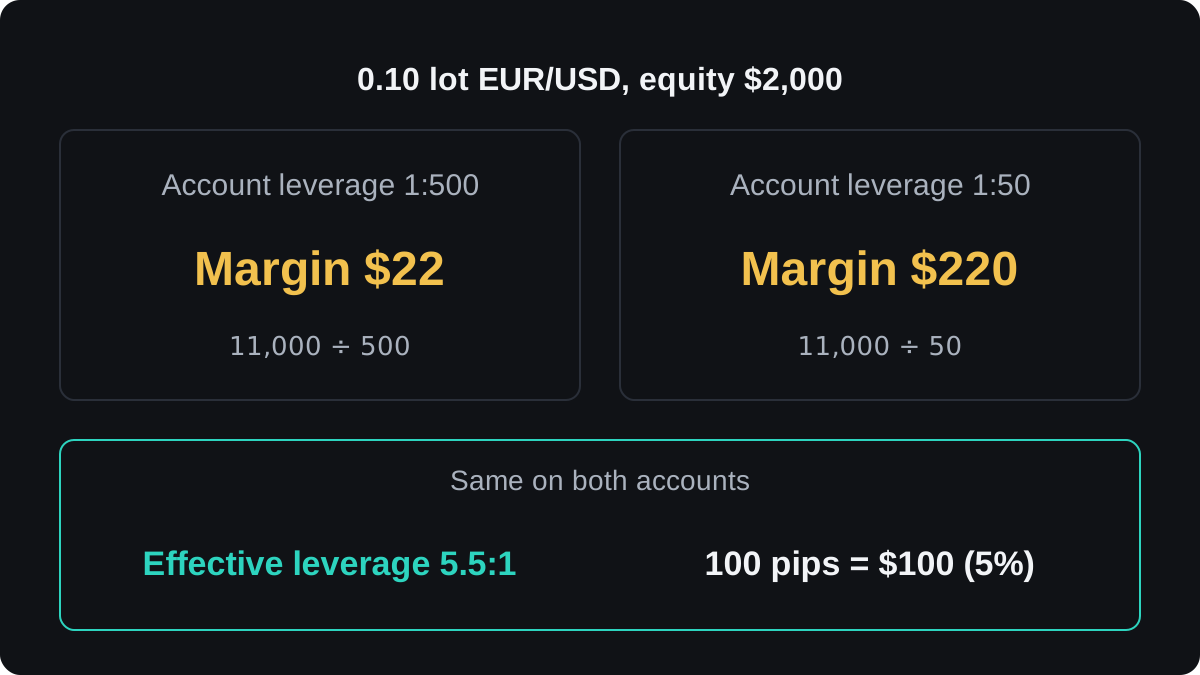
Here is the opening trade, with round illustrative prices, in a US dollar account holding $2,000 of equity:
- You buy 0.10 lot of EUR/USD at 1.10000. A standard lot is 100,000 units of the base currency, so 0.10 lot is 10,000 euros.
- The notional in dollars is 10,000 × 1.10000 = $11,000.
- Effective leverage is 11,000 ÷ 2,000 = 5.5:1.
- Margin at 1:500 is 11,000 ÷ 500 = $22.
- Margin at 1:50 is 11,000 ÷ 50 = $220.
The margin differs by a factor of ten. The pip value does not: 0.10 lot of EUR/USD is $1 per pip on both accounts, so a 100-pip move is $100, or 5% of equity.
With several trades open, add their notional values. USD/JPY has the dollar as its base currency, so 0.10 lot is $10,000 of notional with no conversion. Hold it alongside the EUR/USD trade and you have $21,000 ÷ $2,000 = 10.5:1.
This gross total is the cautious measure. Positions on related pairs can stack or partly offset each other, which the correlation lesson explains.
Why does effective leverage decide how much you gain or lose?
A price move changes your equity by roughly the move in percent multiplied by your effective leverage. On EUR/USD at 1.10000, 100 pips is 0.0100 ÷ 1.10000, a move of about 0.91%.
At 5.5:1 that is about 5.5 × 0.91% = 5% of equity, which matches the $100 worked out above. Larger positions on the same $2,000 account scale in a straight line:
| Position | Notional | Margin at 1:500 | Margin at 1:50 | Effective leverage | 100 pips against you |
|---|---|---|---|---|---|
| 0.10 lot | $11,000 | $22 | $220 | 5.5:1 | $100 (5%) |
| 0.50 lot | $55,000 | $110 | $1,100 | 27.5:1 | $500 (25%) |
| 1.00 lot | $110,000 | $220 | Cannot open | 55:1 | $1,000 (50%) |
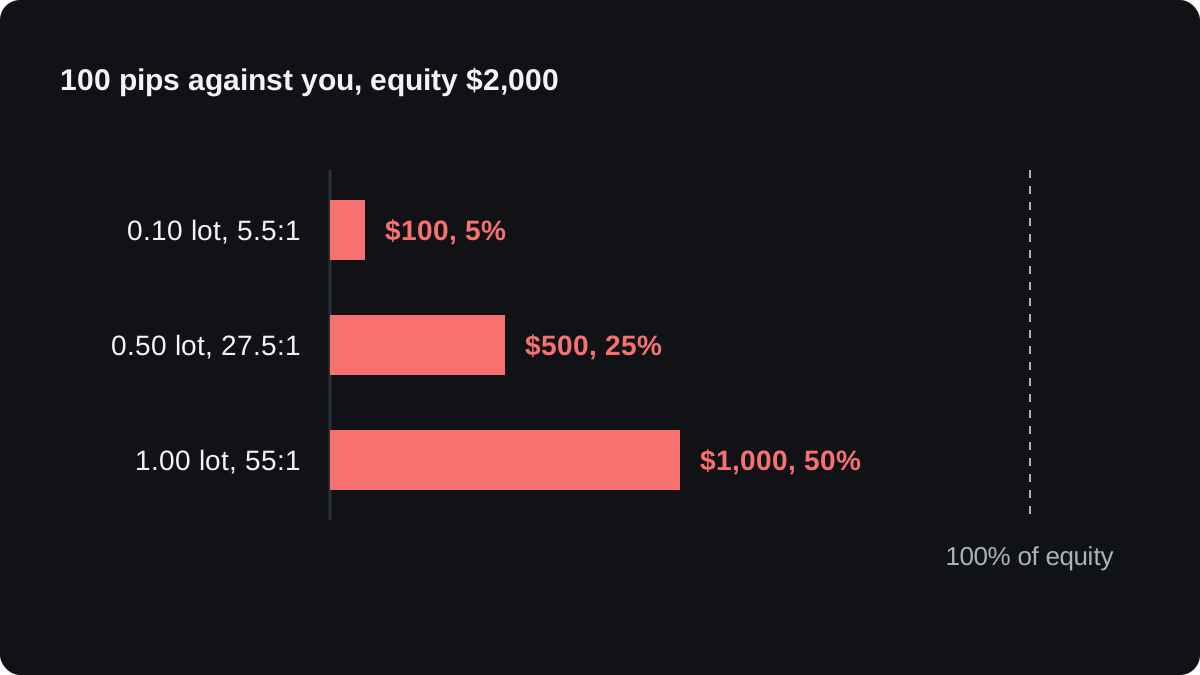
The 1.00 lot trade needs $2,200 of margin at 1:50, more than the $2,000 of equity, so the platform refuses it. Account leverage caps effective leverage, and below that cap your lot size sets it.
Why does effective leverage rise when a trade loses?
Equity moves while a trade is open, and the notional value barely changes. A losing trade therefore pushes effective leverage up, just when you would want it lower.
Take the 1.00 lot EUR/USD buy at 1.10000 on $2,000 of equity, which starts at 55:1:
- Price falls 50 pips to 1.09500. The loss is 50 × $10 = $500, so equity is $1,500.
- Notional is now 100,000 × 1.09500 = $109,500, and 109,500 ÷ 1,500 = 73:1.
- Price falls another 50 pips to 1.09000. Equity is $1,000 and notional is $109,000.
- Effective leverage is 109,000 ÷ 1,000 = 109:1.
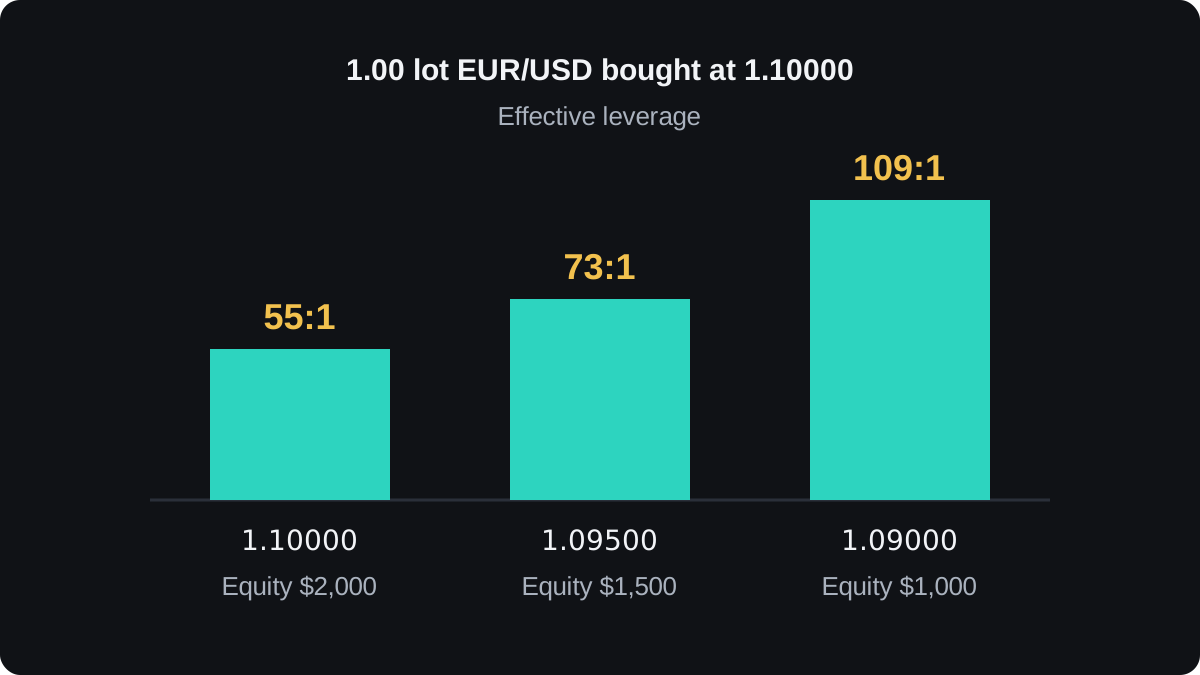
At that point the next 100 pips against you would cost $1,000, all the equity left. A winning trade works the other way, lowering effective leverage as equity grows.
What does a high account leverage change?
High account leverage lowers the margin, which leaves more free margin and delays the moment your broker closes trades. Margin call and stop out levels differ between brokers, as the margin and stop out lesson explains.
Suppose, as an illustration, that stop out happens at a 50% margin level, where margin level is equity ÷ used margin × 100. The 1.00 lot trade at 1:500 uses $220 of margin.
Stop out would come when equity falls to 50% of $220, which is $110. That is a loss of $2,000 − $110 = $1,890, or 189 pips at $10 per pip, ignoring the small change in margin as the price moves.
By the time the account closes the trade, you have lost 94.5% of your money.
A distant stop out gives a trade more room to run against you, and the loss grows the whole way. The next lesson, on keeping a margin buffer, looks at that room.
Choosing an effective leverage you can live with
No single figure suits every trader, and there is no solid evidence for one universal safe level. A practical method works back from how much you risk per trade.
Say you risk 1% of $2,000, which is $20, with a stop loss 40 pips away. That allows $20 ÷ 40 = $0.50 per pip, or 0.05 lot of EUR/USD.
At 1.10000 the notional is 5,000 × 1.10000 = $5,500, so effective leverage is 5,500 ÷ 2,000 = 2.75:1. The stop sets the planned loss, and effective leverage shows what is at stake if the stop fails.
Stops can fill worse than their price in fast markets, and prices can gap over a weekend. The extra loss from a gap grows with effective leverage, and it adds up across every trade you hold.
Platforms such as MetaTrader show margin level rather than effective leverage, so work it out yourself before each new trade: add the new notional to your open positions and divide by equity. The margin calculator gives the margin side of the same trade.
Questions
Does higher account leverage mean more risk?
On its own it does not change your pip value, so the same lot size risks the same dollars. It does let you open far larger positions and delays stop out, which loosens two limits on how much you can lose.
What is effective leverage in forex?
It is the total notional value of your open positions divided by your equity. An $11,000 position on $2,000 of equity is 5.5:1.
Does effective leverage change during a trade?
Yes. Equity rises and falls with open profit and loss, so a losing trade raises effective leverage and a winning one lowers it.
Is effective leverage the same as margin level?
No. Margin level is equity divided by used margin, so it depends on your account leverage. Effective leverage ignores account leverage and measures your exposure to price moves.