 Glossaire · Qu'est-ce que le forex ?
Long and short positions
Ce contenu n'existe pour l'instant qu'en anglais.
Long and short positions are the two directions a trade can take. Going long means buying a currency pair to profit if its price rises. Going short means selling it to profit if the price falls. In forex you can sell a pair as easily as you buy it.
Every trade you open is either long or short. The bid and ask lesson shows which price opens and closes each one.
What going long and going short mean
Going long means buying a currency pair: you buy the base currency and sell the quote currency. You gain if the price rises.
Going short means selling the pair: you sell the base currency and buy the quote currency. You gain if the price falls.
You do not need to own euros to sell EUR/USD: every forex trade swaps one currency for another.
Which prices open and close each side
A long opens at the ask price and closes at the bid price. A short opens at the bid and closes at the ask. Either way, you pay the spread once per round trip.
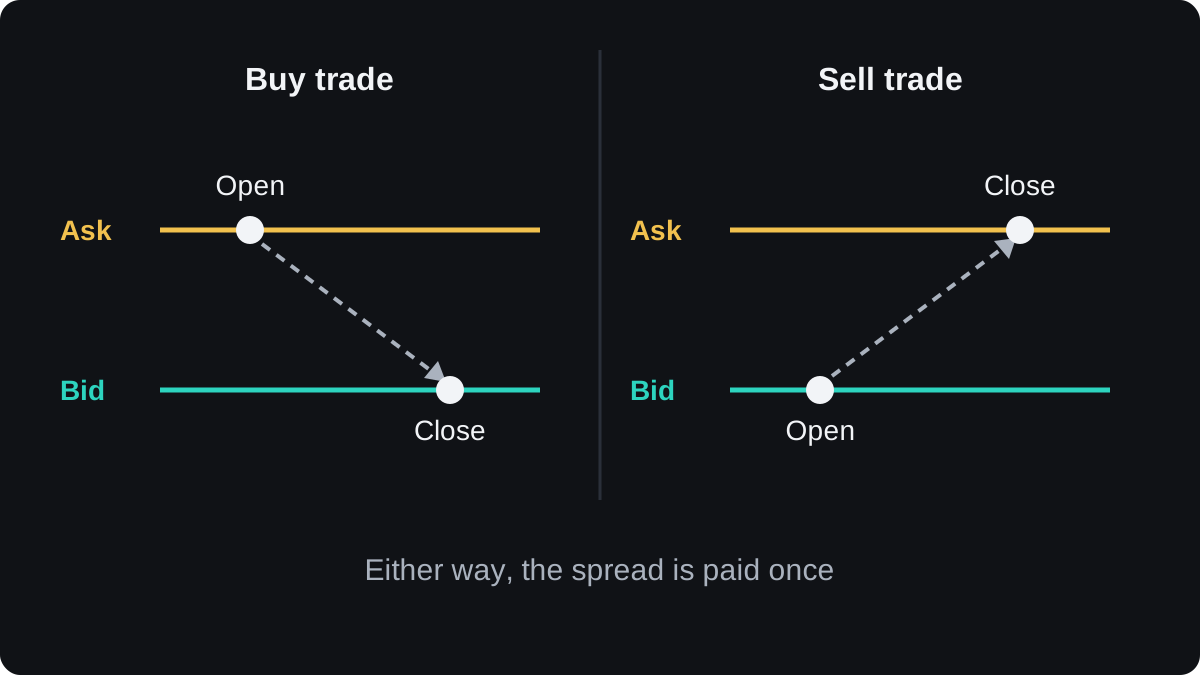
Here is a worked example with round illustrative prices. You sell 0.10 lot of EUR/USD at a bid of 1.10000, where each pip is worth $1. Later you buy it back at an ask of 1.09500.
The pair moved 50 pips your way, so you make 50 × $1 = $50. Had the ask risen to 1.10300 instead, the same short would have lost 30 pips, or $30.
Questions fréquentes
Is buying the same as going long?
Yes. Opening a buy trade is going long, and opening a sell trade is going short.
What does closing a position mean?
Closing means making the opposite trade: a long is closed by selling and a short by buying back. The difference between the two prices is your profit or loss.
Leverage multiplies losses as well as gains; only trade money you can afford to lose.
Autres termes de ce chapitre
 ForexForex (foreign exchange, or FX) is the global market for trading currencies. Every price is quoted as a pair, such as EUR/USD, and trading happens over the counter between dealers rather than on one central exchange.
 Base currencyThe base currency is the first currency in a currency pair, the one whose price is quoted. In EUR/USD it is the euro, so a price of 1.10000 means one euro costs 1.10000 US dollars. Buying the pair means buying the base currency.
 Quote currencyThe quote currency is the second currency in a pair, the one the price is counted in. In EUR/USD it is the US dollar, so 1.10000 means one euro costs 1.10000 dollars. Pip value and profit on the pair are worked out in the quote currency first.
 Exchange rateAn exchange rate is the price of one currency in terms of another. EUR/USD at 1.10000 means one euro exchanges for 1.10000 US dollars. On a trading platform every rate comes as two prices: a bid you can sell at and a higher ask you can buy at.
 Over-the-counter (OTC) marketIn an over-the-counter (OTC) market, traders deal directly with no central exchange. Spot forex works this way: dealer banks quote prices to each other and to brokers, so there is no single official price at any moment.
 Liquidity providerLiquidity providers are banks and firms that quote buy and sell prices to a broker. They stand ready to trade at those prices. A broker combines their quotes into the bid and ask you see, sometimes adding its own markup to the spread.
Apprendre en détail
Termes associés