Overtrading and how to stop it.
Overtrading means taking more trades, or bigger positions, than your trading plan allows. It raises costs, deepens losing runs and often follows a loss, boredom or a winning streak. Written limits help rein it in: a fixed risk per trade, a daily trade cap, a daily loss limit and a rule to trade only planned setups.
Konten ini baru tersedia dalam bahasa Inggris.

You planned two trades this week. By Wednesday you have taken eleven, most of them in the hour after a loss. That is overtrading: trading more often, or with bigger positions, than your plan allows.
It is one of the common beginner mistakes that is easy to miss, because each extra trade feels small on its own while the damage builds up in the total.
What does overtrading look like?
Overtrading has two forms. The first is frequency: taking trades that break your rules, or far more trades than your style needs.
The second is size: opening positions so large that an ordinary losing run does serious harm to the account.
These are common signs of both:
- You open a new trade within minutes of closing a loss.
- You trade a pair or a timeframe that is not in your plan.
- You raise your lot size to win back what you lost.
- You feel uneasy whenever you have no open position.
- Your trade count jumps on days with no clear setups.
There is no correct number of trades. A scalper may take twenty a day inside a written plan, while a swing trader may take two a month, so overtrading is measured against your own rules.
How do extra trades add up in costs?
Every trade pays the spread, and on some accounts a commission as well. One trade's cost looks tiny, so the monthly total is what you need to see.
Take two traders with $2,000 accounts. Both trade 0.10 lot of EUR/USD, where one pip is worth $1. Assume each round trip costs 1.2 pips, an illustrative figure.
- Cost per trade: 1.2 pips × $1 = $1.20.
- Trader A takes 3 trades a week, so 12 in a four-week month: 12 × $1.20 = $14.40.
- Trader B takes 10 trades a day for 20 trading days, so 200 trades: 200 × $1.20 = $240.00.
- As a share of the account: $14.40 ÷ $2,000 = 0.72%, and $240 ÷ $2,000 = 12%.
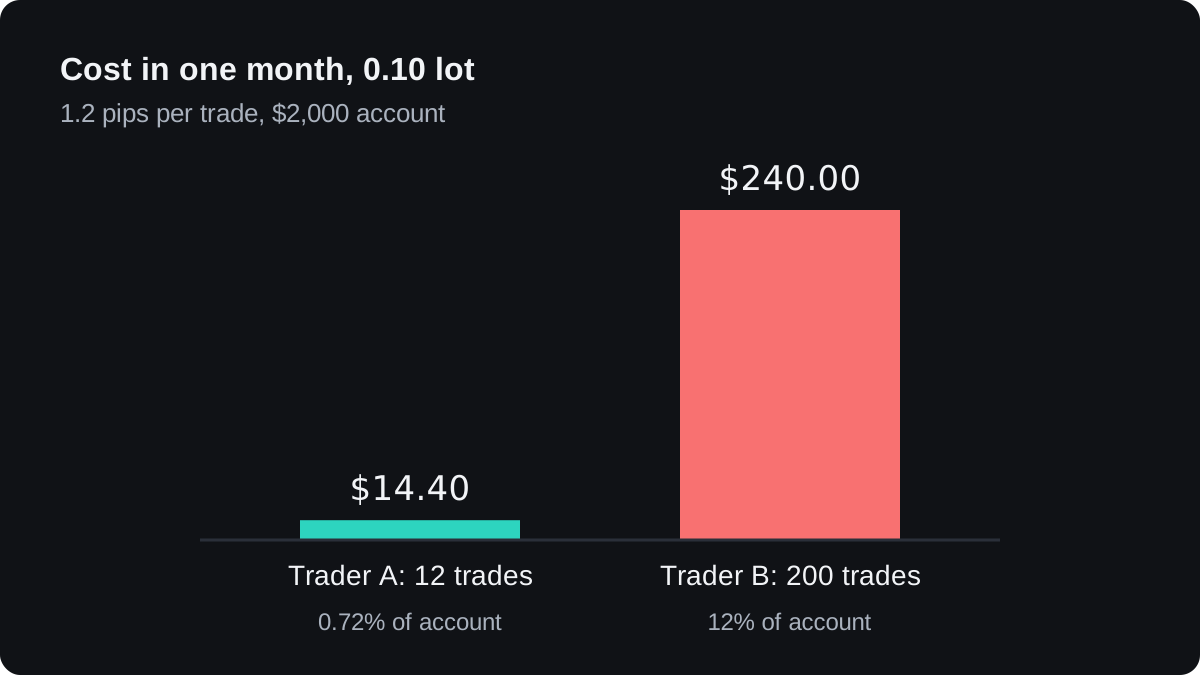
Trader B has to make 12% in a month just to cover costs and stay level, before any trade is judged on its merits.
Cost also grows against the target as trades get shorter. A 1.2 pip cost is 24% of a 5 pip target (1.2 ÷ 5), and only 2% of a 60 pip target (1.2 ÷ 60).
The cost of one trade lesson shows how to add commission and swap to this sum.
What happens when you trade too big?
Size overtrading does its harm faster. Stay with the $2,000 account, trading EUR/USD with a stop loss 25 pips from entry.
- A plan that risks 1% allows a loss of $2,000 × 1% = $20.
- $20 ÷ 25 pips = $0.80 per pip, which is 0.08 lot of EUR/USD.
- An oversized trade of 0.50 lot has a pip value of $5.00, so the same stop loses 25 × $5.00 = $125.
- That is $125 ÷ $2,000 = 6.25% of the account on one trade.
A run of four losses in a row is common over a few dozen trades, even for a method that wins half the time. With a fixed size, four losses at 0.08 lot cost 4 × $20 = $80 and leave $1,920.
Four losses at 0.50 lot cost 4 × $125 = $500 and leave $1,500.
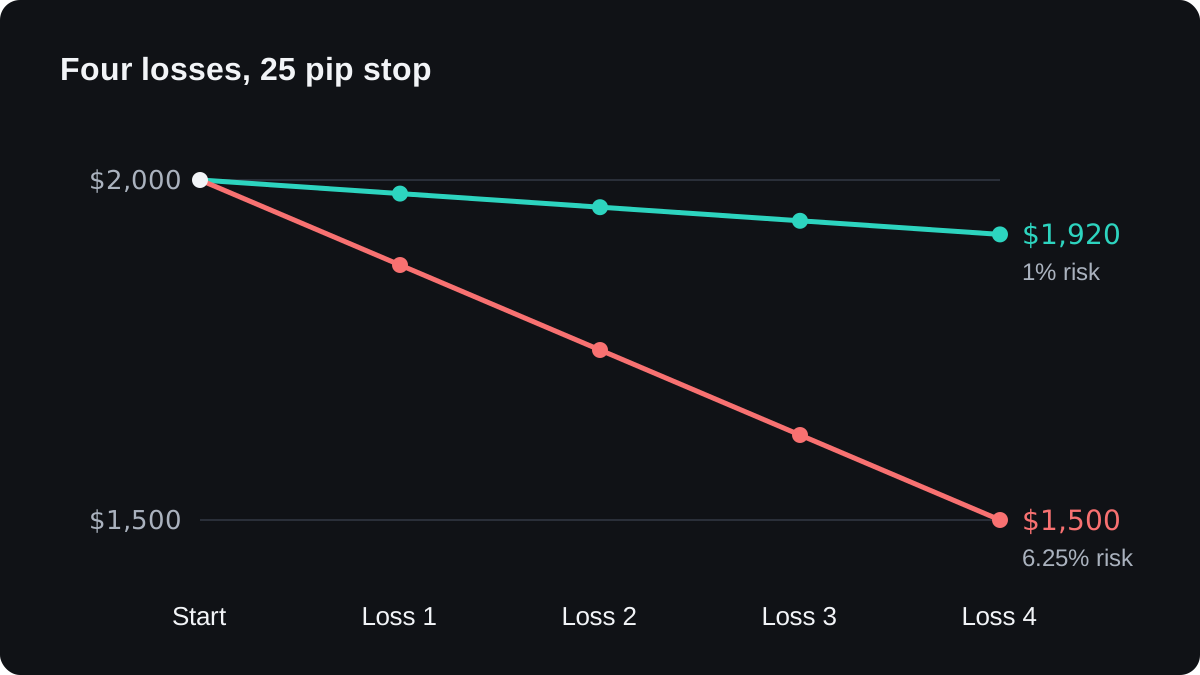
The bigger loss is also harder to repair. Getting from $1,500 back to $2,000 needs a gain of $500 ÷ $1,500 = 33.3%, as the drawdown and recovery lesson explains.
Setting your risk per trade first and then using the lot size calculator keeps every position tied to its stop.
Why do traders overtrade?
An extra trade usually starts with a feeling, and the reason to place it comes afterwards. These are the usual triggers:
- After a loss, the urge to win it back at once, often called revenge trading.
- After a run of wins, a sense that you cannot be wrong, which pushes size up.
- Boredom on quiet days, when nothing fits the plan.
- Fear of missing a move you have just watched happen without you.
- A small account and a large goal, which tempts you to size up to get there faster.
The platform makes all of this easy. Opening a trade takes one tap, and nothing on the screen asks whether the trade fits your plan.
The trading psychology basics lesson, next in this module, covers these emotions in more depth.
How can you tell whether you overtrade?
Your records tell you more than your memory does. A trading journal that logs every trade lets you count instead of guess.
Once a week, compare these numbers:
- Trades taken against trades planned.
- Trades that met every rule in your plan against trades that did not.
- The lot size you used against the size your risk rule gave.
- Minutes between a losing trade and your next entry.
- The results of off-plan trades, kept apart from the rest.
If off-plan trades are frequent and do worse than planned ones, you have found a leak. If they look better, be careful, because a handful of trades proves very little either way.
Which rules rein overtrading in?
Good limits put a decision point before each order, so the choice is made by rules you wrote while calm. Here is one illustrative set for the $2,000 account. It shows the mechanism and is not a recommendation.
- Risk 1% per trade, $20, with the lot size worked out from the stop.
- Take at most 3 trades a day.
- Stop for the day after a 2% loss, $40, which is two full losses.
- Take a trade only when its setup is written in your plan.
- Wait 30 minutes after any loss before the next entry.
- Trade only in hours you set in advance, such as one session.
Three of those rules can be checked in seconds before each order, in the order shown below. If any answer is no, you stand aside.
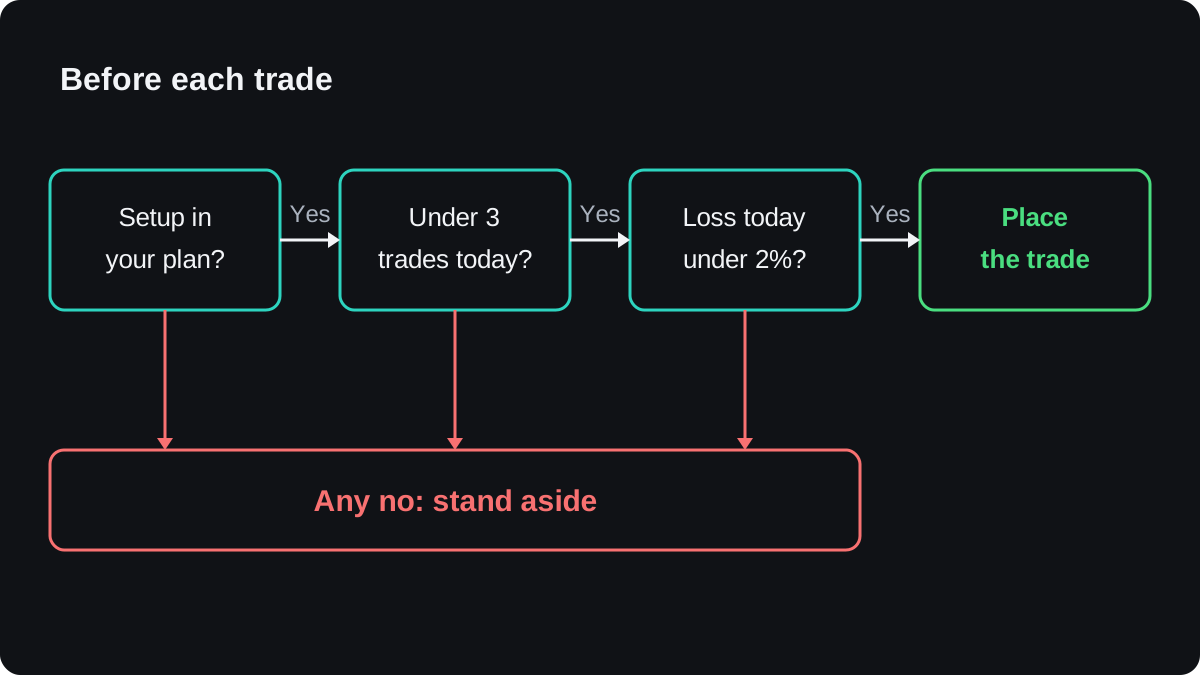
Write the rules down and keep them beside the screen. Some platforms may offer daily loss or trade limits, so check your own platform's settings before you count on one.
Where do these rules fall short?
A trade cap can backfire. If you allow three trades a day, you may feel you must use all three, which is overtrading by another route. Counting only planned setups guards against that.
A daily loss limit stops a bad day from getting worse, yet it cannot fix a weak method. If you hit it often, look for the problem in your strategy or your sizing.
No study gives a best number of trades or a correct daily limit, and the figures here are round examples. Fit yours to your style and test them on a demo account.
Change your limits only between sessions, after you have reviewed the journal, and never in the middle of a losing day.
Pertanyaan
How many trades a day is overtrading?
No number applies to everyone. You are overtrading when you take more trades than your written plan allows, or trades that do not meet its rules.
Is overtrading the same as revenge trading?
Revenge trading is one cause of overtrading: trading fast after a loss to win the money back. You can also overtrade from boredom or overconfidence with no loss involved.
Does trading more often make more money?
More trades do not add profit on their own. Every trade pays a cost, so extra trades only help if each one is expected to make money after that cost.
How do I stop overtrading after a loss?
Set the rule before you start, such as a 30 minute wait after any loss and a daily loss limit. When either one is hit, close the platform.
Is a bigger lot size a form of overtrading?
Yes. Trading too big is the second form, because one loss then takes a larger share of the account, as the 0.50 lot example above shows.
Lanjut belajar
 Bab 3The most common beginner mistakes.The most expensive beginner mistakes are trading too large for the account, trading without a stop loss, and raising size after a loss to win it back. Overtrading and letting losers outrun winners add slower damage. Each can be measured in money, and a fixed risk per trade and a trade journal limit them.
 Bab 3Trading psychology basics.Trading psychology is how emotions and mental shortcuts change your decisions with money at risk. Fear makes you close winners early, hope makes you move stops on losers, and a loss can push you into larger revenge trades. Deciding stop, target and size before entry, and keeping risk small, limits the damage.

