How to calculate position size.
To calculate position size, multiply your account by the percentage you will risk, then divide by the stop distance in pips times the pip value per lot. With $5,000, 1% risk and a 25 pip stop on EUR/USD, that is $50 ÷ (25 × $10) = 0.20 lot. Round down when the answer falls between lot steps.
Konten ini baru tersedia dalam bahasa Inggris.
Two traders can buy the same pair at the same price, with the same stop, and lose very different amounts when the trade fails. The only difference is how big each trade was.
Position sizing means choosing that size on purpose, so a losing trade costs an amount you picked before you clicked buy. This lesson turns three numbers into a lot size with one formula you can check by hand.
What three numbers do you need?
Your position size is how many lots you trade. A lot is a fixed amount of the base currency, and one standard lot is 100,000 units.
To work out the size, you need three inputs:
- Your account size. This lesson uses the balance, which leaves out the floating profit or loss of any open trades.
- The percentage of that account you accept losing on this trade. Account size times this percentage is your risk amount, in money.
- Your stop distance, the number of pips between your entry price and your stop loss.
Say you have $5,000 in a US dollar account and you decide to risk 1% on one trade. Your risk amount is $5,000 × 1% = $50.
The 1% is an illustration. Choosing your own figure is a separate decision, covered in how much to risk per trade.
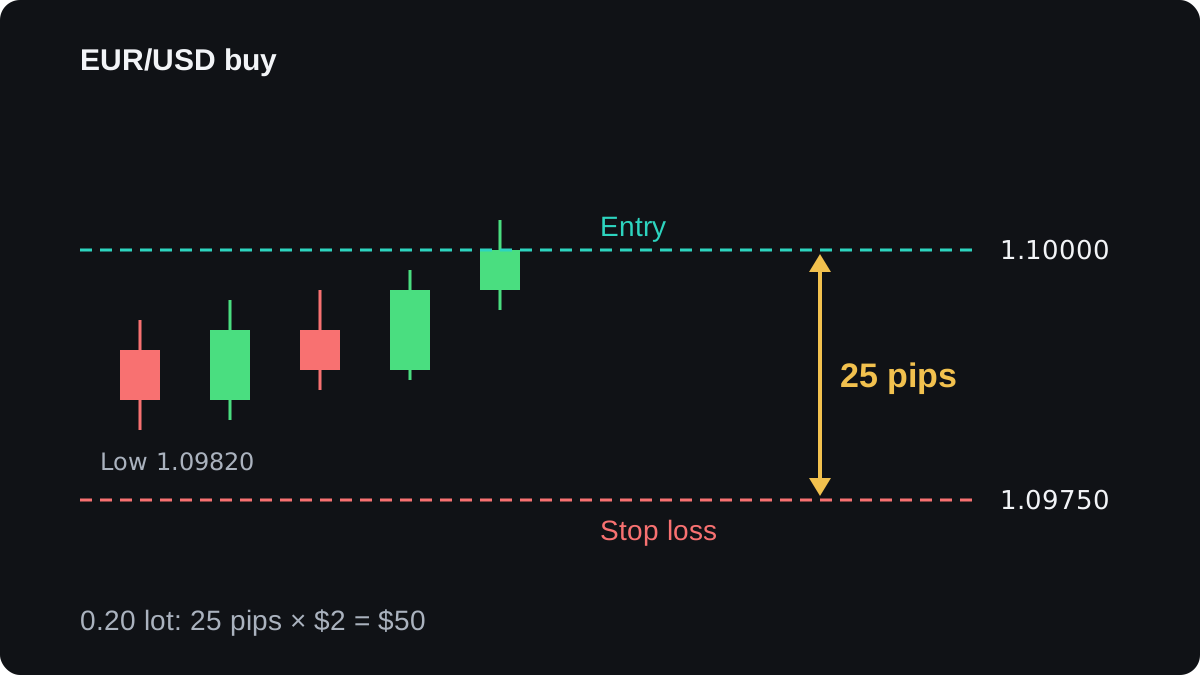
You plan to buy EUR/USD at 1.10000. The recent low is 1.09820, so you put the stop a little below it at 1.09750. The distance is 1.10000 minus 1.09750 = 0.00250, which is 25 pips.
How do you turn risk into a lot size?
You know how much you can lose and how many pips away the stop is. The missing piece is how much each pip must be worth, so spread the risk amount across the stop distance.
Pip value needed = $50 ÷ 25 pips = $2 per pip.
On EUR/USD in a dollar account, one standard lot moves $10 per pip. You need $2 per pip, so the size is $2 ÷ $10 = 0.20 lot.
The two steps join into one formula:
Lots = risk amount ÷ (stop distance in pips × pip value per lot)
With the numbers above: $50 ÷ (25 × $10) = $50 ÷ $250 = 0.20 lot.
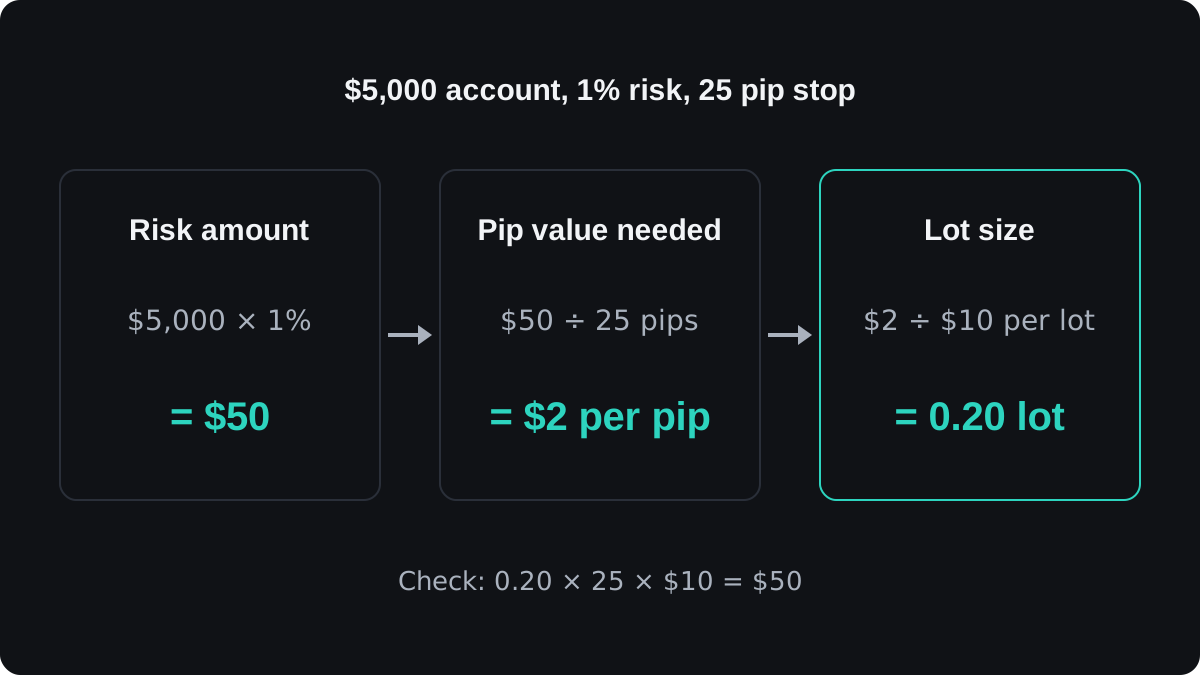
Always check the answer backwards. 0.20 lot × 25 pips × $10 per pip per lot = $50. If the price falls to your stop, you lose $50, which is 1% of the account, before costs.
The same $10 per lot applies to any pair quoted in US dollars when your account is in dollars, such as GBP/USD or AUD/USD. For pairs quoted in another currency, the pip value per lot moves with the exchange rate.
On USD/JPY at 150.00, for example, a pip on one lot is worth about $6.67, so the same risk and stop allow a larger size. The next lesson, position sizing across different pairs, works through those cases.
What if the answer is not a round number?
Real numbers rarely come out clean. Take a $2,000 account, a risk of 2% ($40) and a 30 pip stop on EUR/USD.
Lots = $40 ÷ (30 × $10) = $40 ÷ $300 = 0.1333 lot.
Platforms accept sizes only in fixed steps, often 0.01 lot. Your broker's contract specification for each instrument lists the minimum size and the step.
Round down, to 0.13 lot. The risk becomes 0.13 × 30 × $10 = $39, just under plan. Rounding up to 0.14 lot would risk $42, which is more than you decided to lose.
Very small accounts hit a floor. With $200, 1% is $2, and a 30 pip stop gives $2 ÷ $300 = 0.0067 lot, which is below a 0.01 minimum.
The smallest trade you can place, 0.01 lot, would risk 0.01 × 30 × $10 = $3. That is 1.5% of the account, so you either accept the higher risk or skip the trade.
| Account | Risk | Risk amount | Stop | Exact size | Size traded | Risk at stop |
|---|---|---|---|---|---|---|
| $5,000 | 1% | $50 | 25 pips | 0.2000 lot | 0.20 lot | $50 |
| $2,000 | 2% | $40 | 30 pips | 0.1333 lot | 0.13 lot | $39 |
| $200 | 1% | $2 | 30 pips | 0.0067 lot | 0.01 lot (minimum) | $3 |
All three rows are EUR/USD in a US dollar account, with $10 per pip on one lot.
Why does the stop come before the size?
The stop belongs where the chart says your idea is wrong, for example under a recent low. Once that level is set, the size follows from the formula, and the money at risk stays the same whatever the distance.
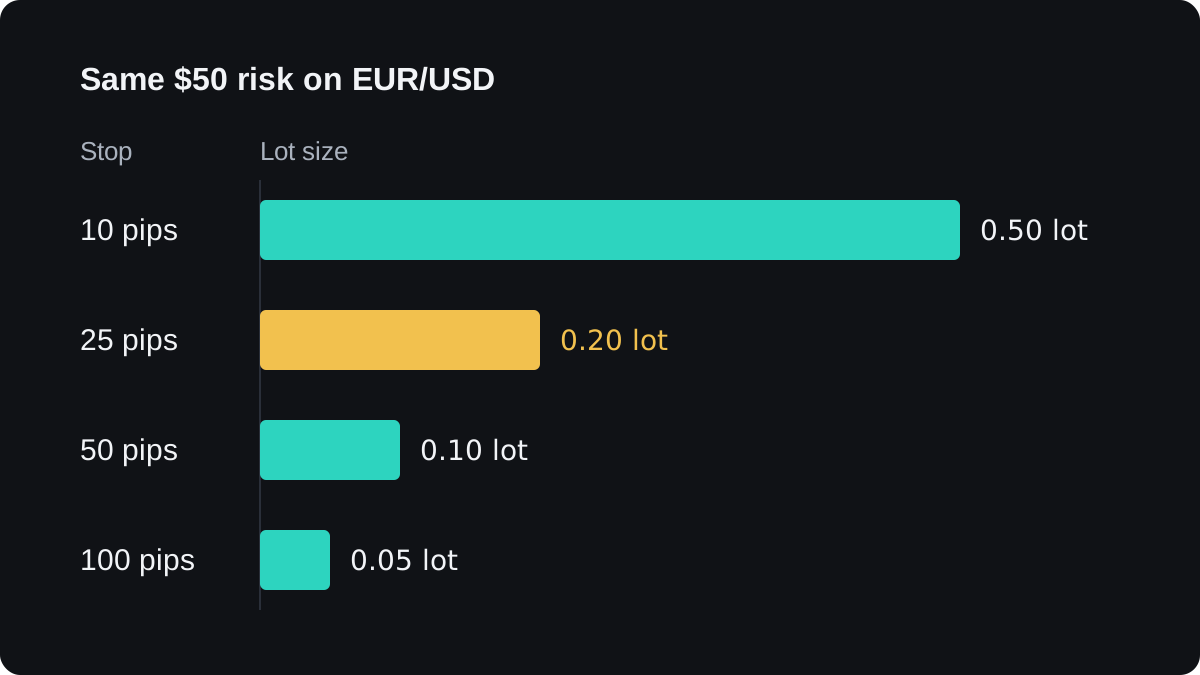
Keep the $50 risk on EUR/USD and change only the stop. A 10 pip stop allows 0.50 lot, a 25 pip stop 0.20 lot, a 50 pip stop 0.10 lot and a 100 pip stop 0.05 lot. Each loses $50 if the stop is hit.
The reverse habit is easy to fall into: picking a favourite lot size first, then squeezing the stop until the loss looks acceptable. That puts the stop where it fits your wallet, wherever the market happens to be.
A tighter stop does allow a bigger size. It also sits closer to ordinary price swings, so it tends to be hit more often. The lesson on ways to place a stop loss covers how to choose the level.
Where can the calculation go wrong?
The formula gives the loss at the stop price. Your real loss can be larger, and a few other limits sit outside the formula.
Start with the spread. MetaTrader draws its charts from the bid price by default, while a buy opens at the ask and its stop closes at the bid.
If the chart shows 1.10000 and the ask is 1.10010, your entry is 26 pips from a stop at 1.09750.
At 0.20 lot that loses 0.20 × 26 × $10 = $52. Putting 26 pips into the formula gives $50 ÷ $260 = 0.1923, rounded down to 0.19 lot, which risks $49.40.
If your account charges a commission per lot, add it to the cost of the losing trade as well, or size slightly smaller to leave room for it.
A stop loss becomes a market order when it triggers. In a fast market, or when the price gaps over a weekend, it can fill worse than your level. That difference is slippage, and the formula cannot see it.
Margin is a separate question. 0.20 lot of EUR/USD at 1.10000 is 20,000 euros, worth $22,000. At an illustrative leverage of 1:100, the broker holds $22,000 ÷ 100 = $220 as margin.
That $220 is a deposit, and the $50 is what the stop can cost. Several trades that each risk 1% can still use up your free margin together, which is why keeping a margin buffer comes before this lesson.
Related pairs can also fail at the same time. Two trades of 1% each on EUR/USD and GBP/USD may behave like one trade of nearly 2% when the dollar moves sharply.
For quick checks, the lot size calculator runs the same formula for any pair and account currency.
Pertanyaan
What is the formula for position size in forex?
Lots = risk amount ÷ (stop distance in pips × pip value per lot). On EUR/USD in a US dollar account, a $50 risk with a 25 pip stop gives $50 ÷ (25 × $10) = 0.20 lot.
Should I round my lot size up or down?
Round down, so the error stays on the safe side. An answer of 0.1333 lot becomes 0.13 lot and risks $39 on a 30 pip stop, where 0.14 lot would risk $42.
Does leverage change my position size?
Leverage sets how much margin the broker holds. The loss at your stop depends on lot size and stop distance, so 0.20 lot with a 25 pip stop on EUR/USD loses $50 at any leverage.
Higher leverage only lets you open larger trades than you otherwise could.
What if my account is too small for the minimum lot?
Then the minimum lot risks more than your chosen percentage. On a $200 account with a 30 pip stop, 0.01 lot of EUR/USD risks $3, which is 1.5% of the account.
Should I use balance or equity to size a trade?
With no trades open they are the same number. With trades open, equity includes their floating profit or loss, so it is the more current measure of what the account holds.
Lanjut belajar
 Bab 3Position sizing across different pairs.The same stop in pips risks different money on different pairs because pip value changes. On one standard lot, a 25-pip stop is $250 on EUR/USD, $166.67 on USD/JPY at 150.00 and $25 on gold, in a US dollar account. Divide your risk by the stop times that pair's pip value per lot to get the lot size.
 Bab 3Position sizing worked examples.To size a trade, divide the money you are willing to lose by what one lot would lose at your stop. With $50 at risk and a 25 pip stop on EUR/USD, one lot loses $250, so you trade 0.20 lot. Pairs not quoted in your account currency need one extra step: converting the pip value.

