Geopolitical risk and forex.
Geopolitical risk is the chance that elections, conflicts or sanctions change a country's economy or its links with the world. Currencies reprice when that risk shifts, often in sudden jumps. Money tends to leave risk-sensitive currencies such as the Australian dollar and move into safe havens such as the US dollar, Japanese yen and Swiss franc.
ខ្លឹមសារនេះមានតែជាភាសាអង់គ្លេសសិន។

A currency is a claim on a country's economy. When an election result, a war or a new round of sanctions changes what that economy is likely to look like, traders reprice its money, sometimes within minutes.
The economic calendar gives you a date and a forecast for most data releases. Geopolitical news rarely comes with either, which is why it can move prices further and faster than a jobs report.
What counts as geopolitical risk?
Geopolitical risk is the chance that politics or conflict, inside a country or between countries, changes its economy, its laws or its links with the rest of the world.
Part of it is scheduled. Elections, referendums and deadlines for trade talks have dates, even when the outcome is unknown.
The rest is not. A military strike, a coup or a sudden sanctions package can land at any hour, including the weekend when your platform shows no prices.
Politics reaches the exchange rate through a few routes. Investors may pull money out of a country or bring it in. The central bank may change interest rates in response, and tariffs or sanctions can block trade.
How do elections move a currency?
Before a vote, polls and betting markets suggest which result is likely. Prices already lean towards that result, so on the night the currency moves mostly by the part nobody expected.
This is the same surprise logic as in expectations versus actual, applied to a vote count instead of a data release.
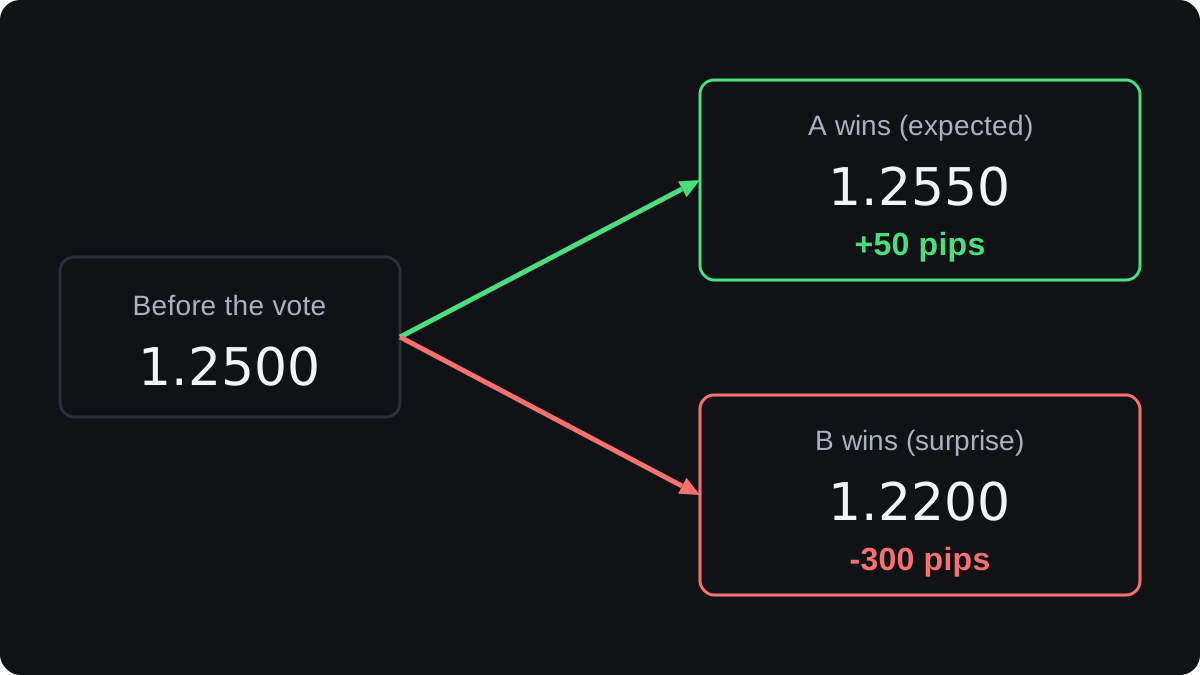
Take an illustrative pair trading at 1.2500 the day before a vote. Polls give outcome A a clear lead, and the market has mostly priced it in.
If A wins, the pair may edge up 50 pips to 1.2550, because little has changed. If B wins, traders must rebuild their forecasts at once, and the pair may drop 300 pips to 1.2200.
The UK referendum on leaving the European Union in June 2016 followed this shape. Markets had leaned towards Remain, and when Leave won, the pound fell overnight to its lowest level against the dollar in about three decades.
After a vote, the currency follows the policy the winner is expected to bring, such as spending and borrowing plans, trade deals, or a change in how the central bank is run.
How do conflicts and sanctions hit currencies?
When a country is drawn into a conflict, its currency tends to weaken. Foreign investors sell local assets, trade is disrupted, and the government may borrow more to pay for defence.
The effect can spread, and neighbours and close trading partners may weaken too.
If a large producer of oil, gas or grain is involved, commodity prices can jump. That tends to help exporters of those goods and hurt importers, though other forces can outweigh it.
Sanctions are restrictions one country or group places on another, such as trade bans, frozen assets and banks cut off from international payment systems. The targeted currency often falls hard, because demand for it from abroad dries up.
The government may then impose capital controls, limits on who can sell the currency and how much money can leave. After the sanctions on Russia in 2022, the rouble fell sharply, then recovered once controls and much higher interest rates were in place.
Under capital controls, a quoted price says less than usual about what you could actually trade. Brokers may widen spreads, allow closing trades only, or remove a pair.
The country risk lesson covers how these risks build up over years.
Why do safe-haven currencies rally?
A safe haven is an asset investors buy when they fear losses elsewhere. In currencies the usual names are the US dollar, the Japanese yen and the Swiss franc, with gold often moving the same way.
The dollar has the largest and most liquid markets, and much of world trade and debt is priced in dollars. Stress raises demand for dollars to pay bills and repay loans.
Japan and Switzerland both hold large amounts of foreign assets. In a scare, some of that money comes home, which means buying yen or francs. Traders who borrowed yen to buy higher-yielding currencies also buy yen back to close those trades.
That buying is funded by selling other currencies. Those tied to global growth and commodity prices, such as the Australian and New Zealand dollars, tend to be sold, along with many emerging market currencies.
The pattern is often called risk-on, risk-off.
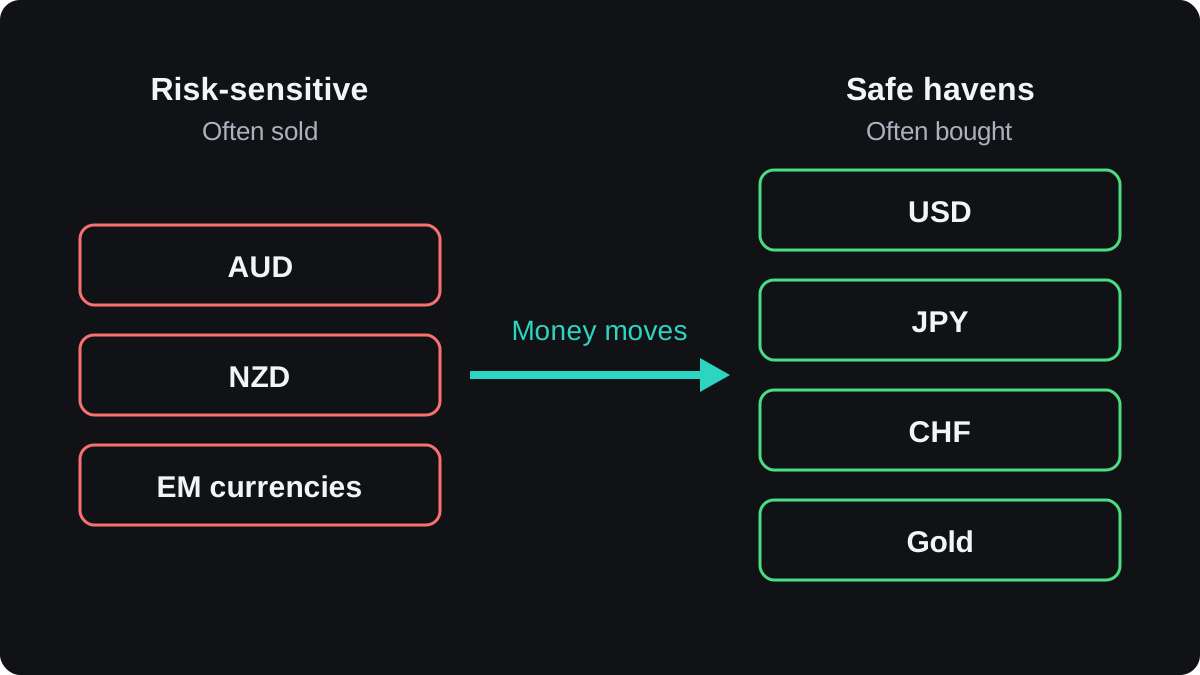
A cross such as AUD/JPY pits a risk-sensitive currency against a haven, so it tends to fall when bad news hits.
These are tendencies with exceptions. The yen's haven role has looked weaker in some periods, and when a shock starts inside the United States the dollar does not always rise.
Havens can also be pushed back. The Swiss National Bank has intervened to stop the franc from rising too far, as the currency intervention lesson explains.
What does a weekend gap do to a stop loss?
Geopolitical news often breaks while markets are closed. When trading resumes, the first price can be far from Friday's close. That jump is a gap, and no trading happens at the prices in between.
Here is an illustrative trade. You buy 0.30 lot of AUD/JPY at 100.00 on Friday, with a stop loss at 99.00. Your account is in US dollars.
- A pip on a JPY pair is 0.01. On 0.30 lot, or 30,000 Australian dollars, one pip is 0.01 × 30,000 = ¥300.
- The stop is 100.00 minus 99.00 = 1.00 away, which is 100 pips. Planned risk is 100 × ¥300 = ¥30,000.
- At an illustrative USD/JPY rate of 150.00, that is ¥30,000 ÷ 150.00 = $200.
- Over the weekend a conflict escalates. AUD/JPY reopens with a bid of 97.50.
- Your stop becomes a market order and fills at the first available price, 97.50. The loss is 100.00 minus 97.50 = 2.50, or 250 pips.
- That is 250 × ¥300 = ¥75,000, which is ¥75,000 ÷ 150.00 = $500.
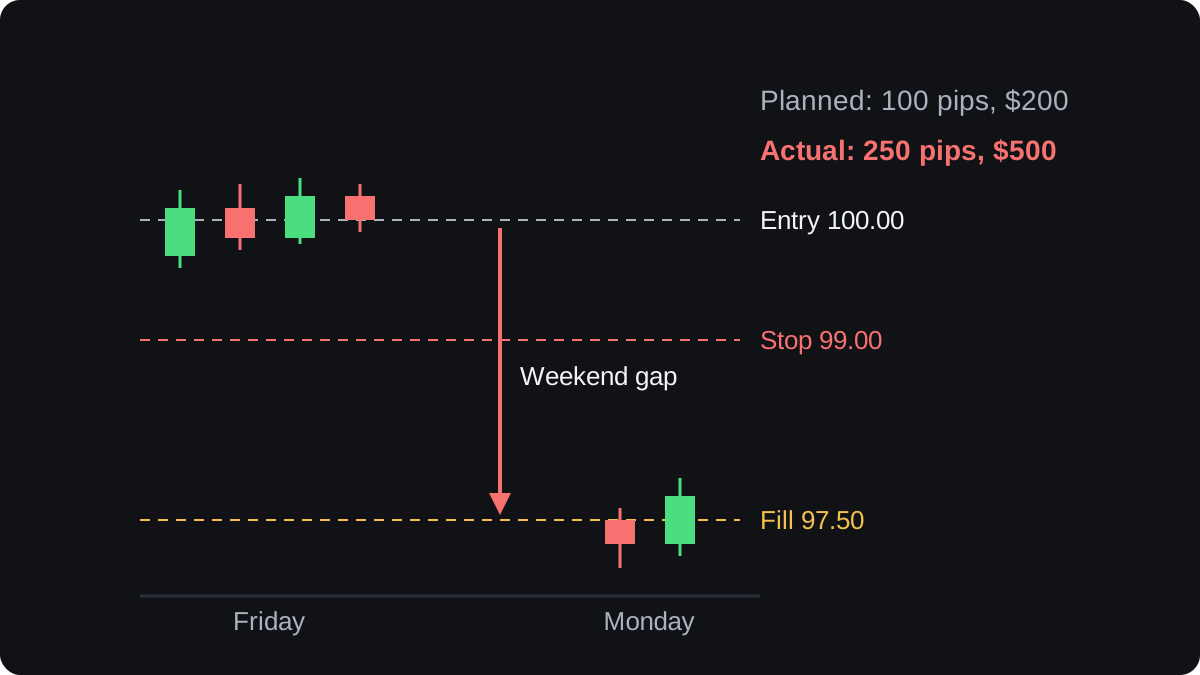
You lost two and a half times what you planned, and the stop still did the job it is built for. In a real shock USD/JPY would move too, so the dollar figure would differ a little.
The slippage lesson explains why fills can land past your stop level, even on calmer days.
How can you limit the damage?
Start with the dates you can know. Election days, referendum days and announced sanction or tariff deadlines are public, and spreads often widen around them as liquidity thins.
You can also size for a gap as well as for the stop. Say $200 is the most you will accept even on a 250-pip gap. The allowed loss is ¥30,000 ÷ 250 = ¥120 per pip, which is 12,000 units, or 0.12 lot.
At 0.12 lot, a 250-pip gap costs 250 × ¥120 = ¥30,000, or $200 at 150.00. Any profit shrinks in the same proportion, and a gap larger than the one you planned for still costs more. The position size lesson shows the full method.
Another option is to cut size or close positions before a weekend or a vote. That gives up any gain from the event, and it is a trade-off with no right answer.
Some brokers offer guaranteed stops for a fee, so read the terms if this risk worries you.
Trading the headline itself is harder than it looks. The first move often reverses as more facts arrive, spreads are wide, and there is no reliable rule for which way or how far the price will go.
សំណួរ
Which currencies are safe havens in forex?
The US dollar, the Japanese yen and the Swiss franc are the usual ones, and gold often rises with them. Their behaviour in a crisis is a tendency, so check how they moved in recent shocks before relying on it.
Why does the yen go up when markets fall?
Japanese investors hold large foreign assets, and some bring money home in a scare, which means buying yen. Traders who borrowed yen to fund higher-yielding trades also buy it back to close them.
Do elections always move currencies?
No. When the result matches what polls and markets expected, the move is often small. Large moves come from surprises and from winners whose policies change the outlook for growth, borrowing or interest rates.
Can a stop loss protect me from a weekend gap?
Only partly. A normal stop becomes a market order and fills at the first available price, which after a gap can be far past your stop level. A guaranteed stop, where a broker offers one, fills at your level for a fee.
បន្តរៀន
 ជំពូក 3Currency intervention.Currency intervention is when a government or its central bank buys or sells currency in the market to push its exchange rate. Buying its own currency with foreign reserves props it up, and selling its own currency weakens it. For traders it means sudden large moves, and stops that can fill far from their price.
 ជំពូក 3Country risk and currency value.Country risk is the chance that a country's debts, deficits or politics make its assets less safe to hold. Large current account deficits, heavy debt owed in foreign currency, thin reserves and unstable politics tend to make investors demand higher interest rates or sell the currency. These forces work slowly and give little help with timing trades.

