 Thuật ngữ · Forex là gì?
Currency pair
Nội dung này hiện chỉ có bản tiếng Anh.
A currency pair is the price of one currency in terms of another, such as EUR/USD. The first is the base currency, the second is the quote currency, and the price is how much of the quote currency buys one unit of the base.
A currency only has a price when you compare it with another currency, so forex is always traded in pairs. The what is traded lesson covers how pairs are grouped and why some cost more to trade than others.
How to read a currency pair
In EUR/USD, the euro is the base currency and the US dollar is the quote currency. A price of 1.10000 means one euro costs 1.10000 US dollars.
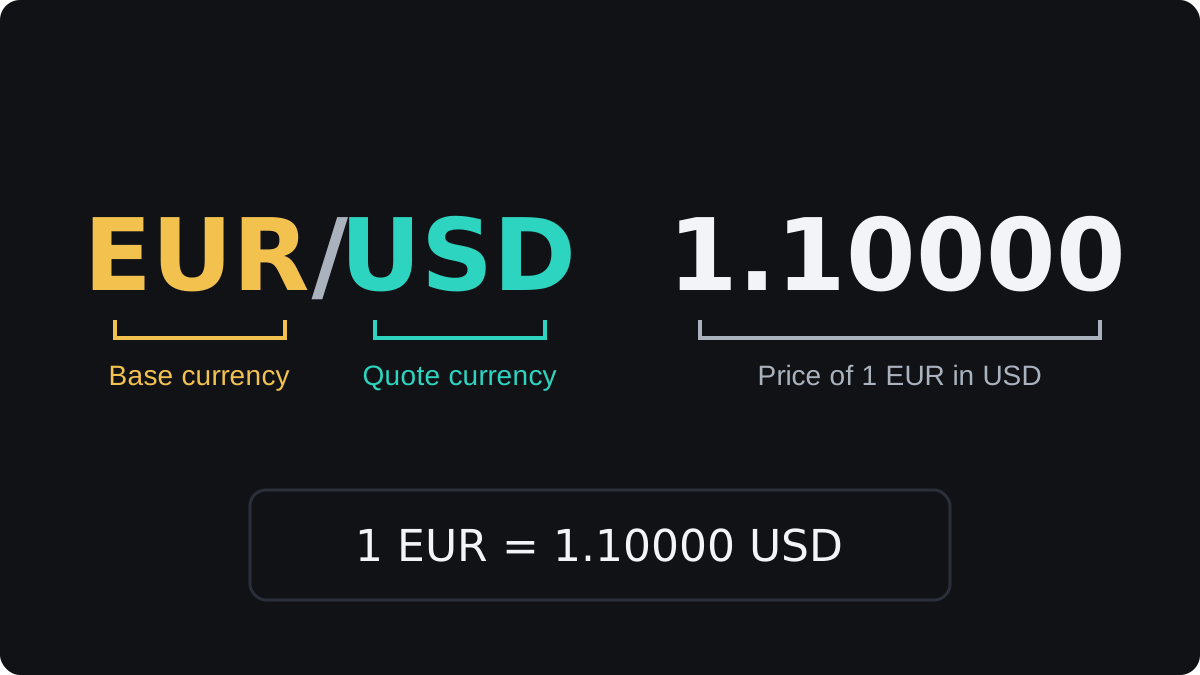
The three-letter codes come from the ISO 4217 standard. Market convention fixes which currency goes first, so platforms list EUR/USD and USD/JPY, never USD/EUR or JPY/USD.
What buying or selling a pair means
Buying a pair means buying the base currency and selling the quote currency at the same time. Selling a pair is the reverse, so it gains when the base weakens.
Here is a worked example with round illustrative prices. You buy 1 standard lot of EUR/USD, which is 100,000 euros, at 1.10000. The price rises to 1.10200, so each euro is worth 0.00200 dollars more.
Your gain is 100,000 × 0.00200 = $200, before costs. A result always starts in the quote currency, and it is converted at the current exchange rate when your account uses another currency.
Câu hỏi thường gặp
What are the major currency pairs?
The majors pair the US dollar with another large, freely traded currency. They are EUR/USD, USD/JPY, GBP/USD, USD/CHF, AUD/USD, USD/CAD and NZD/USD.
Why is it EUR/USD and not USD/EUR?
Market convention ranks currencies for first place, usually in the order EUR, GBP, AUD, NZD, USD, CAD, CHF, JPY. USD/EUR would be the same rate flipped: 1 divided by the EUR/USD price.
Thuật ngữ khác cùng chương
 ForexForex (foreign exchange, or FX) is the global market for trading currencies. Every price is quoted as a pair, such as EUR/USD, and trading happens over the counter between dealers rather than on one central exchange.
 Long and short positionsLong and short positions are the two directions a trade can take. Going long means buying a currency pair to profit if its price rises. Going short means selling it to profit if the price falls. In forex you can sell a pair as easily as you buy it.
 Over-the-counter (OTC) marketIn an over-the-counter (OTC) market, traders deal directly with no central exchange. Spot forex works this way: dealer banks quote prices to each other and to brokers, so there is no single official price at any moment.
 Liquidity providerLiquidity providers are banks and firms that quote buy and sell prices to a broker. They stand ready to trade at those prices. A broker combines their quotes into the bid and ask you see, sometimes adding its own markup to the spread.
 LiquidityLiquidity is how easily you can buy or sell an amount without moving the price much. In a liquid market many quotes with real volume sit near the current price, so spreads are tight and orders fill close to the price you see.
Học đầy đủ trong bài
Thuật ngữ liên quan