Scaling into a position.
Scaling into a position means building a trade in parts. The common version adds size only after price moves your way. To keep total risk fixed, move the stop before each add so all parts together can lose no more than your original budget. It enlarges winners but can turn a breakeven pullback into a loss.
هذا المحتوى متاح حاليًا باللغة الإنجليزية فقط.

You do not have to open a whole position at once. You can start with part of it and add more only if the market moves your way.
Without a rule, each add raises the amount you could lose. With a rule, the total at risk stays at the figure you set before the first order.
What does scaling into a position mean?
Say you plan to buy EUR/USD. Instead of buying 1.00 lot at one price, you buy 0.50 lot now and another 0.50 lot later, at a level you chose in advance.
Scaling in is building a position in two or more parts at different prices. Each part has its own entry, and your risk is measured on all of them together.
On some accounts the parts merge into one position with an average price. On others each part stays separate. The sums in this lesson work the same way in both cases.
There are two ways to do it. You can add when price moves in your favour, often called pyramiding, or add when it moves against you, called averaging down.
Adding to a winner or adding to a loser
Adding to a winner means each new part goes in only after the trade has moved the way you expected. You can then move your stop to protect the earlier parts before the new one opens.
Averaging down means buying more as price falls. Your average entry improves while the trade is going wrong, and if the stop stays where it was, every extra part adds to the loss you face.
Averaging down with no stop is how a small loss grows into a very large one. Some planned strategies do add on pullbacks, with the stop and total size fixed before the first order. This lesson covers adding to a winner.
How do you keep total risk fixed when you add?
Your worst case is the sum of what each part loses if the stop is hit. For each part, take the distance from its entry to its stop in pips and multiply by that part's pip value.
If a part's stop sits on the profitable side of its entry, a stop-out still closes that part with a gain, so count it as a negative loss. Add up all the parts and compare the total with your planned risk per trade.
Before you add, move the stop far enough that the old parts plus the new part can lose no more than your original budget. If that stop would sit somewhere that makes no sense on the chart, skip the add.
A worked example on EUR/USD
The prices below are round and illustrative, and they ignore the spread so the sums stay clear. Your account is $10,000 and you accept a loss of 1% on this idea, which is $100.
On EUR/USD one pip on 0.50 lot is 50,000 × 0.0001 = $5. On 1.00 lot it is $10.
- You buy 0.50 lot at 1.10000 with a stop at 1.09800. The stop is 20 pips away, so the risk is 20 × $5 = $100.
- Price rises to 1.10200. Before adding, you move the stop to 1.10000, your first entry. The first part can now lose nothing.
- You buy another 0.50 lot at 1.10200, with the same stop at 1.10000. This part is 20 pips from its stop, so it risks 20 × $5 = $100.
- The total risk is $0 + $100 = $100, the same as in step 1, on a position twice the size.
You can check step 4 another way. The two parts make 1.00 lot with an average entry of 1.10100. The stop is 10 pips below that, and 10 × $10 = $100.
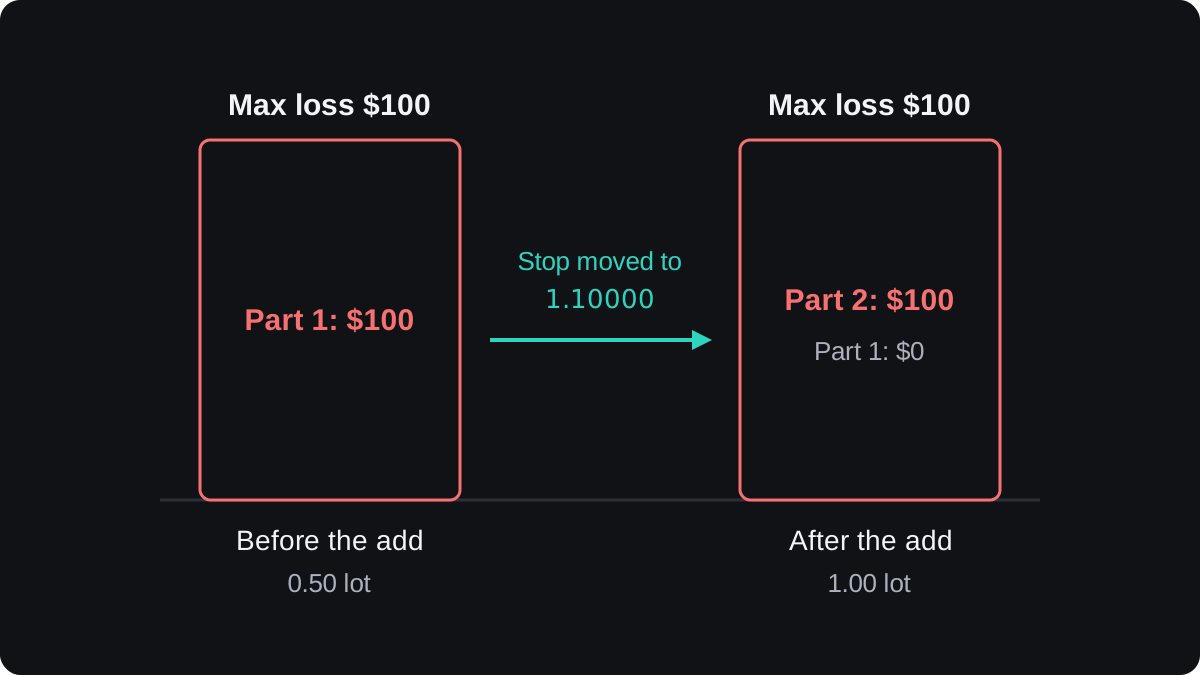
The add size is your choice. With 0.30 lot added at 1.10200 instead, the new part would risk 20 × $3 = $60, so the total would be $60. Smaller adds keep the average entry closer to your first price.
Now say price keeps rising and you close everything at 1.10600. The first part gains 60 pips × $5 = $300. The second gains 40 pips × $5 = $200, for a total of $500.
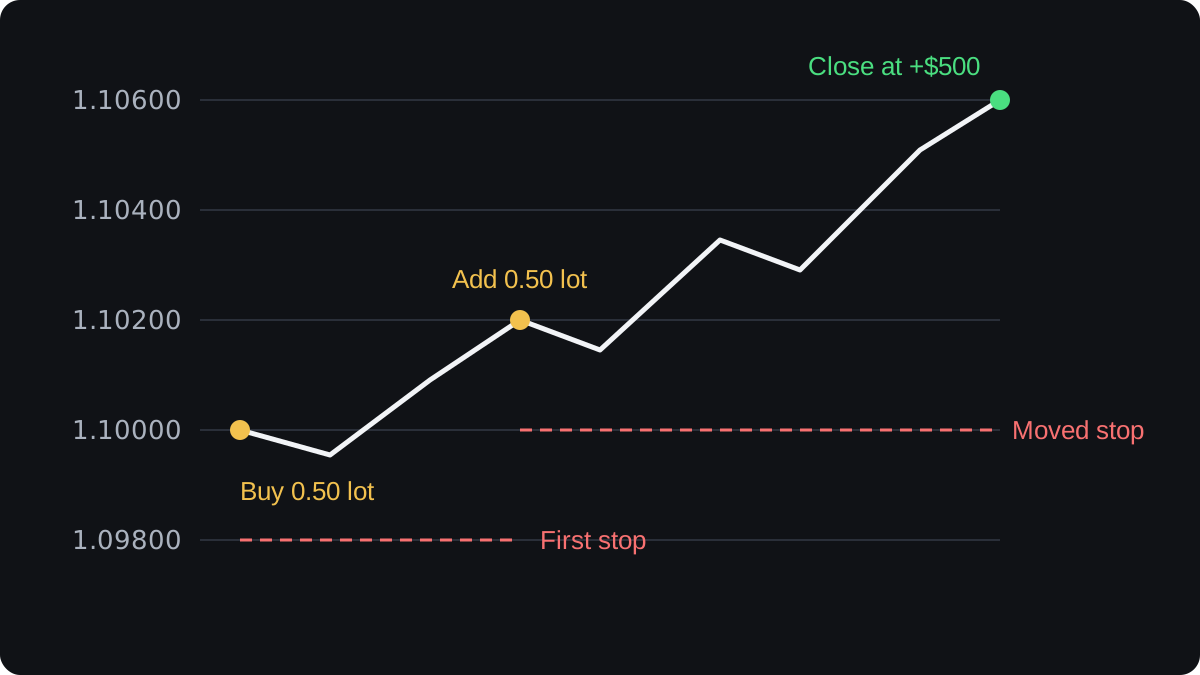
The lot size calculator gives the size for each part once you know its stop distance and the dollar amount you allow it.
What happens if the trade turns against you after the add?
Scaling in changes how the trade ends, and on one path it makes the result worse. Compare the scaled trade with a single 0.50 lot trade whose stop was also moved to 1.10000 when price reached 1.10200.
| Path after entry | 0.50 lot, no add | 1.00 lot, scaled |
|---|---|---|
| Stopped before 1.10200 | −$100 | −$100 |
| Back to 1.10000 after the add | $0 | −$100 |
| Closed at 1.10600 | +$300 | +$500 |
If price never reaches 1.10200, the add never happens and both versions lose the same $100. If it runs to 1.10600, the add earns an extra $200.
The middle row is the price you pay. Without the add, a pullback to 1.10000 closes the trade at breakeven. With the add, the same pullback stops out the second part for a $100 loss.
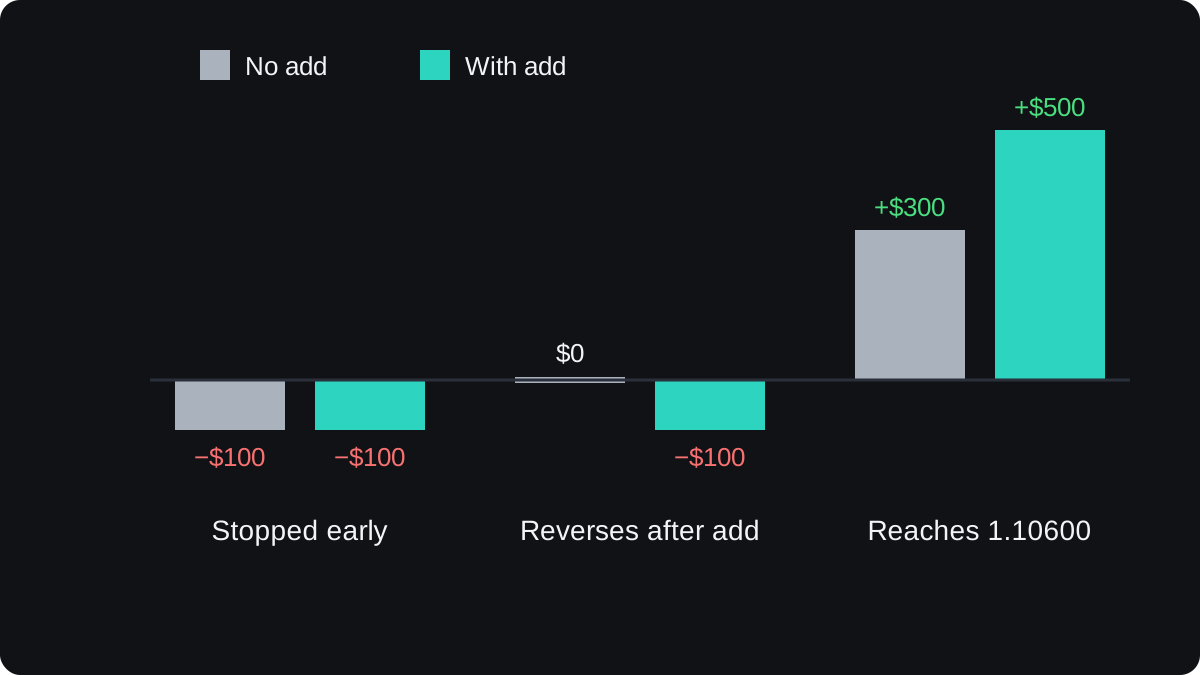
Scaling in swaps some breakeven trades for losses in return for larger winners. Whether that helps depends on how often price keeps going after your add level, and backtesting your own rules is one way to find out.
Pyramiding is widely taught, yet being popular proves nothing about results. Treat it as an idea to test, with no promise that it improves a strategy by itself.
Where scaling in goes wrong
A stop order closes at the next available price. After a weekend gap or a fast news move it can fill beyond your level, and on a bigger position that slippage costs more per pip.
Margin grows with every add. At an illustrative leverage of 1:100, 0.50 lot of EUR/USD at 1.10000 uses $550 of margin, and the full 1.00 lot uses about $1,100. Check your free margin before each add.
Moving the stop to breakeven can get you stopped out by ordinary back and forth. This is the same choice you face with trailing stops: a tight stop protects more but survives less noise.
Spread and commission are charged per lot, so two 0.50 lot parts usually cost about the same as one 1.00 lot trade at the same spread.
The example ignored costs. On a live account, a stop placed exactly at your first entry still loses that part's spread, so breakeven there means breakeven before costs.
Write the add levels, the add sizes and the stop moves into your plan before the first order. Deciding in the moment makes it easy to add because a trade feels good, which is how risk creeps up.
The reverse move, closing a position in parts, is the subject of taking partial profits.
أسئلة شائعة
Is scaling in the same as averaging down?
No. Scaling in is any entry made in parts. Averaging down is the version where you add as price moves against you, which raises your risk unless the stop and total size were fixed in advance.
Does scaling in reduce risk?
It keeps your worst case fixed when you move the stop before each add. If you add without moving the stop, your risk grows with every part.
How many times can you add to a trade?
There is no correct number. Each add needs room to move the stop to a sensible level, so the number is limited by how far price has travelled since your last entry.
Should the second entry be smaller than the first?
It can be either. Equal parts build a larger position, while smaller adds keep the average entry closer to your first price and the worst case below your budget.
Does scaling in cost more in spreads?
Usually about the same. Spread and commission are charged per lot, so the same total size costs roughly the same whether you open it at once or in parts.