Taking partial profits.
Taking partial profits means closing part of an open position at a first target and leaving the rest to run toward a further one. It turns some floating profit into realised profit and swaps a smaller best case for more frequent wins. On the same trades, a 50/50 split averages closing everything at either target.
هذا المحتوى متاح حاليًا باللغة الإنجليزية فقط.

Your trade is 30 pips in profit, and your bigger target is still 30 pips away. You can bank the gain now or let it run.
A third option is to close part of the position now and keep the rest open. This is called taking partial profits, or scaling out. It is the reverse of scaling into a position, where you add to a trade in pieces.
What does taking partial profits mean?
You open one position and close it in pieces at different prices. Each piece you close turns floating profit into realised profit, money that no longer depends on the market. The pieces still open keep moving with price.
A position of 0.20 lot can be closed as two pieces of 0.10 lot, or four of 0.05. The smallest piece is your broker's minimum trade size, often 0.01 lot, so check the contract specification. A 0.01 lot position cannot be split at all.
Each piece usually has its own target. Price reaches the nearer target at least as often as the further one, because every move to the far target passes the near one first.
The far target is reached less often, but each lot closed there earns more.
A worked example with two targets
The prices below are round and illustrative, and the sums ignore spread and commission so the split is easy to follow. On EUR/USD a pip is 0.0001, and 0.10 lot is worth $1 per pip.
- You buy 0.20 lot of EUR/USD at 1.10000. Each pip on 0.20 lot is worth $2.
- Your stop loss sits at 1.09700, 30 pips below entry. The risk is 30 × $2 = $60.
- Target 1 is 1.10300, 30 pips above entry. There you close 0.10 lot for 30 × $1 = $30.
- You then move the stop on the remaining 0.10 lot up to the entry price, 1.10000.
- Target 2 is 1.10600, 60 pips above entry. There you close the last 0.10 lot for 60 × $1 = $60.
- If both targets are reached, the trade makes $30 + $60 = $90.
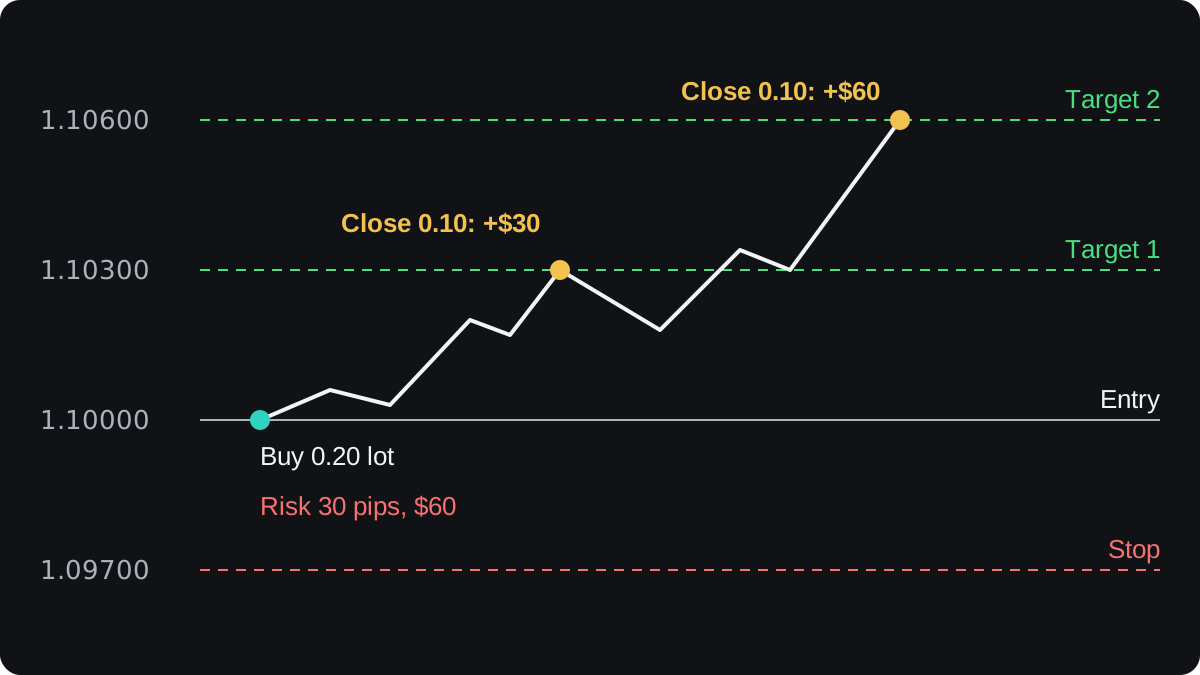
It helps to count in R, where 1R is the amount you risked. Here 1R is $60, so the split trade made $90 ÷ $60 = 1.5R.
Closing all 0.20 lot at target 1 would have made 30 × $2 = $60, which is 1R. Holding all of it to target 2 would have made 60 × $2 = $120, which is 2R. The risk-reward lesson uses the same unit.
How does a split compare with a single exit?
Take three plans for the same entry and stop. Plan A closes all 0.20 lot at target 1. Plan B holds all 0.20 lot for target 2. Plan C is the split above.
In plans B and C, the stop moves to entry once target 1 is reached. Each plan then meets one of three outcomes: the stop is hit first, price reaches target 1 and falls back to entry, or price reaches target 2.
| Outcome | Plan A: all at T1 | Plan B: all at T2 | Plan C: half at each |
|---|---|---|---|
| Stop hit first | -$60 | -$60 | -$60 |
| T1, then back to entry | +$60 | $0 | +$30 |
| T2 reached | +$60 | +$120 | +$90 |
Check the middle row for plan C: the first 0.10 lot closed at +30 pips for $30, and the runner was stopped at entry for $0. In the last row, plan B earns 60 pips × $2 = $120.
When the stop is hit first, all three plans lose the same $60, because nothing has been closed yet. The plans only differ once price reaches target 1.
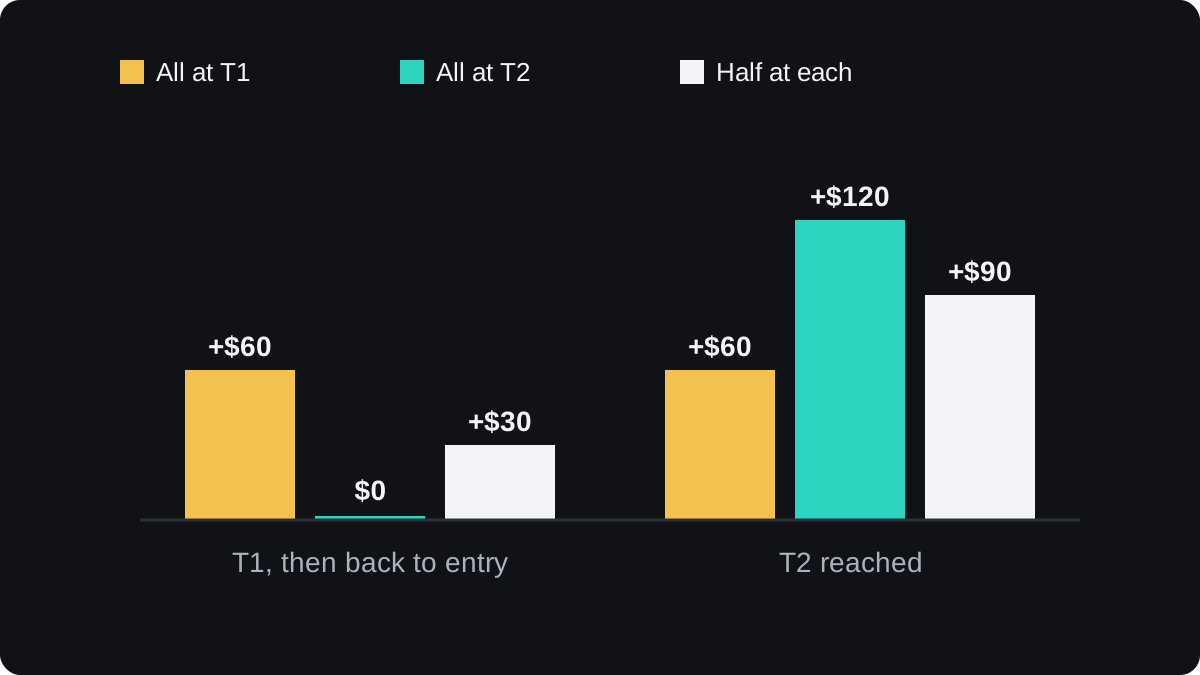
Every figure for plan C sits exactly halfway between plans A and B. This follows from the setup: half of the position follows plan A and the other half follows plan B.
What scaling out does to your average result
Over many trades, your result depends on how often each outcome happens. You cannot know those frequencies in advance. You estimate them from a backtest or from your own past trades.
Here are two illustrative mixes of 10 trades. Neither is a claim about how often real trades behave this way.
Mix A has 4 stops, 4 trades that reach T1 and fall back to entry, and 2 that reach T2:
- Plan A: (4 × -$60) + (4 × $60) + (2 × $60) = +$120, or $12 per trade.
- Plan B: (4 × -$60) + (4 × $0) + (2 × $120) = $0, or $0 per trade.
- Plan C: (4 × -$60) + (4 × $30) + (2 × $90) = +$60, or $6 per trade.
Mix B has 4 stops, 2 trades that fall back to entry, and 4 that reach T2:
- Plan A: (4 × -$60) + (2 × $60) + (4 × $60) = +$120, or $12 per trade.
- Plan B: (4 × -$60) + (2 × $0) + (4 × $120) = +$240, or $24 per trade.
- Plan C: (4 × -$60) + (2 × $30) + (4 × $90) = +$180, or $18 per trade.
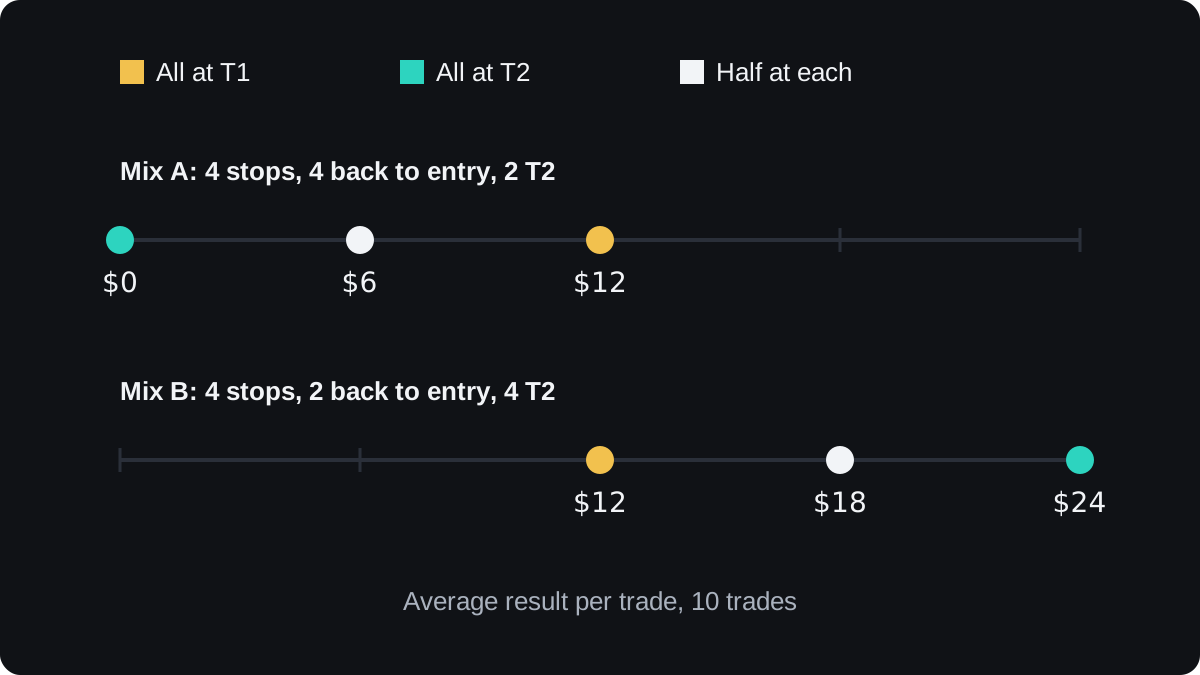
In both mixes, plan C's average is the midpoint of plans A and B. On the same trades with the same stop rules, a half split can never beat the better of the two single-exit plans, and it never does worse than the weaker one.
What the split changes is the pattern of wins and losses. In mix A, plan B wins only 2 trades out of 10, while plan C wins 6. You swap some large wins for more frequent small ones.
Other splits follow the same rule as a weighted average. Close a quarter at target 1 and keep three quarters for target 2, and in mix A the average is 0.25 × $12 + 0.75 × $0 = $3 per trade.
Where partial profits fall short
Your best trades pay less. In the table, plan C gave up $30 of plan B's $120 when target 2 was reached. If your strategy depends on a few large winners, scaling out trims exactly those trades.
A stop at entry can close the runner too early. If price dips back to 1.10000 and then climbs to target 2, the runner is already closed at zero and misses the move.
The entry stop does not guarantee a zero result either. A price gap or slippage can fill the stop below 1.10000, so the runner can still lose a little.
This lesson cannot point to solid public evidence that scaling out by itself improves results. The arithmetic shows a reshaping, with more small wins and a smaller best case, and whether that suits you depends on your own strategy's numbers.
Splitting the exit changes costs very little. Spread and per-lot commission scale with volume, so two closes of 0.10 lot usually cost about the same as one close of 0.20 lot. Each piece does close at the spread of its own moment.
Setting up a partial close on your platform
Most platforms let you close part of an open position by typing a smaller volume into the close window, such as 0.10 of a 0.20 lot position. That works when you are watching the trade.
On MetaTrader, each position holds one take-profit. To exit at two targets automatically, open two positions of 0.10 lot each, give them the same stop, and set a different take-profit on each.
Moving the stop on the runner is usually a manual step. Another choice is to replace target 2 with a trailing stop, which follows price and has trade-offs of its own.
Decide the split, the targets and the stop rule before you enter, and write them into your trading plan. The profit and loss calculator lets you check each piece's result in advance.
أسئلة شائعة
Is taking partial profits a good strategy?
It is a way to manage exits, and it adds no edge to your entries. On the same trades, a half split averages the results of closing everything at the first target or at the second.
How much should I close at the first target?
There is no correct share. Half is easy to manage, and the share you choose decides how close your average lands to the near-target plan or the far-target plan.
Does closing in parts cost more spread?
Usually not, because spread and per-lot commission scale with the volume you trade. Each piece closes at the price of its own moment, so check your broker's terms to be sure.
Should I move my stop to breakeven after a partial profit?
It stops the runner from turning a winning trade into a loss, apart from gaps and slippage. The cost is that a dip back to entry closes the runner before it can reach the further target.