What are currency crosses?
A currency cross is a pair that does not include the US dollar, such as EUR/GBP or AUD/JPY. Its price can be worked out from two dollar pairs: EUR/USD ÷ GBP/USD gives EUR/GBP, and AUD/USD × USD/JPY gives AUD/JPY. A cross moves only when its two currencies move differently against the dollar.
هذا المحتوى متاح حاليًا باللغة الإنجليزية فقط.
EUR/GBP prices the euro in pounds, and AUD/JPY prices the Australian dollar in yen. Neither pair has the US dollar in its name, yet both prices are tied to dollar pairs.
That link decides what moves a cross and how its pip value is worked out in your account.
What counts as a currency cross?
A currency cross is a pair of two currencies where neither is the US dollar. EUR/GBP, EUR/JPY, GBP/JPY, AUD/JPY and AUD/NZD are all crosses.
Traders also call them minor pairs, and in everyday use the two words mean the same thing. The lesson on currency pairs placed them between majors and exotics.
Crosses are often grouped by a currency they share. Euro crosses include EUR/GBP, EUR/JPY, EUR/CHF and EUR/AUD. Yen crosses include EUR/JPY, GBP/JPY and AUD/JPY.
A cross reads like any other pair. The first currency is the base and the second is the quote currency. At 0.8800, one euro costs 0.88 pounds.
How is a cross price worked out from dollar pairs?
Start with two dollar pairs at round illustrative prices: EUR/USD at 1.1000 and GBP/USD at 1.2500.
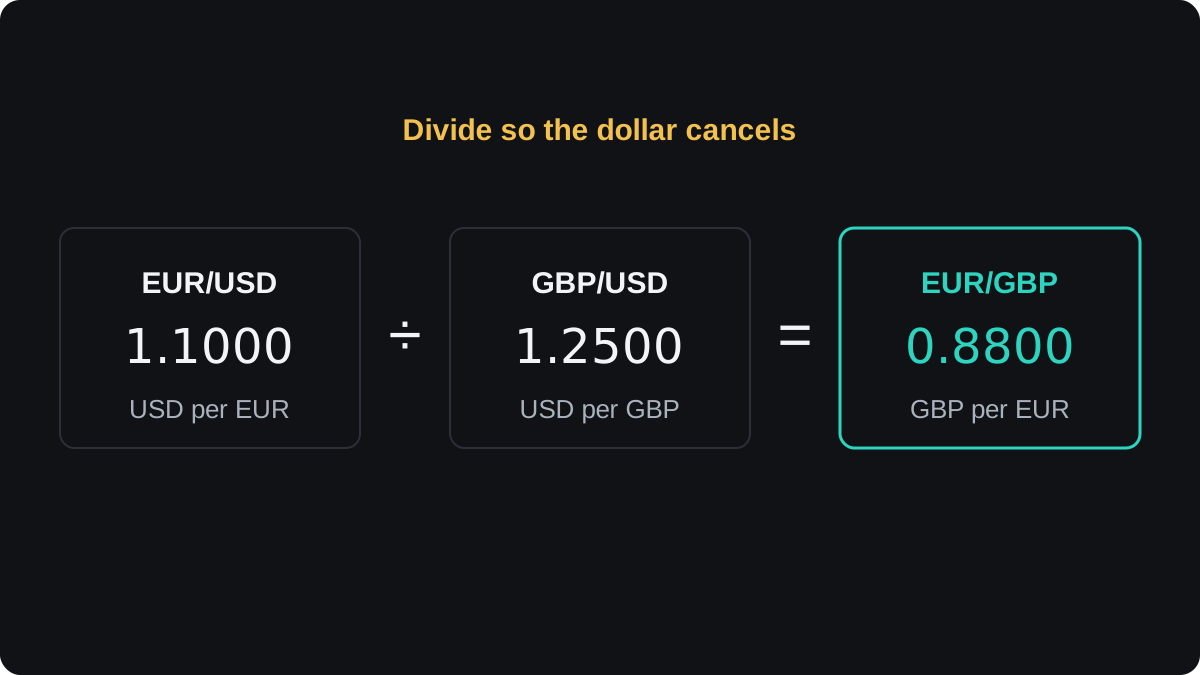
The first says one euro is worth 1.10 dollars. The second says one pound is worth 1.25 dollars. Divide the first by the second and the dollars cancel: 1.1000 ÷ 1.2500 = 0.8800 pounds per euro.
That result is the implied rate of EUR/GBP, the price on which the two dollar pairs agree.
When the dollar sits on opposite sides of the two pairs, you multiply. AUD/USD at 0.6500 gives dollars per Australian dollar, and USD/JPY at 150.00 gives yen per dollar, so AUD/JPY = 0.6500 × 150.00 = 97.50.
When the dollar is the base of both pairs, you divide again. With USD/JPY at 150.00 and USD/CHF at 0.9000, CHF/JPY = 150.00 ÷ 0.9000 = 166.67.
You do not need to memorise the cases. Write each price as units of the quote per one unit of the base, then multiply or divide until the dollar cancels.
Do brokers really price crosses this way?
For thinly traded crosses, often yes. The two dollar pairs are combined, so the cross inherits the spreads of both.
With bid and ask prices, again illustrative, buying EUR/GBP through the dollar means selling pounds at the GBP/USD bid and buying euros at the EUR/USD ask. You get the worse price on both legs.
| Pair | Bid | Ask | Spread |
|---|---|---|---|
| EUR/USD | 1.0999 | 1.1001 | 2.0 pips |
| GBP/USD | 1.2499 | 1.2501 | 2.0 pips |
| EUR/GBP, implied | 0.87985 | 0.88015 | 3.0 pips |
The implied ask is 1.1001 ÷ 1.2499 = 0.88015, and the implied bid is 1.0999 ÷ 1.2501 = 0.87985. The gap of 0.00030 is a spread of 3.0 pips, wider than either leg.
Busy crosses such as EUR/GBP and EUR/JPY also trade directly between banks. Their quotes come from their own buyers and sellers, and can be tighter than the implied spread.
They still cannot drift far from the implied rate. Suppose EUR/GBP traded below it. A bank could buy euros cheaply with pounds, then turn the euros back into pounds through the two dollar pairs and keep the difference.
That trade is triangular arbitrage. It pays only once the gap is bigger than the spreads involved, and the buying and selling it causes pulls the prices back together.
On a retail platform you see one cross with one bid and one ask, however it was built.
The lesson on where your broker's prices come from explains how those quotes reach you, so compare the live bid and ask prices before you assume a cross costs the same as a major.
What moves a cross?
Take the starting prices again. Say the dollar weakens and both EUR/USD and GBP/USD rise 1%, to 1.1110 and 1.2625. EUR/GBP stays at 1.1110 ÷ 1.2625 = 0.8800.
Now say only the euro rises 1% against the dollar. EUR/USD reaches 1.1110, GBP/USD stays at 1.2500, and EUR/GBP climbs to 1.1110 ÷ 1.2500 = 0.8888, up 88 pips.
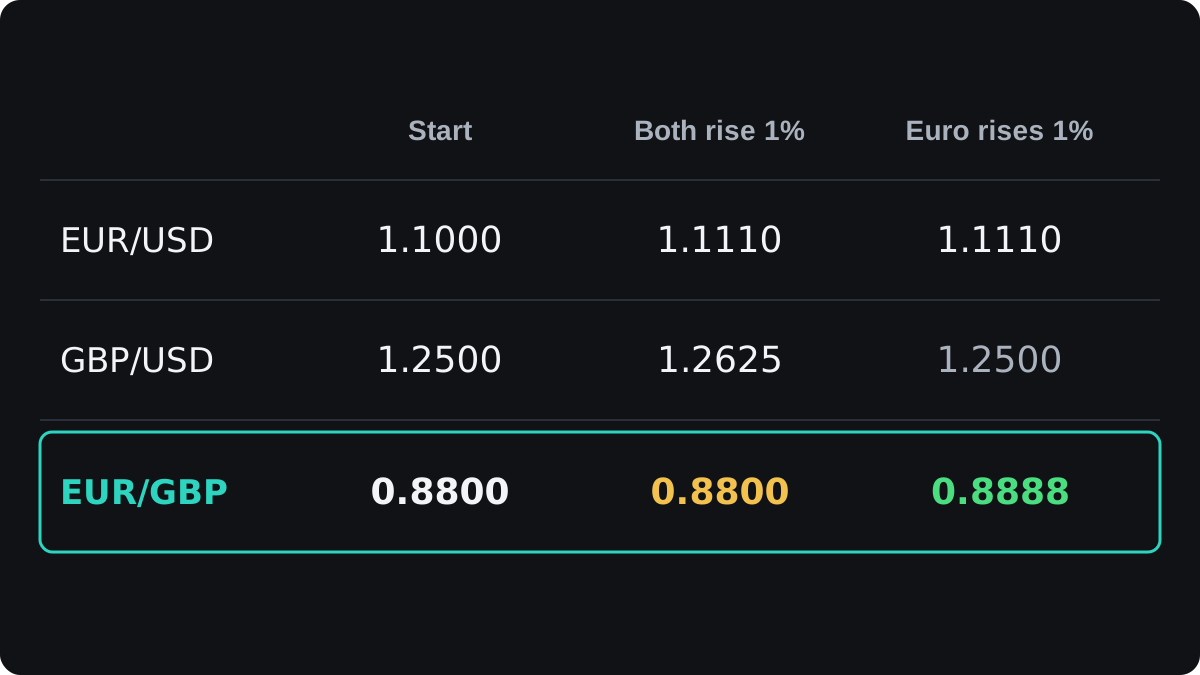
A cross moves only when its two currencies move differently against the dollar. A dollar move that hits both sides by the same percentage cancels out.
That lets you trade a view on two currencies without taking a view on the dollar. Dollar news still reaches a cross through how differently it affects each side, and the next lesson looks at when that matters.
How do you work out pip value on a cross?
Pip sizes follow the usual rule. On EUR/GBP a pip is 0.0001, and on AUD/JPY, like every pair quoted in yen, it is 0.01.
Pip value lands in the quote currency, which on a cross is never the dollar, so a dollar account has to convert it. For one standard lot of 100,000 units of the base:
- EUR/GBP: 0.0001 × 100,000 = £10 per pip. At GBP/USD 1.2500, that is £10 × 1.2500 = $12.50.
- AUD/JPY: 0.01 × 100,000 = ¥1,000 per pip. At USD/JPY 150.00, that is ¥1,000 ÷ 150.00 = $6.67.
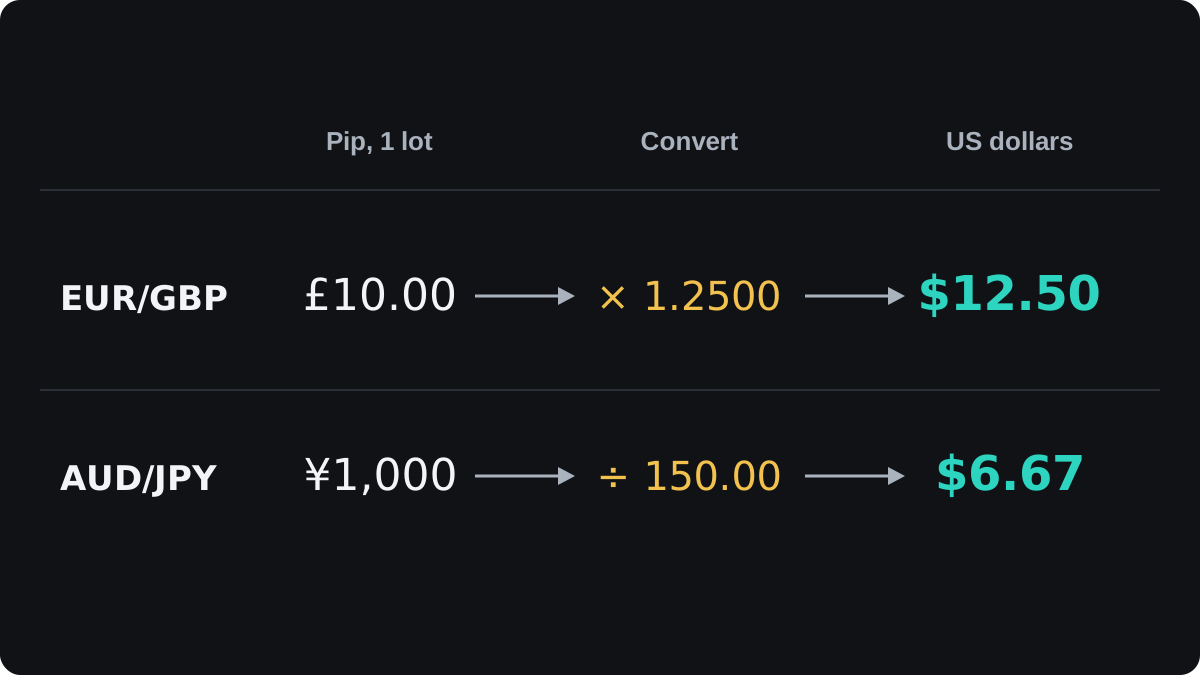
Pounds convert by multiplying because GBP/USD gives dollars per pound. Yen convert by dividing because USD/JPY gives yen per dollar. The pip value calculator does this for any pair and account currency.
How does a trade on a cross make or lose money?
Here is a long trade on EUR/GBP in a US dollar account, with round illustrative prices:
- You buy 0.10 lot of EUR/GBP at the ask, 0.8800. That is 10,000 euros, so one pip is worth £1.
- Later you sell at the bid, 0.8840, to close.
- The move is 0.8840 minus 0.8800 = 0.0040, which is 40 pips.
- The result is 40 × £1 = £40, in the quote currency.
- Your broker converts it at GBP/USD 1.2500: £40 × 1.2500 = $50.00.
You entered at the ask and left at the bid, so the spread is already inside that result. Had the bid fallen to 0.8770 instead, the loss would be 30 pips, £30, or $37.50 at the same rate.
The pip and pound figures are exact. The dollar figure depends on GBP/USD when the broker converts, so the same 40 pips can be worth a little more or less in your account.
أسئلة شائعة
Is EUR/GBP a cross or a major?
It is a cross. Neither currency is the US dollar, and in retail usage the seven major pairs all include the dollar.
How do I calculate a cross rate?
Multiply or divide two dollar pairs so the dollar cancels. EUR/USD 1.1000 ÷ GBP/USD 1.2500 gives EUR/GBP 0.8800, and AUD/USD 0.6500 × USD/JPY 150.00 gives AUD/JPY 97.50.
Are cross pairs more expensive to trade?
Often a little, because a thinly traded cross carries the spreads of two dollar pairs. Busy crosses such as EUR/GBP can be quoted tightly, so check the live spread on your own account.
What is a yen cross?
A pair that sets the Japanese yen against a currency other than the dollar, such as EUR/JPY, GBP/JPY or AUD/JPY. Its pip is 0.01, like every pair quoted in yen.
Does the US dollar affect cross pairs?
Only through how differently it moves each side. If both dollar pairs rise or fall by the same percentage, the cross does not move.