Pipette
このページは現在、英語版のみです。
A pipette is one tenth of a pip, shown as the extra last digit of most forex quotes. On EUR/USD it is 0.00001, the fifth decimal, and on yen pairs such as USD/JPY it is 0.001. Traders also call it a fractional pip.
Most brokers quote prices to one more decimal than the pip, and that last digit counts pipettes. The pip lesson shows pips and pipettes side by side.
How to read a pipette
In EUR/USD at 1.10013, the fourth decimal is the pip digit and the fifth, the 3, is the pipette digit.
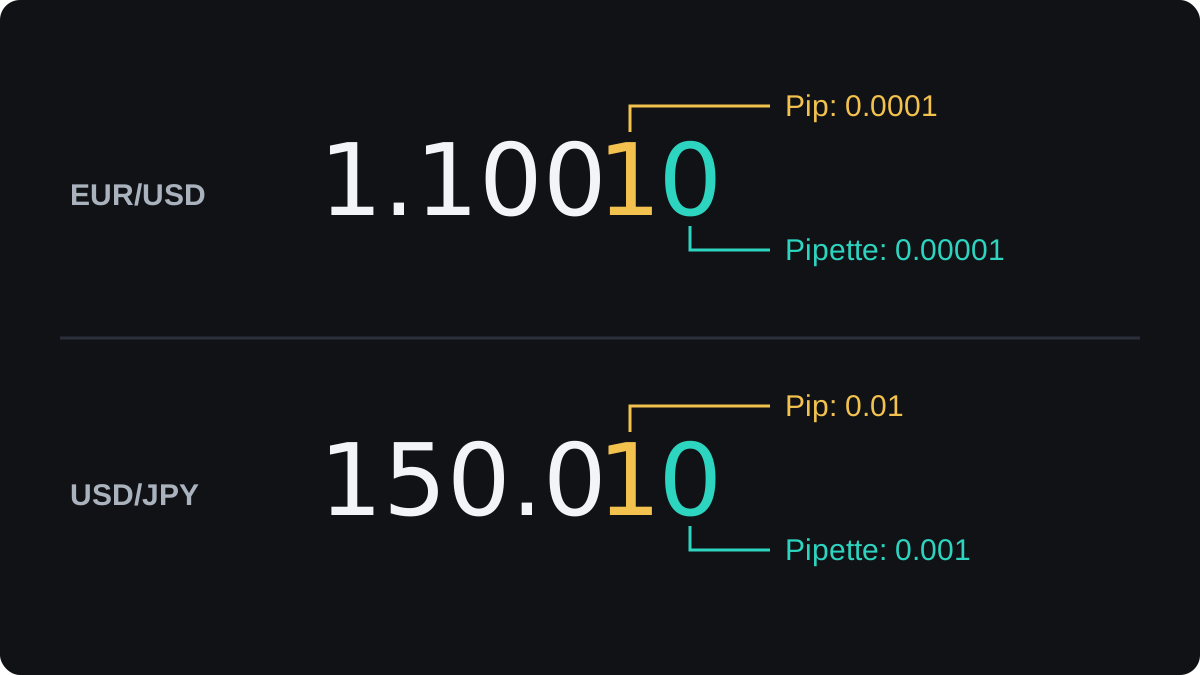
With round illustrative prices, a move from 1.10010 to 1.10013 is 3 pipettes, or 0.3 pip. On USD/JPY, a move from 150.010 to 150.015 is 5 pipettes, or 0.5 pip.
Pipettes, points and stop settings
MetaTrader calls the smallest price step a point. On a five decimal or three decimal quote, one point is one pipette, so 10 points make one pip.
That matters when you type in a distance. A stop loss 50 points from your entry is only 5 pips away.
Spreads are often shown in points as well, so a spread of 8 points on EUR/USD is 0.8 pip.
よくある質問
What is the difference between a pip and a pipette?
A pip is 0.0001 on most pairs and 0.01 on yen pairs. A pipette is one tenth of that, 0.00001 or 0.001.
Is a point the same as a pipette?
On five and three decimal quotes, yes: MetaTrader's point is the smallest price step, which there equals one pipette. On a four or two decimal quote, one point equals a full pip.
関連用語

Pip
A pip is the standard unit for measuring a change in a forex price. On most currency pairs it is 0.0001, the fourth decimal place, and on pairs quoted in Japanese yen it is 0.01. One tenth of a pip is called a pipette.

Spread
The spread is the gap between the ask, where you buy, and the bid, where you sell. You pay it on every trade as soon as the trade opens, and it is quoted in pips or, on MetaTrader, in points.

Bid price
The bid price is the price at which you can sell a currency pair right now. It is the lower of the two prices in every forex quote. You open a sell trade at the bid, and you close a buy trade at the bid.

Ask price
The ask, or offer, is the price at which you can buy a currency pair right now. It is the higher of the two prices in every forex quote. You open a buy trade at the ask, and you close a sell trade at the ask.

Pip value
Pip value is the amount of money a one pip move adds to or takes from a position. It equals the pip size times the units traded, counted in the quote currency. On one standard lot of EUR/USD in a US dollar account it is $10.

Lot
A lot is the standard unit of trade size in forex. One standard lot is 100,000 units of the base currency, a mini lot is 10,000 and a micro lot is 1,000. MetaTrader shows these sizes as volumes of 1.00, 0.10 and 0.01.

Market order
A market order is an instruction to buy or sell straight away at the best price available. A buy fills at the ask and a sell at the bid. You get a fast fill but not a guaranteed price, so in a fast market the fill can slip.

Pending order
A pending order is an instruction to trade later, once price reaches a level you set. Limit orders wait for a better price than now; stop orders wait for price to break through a level. Until it triggers, no position is open.

Stop loss
A stop loss is an order that closes your trade at a set price to cap the loss. It turns into a market order when price reaches it, so in a fast market or a gap it can fill at a worse price.

Take profit
A take profit is an order that closes your trade at a target price, locking in the gain. It works like a limit order: it fills at your price or better, and only if price gets there.

Forex
Forex (foreign exchange, or FX) is the global market for trading currencies. Every price is quoted as a pair, such as EUR/USD, and trading happens over the counter between dealers rather than on one central exchange.

Currency pair
A currency pair is the price of one currency in terms of another, such as EUR/USD. The first is the base currency, the second is the quote currency, and the price is how much of the quote currency buys one unit of the base.

Base currency
The base currency is the first currency in a currency pair, the one whose price is quoted. In EUR/USD it is the euro, so a price of 1.10000 means one euro costs 1.10000 US dollars. Buying the pair means buying the base currency.

Quote currency
The quote currency is the second currency in a pair, the one the price is counted in. In EUR/USD it is the US dollar, so 1.10000 means one euro costs 1.10000 dollars. Pip value and profit on the pair are worked out in the quote currency first.

Exchange rate
An exchange rate is the price of one currency in terms of another. EUR/USD at 1.10000 means one euro exchanges for 1.10000 US dollars. On a trading platform every rate comes as two prices: a bid you can sell at and a higher ask you can buy at.

Long and short positions
Long and short positions are the two directions a trade can take. Going long means buying a currency pair to profit if its price rises. Going short means selling it to profit if the price falls. In forex you can sell a pair as easily as you buy it.

Leverage
Leverage is the ratio between the size of a position and the margin needed to open it. At 1:100, each $1 of margin controls $100 of position. Leverage sets how much margin a trade locks, not how much each pip is worth.

Margin
Margin is the part of your account set aside as a deposit for an open leveraged trade. It equals the position's value divided by your leverage. It is not a fee, and it is released when the trade closes.

Free margin
Free margin is the part of your equity not tied up as margin by open trades. It equals equity minus used margin. You need free margin to open new positions, and it shrinks as open trades lose money.

Equity
Equity is your account's value right now: balance plus or minus floating profit or loss. It counts every open position. Free margin and margin level are both worked out from equity, not from the balance.

Account balance
Your balance is the money in your account from deposits, withdrawals and closed trades. It does not move with open positions. Their floating profit or loss is counted in equity instead, so balance and equity differ while trades are open.

Margin level
Margin level is your equity divided by the margin used by open trades, times 100%. It shows how well those trades are covered. Brokers compare it with their margin call and stop out levels, which differ by broker and account type.

Margin call
A margin call is a warning that your margin level has hit the broker's threshold. Your open trades are thinly covered, but it does not close them by itself. If losses continue to the stop out level, the broker closes them.

Stop out
Stop out is the margin level at which your broker starts closing your positions. The biggest loser usually goes first, because equity no longer covers the margin they need. The exact level depends on the broker and the account type.

Over-the-counter (OTC) market
In an over-the-counter (OTC) market, traders deal directly with no central exchange. Spot forex works this way: dealer banks quote prices to each other and to brokers, so there is no single official price at any moment.

Liquidity provider
Liquidity providers are banks and firms that quote buy and sell prices to a broker. They stand ready to trade at those prices. A broker combines their quotes into the bid and ask you see, sometimes adding its own markup to the spread.

Liquidity
Liquidity is how easily you can buy or sell an amount without moving the price much. In a liquid market many quotes with real volume sit near the current price, so spreads are tight and orders fill close to the price you see.

Trading session
A trading session is one block of the 24-hour forex day, named after a financial centre. The four are Sydney, Tokyo, London and New York. Sessions overlap, and the London and New York overlap is usually the busiest part of the day.

Commission
Commission is a fixed fee per lot charged on top of a thin spread. Raw and zero spread accounts are the main ones that charge it. It is quoted per side, for opening or for closing, or per round turn, which covers both, and it is due win or lose.

Swap (overnight fee)
Swap is the interest you pay or earn for holding a position past the daily rollover. Rollover falls at 17:00 New York time. The amount comes from the interest rate gap between the two currencies plus the broker's markup, and Wednesday usually counts three nights.

Slippage
Slippage is the gap between the price you asked for and the price you got. It happens when the market moves before execution, most often around news, the daily rollover and the weekly open, and it can go for or against you.

Raw spread account
A raw spread account has a near-market spread and charges a commission per lot instead. Brokers call these accounts Raw, Raw Spread, Zero or ECN. Whether one is cheaper depends on the symbol you trade.

Forex rebate
A forex rebate is money paid back to you for every lot you trade. The broker funds it from the commission it pays the introducing broker on your account, and that partner passes some or all of it to you. Your spread and conditions stay the same.

Introducing broker (IB)
An introducing broker (IB) refers clients to a broker for a commission on their volume. It does not hold your account or your money. A rebate service is an IB that passes that commission back to you.

IB commission
IB commission is what a broker pays an introducing broker per lot its clients trade. The broker funds it from the spread and fees it already earns, so the trader pays nothing extra. A rebate is a share of it.

Breakeven
Breakeven is the point at which a trade covers its own costs and closes at zero. Because you pay the spread and any commission when you open, price must first move your way by that many pips. A rebate cuts the net cost and moves breakeven closer.

Trading bonus
A trading bonus is promotional credit a broker adds to your account. It is usually sized to your deposit and often comes with conditions, such as a volume target before withdrawal, and can be removed when you withdraw. A rebate is cash and carries no such conditions.

