How does buying and selling a currency pair work?
Buying a currency pair buys the first currency and sells the second, so you gain if the price rises. Selling does the opposite and gains if it falls. A buy opens at the ask and closes at the bid, and a sell does the reverse. Profit and loss land in the quote currency.
ខ្លឹមសារនេះមានតែជាភាសាអង់គ្លេសសិន។
You can trade a currency pair in either direction. Buy it and you gain if the price rises. Sell it and you gain if the price falls.
Your result is the gap between the price you opened at and the price you closed at, multiplied by the size of the trade.
How do you read a currency pair?
A pair reads from left to right. The first code is the base currency, the one being priced. The second is the quote currency, the one the price is written in.
The starting prices in this lesson are real readings from AutoFXRebate's public market data: the MetaTrader 5 feed of an Exness Standard account at 01:05 UTC on 30 October 2026. Treat them as examples, because live prices will differ.
At that moment you could buy EUR/USD at 1.12011, the price called the ask, so one euro cost 1.12011 US dollars.
The base currency always counts as one unit, and the price says how much of the quote currency buys that unit.
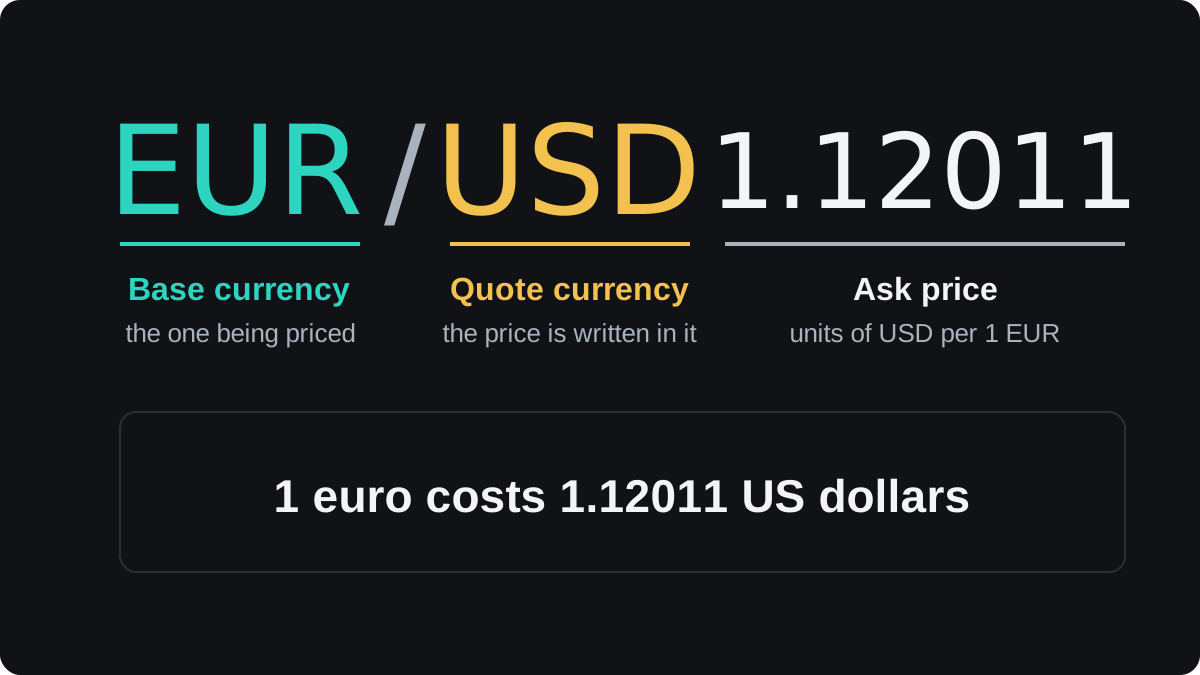
USD/JPY puts the dollar on the left, so its ask of 157.323 meant one US dollar cost 157.323 yen.
Market custom fixes which name goes first. A platform shows EUR/USD whichever way you plan to trade, and if you expect the euro to fall, you sell that same pair.
A bigger number does not mean a stronger currency. The USD/JPY price is high because a yen is a small unit of money.
AUD/CAD makes the same point with a low number. Its ask of 0.98117 meant one Australian dollar cost slightly less than one Canadian dollar, and that says nothing about which economy is doing better.
A currency has strengthened when one unit buys more of the other currency than it did before, whatever number the pair started from.
What happens when you buy or sell a pair?
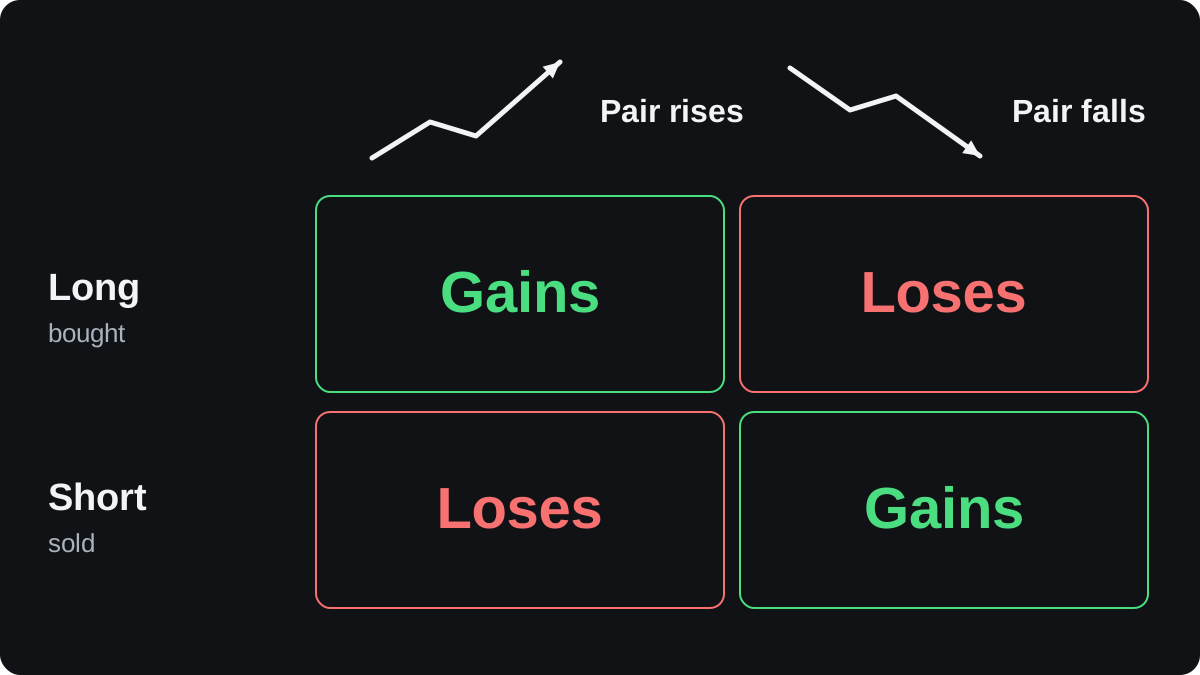
Buying a pair is called going long: you buy the base currency and sell the quote currency. Selling a pair is called going short: you sell the base and buy the quote.
An open trade is a position. When a pair rises, one unit of the base buys more of the quote, so a long position gains and a short position loses. A fall does the reverse.
You can sell a currency you do not own because what a retail trader holds is a cash-settled contract with a broker. No currency changes hands, so your account needs only margin, the deposit held while the trade is open.
Which price do you get when you open and close?
So far each pair has had one price. A platform always shows two, and the one you get depends on whether your order is a buy or a sell.
The ask is the higher price, where you can buy. The bid is the lower price, where you can sell. The gap between them is the spread.
Take GBP/USD, with a bid of 1.33956 and an ask of 1.33966. A pip, the standard step of price movement, is 0.0001 on this pair, so the gap of 0.00010 is a spread of 1.0 pip.
You buy at the ask and sell at the bid, whether the order opens a trade or closes one. Closing means placing the opposite order, so every round trip, one open plus one close, uses both prices.
| What you do | Your order | Price you get |
|---|---|---|
| Open a long | Buy | Ask |
| Close a long | Sell | Bid |
| Open a short | Sell | Bid |
| Close a short | Buy | Ask |
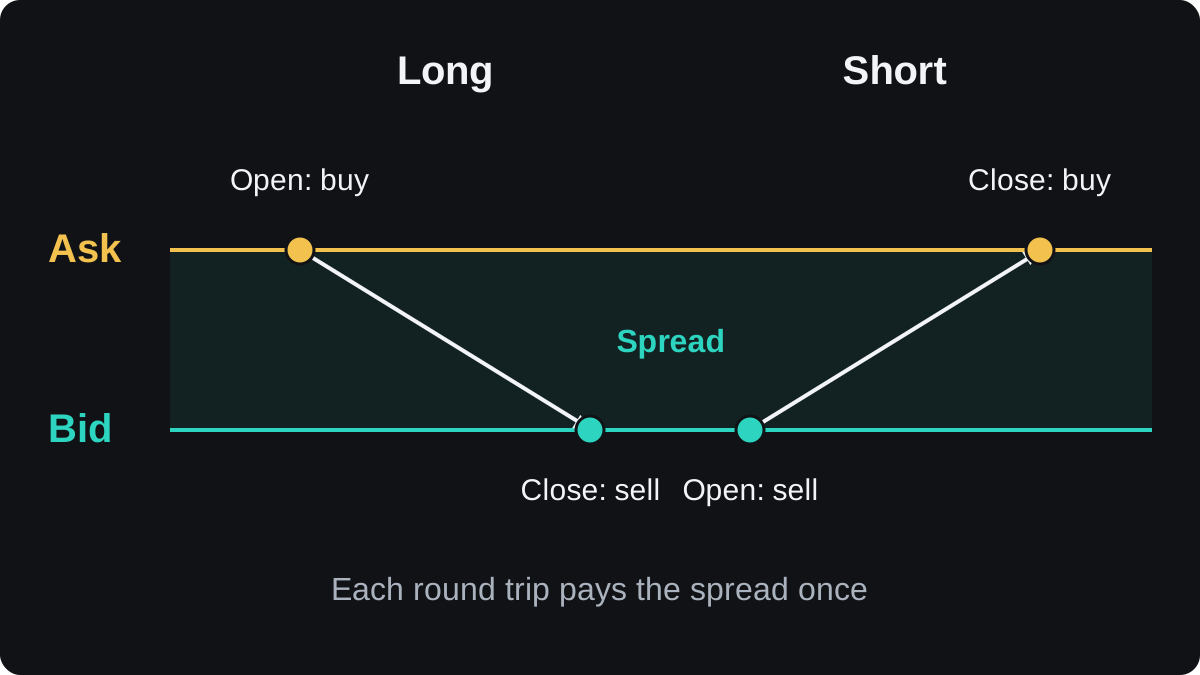
This is why a new trade shows a small loss the moment it opens. You entered at one price and can only leave at the other, so the loss equals the spread.
The market then has to move by the full spread in your favour before the trade breaks even. The bid and ask lesson looks at both prices in more detail.
How does a long trade make or lose money?
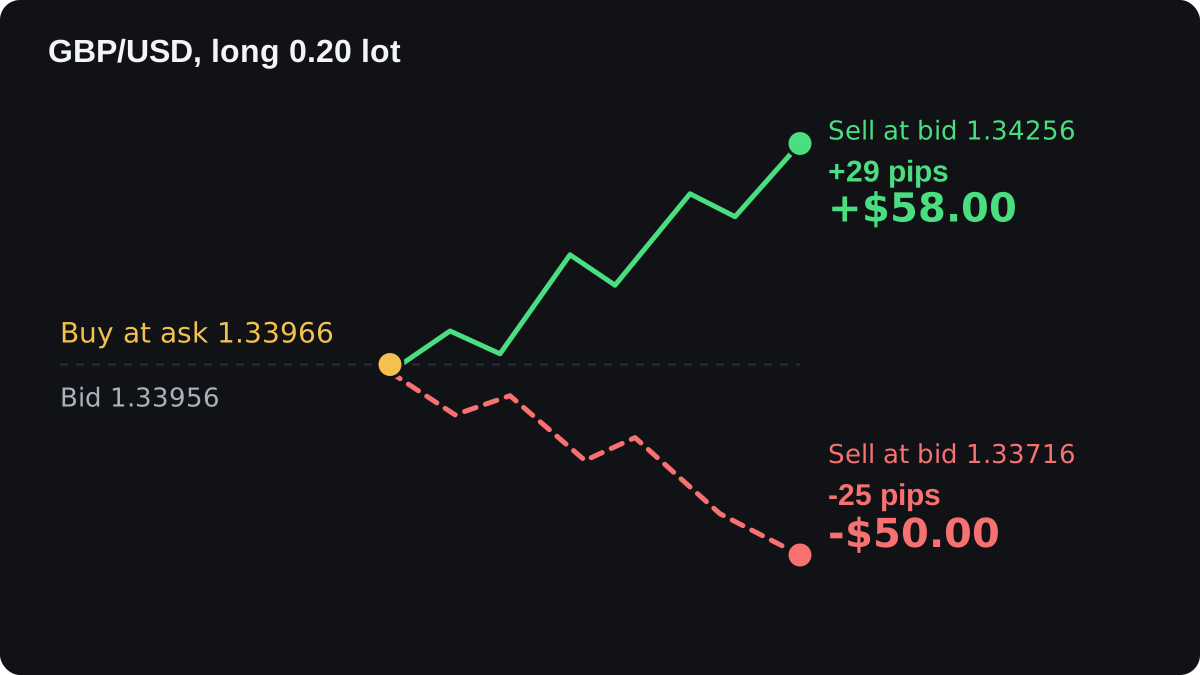
Say you expect the pound to rise against the dollar, so you buy 0.20 lot of GBP/USD. A standard lot is 100,000 units of the base currency, so the position's notional, its full face amount, is 20,000 pounds.
You will close with a sell, so the bid is the price to watch. The entry is the real reading, and the later prices here and in the short trade are illustrative.
- Work out the pip value. One pip is a move of 0.0001 dollars per pound, so on 20,000 pounds it is 20,000 × 0.0001 = $2.00.
- Open at the ask, 1.33966. The bid is 1.33956, so closing at once would lose 1.0 pip, or $2.00.
- Later the bid reaches 1.34256, and you sell at the bid to close: 1.34256 − 1.33966 = +0.00290.
- That gap is +29 pips, and 29 × $2.00 = +$58.00.
- Had the bid fallen to 1.33716 instead, the sum would be 1.33716 − 1.33966 = −0.00250.
- That gap is −25 pips, and 25 × $2.00 = −$50.00.
The spread is already inside both results. You entered at the ask and left at the bid, so the 1.0 pip you saw at entry needs no separate deduction.
These sums cover price only, so any commission, a fee per trade, would be separate. The profit and loss calculator repeats this arithmetic for other pairs and sizes.
How does a short trade make or lose money?
Now you expect the dollar to fall against the yen, so you sell 0.10 lot of USD/JPY, a notional of 10,000 dollars. On JPY pairs a pip is 0.01.
You will close with a buy, so the ask is the price to watch. You sold first and buy back later, so the sum runs the other way: opening price minus closing price.
- Work out the pip value. One pip is a move of 0.01 yen per dollar, so on 10,000 dollars it is 10,000 × 0.01 = ¥100.
- Open at the bid, 157.313. The ask is 157.323, so closing at once would lose 1.0 pip, or ¥100.
- Later the ask falls to 156.823, and you buy at the ask to close: 157.313 − 156.823 = +0.490.
- That gap is +49 pips, and 49 × ¥100 = +¥4,900.
- In a dollar account the broker converts at the current rate: ¥4,900 ÷ 156.823 = $31.25.
- Had the ask risen to 157.723 instead, the sum would be 157.313 − 157.723 = −0.410.
- That gap is −41 pips, and 41 × ¥100 = −¥4,100, which is ¥4,100 ÷ 157.723 = $25.99 lost.
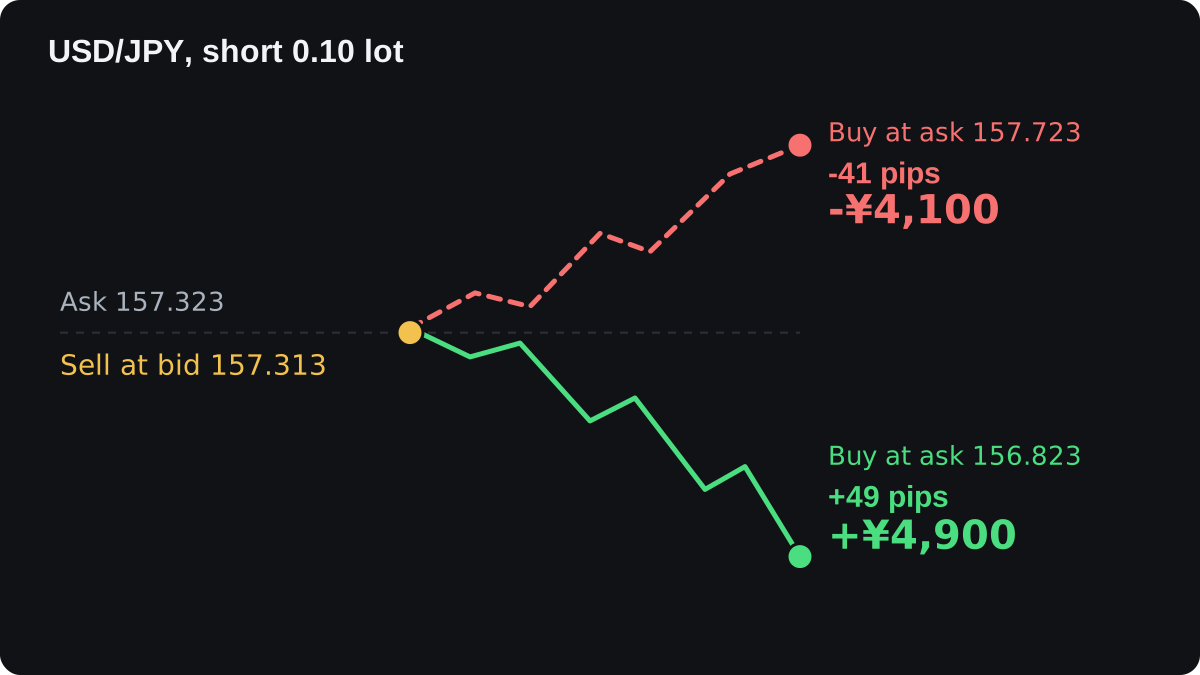
The pips and the yen are exact. The dollar figures depend on the rate when the broker converts, so treat $31.25 and $25.99 as examples.
Which currency is your profit paid in?
Profit and loss land in the quote currency, the second name in the pair. On GBP/USD that is dollars, on USD/JPY it is yen and on AUD/CAD it is Canadian dollars.
Your broker then converts the result into your account currency, the one your balance is held in, at the current rate. In a US dollar account, the long trade's $58.00 needed no conversion.
The short trade's ¥4,900 did. USD/JPY says how many yen one dollar costs, so dividing the yen by that rate gives dollars.
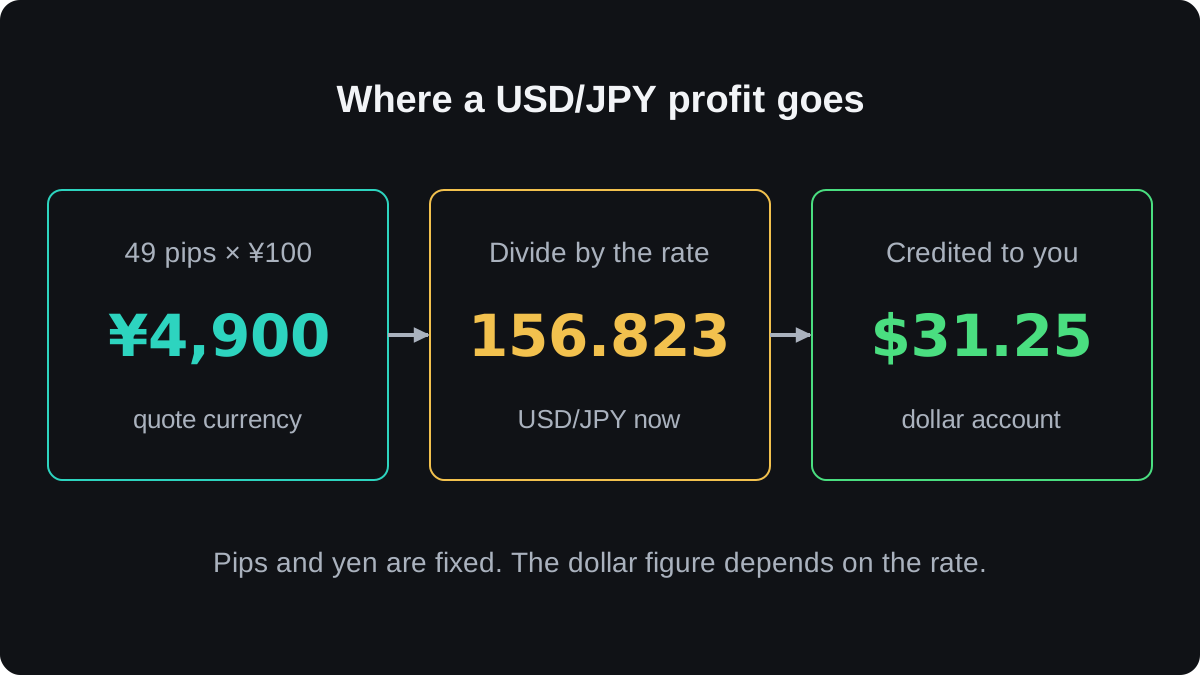
In a US dollar account, a pair without the dollar needs a rate from another pair. Suppose a trade on AUD/CAD gains C$40, a figure chosen only to illustrate the conversion.
The gain is in Canadian dollars, so your broker converts it through USD/CAD. At the ask from the same reading, 1.39706, C$40 ÷ 1.39706 = $28.63.
What are major, cross and exotic pairs?
Traders sort pairs into three groups. The groups rest on market custom, and no regulator publishes them.
A major pair sets the US dollar against one of the other seven major currencies. That gives seven pairs: EUR/USD, USD/JPY, GBP/USD, USD/CHF, AUD/USD, USD/CAD and NZD/USD.
A cross, also called a minor, joins two major currencies without the US dollar. EUR/GBP, EUR/JPY, GBP/JPY and AUD/NZD are all crosses.
An exotic sets a major currency against the currency of a smaller or emerging economy. Examples are USD/TRY (Turkish lira), USD/ZAR (South African rand), USD/MXN (Mexican peso) and EUR/TRY.
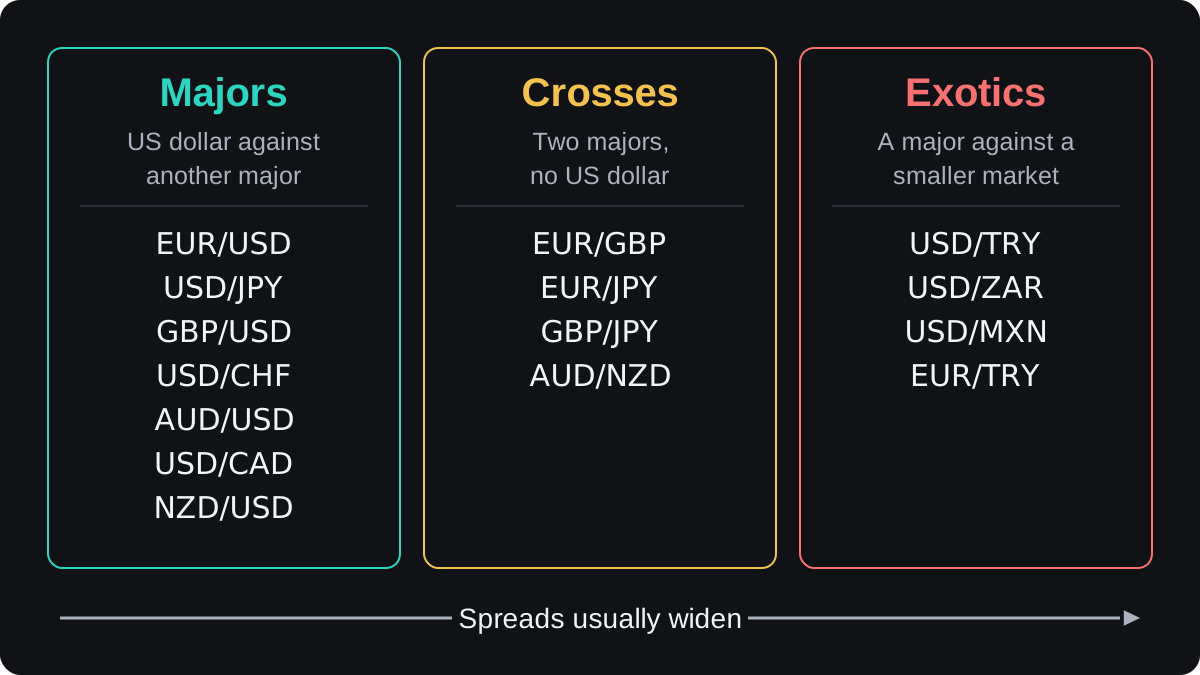
Exotic spreads are usually wider, so read your broker's contract specifications, the terms it publishes for each instrument, before you trade one.
Exotics can also jump on local events, such as an election, a central bank move or a change in capital rules, the limits on money moving in and out of a country.
High-interest currencies can bring large overnight swap charges or credits. Swap is interest charged or paid on a position held past about 17:00 New York time.
A few wider labels each name a set of currencies:
| Label | What it covers |
|---|---|
| Scandies | Swedish krona (SEK) and Norwegian krone (NOK) |
| G10 | The eight major currencies plus the two Scandies |
| CEE | Central and Eastern Europe: Polish zloty, Hungarian forint, Czech koruna |
| BRICS | The original five: Brazilian real, Russian rouble, Indian rupee, Chinese yuan, South African rand |
Which pairs trade the most, and which cost least?
The BIS survey of April 2025, run by the Bank for International Settlements, measured turnover, the total notional value of new deals.
In its final tables, EUR/USD took 20.7% of global forex turnover, USD/JPY 14.4%, USD/CNY 8.2% and GBP/USD 7.5%. Those four pairs make up about half of the total.
The largest pair without the US dollar was EUR/GBP, at 1.8%.
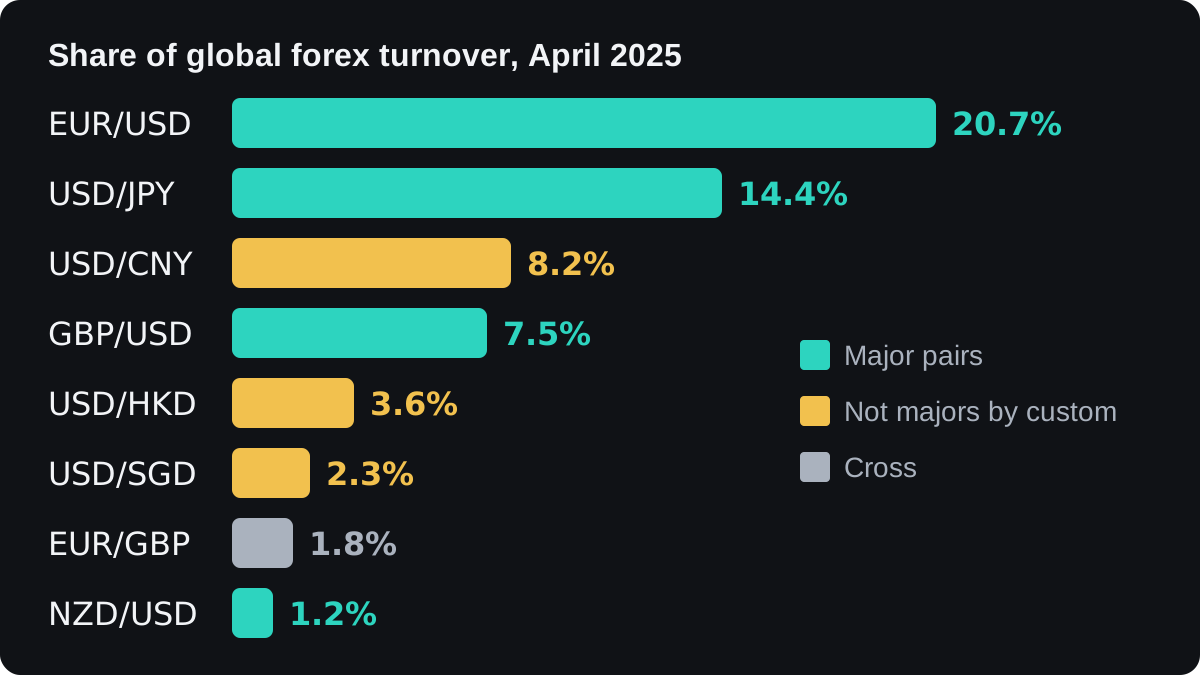
These shares cover all forex instruments, not only spot deals (exchanges at today's rate).
Volume does not decide the labels. USD/CNY moved past GBP/USD to third place in April 2025, behind only EUR/USD and USD/JPY, yet retail vocabulary does not call it a major pair.
Almost all yuan trading is against the US dollar. Retail platforms that list the yuan often show the offshore version, USD/CNH, for yuan traded outside mainland China.
Broker lists follow custom too. Many file USD/HKD and USD/SGD under exotics, although USD/HKD took 3.6% of turnover and USD/SGD 2.3%. NZD/USD, one of the seven majors, took 1.2%.
Liquidity, how much buying and selling a pair attracts, tends to narrow the spread, so a major pair usually costs less to enter and leave.
On the same Exness Standard account, 12-hour median spreads on the seven majors ran from 0.8 pip on EUR/USD to 1.4 pips on USD/CAD and NZD/USD. A median is the middle reading.
AUD/CAD and NZD/CAD, the two crosses in that reading, both came in at 1.8 pips, more than double EUR/USD on this account.
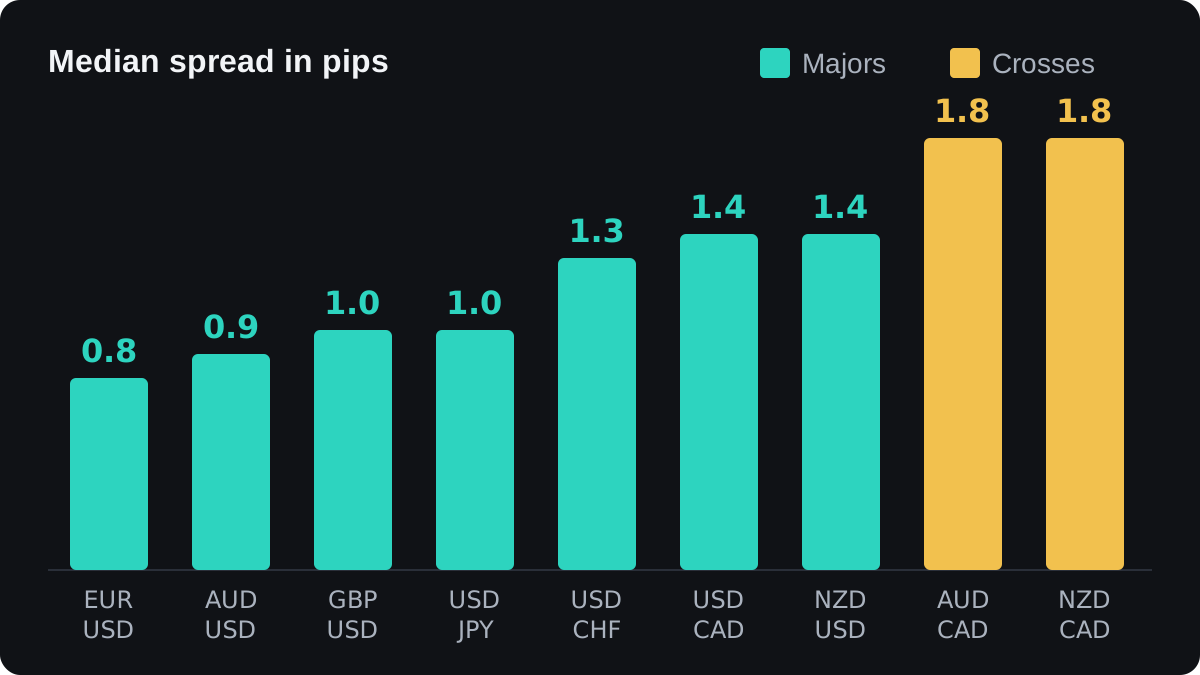
On 0.10 lot, a pip is worth $1 on EUR/USD, so 0.8 pip costs $0.80. On AUD/CAD it is worth C$1, so 1.8 pips cost C$1.80, which is $1.29 at the USD/CAD rate of 1.39706.
This is one account on one day, so check current spreads before you rely on these numbers. The chart has no exotics because this lesson has no measured figure for them.
The spread is one part of your cost, and commission and swap can add to it.
An introducing broker earns a commission from the broker on your trades, and a rebate passes part of that commission back to you, which lowers your cost per round trip.
សំណួរ
Does buy mean the price goes up?
No. Buying means you gain if the price goes up and lose if it goes down instead.
What is the base currency?
The first currency in a pair, the one being priced. In GBP/USD it is the pound, and the price says how many US dollars one pound costs.
Why is my trade negative right after opening?
You opened at one price and would close at the other. On 0.20 lot of GBP/USD with a 1.0 pip spread, that is $2.00 before the price has moved.
Are exotic pairs good for beginners?
They are a harder place to start. Spreads are usually wider and prices can jump on local news, so read the contract specifications first.
What is the difference between a cross and a minor pair?
None in everyday use. Both words describe a pair of two major currencies without the US dollar, such as EUR/GBP or AUD/NZD.
បន្តរៀន
 ជំពូក 1What is forex trading?Forex trading is exchanging one currency for another, either because a business needs the currency or to profit from a change in the exchange rate. Prices are quoted in pairs such as EUR/USD, with a bid to sell at and an ask to buy at. Forex turnover averaged $9.5 trillion a day in April 2025.
 ជំពូក 1What is traded in the forex market?The forex market trades currencies, always two at a time: every deal buys one and pays with another. Eight are known as the majors, and the US dollar was on one side of 89% of turnover in April 2025. A retail trader receives no currency and instead holds a cash-settled contract with a broker.
 ជំពូក 1How big is the forex market, and what is liquidity?Forex turnover averaged $9.5 trillion a day in April 2025, in the final results of the BIS Triennial Survey. The figure adds up the face value of new deals. Liquidity is how easily you can trade without moving the price. In AutoFXRebate's measurements, EUR/USD spreads held steady through the sessions and widened sharply at the daily rollover.
 ជំពូក 1Ways to trade forex: spot, forwards, swaps, futures, options and CFDs.Currencies change hands as spot deals, outright forwards, FX swaps, currency swaps, options and futures. Spot settles within two business days, a forward fixes a rate for a later date, and an FX swap pairs an exchange now with its reverse later. Retail traders usually trade CFDs or rolling spot, cash-settled contracts with a broker.

