 សទ្ទានុក្រម · មូលដ្ឋាននៃការជួញដូរ Margin
Leverage
ខ្លឹមសារនេះមានតែជាភាសាអង់គ្លេសសិន។
Leverage is the ratio between the size of a position and the margin needed to open it. At 1:100, each $1 of margin controls $100 of position. Leverage sets how much margin a trade locks, not how much each pip is worth.
Leverage is what lets a small account open a full-size forex trade. The leverage lesson works through effective leverage and how to choose a setting.
How leverage works
Leverage links the size of a position to the deposit it needs:
Required margin = position value ÷ leverage
Take 0.10 lot of EUR/USD at an illustrative 1.10000. The position is worth 10,000 × 1.10000 = $11,000, so at 1:100 the margin is $11,000 ÷ 100 = $110.
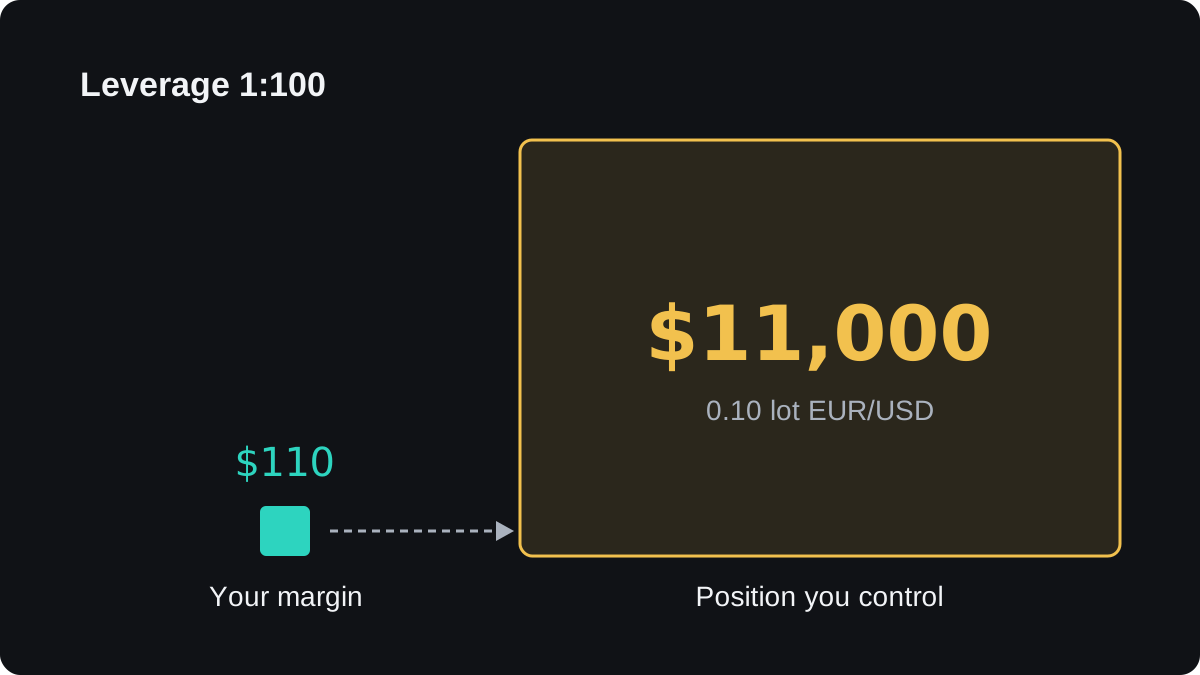
At 1:500 the same trade would lock $22. The margin rate is 100 ÷ leverage as a percentage, so 1% at 1:100 and 0.2% at 1:500.
The leverage calculator runs this for any pair and size.
Why leverage raises your risk
Leverage does not change pip value: 0.10 lot of EUR/USD moves $1 per pip at any setting. The risk is that cheap margin lets you open positions far larger than your account.
Effective leverage, total position value divided by equity, shows that risk. A $1,000 account holding $55,000 of EUR/USD runs at 55:1, so a 1% price move against it costs $550.
If losses go far enough, the broker closes positions at its stop out level, which differs by broker and account type.
សំណួរ
What does 1:500 leverage mean?
Each $1 of margin controls $500 of position. One standard lot of EUR/USD at 1.10000, worth $110,000, would need $220 of margin.
Is higher leverage riskier?
Not by itself, because pip value depends on lot size. It becomes riskier when the lower margin tempts you into positions larger than your account can carry.
Leverage multiplies losses as well as gains; only trade money you can afford to lose.
ពាក្យផ្សេងទៀតក្នុងជំពូកនេះ
 Free marginFree margin is the part of your equity not tied up as margin by open trades. It equals equity minus used margin. You need free margin to open new positions, and it shrinks as open trades lose money.
 EquityEquity is your account's value right now: balance plus or minus floating profit or loss. It counts every open position. Free margin and margin level are both worked out from equity, not from the balance.
 Account balanceYour balance is the money in your account from deposits, withdrawals and closed trades. It does not move with open positions. Their floating profit or loss is counted in equity instead, so balance and equity differ while trades are open.
 Margin levelMargin level is your equity divided by the margin used by open trades, times 100%. It shows how well those trades are covered. Brokers compare it with their margin call and stop out levels, which differ by broker and account type.
 Margin callA margin call is a warning that your margin level has hit the broker's threshold. Your open trades are thinly covered, but it does not close them by itself. If losses continue to the stop out level, the broker closes them.
រៀនលម្អិតក្នុងមេរៀន