How to spot a forex scam.
A forex scam usually shows itself through a few shared signs: a guaranteed or fixed return, pressure to pay before you can check, a stranger who contacted you first, payments to personal accounts or to crypto wallets sent in a chat, and new fees before any withdrawal. Check every firm on the regulator's own register before sending money.
ខ្លឹមសារនេះមានតែជាភាសាអង់គ្លេសសិន។
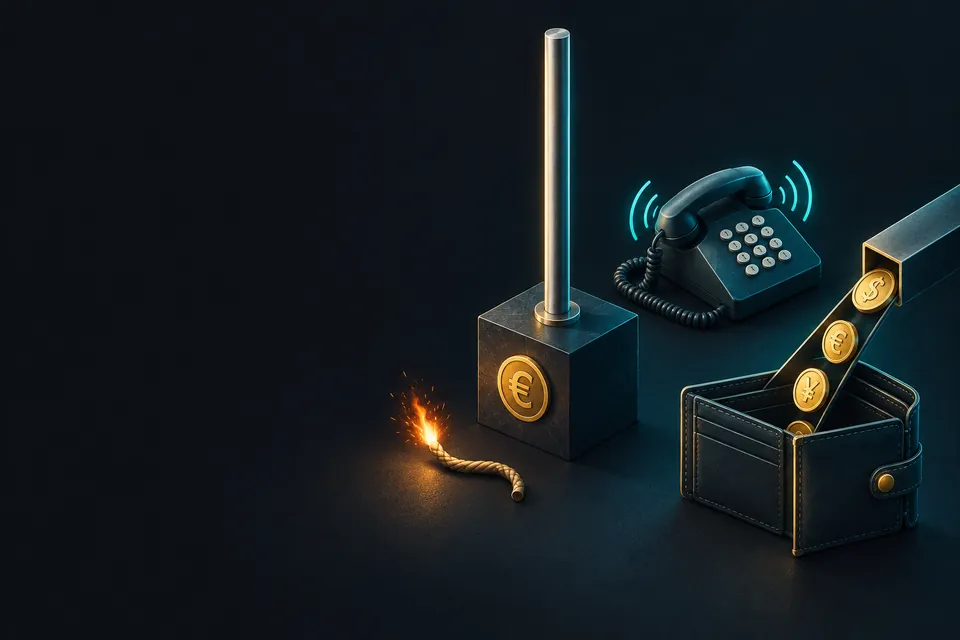
A forex scam rarely looks like one at first. It looks like a helpful account manager or a slick trading app with a dashboard full of profits. The warning signs sit in what the offer promises and in how it asks for your money.
The previous lesson described the common types of forex scams. This one covers the signs most of them share, so you can test an offer before any money leaves your account.
Why is a guaranteed return the clearest warning sign?
Picture a message that says: 1% a day, guaranteed, withdraw any time. One percent sounds modest, so it helps to work out where it leads.
Take $1,000 and grow it by 1% every trading day, with about 260 trading days in a year. The numbers are illustrative, and you can redo them with a compounding calculator.
- Each day the balance is multiplied by 1.01.
- After 21 trading days, about one month, that is 1.01 to the power 21, about 1.232. Your $1,000 is now about $1,232.
- After one year, 1.01 to the power 260 is about 13.29, so the balance is about $13,291.
- After two years, 1.01 to the power 520 is about 176.65, so the balance is about $176,650.
- After three years, 1.01 to the power 780 is about 2,347.86, so the balance is about $2,347,856.
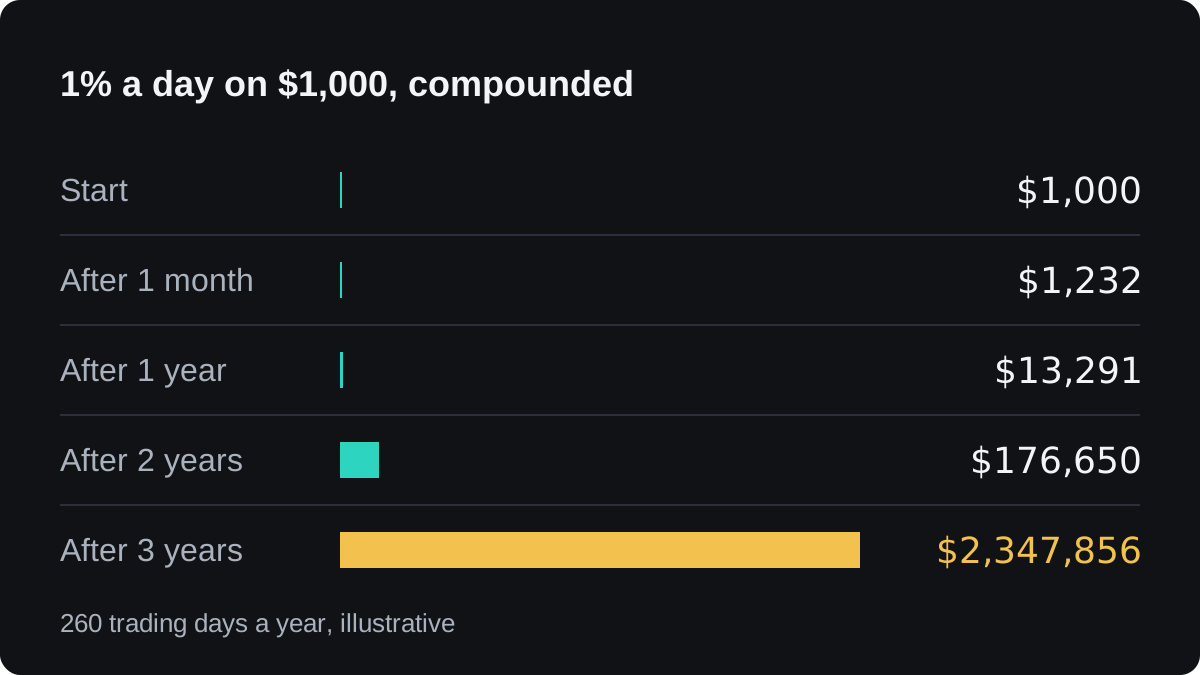
A person who could do this would turn a small sum of their own into millions within a few years. They would have no need for your deposit, or for a monthly subscription fee.
Real trading has losing days and losing months, and every account goes through drawdowns. A scheme that pays the same return whatever the market does is usually paying earlier investors with newer investors' money, or showing numbers that were never earned.
The promise can come in softer words, such as fixed monthly profit, capital protected or no losing months. Read them all as a guarantee. The lesson on whether you can get rich trading forex looks at what real returns involve.
Profit screenshots prove nothing either. A demo account looks almost the same as a live one, and images are easy to edit.
How do scammers rush you into a decision?
A genuine firm will still be there next week. A scam needs you to pay before you check, so it invents a deadline. Common lines include:
- only a few places are left in the program
- the bonus expires tonight
- the account manager can only help you this week
- this trade must be opened within the hour
Secrecy usually travels with urgency. If someone tells you to keep the plan from your bank or your family, the request protects them, and it removes the people most likely to ask hard questions.
Pressure often grows after the first deposit. Some schemes let you withdraw a small amount early so that you trust them with a larger one.
A simple test helps here. If an offer cannot wait 48 hours while you check it, walk away from it.
Why does it matter who contacted whom?
Think about how the offer reached you. A common opening is a stranger on social media, or a new online friend or partner who soon starts talking about a trading app that made them rich.
A legitimate firm has no reason to recruit you through a private chat with someone you have never met. When the contact came first and the trading talk came second, slow down.
Be careful with anyone who offers to trade for you. A manager who asks for your trading password, or for a remote access app on your device, can move money without you seeing it.
On MetaTrader you can share a read-only investor password if someone genuinely needs to view an account. Nobody needs your main trading password.
Treat signal groups and trading robots sold as never losing the same way. No method wins every trade over time, so a long record with no losing trades has almost certainly left some out.
What payment requests should stop you?
Look at where your money is supposed to go. A legitimate broker lists its deposit methods in its own client area, and the money goes to the firm. Stop if you are asked to pay:
- into a personal bank account, or a company with a different name
- in crypto, to a wallet address sent in a chat
- with gift cards or vouchers
- through someone who offers to deposit for you outside the broker's own payment page
The surest sign arrives when you try to withdraw. Say you deposit $5,000 and the dashboard soon shows $12,000. When you ask for your money, you are told to pay a 10% tax first: 10% of $12,000 is $1,200.
You pay, and a new charge appears, such as a verification fee or an anti-money laundering deposit. The $12,000 on the screen may never have existed.
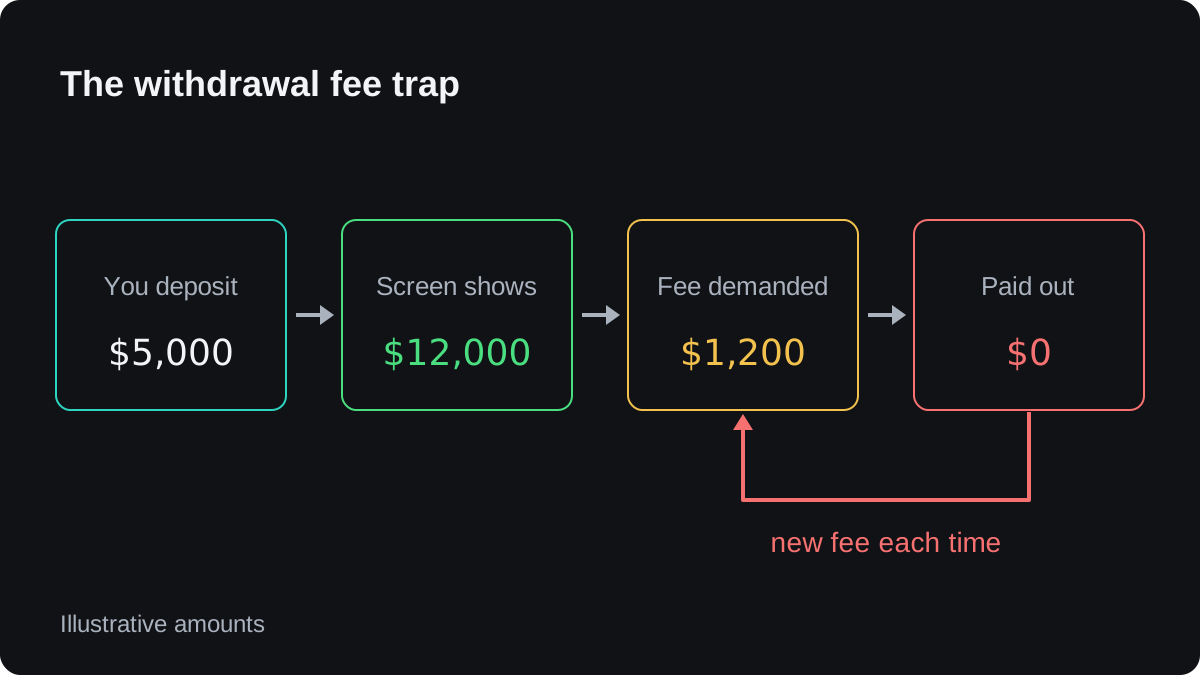
A genuine tax is either deducted from your balance or settled with your own tax authority. Genuine fees are deducted from your balance or published in advance. Sending new money so that you can receive your own money is a reason to stop paying.
If this has already happened, the next lesson covers what to do first. Be wary of anyone who then offers to recover your losses for an upfront fee, because recovery offers are a common second scam.
How do you check a firm before you send money?
Find out which regulator the firm says licenses it. Then open that regulator's public register yourself, through a search engine or its main website, never through a link the firm sent you.
The lesson on checking a broker's licence goes through this step by step. Check the regulator too, because some scams cite official-sounding bodies that do not exist.
Some scams borrow a real firm's identity. They copy its name and licence number, then give you their own website, phone number and email address. This is called a clone firm.
So compare every detail the firm gave you with the register. In the example below, the name and number match a real entry, while the website and phone do not.
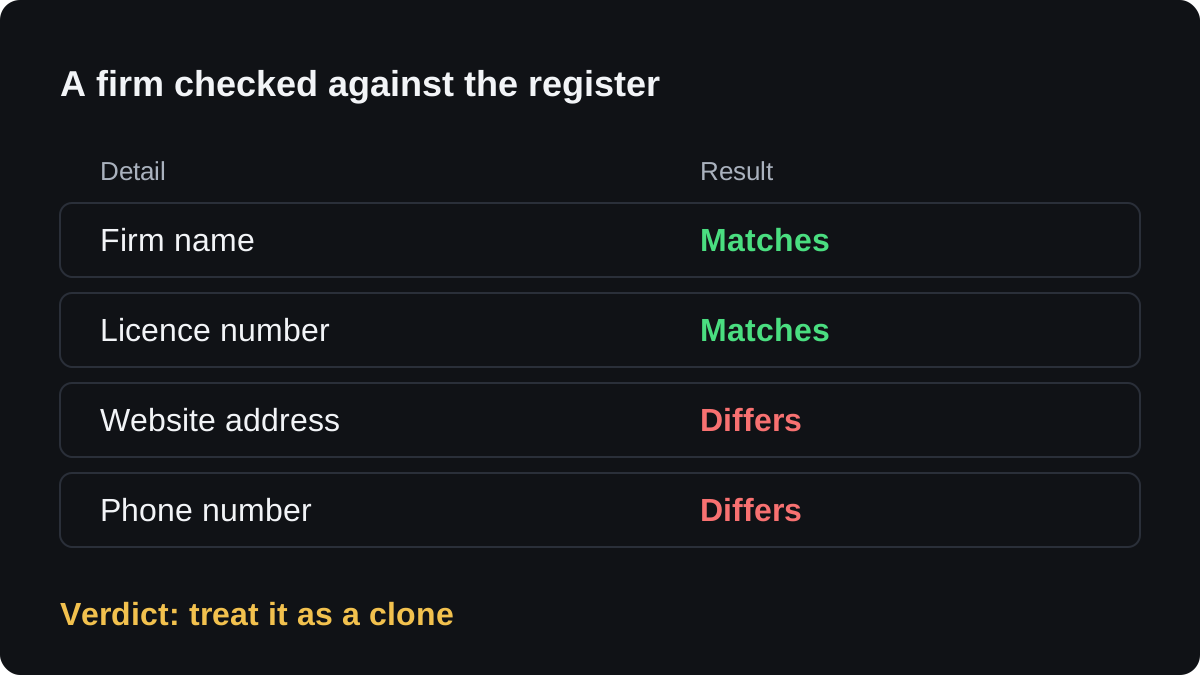
When details differ, contact the real firm using the details on the register and ask whether the offer is theirs. The fake broker red flags lesson lists more checks on the platform itself.
Many regulators also publish warning lists of firms they have flagged. A firm missing from a warning list is no proof of safety, since new scam sites can appear faster than lists are updated.
How do the signs compare with a genuine firm?
The table sets each warning sign beside what a genuine firm does instead.
| Sign | In a scam | At a genuine firm |
|---|---|---|
| Returns | Fixed or guaranteed profit | Warns that you can lose money |
| Timing | Deadlines and limited places | Lets you take time to check |
| Contact | A stranger messages you first | Can be reached through its registered details |
| Access | Asks for your password or remote access | Has no need for your trading password |
| Payments | Personal accounts, crypto sent by chat, gift cards | Methods listed in its own client area |
| Withdrawals | New fees before any payout | Fees deducted or published in advance |
One sign alone can have an innocent explanation, such as a pushy sales call from a real firm. Two or more together are a strong reason to keep your money where it is.
សំណួរ
How can I tell if a forex broker is real?
Find the regulator it names, open that regulator's register yourself and search for the firm. Then check that the website, phone number and email on the register match the ones you were given.
Is a forex bonus always a scam?
No. Some brokers run bonus offers with trading conditions attached, and the rules on bonuses differ between regulators. Read the terms, and be wary when a bonus is used to rush your deposit or to block a withdrawal.
Can a Telegram or WhatsApp trading group be trusted?
A chat group can share trading ideas, but it cannot guarantee profits. Leave any group that promises fixed returns, pushes a platform you cannot find on a register, or asks you to pay a person.
Why does the scam site show my account in profit?
The numbers on a scam dashboard are whatever the operator chooses to display. The profit exists only on the screen, and it is shown to encourage larger deposits.
Can someone get my money back for a fee?
Be very careful. Offers to recover lost money for an upfront payment are often a second scam aimed at people who have already lost money.
បន្តរៀន
 ជំពូក 2Common forex scams.Common forex scams include fake or cloned brokers that block withdrawals, signal sellers with unverifiable records, strangers who offer to manage your account, and schemes that pay fixed monthly returns from new deposits. They share one promise: steady profit with little risk. Recovery scams then target people who have already lost money.
 ជំពូក 2What to do if you have been scammed.If you have been scammed, stop sending money at once and call your bank or card provider, because speed often decides whether a payment can be stopped or disputed. Save all evidence, report to the police and your financial regulator, and ignore anyone who offers to recover your money for a fee.

