Why you need a trading plan.
A trading plan is a written set of rules for what you trade, how much you risk and when you exit, decided before you open a position. It protects you from impulsive trades made under pressure, such as chasing a move or moving a stop, by capping what any single trade or day can cost.
ខ្លឹមសារនេះមានតែជាភាសាអង់គ្លេសសិន។

Picture a quiet afternoon. EUR/USD jumps 30 pips in a minute, and you buy because it looks like the start of something big. You have not decided where you would get out, or how much you are willing to lose.
Five minutes later the move has reversed. Now both decisions have to be made while your balance changes with each tick. A trading plan answers them in advance, in writing, while you are calm.
What is a trading plan?
A trading plan is a written set of rules for how you trade. It says which pairs you trade, at what times, how much you can lose on one trade and in one day, and what must happen before you enter or exit.
The full list of contents is the subject of the next lesson, what goes into a trading plan. This lesson is about why the effort pays for itself.
Decisions made while a position is open are made under pressure. A plan moves the big decisions, such as size and exit, to a time when nothing is at stake.
How do impulsive trades start?
An impulsive trade is one you did not intend to take an hour earlier. It usually begins with a feeling about price, such as the fear of missing a move or the urge to win back a loss.
The common forms look like this:
- Chasing: buying after a fast rise because it might keep going, with no reason to enter at that price.
- Moving the stop: pushing a stop loss further away as price gets near it, so a small planned loss turns into a large one.
- Revenge trading: opening a bigger trade straight after a loss to get the money back quickly.
- Oversizing after a win: treating a good run as proof that your method cannot fail, and doubling your position.
Each of these feels reasonable in the moment. They share one feature: the size of the possible loss was never decided in advance.
The trading psychology lesson explains why the mind pushes in these directions when money is on the line.
A worked example: one bad day, with and without a plan
Take a $5,000 account trading EUR/USD. The prices are illustrative, costs such as the spread are left out, and the day is deliberately unlucky: every trade loses.
Suppose the plan has these rules for size and loss:
- Risk at most 1% of the balance on one trade.
- Place the stop loss 25 pips from the entry price.
- Stop trading for the day after losing 2% of the balance.
To keep the sums simple, the plan measures both limits from the day's starting balance. Here is how the first two rules set the trade size, using the method from how much to risk per trade:
- 1% of $5,000 is $50. That is the most one trade may lose.
- The stop is 25 pips away, so each pip may be worth at most $50 ÷ 25 = $2.
- On EUR/USD one standard lot is worth $10 per pip, so $2 per pip means 0.20 lot.
- Check: 0.20 lot is 20,000 euros, and 20,000 × 0.0001 = $2 per pip. A full stop loses 25 × $2 = $50.
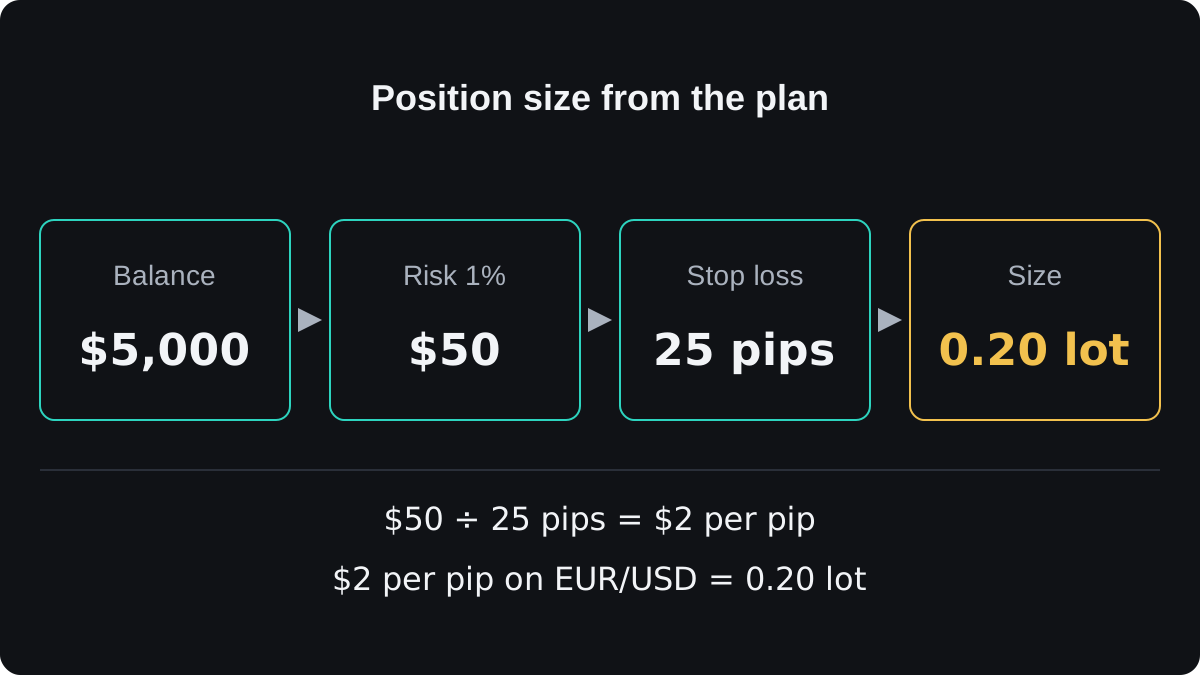
The lot size calculator does this sum for other pairs and stops.
Now the bad day. The first trade hits its stop for a loss of $50, and the second hits its stop for another $50.
That reaches the daily limit of 2%, which is $100, so the plan says stop. The balance is $4,900.
Without a plan, the same trader buys 1.00 lot on the first idea with no stop, so each pip is worth $10. Price falls 40 pips before they give up and close, a loss of 40 × $10 = $400.
Upset, they open 2.00 lots, worth $20 per pip, to win it all back in one trade. Price falls another 20 pips: 20 × $20 = $400. The balance is now $4,200.
| With the plan | Without a plan | |
|---|---|---|
| Trades taken | 2 | 2 |
| Size | 0.20 lot each | 1.00 lot, then 2.00 lots |
| Loss per trade | $50 and $50 | $400 and $400 |
| Loss for the day | $100 (2%) | $800 (16%) |
| Balance after | $4,900 | $4,200 |
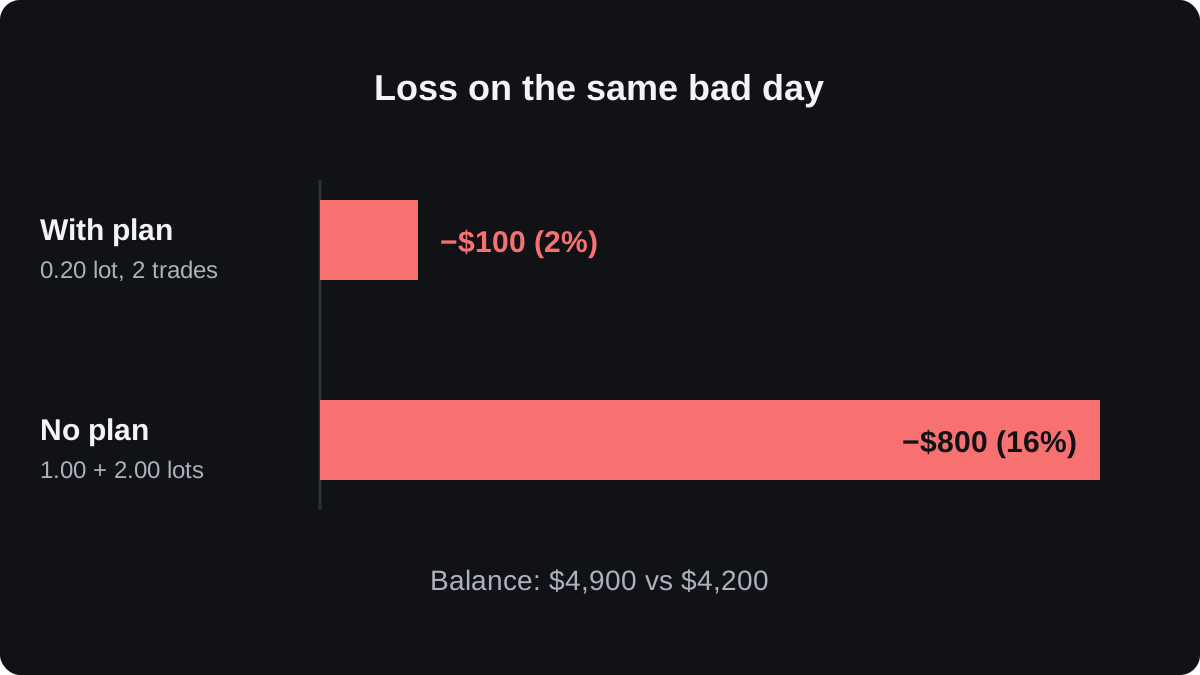
Both traders picked equally bad entries. The whole difference in damage came from size and exits, the two things a plan fixes before the trade opens.
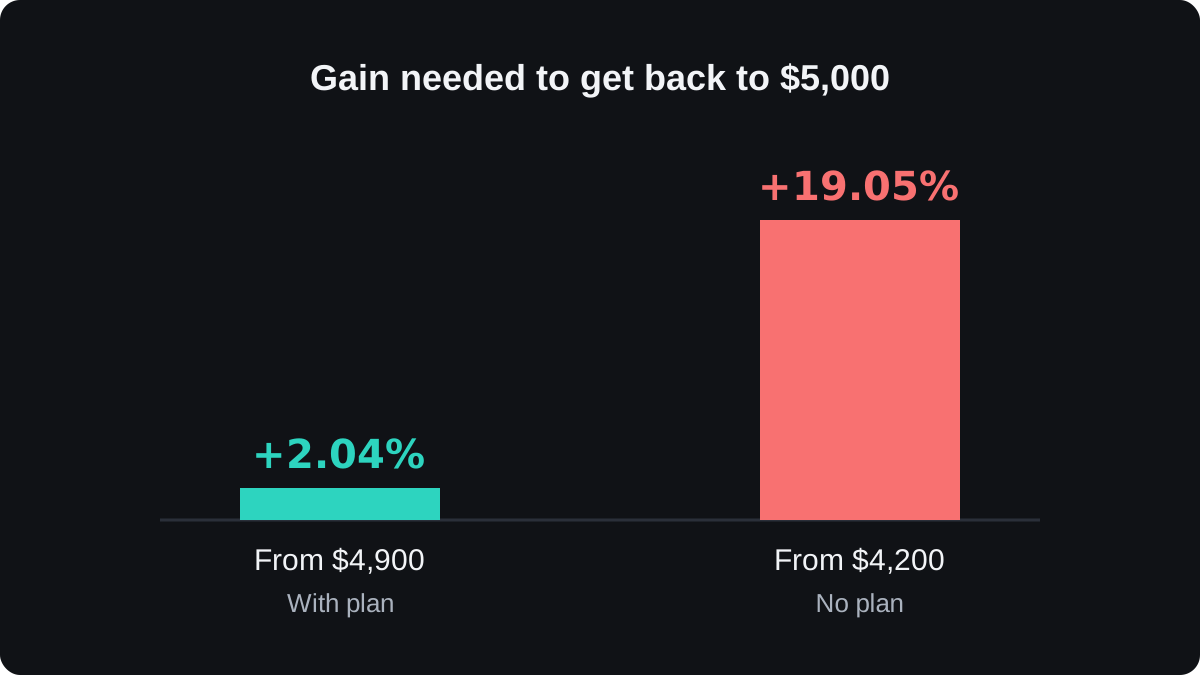
Losses also cost more to repair than they look, as the lesson on drawdown and recovery shows. To get from $4,900 back to $5,000 you need $100 ÷ $4,900 = 2.04%. From $4,200 you need $800 ÷ $4,200 = 19.05%.
Why does writing it down matter?
Rules kept in your head bend easily. When a trade is losing, it is tempting to decide that today is an exception, and nothing records that you changed your mind.
A written rule is something you can check. Before each order you can ask plain yes or no questions: is this pair on my list, is the size within 1%, is the stop set, and have I reached today's loss limit?
Writing also makes your results readable. If you follow the same rules for 50 trades, the outcome tells you something about those rules. If every trade was invented on the spot, a losing month gives you nothing specific to fix.
This is why a plan pairs well with a trading journal. The plan says what you meant to do, and the journal records what you actually did.
A demo account is a low-cost place to find out whether you can follow your own rules before real money is involved.
What can a trading plan not do?
A plan controls how much you can lose. It does not tell you whether your method makes money, and a method that loses over time will still lose under a plan, only more slowly and in smaller steps.
A stop loss is also not a guaranteed exit price. If the market gaps over a weekend or jumps on news, your order can fill beyond the stop, so a planned $50 loss can be larger.
The slippage lesson explains how this happens.
Plans also go stale. Volatility changes, and a 25 pip stop that suits a quiet month may sit too close in a busy one.
Review the rules on a fixed schedule, such as once a month, and never in the middle of an open trade.
The case for a plan rests on the arithmetic above, about how size and loss limits cap damage. Little published research measures whether retail traders with written plans earn more, so be wary of claims that a plan alone makes you profitable.
A plan also only helps when you follow it. The module's last lesson, sticking to your plan, deals with that harder part.
សំណួរ
Do I need a trading plan for a small account?
A small account has less room to absorb one oversized loss, so the rules matter at any size. Writing them costs nothing, and the arithmetic is the same for $500 or $50,000.
Does a trading plan guarantee profit?
No. It limits how much you can lose per trade and per day. Whether you make money depends on the method inside the plan, your costs and how the market behaves.
How long should a trading plan be?
Long enough to say what you trade, when, how much you risk and how you exit. A plan you can read in two minutes is easier to check before every trade.
Can I change my trading plan?
Yes, between sessions, after reviewing your journal, and always in writing. Changing a rule while a trade is open is the exact impulse the plan exists to stop.
What is a daily loss limit?
It is the most you allow yourself to lose in one day before you stop trading. In this lesson's example it was 2% of a $5,000 account, which is $100.
បន្តរៀន
 ជំពូក 1What goes into a trading plan?A trading plan is a set of written rules you decide before you trade. It covers your goals, the markets and hours you trade, the exact setups that let you enter, your exits, your risk limits per trade, day and week, and the daily routine and review that keep you following it.
 ជំពូក 1Sticking to your plan.Sticking to your plan means following rules you wrote before the trade, even when a trade goes wrong. A short pre-trade checklist, a fixed risk per trade, stops you never widen and a daily loss limit turn the plan into habits. A journal then shows where you broke a rule and what it cost.

