What is Bitcoin?
Bitcoin is the first cryptocurrency: digital money that runs on a public network with no central bank or company in charge. Its software caps the supply at 21 million coins and releases new ones to miners on a fixed schedule. Anyone who holds the private key to an address can send its bitcoin to anyone else, at any hour.
เนื้อหานี้ยังมีเฉพาะภาษาอังกฤษ

You will see the word written two ways. Bitcoin with a capital B is the network and its software. Written in lower case, bitcoin (BTC) is the coin that moves on it.
The network started in January 2009, about two months after its creator, using the name Satoshi Nakamoto, published the design. Thousands of cryptocurrencies have launched since, and many of them borrow parts of its design.
How a bitcoin payment works
Say Mia wants to send Leo 0.05 BTC. Leo gives her his address, a string of letters and numbers that identifies where coins can be sent.
- Mia's wallet builds the payment and signs it with her private key.
- The wallet broadcasts it to the network, and nodes check the signature and that she has the coins.
- The payment waits in the mempool, the queue of valid payments not yet in a block.
- A miner puts it in a block, usually picking the payments that pay the highest fee rate first.
- Leo's wallet shows the payment as confirmed. Each new block added on top counts as another confirmation.
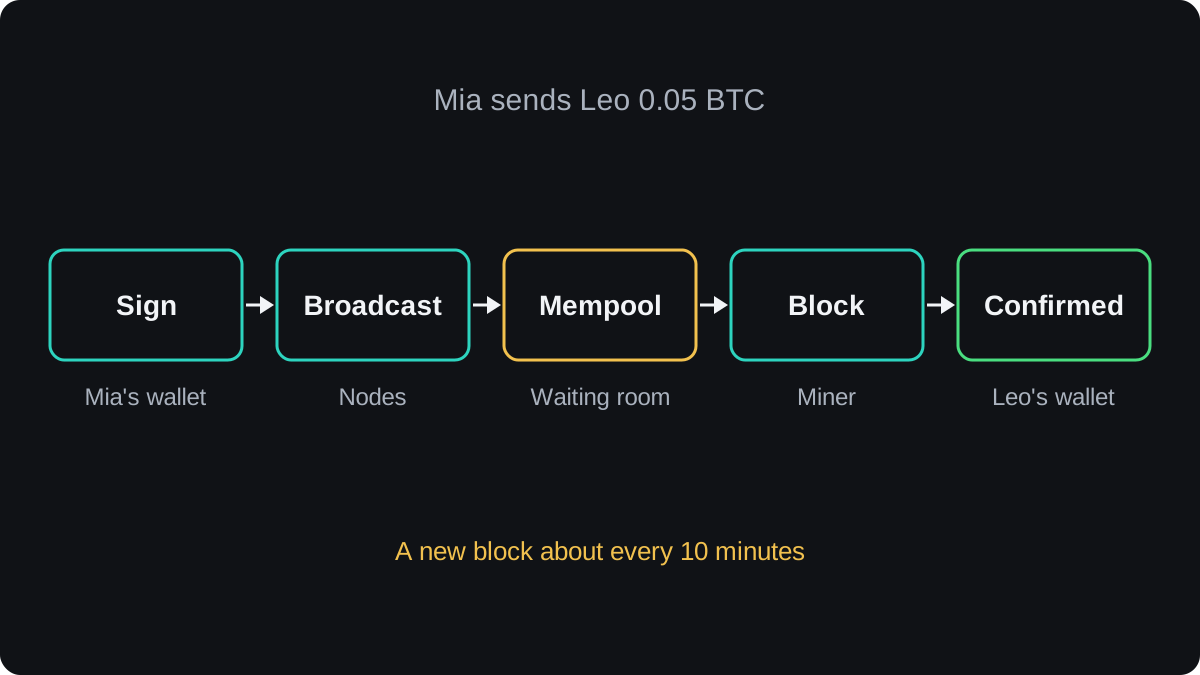
A new block arrives about every 10 minutes on average. Many services wait for several confirmations before they treat a large payment as settled. The transaction lesson follows each step in more detail.
Who runs Bitcoin?
No company owns Bitcoin, and it has no head office. It runs on two groups of computers with different jobs.
Nodes keep a copy of the blockchain and check every payment and block against the rules. Anyone can run one on an ordinary computer, as the node lesson explains.
Miners compete to add the next block. Their machines guess numbers trillions of times a second until one finds a valid answer, a process called proof of work. The winner earns new bitcoin plus the fees in the block.
The mining lesson shows why that guessing makes the ledger hard to rewrite.
Changing the rules needs wide agreement. Developers can propose new code, but each node rejects blocks that break the rules it runs, so a change takes effect only when node operators choose to adopt it.
The 21 million cap and the halving
New bitcoin enter circulation only as a reward to the miner of each block. In 2009 the reward was 50 BTC per block.
Every 210,000 blocks, about once every four years, the reward is cut in half. This is the halving. The reward fell to 25 BTC in 2012, 12.5 in 2016, 6.25 in 2020 and 3.125 in 2024.
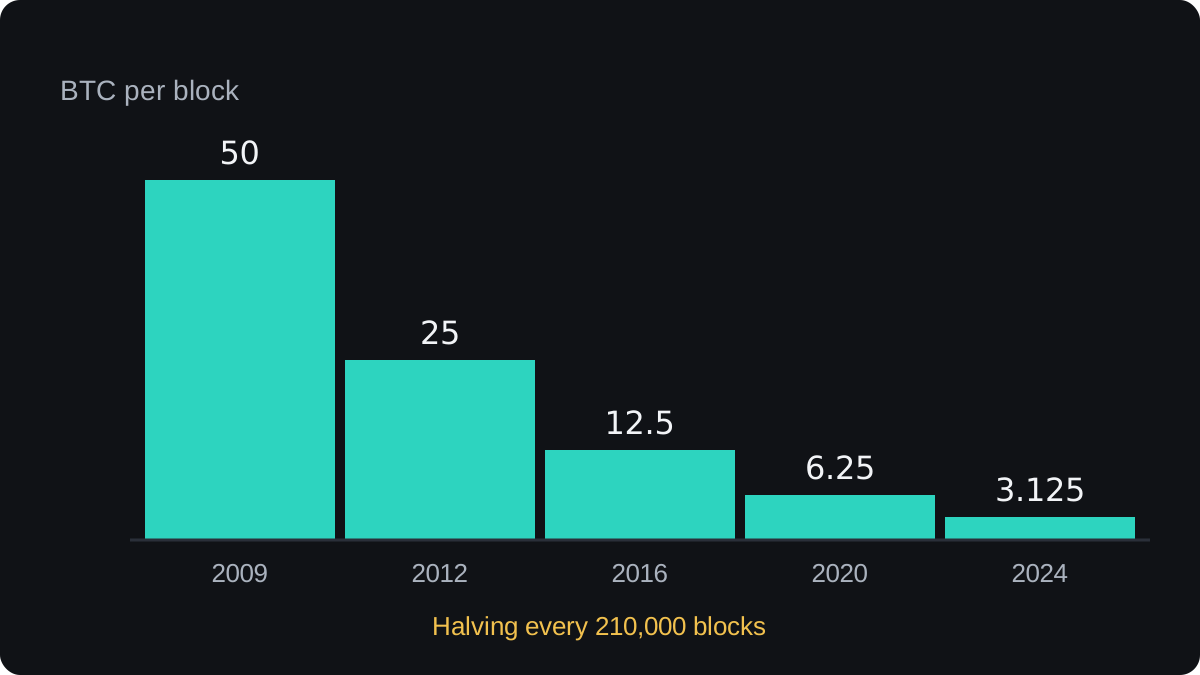
You can check the cap yourself. The first 210,000 blocks paid 210,000 × 50 = 10,500,000 BTC, which is half of 21 million.
Each later period pays half as much as the one before: 5,250,000 BTC, then 2,625,000, and so on. The total creeps toward 21 million and never passes it.
Most bitcoin has already been issued, and the last tiny fractions are expected around the year 2140. The halving lesson looks at what the cuts mean for miners and for the market.
Satoshis: buying a small piece
One bitcoin divides into 100,000,000 units called satoshis, or sats, named after the creator. So 1 sat is 0.00000001 BTC.
Here is an example with a round illustrative price:
- Bitcoin trades at $40,000.
- You buy $50 worth: 50 ÷ 40,000 = 0.00125 BTC.
- In satoshis: 0.00125 × 100,000,000 = 125,000 sats.
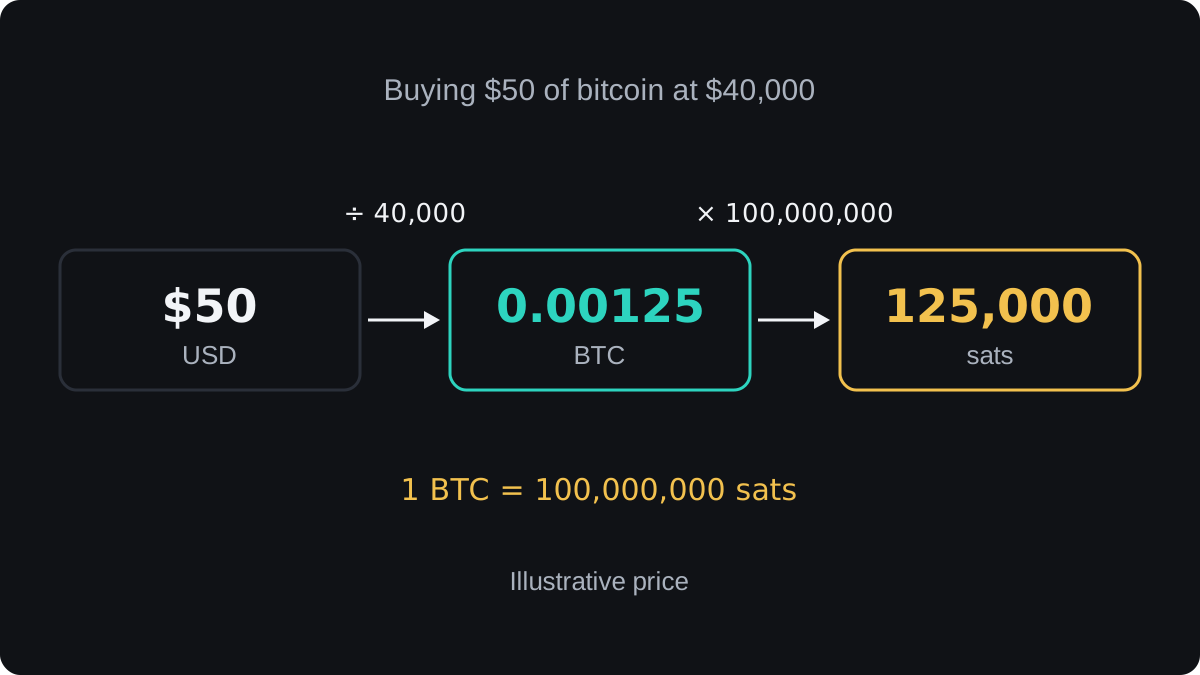
Wallets often show sats for small amounts, because 125,000 is easier to read than 0.00125. Network fees are quoted in sats too, as a rate per unit of transaction data.
What bitcoin is used for, and what can go wrong
Some people hold bitcoin as a long-term asset with a fixed supply. Others send it across borders or trade its price swings.
The risks come with the design:
- The price can fall fast. Bitcoin has dropped by more than 70% from a peak more than once, as the volatility lesson shows.
- Payments cannot be reversed. A payment to the wrong address, or to a scammer, is final.
- Lost keys mean lost coins. No one can reset a private key or the seed phrase that backs it up.
- Scams are common, from fake support staff to fake investment schemes. The common crypto scams lesson shows how they work.
คำถามที่พบบ่อย
Who created Bitcoin?
Bitcoin was created by a person or group using the name Satoshi Nakamoto, whose identity is unknown. Satoshi published the design in 2008 and stopped posting in public at the end of 2010, as why Bitcoin was created explains.
How many bitcoins are there?
The software caps the supply at 21 million. Most have already been mined, and each halving slows the release of the rest.
Is Bitcoin anonymous?
Bitcoin is public, so every payment is visible on the blockchain. Addresses carry no names, but exchanges collect identity documents, so addresses can often be linked to people.
Can Bitcoin be shut down?
There is no central server to switch off, because thousands of nodes run copies around the world. Governments can still ban or restrict the exchanges and banks that deal in it, which limits how easily people can use it.
เรียนต่อ
 บทที่ 2Why was Bitcoin created?Bitcoin was created so people could pay each other online without a bank or payment company in the middle. Its pseudonymous author, Satoshi Nakamoto, published the design in October 2008, during the global financial crisis. It solved a problem that earlier digital cash had not: stopping the same money being spent twice without a central referee.
 บทที่ 2What problems does Bitcoin solve?Bitcoin lets two people move value over the internet without a bank or payment company approving the transfer. Its supply follows a schedule fixed in code that no one can speed up. It leaves other problems open: the price swings hard, and a lost key means lost coins, so it suits some jobs much better than others.

