What is a stablecoin?
A stablecoin is a crypto token designed to hold a steady price, usually one US dollar. Most are backed by reserves such as cash and short-term government debt, held by a company that swaps tokens for dollars at $1. Others lock up crypto as collateral or rely on supply rules. Every design can lose its peg under stress.
เนื้อหานี้ยังมีเฉพาะภาษาอังกฤษ

Bitcoin's price can move several percent in a day. That makes it an awkward unit for a loan or an invoice. A stablecoin gives crypto a unit that is meant to stay put.
What a stablecoin is
A stablecoin is a crypto token built to keep a fixed price against an outside asset, almost always the US dollar. That target price is the peg. One token aims to be worth $1 at all times.
You send 500 tokens to someone, and they receive something worth about $500. The transfer runs on a blockchain at any hour of any day, with no bank processing it.
Most stablecoins are tokens on existing blockchains, which makes them a kind of altcoin. USDT and USDC are two widely used dollar stablecoins.
How the peg holds
Take a stablecoin backed by dollars. The issuer creates, or mints, one new token for each $1 a customer deposits. It destroys, or burns, one token for each $1 it pays back out.
That promise to swap tokens for dollars at $1 anchors the price. Traders watch for any gap between the market price and $1, because closing the gap pays.
If the token slips to $0.99 on an exchange, traders buy it there and redeem it with the issuer for $1. Their buying lifts the price.
If it rises to $1.01, they deposit dollars, mint tokens at $1 and sell them on the exchange. Their selling pushes it back down.
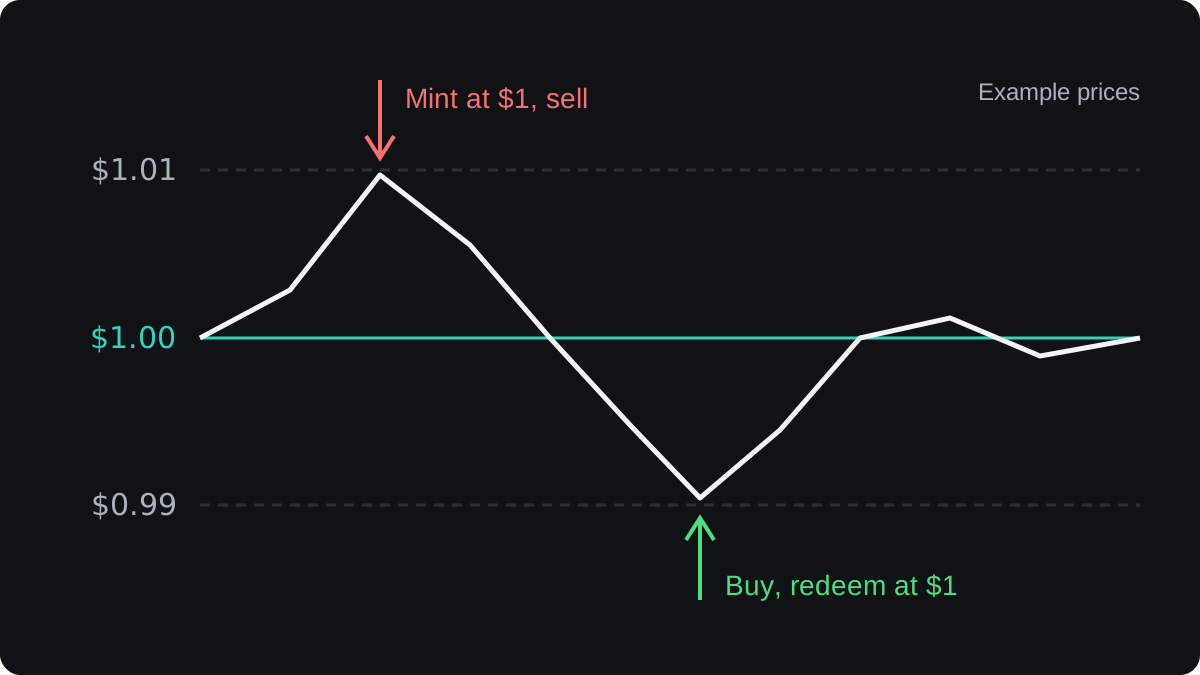
Here is the trade with round, illustrative numbers:
- The token trades at $0.99 on an exchange.
- You buy 10,000 tokens for 10,000 × $0.99 = $9,900.
- You redeem them with the issuer for $10,000.
- Your gross profit is $100, before fees and transfer costs.
This only works while redemption is open and trusted. Many issuers redeem directly only for verified customers, often above a minimum amount. Everyone else relies on those large traders to keep the market price close to $1.
Three ways to back a stablecoin
Cash and government debt
Fiat-backed stablecoins hold reserves such as bank deposits and short-term government bills. A company issues the token, and you are trusting it to hold what it says it holds. USDT and USDC work this way.
The issuer earns the interest on those reserves. Holding the token itself usually pays you nothing.
A few tokens track gold instead of a currency, with each token tied to a set weight of metal in a vault. They rely on the same kind of trust in the issuer.
Other crypto as collateral
Crypto-backed stablecoins are minted by smart contracts against crypto collateral. Because the collateral swings in price, the system asks for more than $1 of it for every $1 of stablecoin. DAI is a long-running example.
Here is how that collateral can run out, with illustrative numbers:
- You lock ether worth $1,500 and mint 1,000 stablecoins. Your collateral ratio is $1,500 ÷ $1,000 = 150%.
- The system's minimum ratio is 120% in this example.
- Ether falls 20%. Your collateral is now worth $1,500 × 0.8 = $1,200, a ratio of exactly 120%.
- Any further fall takes you below the minimum. The system then sells your ether to cover the 1,000 coins, usually with a penalty on top.
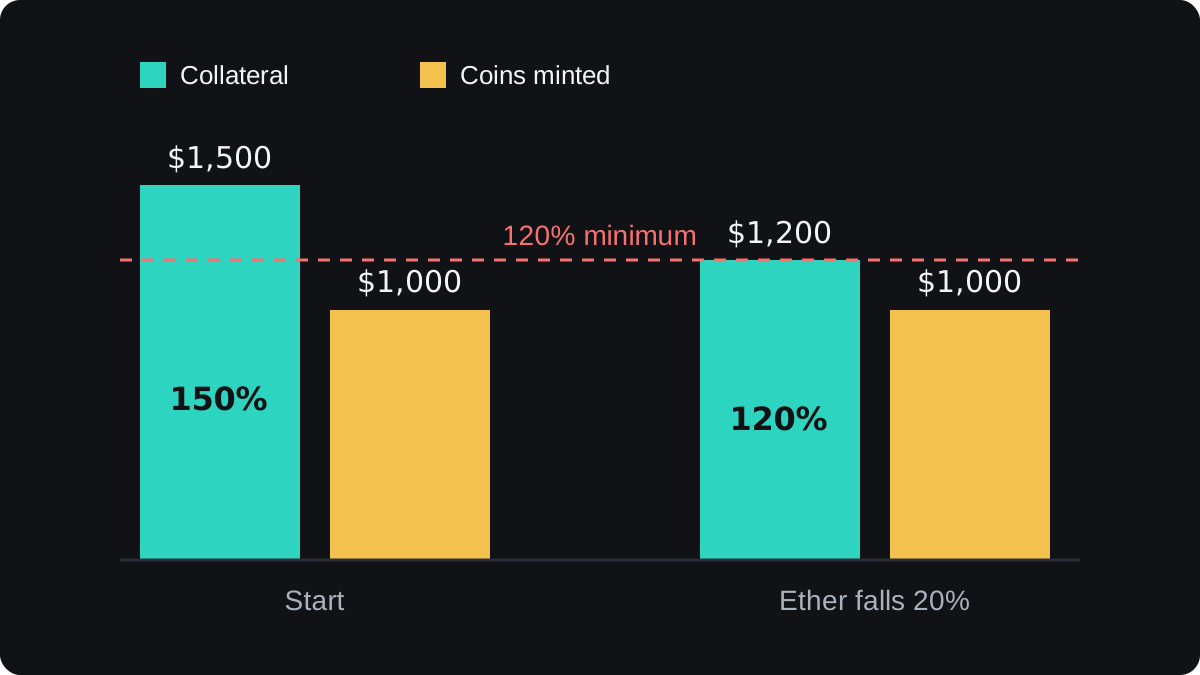
The forced sale keeps every coin in the system backed. You keep the 1,000 coins you minted, but the ether sold to cover them, and the penalty, are gone.
Supply rules
Algorithmic stablecoins try to hold the peg with supply rules instead of full reserves. A common design lets holders swap one stablecoin for $1 worth of a partner token, which the system creates on demand.
That works while people value the partner token. When confidence breaks, holders rush to swap, the system mints huge amounts of the partner token, and its price collapses.
TerraUSD (UST) failed this way in May 2022. It fell far below $1 within days and never regained its peg.
What people use stablecoins for
- Many crypto exchanges price coins against dollar stablecoins, so pairs such as BTC/USDT are common.
- Traders move into stablecoins to step out of price swings without cashing out to a bank.
- People send them across borders at any hour, which can be faster than a bank transfer.
- Lending and trading apps in DeFi use stablecoins heavily.
Where the risks sit
- The peg can break. USDC fell well below $1 over a weekend in March 2023, after a US bank holding part of its reserves failed, and then recovered.
- You depend on the reserves. An attestation by an accounting firm checks them on one date. A full audit goes further, and not every issuer publishes one.
- The issuers of the largest fiat-backed tokens can freeze the tokens held at a specific address, often at the request of authorities.
- Crypto-backed and algorithmic designs depend on smart contract code, and a bug can break the peg.
- Rules are changing in many countries. A new law can change who may issue a token or list it.
คำถามที่พบบ่อย
Is a stablecoin the same as a dollar in the bank?
No. A bank deposit sits with a regulated bank and may be covered by deposit insurance. A stablecoin is a claim on a private issuer or on smart contract code, and it is only as good as what backs it.
Can a stablecoin lose its peg?
Yes. Fiat-backed, crypto-backed and algorithmic stablecoins have all traded below $1 at times, some briefly and some for good.
Do stablecoins pay interest?
The token itself usually pays nothing, since the issuer keeps the interest on its reserves. Platforms that offer a yield on stablecoins lend them out or use them in DeFi, which adds new risks.
Why do crypto exchanges use stablecoins instead of dollars?
Stablecoins move between exchanges and wallets on a blockchain at any hour. Many bank transfers still wait for banking days and cut-off times.
เรียนต่อ
 บทที่ 4What is an altcoin?An altcoin is any cryptocurrency other than Bitcoin. The name is short for alternative coin. Some altcoins run their own blockchain, like ether on Ethereum, while others are tokens issued on a chain that already exists. They range from large platforms to stablecoins and meme coins, and most trade in smaller, jumpier markets than Bitcoin.
 บทที่ 4What is a privacy coin?A privacy coin is a cryptocurrency that hides the details of a payment from outsiders: the sender, the receiver, the amount, or all of them. Bitcoin records these in public. Monero hides them by default with ring signatures and one-time addresses, while Zcash lets users choose shielded payments built on zero-knowledge proofs.
 บทที่ 4What is a meme coin?A meme coin is a cryptocurrency built around a joke, a mascot or an internet meme, with no product, revenue or reserve behind it. Its price moves on attention and community. Dogecoin, launched in 2013, was the first well-known one. Meme coins can multiply in days and lose most of their value just as fast.

