What is an altcoin?
An altcoin is any cryptocurrency other than Bitcoin. The name is short for alternative coin. Some altcoins run their own blockchain, like ether on Ethereum, while others are tokens issued on a chain that already exists. They range from large platforms to stablecoins and meme coins, and most trade in smaller, jumpier markets than Bitcoin.
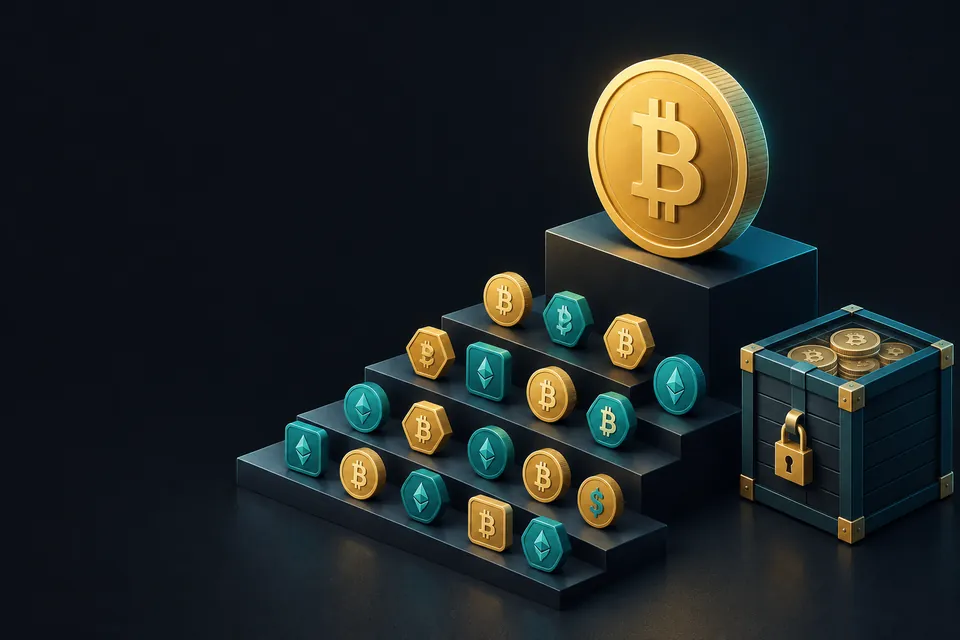
Bitcoin went live in 2009 as the first cryptocurrency. Thousands of coins have launched since then, and traders call almost all of them altcoins.
What counts as an altcoin
An altcoin is any cryptocurrency other than Bitcoin. The word is short for "alternative coin". It tells you what a coin is not, so it lumps very different projects into one group.
The edges of the word are fuzzy. Some people treat ether as a class of its own because of its size. Others leave out stablecoins, since their price is meant to stay flat.
In everyday use, the word covers both. When you read that "altcoins rallied", it usually means the market outside Bitcoin as a whole.
Why altcoins exist
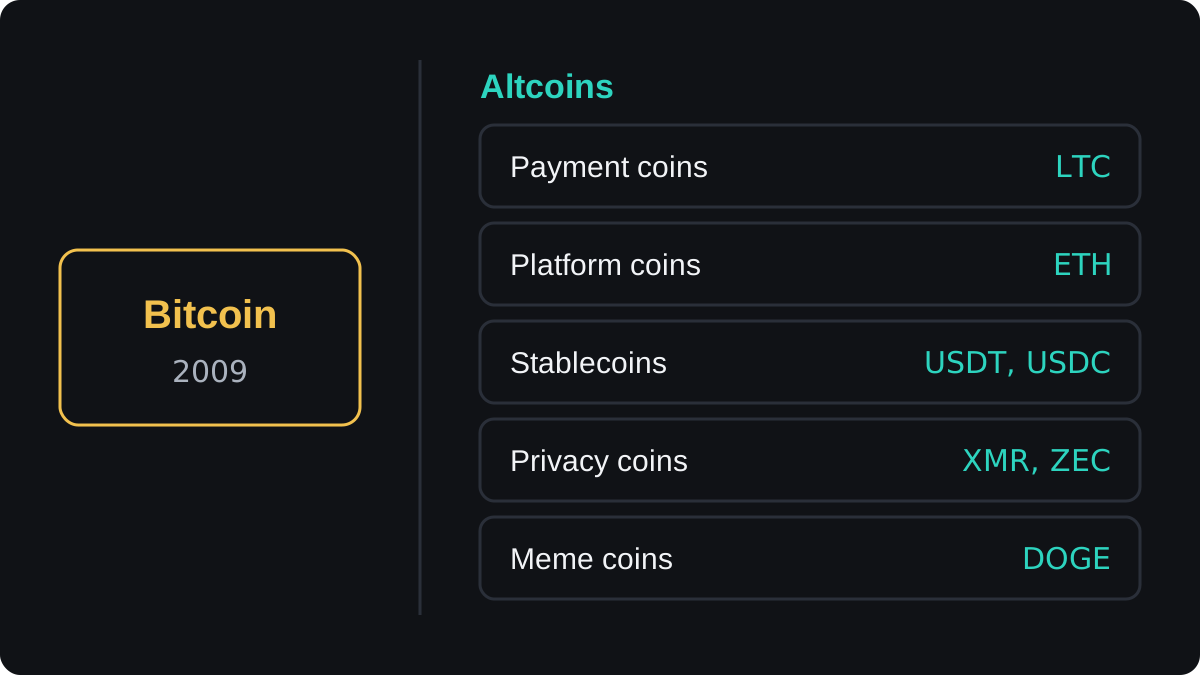
Each altcoin is an attempt to change something about Bitcoin, or to do something Bitcoin was never built for. Most fall into a handful of groups.
- Payment coins tweak Bitcoin's design for faster or cheaper transfers. Litecoin (LTC), launched in 2011 from a copy of Bitcoin's code, is an early example.
- Platform coins run blockchains where developers can build applications. Ether (ETH) powers Ethereum, the best-known example.
- Stablecoins such as USDT and USDC track a currency, usually the US dollar.
- Privacy coins such as Monero (XMR) and Zcash (ZEC) hide payment details that Bitcoin leaves public.
- Meme coins such as Dogecoin (DOGE) began as jokes and trade mostly on attention.
Coins and tokens
Altcoins come in two technical forms. The difference shows up the first time you try to send one.
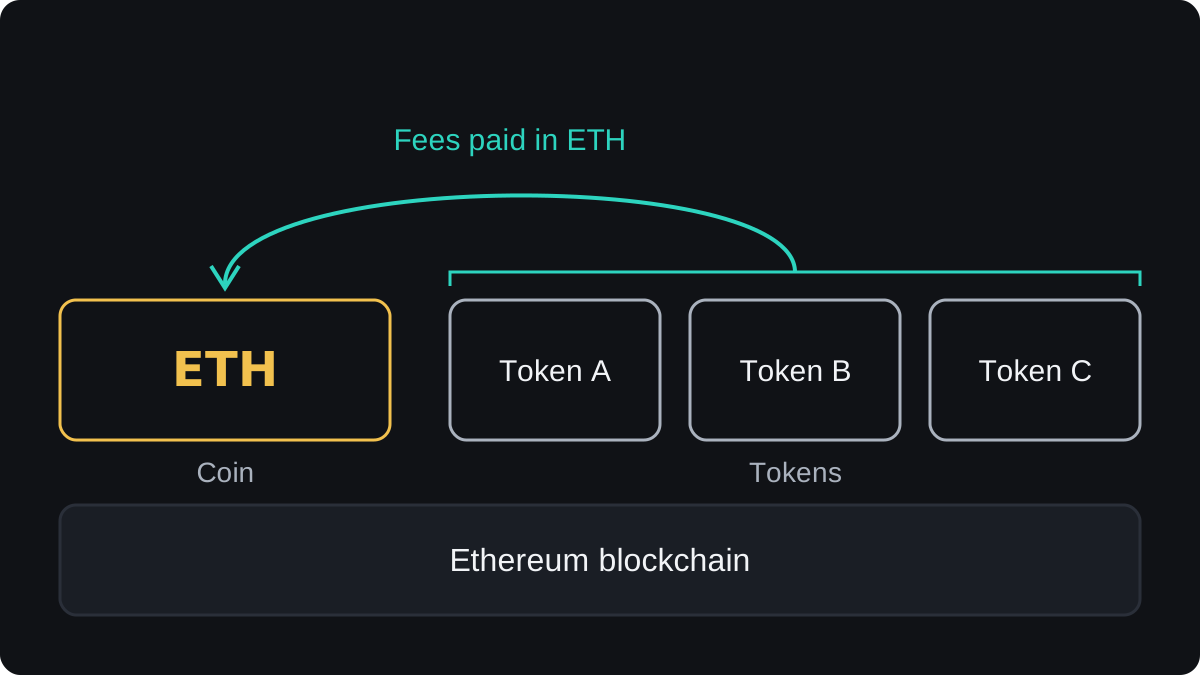
A coin is the native asset of its own blockchain. Ether is Ethereum's coin, and every transaction on that network pays its fee in ether.
A token is created by a smart contract on a blockchain that already exists. Thousands of tokens live on Ethereum and similar chains, including most stablecoins.
Tokens borrow the chain's coin for fees. To move 100 USDC on Ethereum, you also need a small amount of ether in the same wallet. An ordinary wallet that holds only tokens cannot send them until you add some ether.
Why a low price does not make a coin cheap
Beginners often compare coins by price per coin. That number tells you very little on its own, because coins have very different supplies.
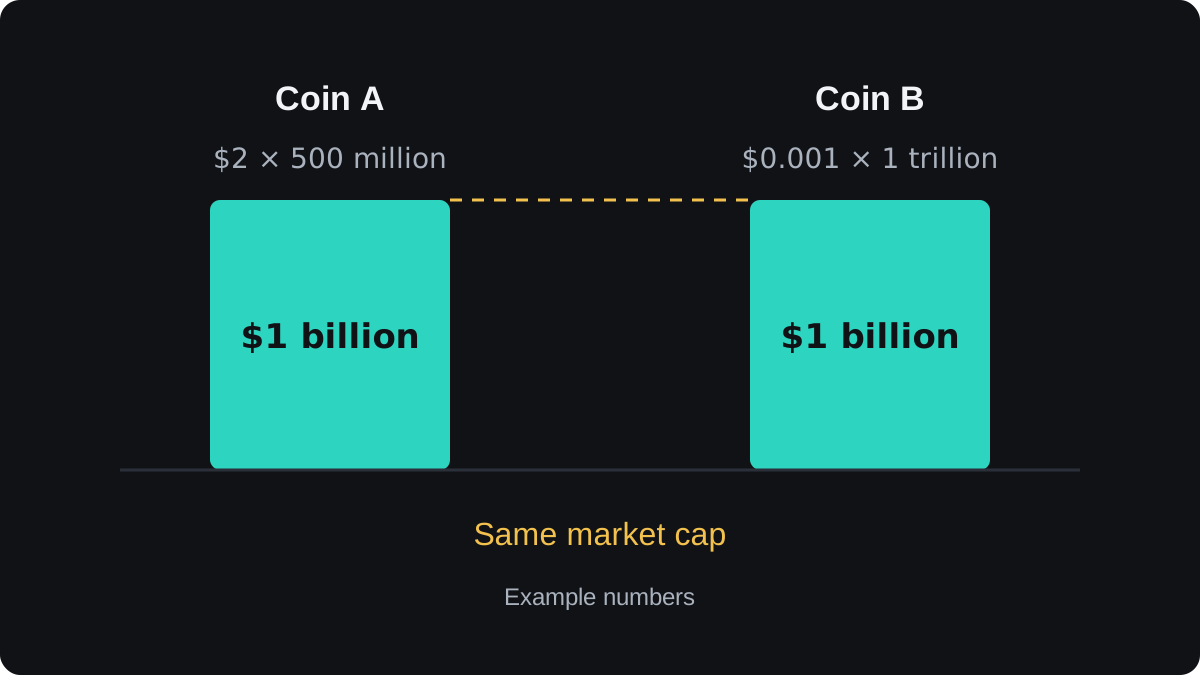
What matters is the market cap: the price per coin multiplied by the number of coins in circulation. It is the total value the market puts on a coin today.
Here is an example with round, illustrative numbers:
| Coin A | Coin B | |
|---|---|---|
| Price per coin | $2 | $0.001 |
| Coins in circulation | 500 million | 1 trillion |
| Market cap | $1 billion | $1 billion |
Both coins are worth the same in total. Coin B only looks cheaper. For Coin B to reach $1 a coin, its market cap would need to grow 1,000 times, to $1 trillion.
Watch the coins that are not out yet
Many projects release only part of their supply at launch. The rest is released over months or years, often to the team and early investors.
Price multiplied by the maximum supply gives the fully diluted value. It shows what the whole supply would be worth at today's price once every coin exists.
Back to the example. Coin A has a maximum supply of 2 billion. At $2, its fully diluted value is $4 billion, four times its market cap.
Now suppose the market still values Coin A at $1 billion once all 2 billion coins are out. Each coin would then be worth $0.50.
Projects usually publish a release schedule. A large release puts new sellers in the market on a date everyone can see coming.
How altcoins trade
Most altcoins trade in smaller markets than Bitcoin. With fewer buyers and sellers, spreads are wider and a large order moves the price further. The lesson on crypto liquidity covers why.
Altcoins also tend to move with Bitcoin. When Bitcoin drops sharply, most altcoins drop too, and smaller ones often drop further. The link is only a tendency, and it can loosen for weeks.
Some risks weigh more heavily on altcoins than on Bitcoin:
- Founders and early investors can hold a large share of the supply and sell it into the market.
- An exchange can delist a coin, and much of its trading can disappear with it.
- Development can stop, leaving a coin that still trades but no longer does anything.
- A bug in a token's smart contract can freeze or drain the tokens.
Some brokers offer crypto CFDs on a short list of large altcoins. A CFD lets you trade the price without holding the coin, and each broker sets its own list and terms.
Questions
Is Ethereum an altcoin?
By the usual definition, yes, because ether is a cryptocurrency other than Bitcoin. Because of its size, some people prefer to treat it as a category of its own.
What is the difference between a coin and a token?
A coin is the native asset of its own blockchain and pays that chain's fees. A token is issued by a smart contract on a chain that already exists, and its transfers pay fees in that chain's coin.
Are altcoins riskier than Bitcoin?
Smaller altcoins usually trade in thinner markets and swing harder. They also carry project risks that Bitcoin does not, such as a team that stops working, and size alone does not make any coin safe.
Why are there so many altcoins?
Creating a token on an existing chain takes little time or money. That makes it easy to launch a coin, whether the project behind it is serious or not.
Keep learning
 Chapter 4What is a stablecoin?A stablecoin is a crypto token designed to hold a steady price, usually one US dollar. Most are backed by reserves such as cash and short-term government debt, held by a company that swaps tokens for dollars at $1. Others lock up crypto as collateral or rely on supply rules. Every design can lose its peg under stress.
 Chapter 4What is a privacy coin?A privacy coin is a cryptocurrency that hides the details of a payment from outsiders: the sender, the receiver, the amount, or all of them. Bitcoin records these in public. Monero hides them by default with ring signatures and one-time addresses, while Zcash lets users choose shielded payments built on zero-knowledge proofs.
 Chapter 4What is a meme coin?A meme coin is a cryptocurrency built around a joke, a mascot or an internet meme, with no product, revenue or reserve behind it. Its price moves on attention and community. Dogecoin, launched in 2013, was the first well-known one. Meme coins can multiply in days and lose most of their value just as fast.

