What is a crypto CFD?
A crypto CFD is a contract with your broker that settles the change in a cryptocurrency's price in cash. You never own the coin, so you need no wallet or private key. You can buy or sell, profit or loss lands in your account currency, and the broker sets the contract's terms.

Say bitcoin trades at 60,000 dollars, an illustrative price, and you expect it to rise. You can buy part of a coin on an exchange and keep it in a wallet.
Or you can open a buy position on BTCUSD at a broker, on the same platform many people use for forex. That second route is a crypto CFD.
This lesson shows what you hold when you take it, and what you give up.
What is a crypto CFD?
A contract for difference (CFD) is an agreement between you and your broker. When you close it, one side pays the other the change in price since you opened it, in cash.
A crypto CFD is a CFD whose price follows a cryptocurrency such as bitcoin or ether. Its symbol looks like a currency pair: BTCUSD is bitcoin priced in US dollars, and ETHUSD is ether.
Nothing moves on a blockchain when you trade one. You never receive a coin, so you need no crypto wallet and no private key.
Your account shows an open position with a floating profit or loss, as a forex trade does.
How a crypto CFD makes or loses money
Profit or loss on a CFD comes from one sum:
Profit or loss on a buy = (close price minus open price) × contract size × lots
The contract size is how much of the coin one lot tracks. Each broker sets its own, so this lesson uses 1 coin per lot purely as an illustration. Read the real figure before you trade.
A worked example with illustrative prices:
- You buy 0.10 lot of BTCUSD at 60,000.
- At 1 coin per lot, the position tracks 0.1 BTC, worth 0.1 × 60,000 = $6,000.
- You close at 63,000, a move of 63,000 minus 60,000 = 3,000.
- Profit = 3,000 × 1 × 0.10 = $300, paid into your account in cash.
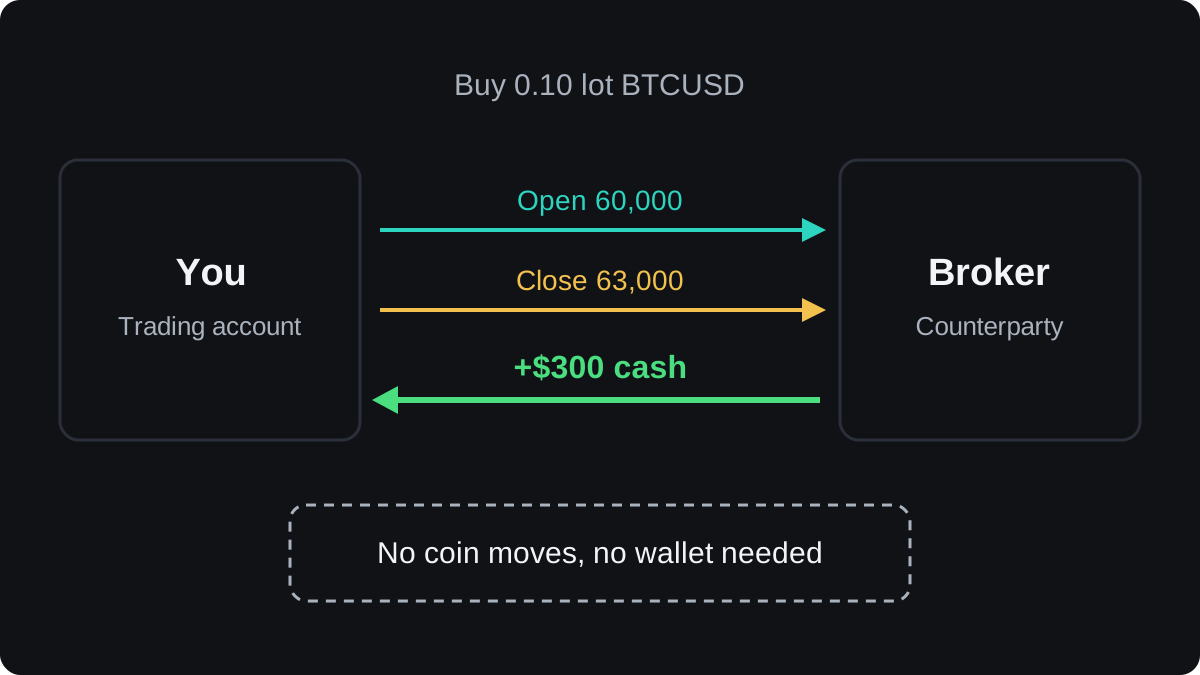
Had the price fallen to 57,000 instead, the same sum gives minus 3,000 × 1 × 0.10 = -$300, taken from your balance. Either way, the only thing that changes hands is money.
These examples leave out the spread, the gap between the price you buy at and the price you sell at. What it costs to trade crypto CFDs adds it back in.
Buying and selling: long and short
A CFD works in both directions, as the glossary entry on long and short positions explains. Buying, or going long, gains when the price rises. Selling first, or going short, gains when it falls.
Take the fall from the short side: you sell 0.10 lot at 60,000 and buy it back at 57,000. A sell counts open minus close, so you make 3,000 × 1 × 0.10 = $300.
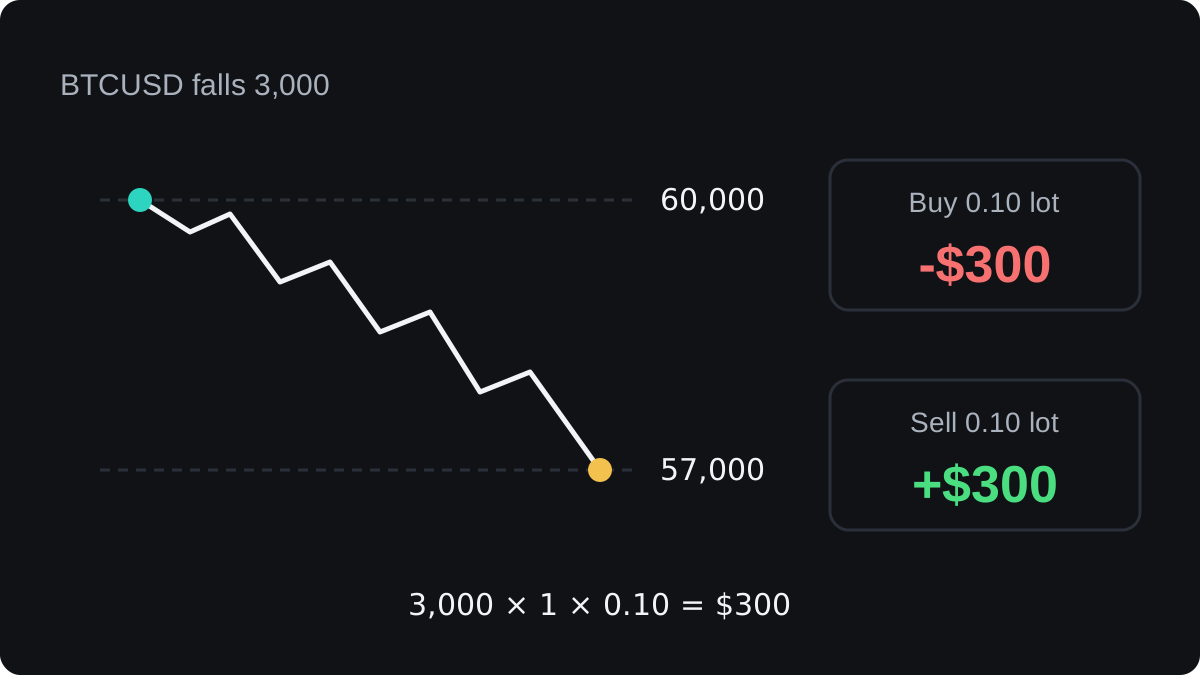
To gain from a fall on an exchange, you need a margin account that lends you coins, or a separate derivative. With a CFD you press Sell.
The risk runs the other way too. A 0.10 lot short loses $0.10 for every dollar the price climbs, and there is no ceiling on how far it can climb.
Who is on the other side of the trade?
Your counterparty is the broker. It may keep the opposite risk or pass it to its own liquidity providers, as who is on the other side of your trade explains for forex. The same applies here.
Each broker sets its own BTCUSD quote from the price feeds it chooses. Your quote tracks the wider market closely, but it may not match any single exchange to the dollar.
The contract exists only at that broker. You cannot withdraw it as coins, send it to a wallet or move the open position to another broker.
If the broker fails, your claim is against the broker. That is why checking its licence matters before you deposit.
Leverage comes with the contract
CFDs are usually traded with leverage: you lock only part of the position's value as margin. The mechanics are those of forex leverage, and leverage on crypto CFDs runs the numbers for coins.
Leverage changes how much margin a trade locks. The profit or loss still comes from the full position: a 10% fall on the $6,000 position above costs $600, whatever margin you put up.
Crypto prices can move several percent in a day, so the leverage allowed on crypto is usually much lower than on major currency pairs.
Some places bar retail clients from crypto CFDs altogether. In the UK, firms have not been allowed to sell them to retail clients since January 2021. Rules like this can change, so check the ones where you live.
Read the contract specification first
Your broker sets every term of a crypto CFD, within its regulator's limits. Trading hours, weekend behaviour, maximum leverage, contract size and fees differ between brokers, and a broker can change them.
In MetaTrader 5, right click the symbol in Market Watch and choose Specification. These fields matter most for a crypto CFD:
- Contract size: how many coins one lot tracks.
- Minimal volume and Volume step: the smallest trade and the size steps above it.
- Spread and Commission: what you pay to trade.
- Swap long, Swap short and Swap rates: the charge for each night, and how each weekday counts.
- Sessions: the hours the symbol is quoted and traded, in server time.
- Margin: the rate that sets how much a position locks.
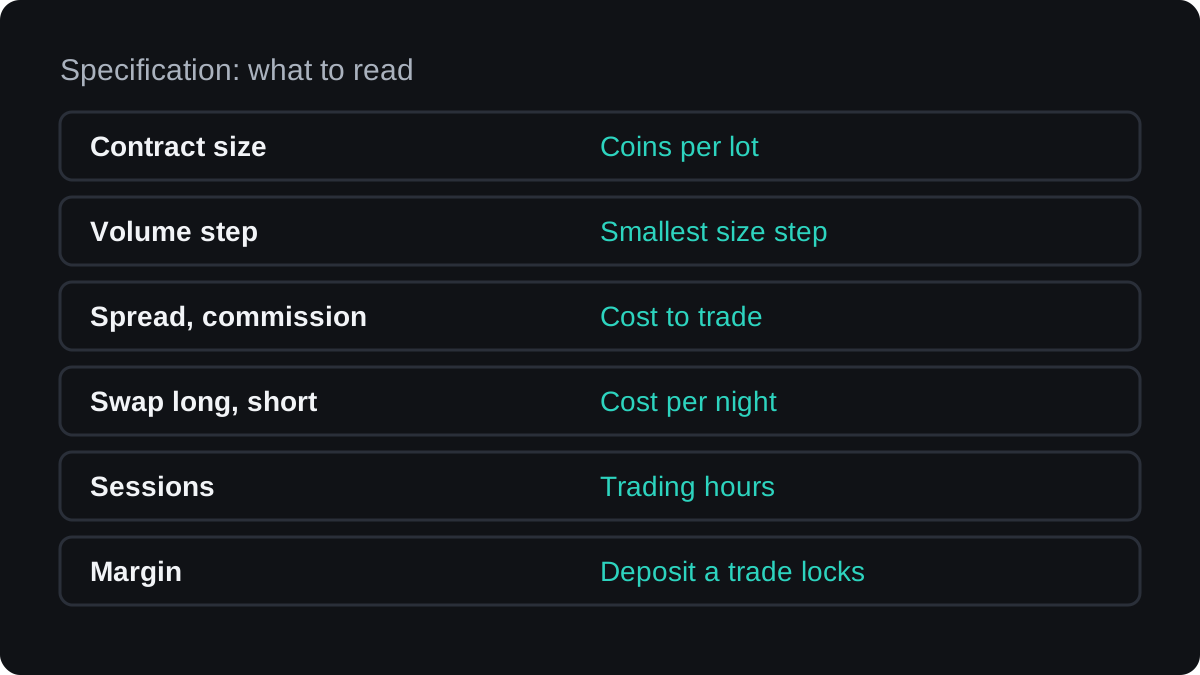
Read them once for each broker and each symbol. A BTCUSD at one broker and a BTCUSD at another can be quite different contracts.
Questions
Do I own bitcoin when I trade a BTCUSD CFD?
No. You hold a contract with your broker that pays or charges the change in price. There is no coin in your name, and you cannot withdraw one.
Do I need a crypto wallet to trade crypto CFDs?
No. The position lives in your broker account and settles in your account currency. A wallet only matters if you buy the coins themselves.
Is a crypto CFD the same as crypto futures?
No. Futures are standardised contracts traded on an exchange, and many have an expiry date. A CFD is a private contract with your broker, usually with no expiry, that may charge swap for each night it stays open.
Can I lose more than I deposit on a crypto CFD?
It depends on your broker and where you live. With negative balance protection, which EU rules require for retail clients, your losses are capped at the money in your account. Without it, a sharp gap can leave you owing money.
Keep learning
 Chapter 2Buying coins vs trading crypto CFDs.Buying coins gives you the asset itself, which you can hold or send, and you must guard the keys. A crypto CFD gives you only the price change, settled in cash by your broker. CFDs make shorting and leverage easy but usually charge swap each night, so long holds tend to cost more.
 Chapter 2What does it cost to trade crypto CFDs?Trading a crypto CFD costs the spread on every trade, commission on some account types, and swap for each night the position stays open. Slippage can add to the bill. The spread matters most on short trades and swap on long ones. Your broker sets every rate, so read them in the symbol's specification.
 Chapter 2How does leverage work on crypto CFDs?Leverage on a crypto CFD lets you open a position worth more than the margin you put up. At 1:10, a $6,000 bitcoin position locks $600. Leverage sets the margin and position size sets the risk. Because crypto moves fast, brokers and regulators usually allow far less leverage on crypto than on forex.
 Chapter 2Trading crypto CFDs at weekends.Coins trade on exchanges seven days a week, but a crypto CFD trades only when your broker's sessions allow. Some brokers quote crypto CFDs through the weekend, others pause them. Either way, weekend markets can be thinner, spreads can widen, prices can gap, and swap may count Saturday and Sunday nights.

