Trading crypto CFDs at weekends.
Coins trade on exchanges seven days a week, but a crypto CFD trades only when your broker's sessions allow. Some brokers quote crypto CFDs through the weekend, others pause them. Either way, weekend markets can be thinner, spreads can widen, prices can gap, and swap may count Saturday and Sunday nights.

On Friday evening, New York time, the forex market shuts for the weekend. Bitcoin keeps trading on exchanges all through Saturday and Sunday.
Whether your BTCUSD CFD keeps trading too depends on your broker. This lesson shows how to find out, and what changes when it does.
Coins never close, but a CFD might
Crypto exchanges run around the clock, every day of the year, as when the crypto market trades explains. Forex runs from Sunday evening to Friday evening, New York time, through its trading sessions.
A crypto CFD follows its broker's schedule, which the broker sets day by day. It can quote the CFD seven days a week, with or without short daily breaks, or pause it at weekends, and holiday schedules can differ again.
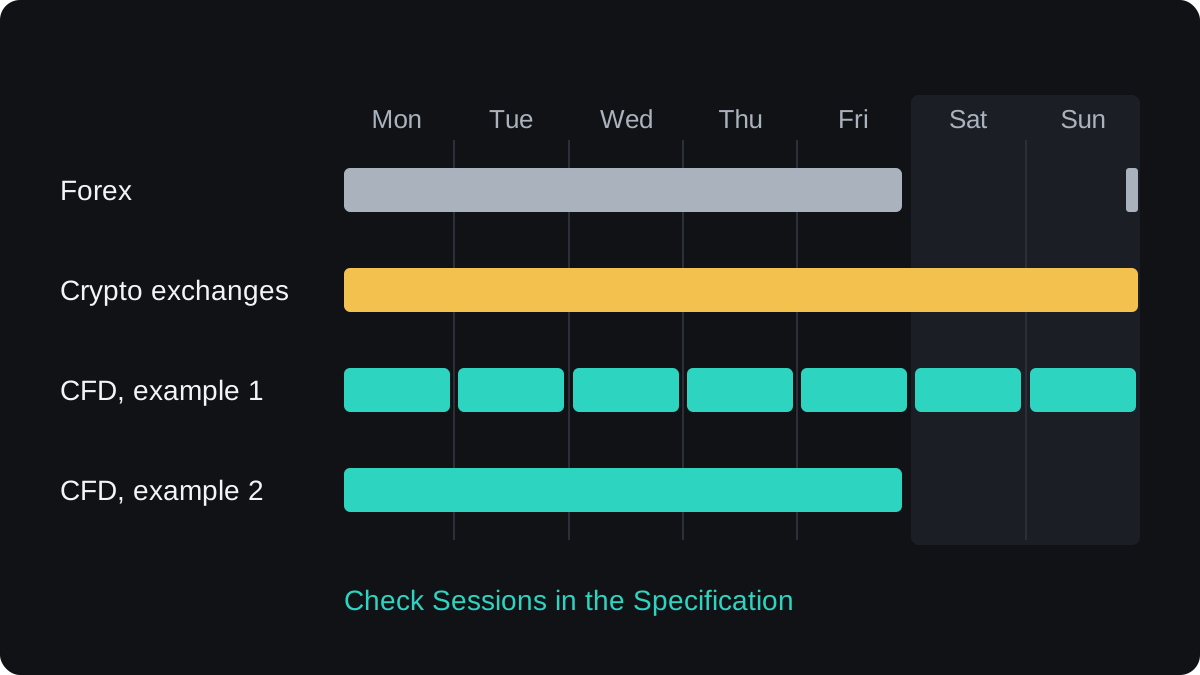
How to read the trading sessions
In MetaTrader 5, right click BTCUSD in Market Watch and choose Specification. The Sessions part at the bottom lists the quote and trade times for each day of the week.
Look at the Saturday and Sunday rows. If they show trade times, you can open and close positions then. If they show none, the CFD is closed on those days.
The times are in the broker's server time, which may differ from yours. Market Watch can show a Time column with the last quote time in server time, so compare it with your own clock and convert.
Also check the Trade field near the top of the specification. It shows whether the symbol allows full access, long only, short only or close only, or no trading at all.
What changes at weekends
Weekend crypto trading is often quieter: exchanges usually handle less volume than on weekdays, and fewer orders may rest near the price. The liquidity behind a crypto CFD can be thinner, and spreads can widen.
A broker can raise margin requirements on crypto before the weekend, or for the whole of it, to guard against gaps. Watch for notices from your broker about such changes.
Your other positions matter too. Forex is closed, but its open positions still count in your equity and margin, so a crypto loss on Saturday lowers the margin level of the whole account.
While forex is shut, you cannot close those positions to free margin. Free margin you left in advance, as in keeping a margin buffer, is the only room you have before a stop out.
Gaps when a crypto CFD reopens
If your broker pauses a crypto CFD while coins keep trading elsewhere, the CFD reopens at the new price. Everything in between is skipped, and a stop fills at the first price available.
An example with illustrative prices, at an illustrative 1 coin per lot:
- You buy 0.10 lot of BTCUSD at 60,000 with a stop loss at 58,000. The planned risk is 2,000 × 1 × 0.10 = $200.
- The CFD pauses on Friday at 59,500.
- Over the weekend the coin falls, and the CFD reopens at 56,000.
- Your stop fills at 56,000. The loss is 4,000 × 1 × 0.10 = $400, twice the plan.
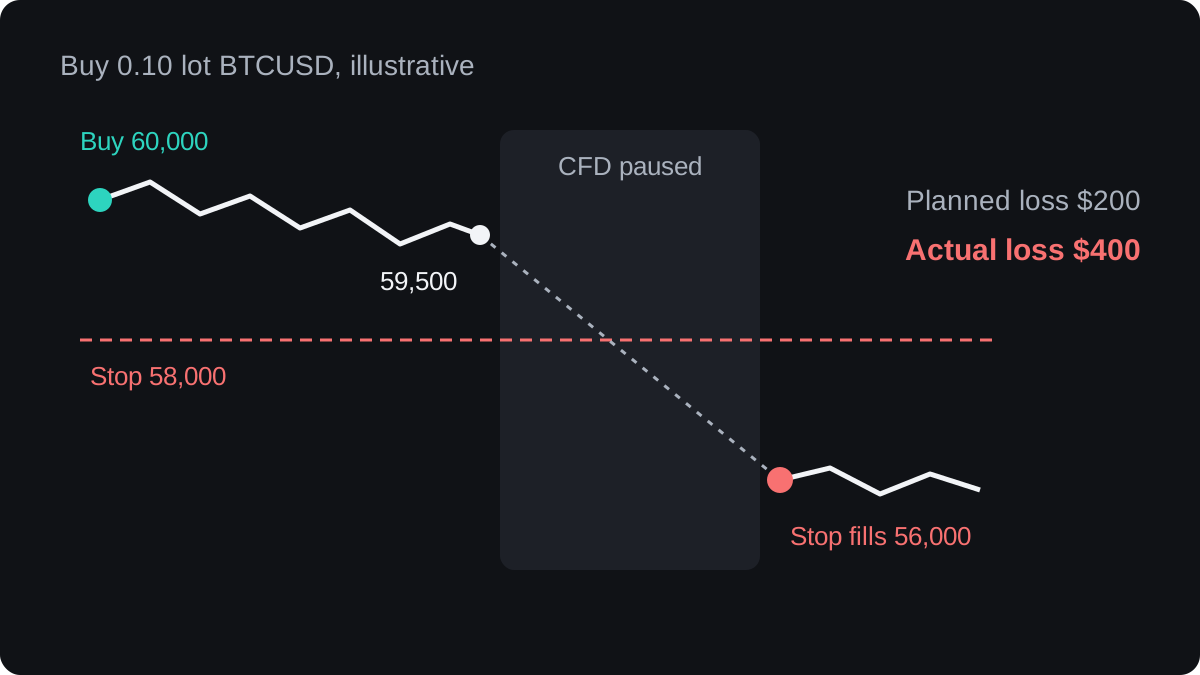
A CFD that trades all weekend can still jump. When few prices are quoted, the price can skip past your stop, and the difference is slippage.
Swap over the weekend
On forex pairs the weekend is usually charged on Wednesday. That night counts three times, so a forex position held from Friday to Monday pays one night. The swap lesson explains why.
Crypto symbols can work differently, because the broker sets a multiplier for each day of the week. It can count every calendar night, Saturday and Sunday included, or put the triple charge on another day.
Swap rates in the specification show the multiplier for each day.
An illustrative comparison, with swap of -$3 per night on 0.10 lot, held from Friday to Monday:
- Every night counts: Friday, Saturday and Sunday each count once, so 3 × $3 = $9.
- Wednesday counts triple: only Friday's single night applies, so 1 × $3 = $3.
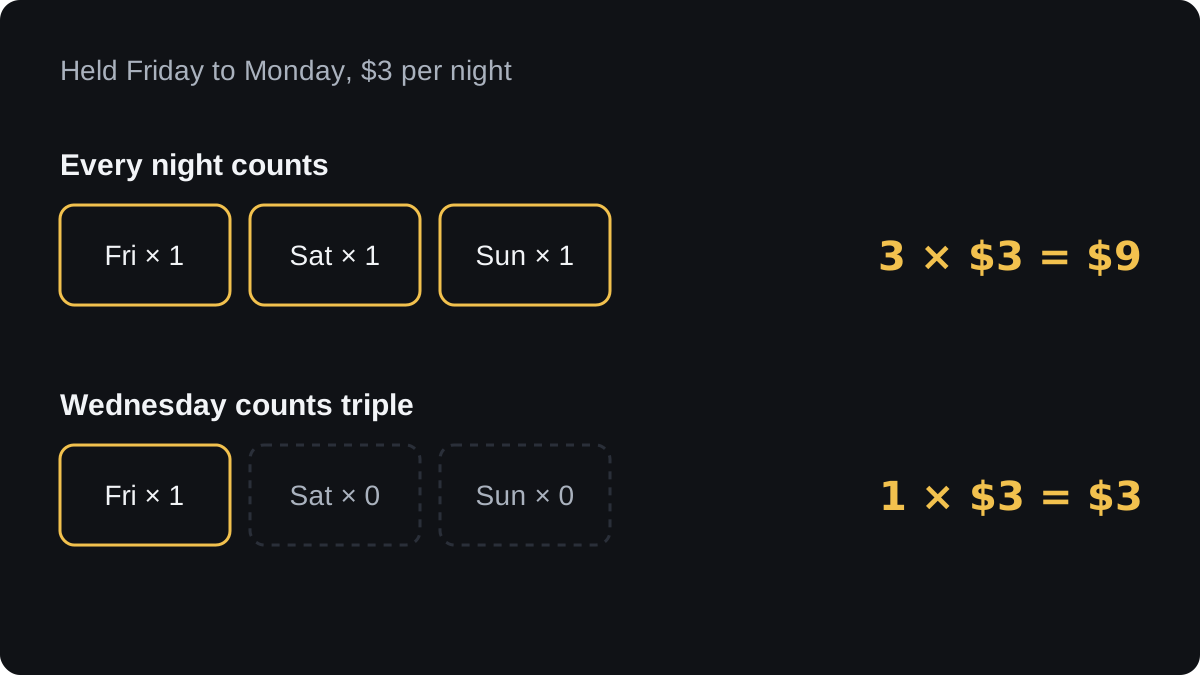
Over a full week both schedules can come to the same seven nights. The difference is when you pay, which matters most for trades held only over the weekend.
A check before the weekend
Before Friday, these checks take a few minutes:
- Sessions: does the CFD trade on Saturday and Sunday, and at what times?
- Swap rates: how many nights does Friday to Monday count?
- Broker notices: is there a weekend margin change or maintenance?
- Position size: if the price gaps past your stop, can the account take it?
- Other positions: is there enough free margin while forex is closed?
Questions
Can you trade crypto CFDs on Saturday and Sunday?
At some brokers you can, and at others you cannot. The Sessions part of the symbol's specification shows the trade times for each day, in server time.
Why did my crypto CFD open with a gap?
The CFD was paused while the coin kept trading elsewhere, so it reopened at the new market price. Stops between the two prices fill at the first price available.
Is swap charged on crypto CFDs at the weekend?
It depends on the symbol's swap rates, which can count Saturday and Sunday like any other night. Check the multiplier for each day in the specification.
Are crypto CFD spreads wider at the weekend?
They can be, because weekend markets are often thinner. Check the live spread before you trade instead of relying on a weekday figure.
Keep learning
 Chapter 2What is a crypto CFD?A crypto CFD is a contract with your broker that settles the change in a cryptocurrency's price in cash. You never own the coin, so you need no wallet or private key. You can buy or sell, profit or loss lands in your account currency, and the broker sets the contract's terms.
 Chapter 2Buying coins vs trading crypto CFDs.Buying coins gives you the asset itself, which you can hold or send, and you must guard the keys. A crypto CFD gives you only the price change, settled in cash by your broker. CFDs make shorting and leverage easy but usually charge swap each night, so long holds tend to cost more.
 Chapter 2What does it cost to trade crypto CFDs?Trading a crypto CFD costs the spread on every trade, commission on some account types, and swap for each night the position stays open. Slippage can add to the bill. The spread matters most on short trades and swap on long ones. Your broker sets every rate, so read them in the symbol's specification.
 Chapter 2How does leverage work on crypto CFDs?Leverage on a crypto CFD lets you open a position worth more than the margin you put up. At 1:10, a $6,000 bitcoin position locks $600. Leverage sets the margin and position size sets the risk. Because crypto moves fast, brokers and regulators usually allow far less leverage on crypto than on forex.

