What is Ethereum?
Ethereum is a public blockchain that records balances and also runs programs called smart contracts. Anyone can use it or build on it without asking permission. Its own currency, ether (ETH), pays the fee for every action. Since 2022 the network has been secured by proof of stake instead of mining.

When you send bitcoin to a friend, the Bitcoin network records one fact: coins moved from one address to another. Ethereum can record that same kind of payment.
It can also store a program that decides by itself when money moves and to whom. Running programs that everyone can check is what Ethereum was built for.
A blockchain that runs programs
A blockchain is a shared record that thousands of computers keep identical. Bitcoin's record is mainly a list of who owns which coins.
Ethereum keeps a larger record called the state. It holds every account's balance, plus the code and stored data of every program on the network.
Those programs are smart contracts. Every computer in the network runs a contract's code the same way and gets the same result, so nobody has to trust one company's server.
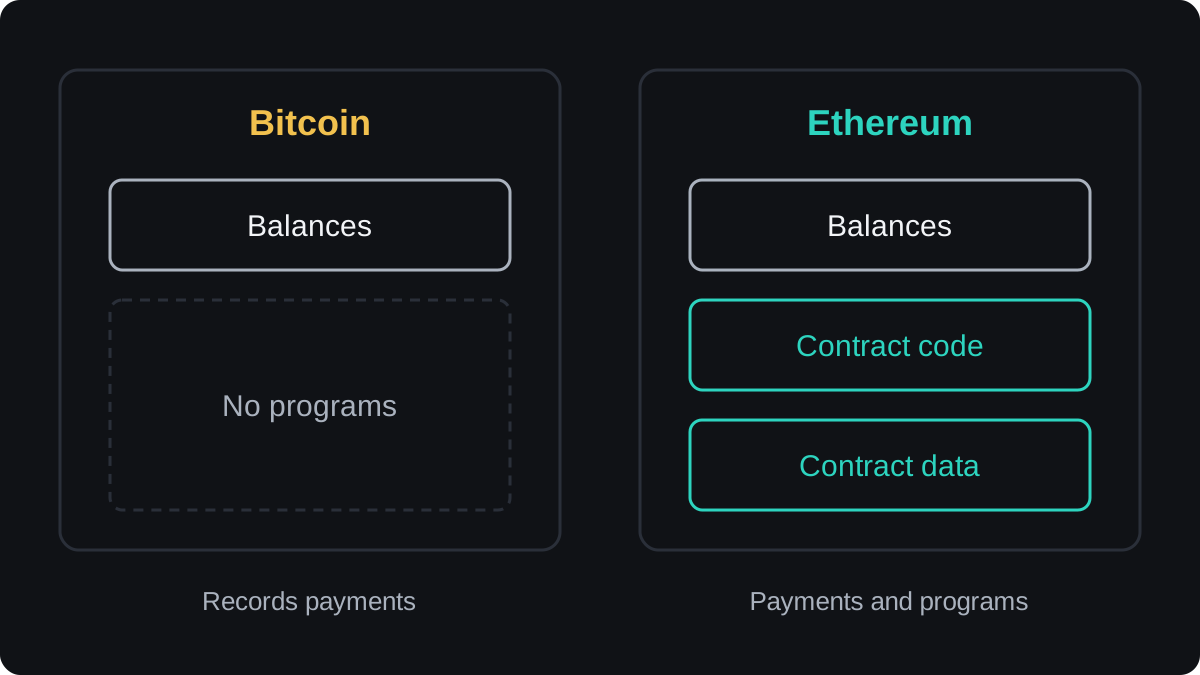
People sometimes call Ethereum a world computer. By normal standards it is slow and expensive. What you get in return is a result that no single company can quietly change.
Who created Ethereum, and when
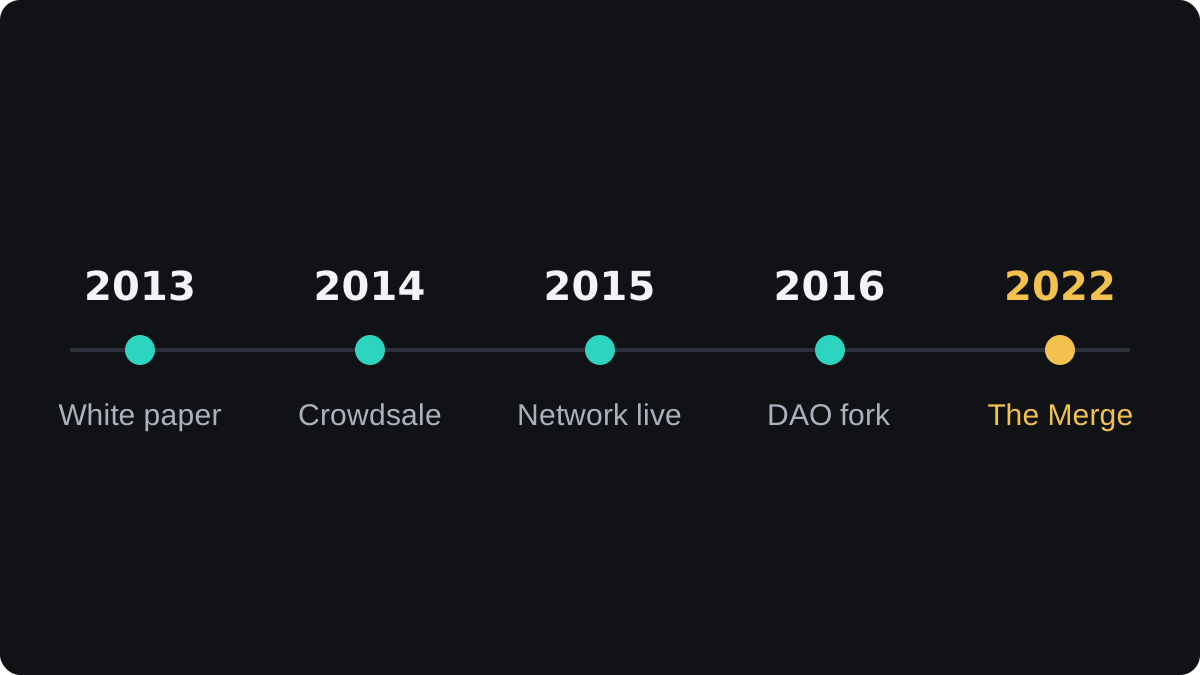
Vitalik Buterin, a young programmer who wrote about Bitcoin, described Ethereum in a white paper at the end of 2013. His idea was a blockchain that could run general programs as well as payments.
Several co-founders joined him. One of them, Gavin Wood, wrote the formal technical specification. In 2014 the project funded itself by selling ether to the public in a crowdsale.
The network went live in July 2015. A Swiss non-profit, the Ethereum Foundation, funds research and development, but it does not own or control the network.
In 2016 a project called The DAO was drained through a flaw in its code. Most of the community backed a hard fork, a rule change that let investors reclaim their ether.
A minority kept the old chain, now called Ethereum Classic.
In September 2022 an upgrade called the Merge ended mining on Ethereum. The network moved to proof of stake, which cut its electricity use by more than 99%.
Accounts, blocks and validators
Ethereum has two kinds of account. One is controlled by a private key, which is what your wallet holds. The other is a smart contract, which is controlled only by its own code.
Both kinds have an address starting with 0x and a balance in ether. Only a key-controlled account can start a transaction. A contract runs only when a transaction calls it.
Transactions are grouped into blocks, and Ethereum adds a new block several times a minute. Bitcoin aims for one block about every 10 minutes.
Blocks are proposed and checked by validators. Each validator locks up at least 32 ETH as a deposit. A validator that breaks the rules loses part of it, so cheating costs real money.
Locking ether up this way is called staking. Validators earn newly created ether and part of the fees as a reward for doing the work honestly.
Gas: how Ethereum charges for work
Every action on Ethereum takes computing work, measured in units of gas. A plain ether transfer to a wallet that has been used before takes 21,000 gas. A token swap can use 150,000 gas or more.
You pay for each unit of gas at a price quoted in gwei. One gwei is one billionth of an ether. The price per unit rises when many people want to use the network at the same time.
Here is a transfer worked through with an illustrative gas price of 20 gwei:
- You send 0.5 ETH to a friend. The transfer uses 21,000 gas.
- The fee is 21,000 × 20 = 420,000 gwei.
- In ether that is 420,000 ÷ 1,000,000,000 = 0.00042 ETH.
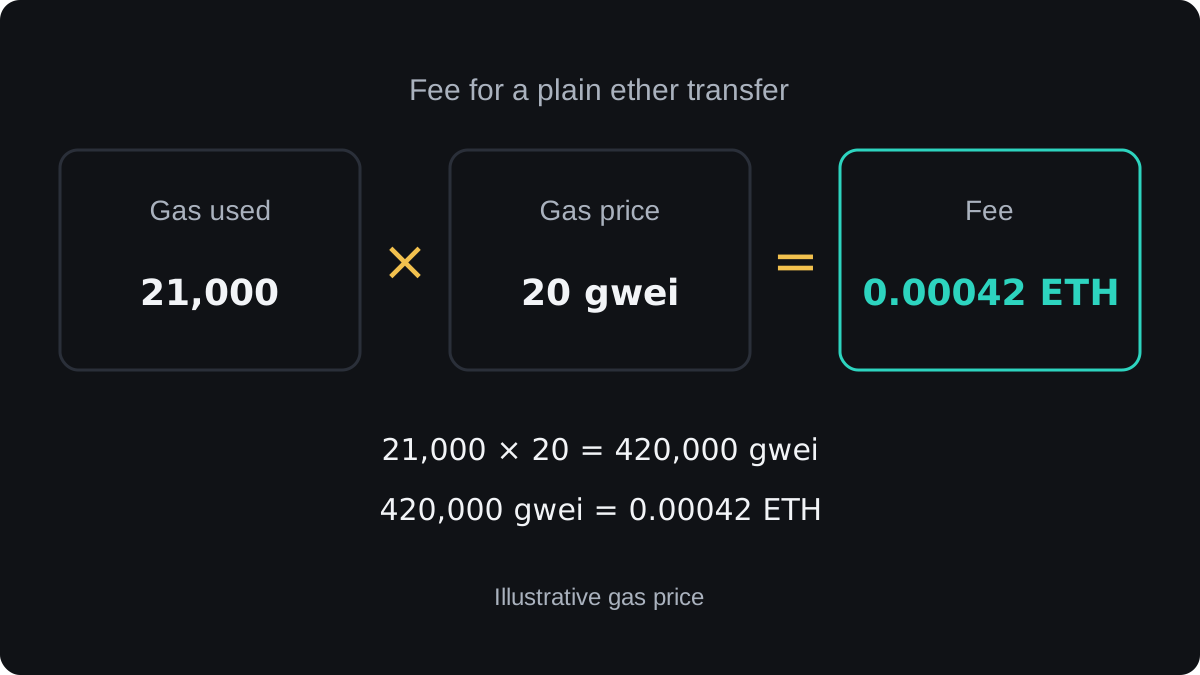
The amount you send does not change the fee. Sending 0.01 ETH or 100 ETH takes the same 21,000 gas.
A swap using 150,000 gas at the same price costs 150,000 × 20 = 3,000,000 gwei, which is 0.003 ETH, about seven times the fee for the transfer.
The network collects every fee in ether, whatever you are doing on it. That gives ether a steady source of demand, as the lesson on ether explains.
What people build on Ethereum
Most activity on Ethereum runs through smart contracts. Common uses include:
- Tokens issued by anyone through a contract, including stablecoins that track the US dollar.
- Lending and trading apps that run without a company holding your funds, known together as DeFi.
- NFTs, where a contract records who owns a unique token.
- Layer 2 networks, separate chains that process transactions more cheaply and post the results back to Ethereum.
Apps built on these contracts are called dApps, short for decentralized applications.
Where Ethereum falls short
Fees jump when the network is busy, because users bid against each other for limited space in each block. At peak times a simple action can cost more than the amount being sent.
Contract code is public, and attackers study it. A buggy contract can be drained in minutes, and since transactions cannot be reversed, stolen funds are usually gone.
Mistakes by users are permanent too. Send ether to a wrong address and no one can undo it.
A large share of staked ether sits with a handful of staking services and exchanges. Critics see that as a risk to how decentralized the network really is.
Other blockchains compete for the same users, often with lower fees. Some of Ethereum's own activity has moved to layer 2 networks, which changes how much the main chain earns in fees.
Questions
Is Ethereum the same as ether?
Ethereum is the network. Ether (ETH) is its currency, used to pay fees and to stake. People often say Ethereum when they mean the coin.
Who owns Ethereum?
No company owns it. The software is open source, independent validators run the network, and changes need broad agreement among developers and node operators.
Does Ethereum still use mining?
No. Mining ended with the Merge in September 2022. Validators who stake ether now propose and check blocks.
Why are Ethereum fees sometimes so high?
Each block has limited space, so users bid for it. When demand jumps, the price per unit of gas rises with it.
Is Ethereum better than Bitcoin?
They are built for different jobs. Bitcoin is designed mainly as money with a capped supply, while Ethereum is designed to run programs, so each makes different trade-offs.
Keep learning
 Chapter 3What is a smart contract?A smart contract is a program stored on a blockchain such as Ethereum. It holds funds and follows fixed rules: when someone calls it and the conditions are met, it acts automatically, with no company in the middle. It cannot see outside data on its own, and a bug can lose money for good.
 Chapter 3What is a dApp?A dApp, short for decentralized application, is an app whose core rules run as smart contracts on a blockchain instead of on a company's servers. You use it through a website and a crypto wallet that signs each action. No company holds your funds, so contract bugs, fake sites and fees are yours to manage.
 Chapter 3What is ether, and why does it have value?Ether (ETH) is the native currency of the Ethereum network. Every transaction pays its fee in ether, and validators lock it up as a deposit to secure the network. Its value comes from that demand meeting a supply with no fixed cap, which grows through new issuance and shrinks when fees are burned. Nothing guarantees its price.
 Chapter 3What moves the price of ether?Ether's price moves when the balance between buyers and sellers shifts. Most days the biggest driver is the crypto market as a whole, led by bitcoin, which in turn reacts to interest rates and risk appetite. Ether's own supply, use of the network, fund flows and forced selling by leveraged traders add moves on top.

