Proof of work vs proof of stake.
Proof of work and proof of stake are two ways for a blockchain to decide who adds the next block. In proof of work, miners spend electricity on a guessing race. In proof of stake, validators lock up the network's own coins as a deposit, get picked in proportion to that stake, and lose part of it if they cheat.

Picture a club that anyone can join under any name, whose members must agree on one shared account book. A vote by headcount fails at once, because one person could sign up a thousand fake members and outvote everyone.
Open blockchains face the same problem. A blockchain network has no owner to pick the next block, and anyone can join under as many names as they like.
A consensus mechanism is the rule that lets those strangers agree on the next block anyway. The two main designs work by tying influence to something scarce that costs real money.
Proof of work ties influence to computing power, which costs hardware and electricity. Proof of stake ties it to coins locked where the network can take them. Either way, an attacker needs a large share of that resource.
How proof of work picks the next block
In proof of work, miners race to find a block whose hash falls below a target. The first to succeed adds the block and earns the reward. The Bitcoin mining lesson goes through it step by step.
Your chance of winning any block equals your share of the total hashing power. With 1% of it, on a network that makes 144 blocks a day, you would win about 1.44 blocks a day on average.
Cheating is expensive in a simple way. A block with an invalid transaction is rejected by every node, and the electricity spent finding it is gone.
How proof of stake picks the next block
In proof of stake, there is no guessing race. Validators lock up coins as a deposit, called their stake.
For each new block, the protocol picks one validator at random to propose it, with odds weighted by stake. Other validators check the block and vote on it.
Your chance of being picked equals your share of all staked coins. With 1% of the stake, on a network that picks a proposer 10,000 times a day, you would propose about 100 blocks a day on average.
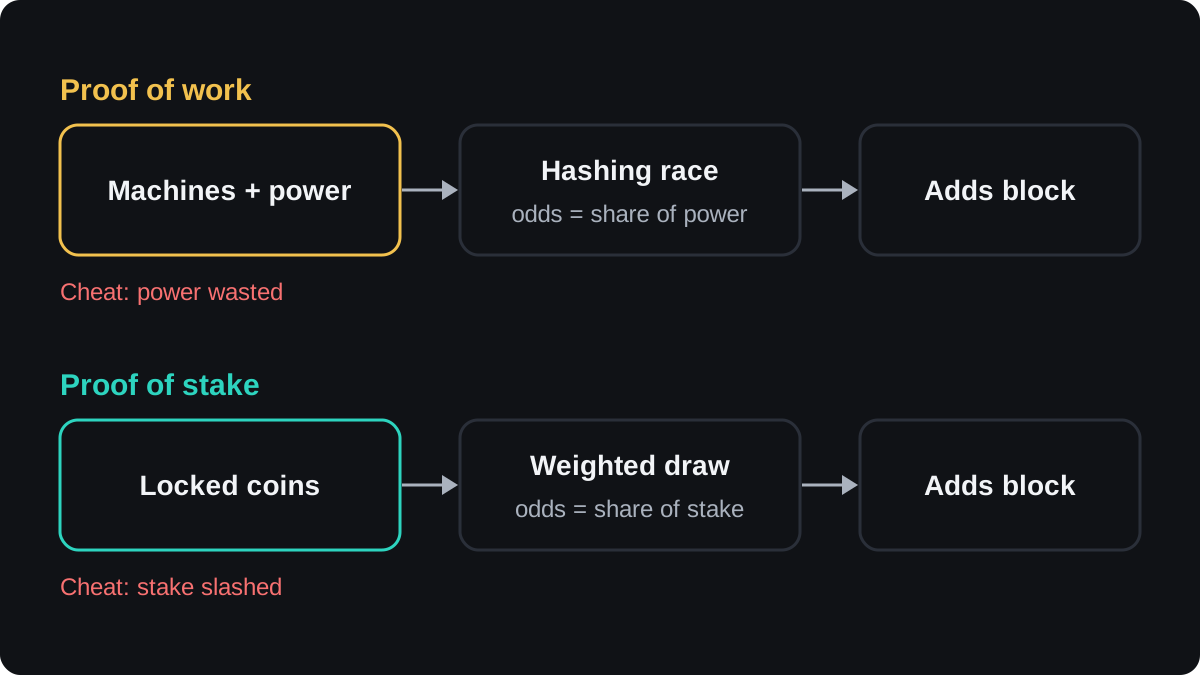
The deposit keeps validators honest. If one signs two conflicting blocks or votes, the protocol destroys part of its stake, which is called slashing. Validators that are simply offline usually lose smaller amounts.
Ethereum moved from proof of work to proof of stake in 2022. As of 2026, running your own Ethereum validator takes a deposit of at least 32 ETH. The staking lesson shows how holders take part with less.
Side by side
The table puts the two designs next to each other. Many details differ between networks, so treat it as the general pattern.
| Proof of work | Proof of stake | |
|---|---|---|
| Who adds blocks | Miners | Validators |
| What they commit | Machines and electricity | Coins locked as a deposit |
| How one is chosen | First valid hash wins | Random draw weighted by stake |
| Penalty for cheating | Wasted electricity | Part of the stake destroyed |
| Energy use | High | Low |
| When a block is final | Safer with every new confirmation | Many designs mark blocks as final |
| Examples | Bitcoin, Litecoin, Dogecoin | Ethereum, Cardano, Solana |
What it would cost to attack each one
Both systems are only as safe as the price of taking over. Every number below is illustrative.
- A proof of work network runs the equivalent of 100,000 mining machines.
- To outpace them, an attacker needs more than 100,000 machines of their own.
- At $2,000 each, that is over 100,000 × $2,000 = $200 million, before the power bill.
Now a proof of stake network with the same idea:
- Validators have staked 10,000,000 coins, and the coin trades at $50.
- To outweigh them, an attacker needs more than 10,000,000 coins.
- That is over 10,000,000 × $50 = $500 million, and buying that many would push the price up.
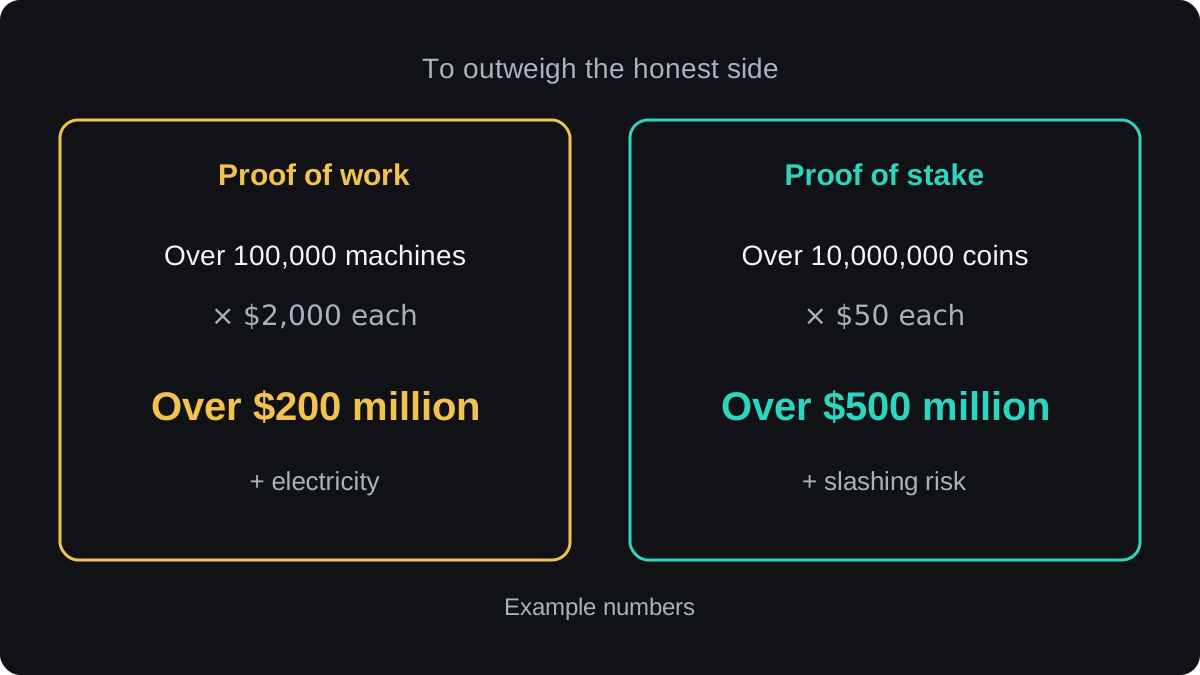
A failed proof of work attacker still owns the machines and can try again. A proof of stake attacker caught signing conflicting votes can lose a large part of the stake to slashing.
Scale changes the picture. A small proof of work coin that shares its hash function with a much bigger one is cheap to attack, because machines can be rented away from the big coin for a few hours.
Proof of stake has its own thresholds. On Ethereum, a block becomes final once validators holding two thirds of the stake have voted for it, and undoing it would mean slashing at least a third of all stake.
So validators with more than a third could stop blocks from becoming final, without controlling the chain outright. The protocol would then slowly drain the stake of validators that do not vote.
Where each design breaks
Proof of work spends energy by design, since the cost of guessing is what protects the chain. Critics count that electricity against it. Mining also tends to gather around cheap power and a handful of large pools.
Proof of stake uses little energy, and its weak points lie elsewhere. Stake tends to pool at large exchanges and staking services, which then cast a big share of the votes.
Rewards in proof of stake go to holders who stake. A staker's share of the supply holds steady or grows a little, while holders who do not stake slowly lose share as new coins are issued.
Proof of stake is also younger and more complex. More rules mean more code that can fail, and lock-up periods mean a staker cannot always sell quickly.
What the choice means for holders and traders
The two systems pay new coins to different people. Miners have power bills in ordinary money, so they tend to sell part of what they earn, while stakers have few running costs.
How much either effect moves the price is hard to measure, and it is one input among many.
A proof of stake coin can earn a staking reward if you stake it. A proof of work coin pays nothing for holding it, because the new coins go to whoever mines.
A crypto CFD gives you neither. It is a contract on the price with a broker, so you never hold the coins needed to mine or stake.
Questions
Is proof of stake safer than proof of work?
Neither is safer in every case. A large proof of work network is very expensive to attack. Proof of stake adds slashing and faster finality, but it has more complex rules and a risk of stake pooling.
Why did Ethereum switch to proof of stake?
Its developers gave several reasons, among them far lower energy use and fewer new coins, since validators need less reward than miners to cover their costs. The switch took place in 2022.
Can a proof of work coin switch to proof of stake?
It can, though it is hard. Ethereum ran a proof of stake chain alongside its old chain for almost two years before joining them in 2022.
Does proof of stake make the rich richer?
Protocol rewards follow stake, so a small stake earns about the same percentage as a large one, before any pool or exchange fee. Holders who do not stake slowly lose share, and large staking providers gather many small holders' votes.
Keep learning
 Chapter 4What is crypto mining?Crypto mining is the work of packing pending transactions into a block, then racing other computers to find a number that makes the block valid. The winner adds the block to the blockchain and collects newly created coins plus the fees inside it. Bitcoin is the best-known coin that is secured this way.
 Chapter 4What is a mempool?A mempool is the waiting area for crypto transactions that have been sent but not yet added to a block. Each node keeps its own copy in memory. When blocks are full, miners pick the transactions that pay the highest fee for each unit of space first, so a low-fee payment can wait for hours or longer.
 Chapter 4How does Bitcoin mining work?Bitcoin miners build a candidate block, then hash its header over and over, changing a number called the nonce each time. The block counts only when its hash comes out below a target set by the network. Every 2,016 blocks the network resets the target so that blocks keep arriving about every ten minutes.
 Chapter 4What is staking?Staking is locking up coins on a proof of stake blockchain so they can help secure it. The coins back a validator that proposes and checks blocks, and the network pays rewards in new coins and fees. You can run a validator, delegate to one, or stake through a pool or an exchange, and each route carries its own risks.

