What is a seed phrase?
A seed phrase is a list of 12 or 24 ordinary words that encodes the master secret of a crypto wallet. Typed into a compatible wallet, it rebuilds every private key and address you had. Anyone who sees it can take your coins, so it belongs on paper or metal, kept offline.
Picture losing your phone on a trip. Back home, you install a wallet app on a new phone, choose restore, and type 12 words from a sheet of paper. A minute later your addresses and balances are back.
Those 12 words are the seed phrase, also called a recovery phrase or mnemonic. They are the master backup of a self-held crypto wallet, and whoever holds them holds the coins.
What the words really are
Underneath, a wallet's secret is a very large random number. A number that long is easy to mistype, so the wallet shows it as words taken from a fixed list of 2,048 entries.
Many wallets follow an open standard for this, known as BIP39. Each word stands for an 11-bit slice of the number (a bit is a binary digit, 0 or 1), because 2,048 is 2 multiplied by itself 11 times.
Twelve words carry 132 bits: 128 bits of the random number plus a 4-bit checksum at the end, a small check value that lets the wallet catch most typing mistakes. Twenty-four words carry 256 bits plus an 8-bit checksum.
A few rules follow from this:
- Spelling matters. Each word must match the list exactly.
- Order matters. The same 12 words in a different order make a different wallet, or no valid wallet at all.
- Every word comes from the list. A phrase with a word that is not on it was not made by a standard wallet.
- Most wallets use 12 or 24 words. The standard also allows 15, 18 and 21.
How 12 words rebuild every key
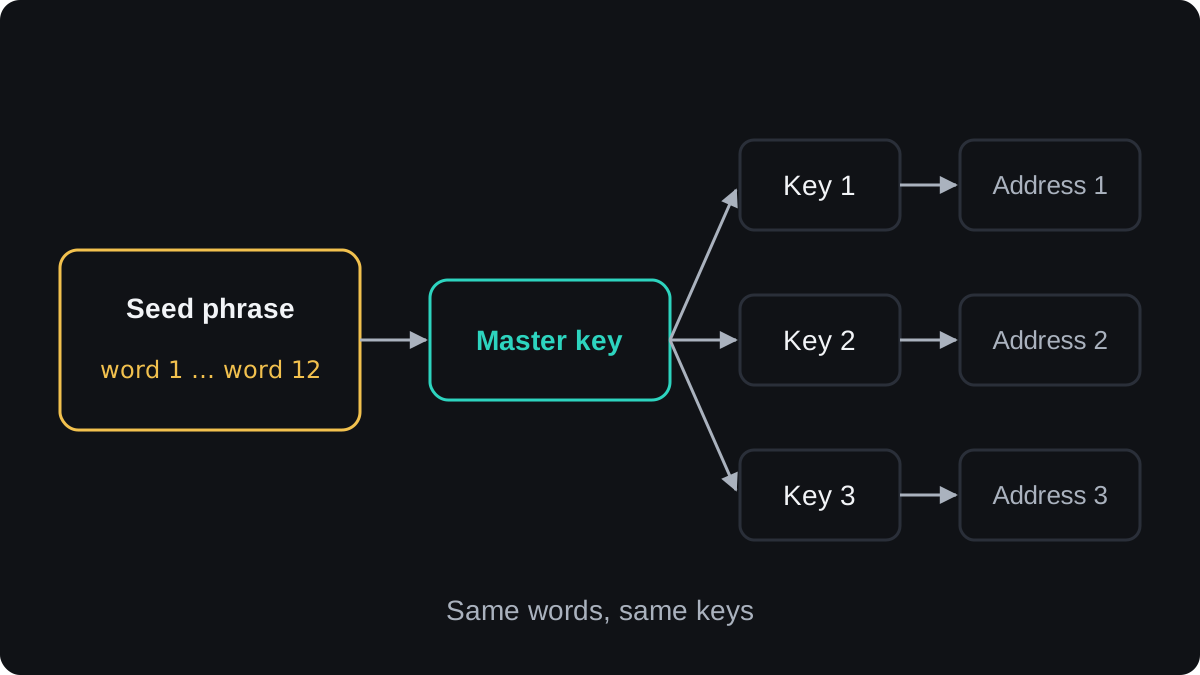
The wallet runs the phrase through a fixed calculation that always gives the same result, a master key. From the master key it derives private key number 1, number 2, number 3 and so on, each with its own address.
Because the steps never change, any wallet using the same standard gets the same keys from the same words. That is why you can restore on a different app or device and see the same addresses.
Wallets can follow slightly different routes from the master key to the addresses, called derivation paths. If a restore shows a zero balance, check the words first.
If the words are right, the wallet may be looking on a different route or network. Checking those settings usually brings the balance back.
Why nobody can guess your phrase
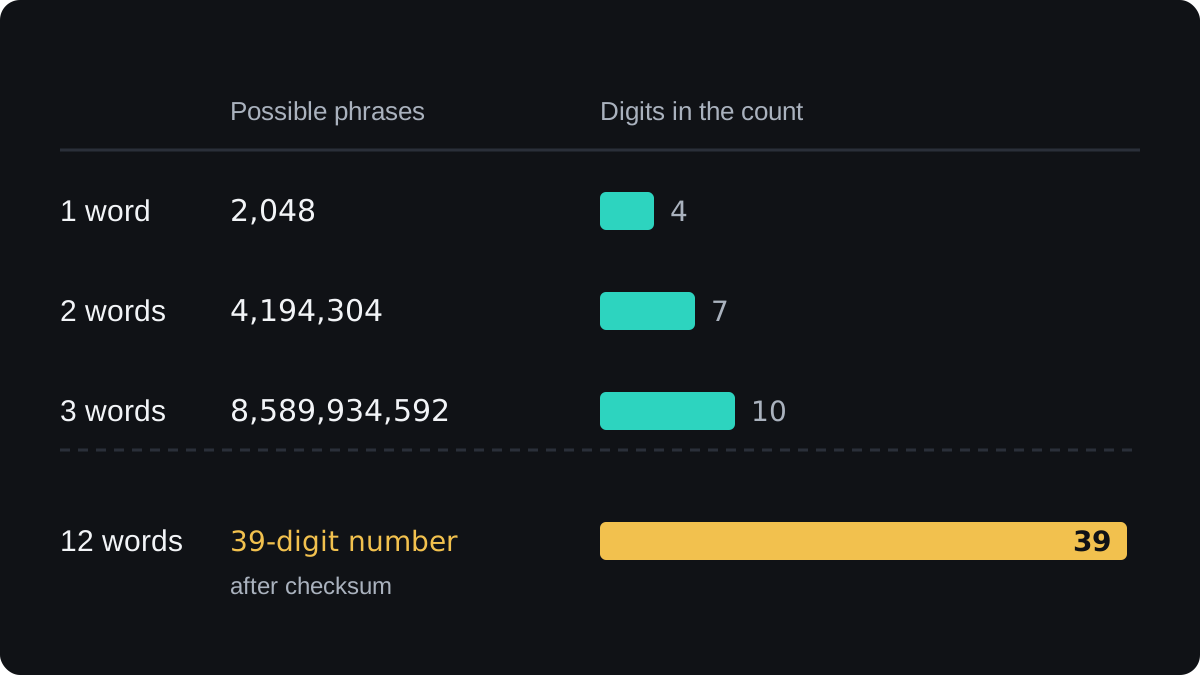
Count the possibilities one word at a time. The first three counts are exact.
- One word from a list of 2,048 gives 2,048 options.
- Two words give 2,048 × 2,048 = 4,194,304 options.
- Three words give 4,194,304 × 2,048 = 8,589,934,592 options, about 8.6 billion.
- Twelve words give 2,048 multiplied by itself 12 times, a number 40 digits long. The checksum rules out 15 of every 16 of those, which leaves about 340 trillion trillion trillion valid phrases, a number 39 digits long.
Now an illustration with an imaginary machine. Suppose it could test one trillion phrases every second. Working through all of them would take about ten billion billion years.
So words that a wallet picked at random are safe from guessing. The weak point is the person and the places where the phrase is kept.
How seed phrases get stolen
Thieves almost never guess a seed phrase. They get you to reveal it, or they find a copy. Common routes include:
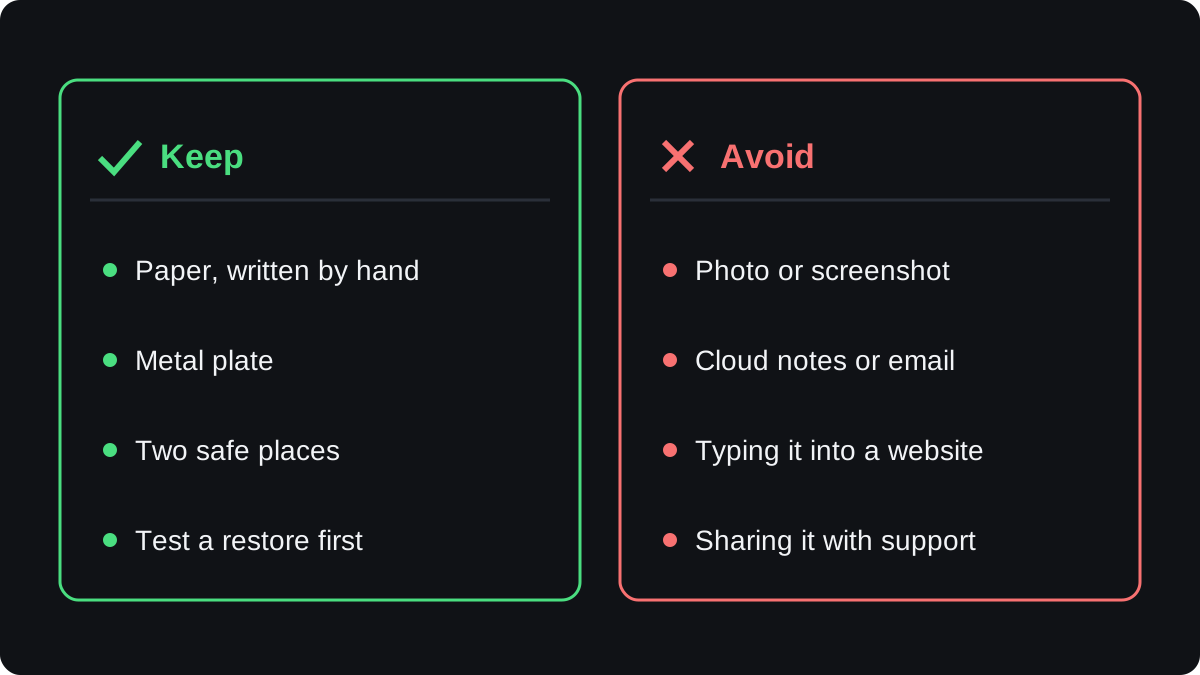
- a photo or screenshot that syncs to a cloud account
- a notes app, email draft or document on a computer that later catches malware
- a fake support agent in a chat who asks for your words to fix or verify the wallet
- a website or app that asks you to type the phrase to claim a reward or sync your wallet
- a hardware wallet bought second-hand or from an unofficial seller, with words already printed on a card
A wallet you already use never needs your seed phrase again. You type it only when you restore a wallet yourself, on a device you trust.
The lesson on common crypto scams shows how these tricks are dressed up.
How to store a seed phrase safely
Write the words by hand, in order, and check each one against the screen. Keep the paper offline, away from cameras and cloud backups.
Some people stamp the words on a metal plate, which survives fire and water better than paper.
Two copies in two safe places mean one fire or flood cannot take both. Tell someone you trust how to find them if something happens to you, without showing them the words.
Before you move real money in, test the backup. Send a small amount to the wallet, reset it, restore it from your written words, and confirm the small amount is still there.
Some wallets let you add an optional passphrase, an extra word or sentence of your choosing. The same 12 words with a different passphrase open a different wallet.
A passphrase protects you if someone finds the paper. If you forget it, though, the words alone will not bring the coins back.
One habit looks clever and backfires: splitting the 12 words into two halves stored apart. Losing either half locks you out.
Whoever finds one half has only 6 words left to guess. The imaginary machine from earlier would try every option for those 6 in under three years, against ten billion billion years for all 12.
Questions
Is a seed phrase the same as a private key?
A private key controls one address, while the seed phrase rebuilds the master key and every private key derived from it. Exposing either is serious, but the seed phrase exposes the whole wallet.
Can I recover my crypto without the seed phrase?
For a self-held wallet, only if you still have a working device with the wallet unlocked, or another backup of the keys. If both the device and the phrase are gone, nobody can recover the coins.
Is it safe to store a seed phrase in a password manager?
It is safer than a photo or a plain note, but it puts the phrase on devices that go online. Paper or metal kept offline removes that exposure.
Do I need a new seed phrase for every coin?
One phrase can hold keys for many coins and networks, as long as your wallet supports them. A different wallet app will usually create its own new phrase, so note which phrase belongs to which wallet.
What should I do if someone sees my seed phrase?
Treat the wallet as compromised. Create a new wallet with a new phrase and move the coins there at once, before the other person does.
Keep learning
 Chapter 3What is a crypto wallet?A crypto wallet is an app or device that stores your private keys and uses them to sign transactions. Your coins never sit inside it: they are records on a blockchain, tied to addresses. The wallet reads those records to show your balance and signs the messages that move the coins.
 Chapter 3Hot, cold, custodial: the types of crypto wallet.Crypto wallets split along two lines. In a custodial wallet, such as an exchange account, a company holds the keys; in a non-custodial wallet, you do. Hot wallets keep keys on an online device and suit small, frequent payments. Cold wallets keep keys offline, usually on a hardware device, and suit larger amounts you rarely move.
 Chapter 3How to choose a crypto wallet.Choose a crypto wallet by working back from what you will do with your coins. Decide who should hold the keys, check that the wallet supports the exact networks you use, look at how it backs up and recovers, and add up what it costs. Then test it with a small amount before you move more.
 Chapter 3How to send and receive crypto.To receive crypto, you share an address from your wallet for the right coin and network. To send, you paste the recipient's address, pick the same network, enter the amount, check the fee and sign. Transfers cannot be reversed, so check the whole address and test with a small amount first.

