Hot, cold, custodial: the types of crypto wallet.
Crypto wallets split along two lines. In a custodial wallet, such as an exchange account, a company holds the keys; in a non-custodial wallet, you do. Hot wallets keep keys on an online device and suit small, frequent payments. Cold wallets keep keys offline, usually on a hardware device, and suit larger amounts you rarely move.

Two people can both say their crypto is in a wallet and mean very different things. One has a login to an exchange. The other has a small device in a drawer and 24 words on paper.
Every crypto wallet answers two questions. Who holds the private keys? Are those keys on a device that touches the internet?
Two questions that sort every wallet
A custodial wallet is one where a company holds the private keys and you hold a username and password. A non-custodial wallet, often called self-custody, keeps the keys on your own device, backed up by your own seed phrase.
A hot wallet keeps its keys on a device that is online, such as a phone app or a browser extension. A cold wallet keeps them on a device that never connects to the internet, such as a hardware wallet.
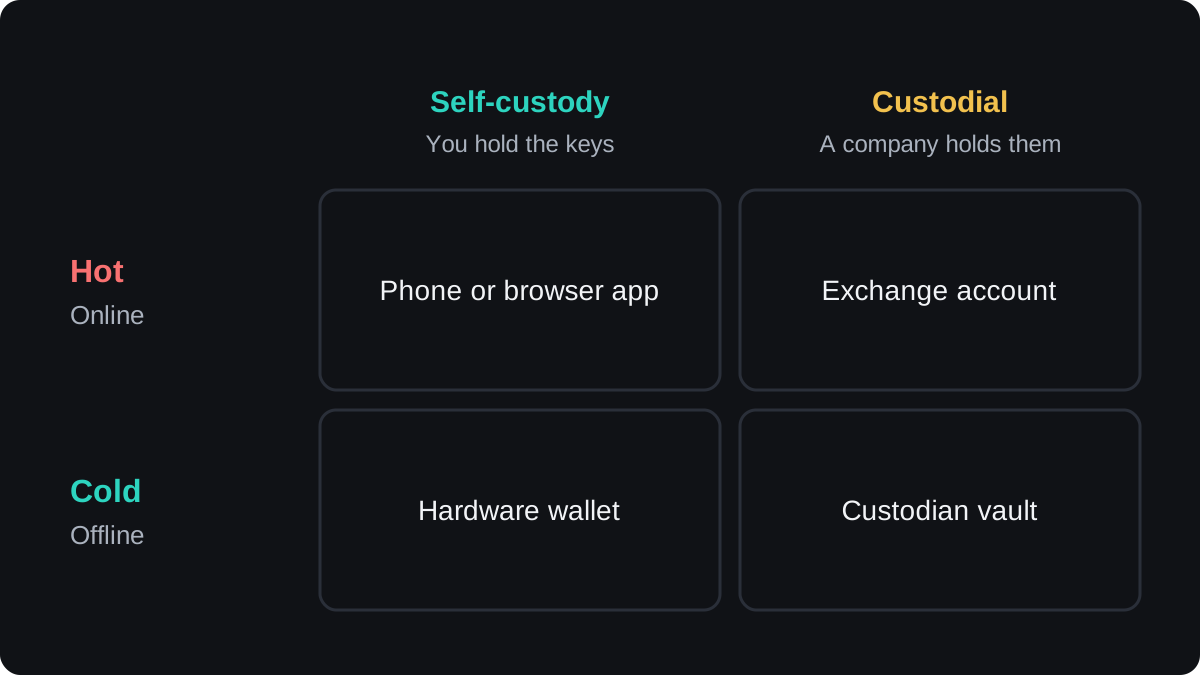
The two labels mix. A hardware wallet in your drawer is cold and non-custodial. An exchange account is custodial and you reach it online, even if the exchange keeps client coins in its own cold storage.
The last corner is a custodian vault: a company that keeps clients' keys offline as a paid service.
Custodial wallets: a company holds the keys
When you buy coins on a crypto exchange and leave them there, you have a custodial wallet. The balance on your screen is the exchange's record of what it owes you.
The upside is comfort. You can reset a forgotten password, contact support, and trade without moving coins around. There is no seed phrase for you to lose.
The cost is trust. The exchange can freeze withdrawals, close your account, get hacked or go bankrupt. When an exchange fails, its customers become creditors and may wait years to get part of their money back.
A broker offering crypto CFDs sits outside this scheme. You trade the price through a contract with the broker, so there are no coins or keys for you to hold.
Hot wallets: online and quick to use
Hot wallets are apps on a phone or computer, or extensions in a web browser. They create a seed phrase when you set them up and keep the private keys on that device, locked by a PIN or password.
They make it quick to send coins and to connect to crypto apps. The device is online, though, so malware and fake websites can reach it too.
One way people lose funds from browser wallets is approving a request they did not read. Connecting to a fake site and signing its request can give a stranger's smart contract permission to move your tokens.
Cold wallets: keys that stay offline
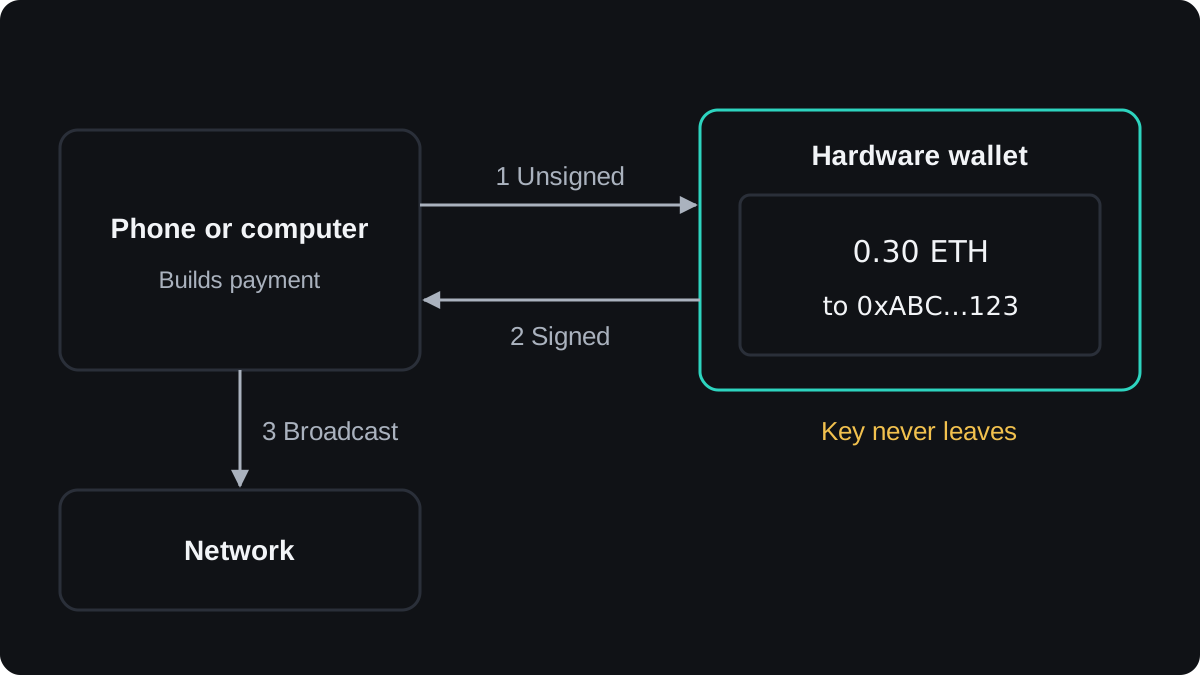
A hardware wallet is a small device built to hold private keys and sign transactions inside itself. Your phone or computer prepares the payment, the device signs it, and only the signed payment comes back out.
The device has its own screen. Before you approve, it shows what you are signing, for example 0.30 ETH to 0xABC…123. If malware on the computer swapped the address, the change would show on that screen.
Older cold methods exist. A paper wallet is a private key printed on paper, and an air-gapped computer is one kept offline for good. Both can work, but both are easy to get wrong.
A cold wallet still needs a backup. If the device breaks or goes missing, the seed phrase restores the keys onto a new one.
Multisig wallets
A multisig wallet needs several keys to approve a payment, for example any 2 of 3. You might keep one key on a hardware wallet, one on a second device and one with a person you trust.
With 2 of 3, one stolen key cannot move the coins, and one lost key does not lock you out. The cost is a more complex setup and more backups to look after.
Splitting between hot and cold
You do not have to pick only one type. One simple setup keeps a small spending balance hot and the rest cold. Here is the arithmetic with round, illustrative numbers.
- You hold $2,000 of crypto in total.
- You keep $200 in a phone wallet for payments.
- The other $1,800 sits on a hardware wallet that you connect a few times a year.
- If the phone is hacked, the most you can lose from it is $200, which is 200 ÷ 2,000 = 10% of the total.
- If everything sat on the phone, the same hack would put the full $2,000 at risk.
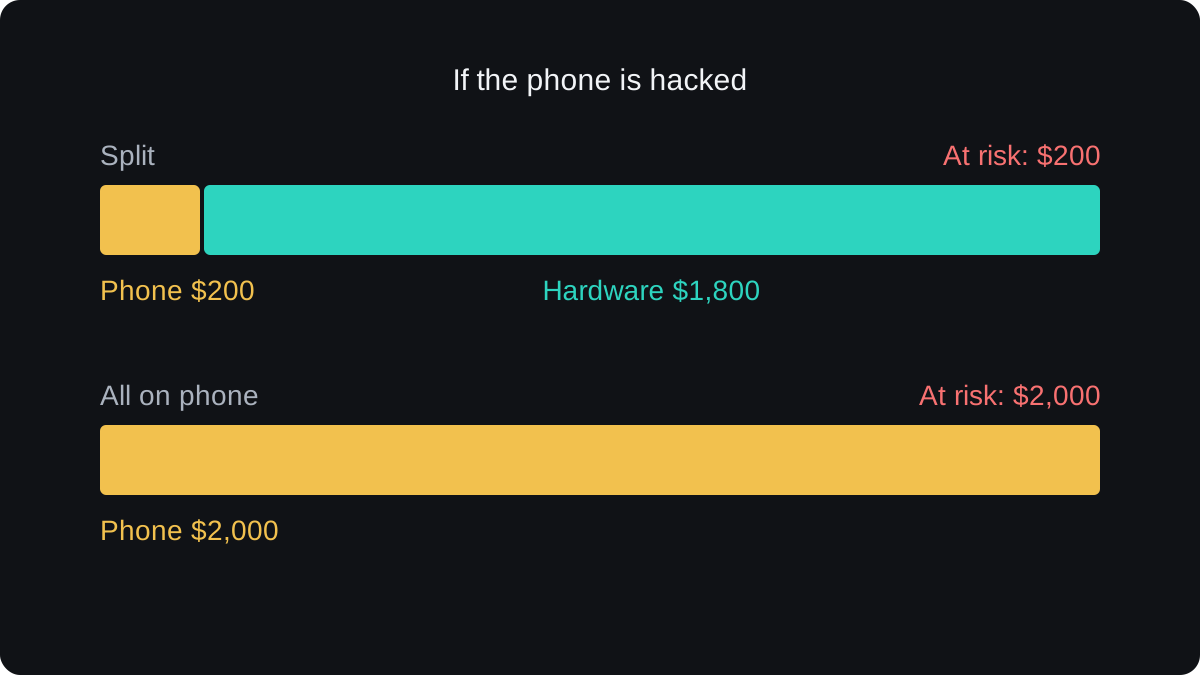
The split does not protect you from losing the hardware wallet's seed phrase, and it does nothing about price swings. It limits how much one compromised device can cost you.
The lesson on how to choose a crypto wallet turns these types into questions to ask before you pick one.
Questions
What is the difference between a hot and a cold wallet?
A hot wallet keeps its keys on an internet-connected device such as a phone. A cold wallet keeps them offline, usually on a hardware device that signs transactions without exposing the keys.
Is an exchange account a hot or cold wallet?
It is custodial, which matters more than hot or cold. The exchange may store coins in its own hot and cold wallets, but what you hold is a claim on the exchange.
Can a hardware wallet be hacked?
Malware on your computer or phone cannot read the keys, because they never leave the device. You can still lose coins by approving a scam transaction, buying a tampered device or exposing the seed phrase.
Which type of crypto wallet is best for beginners?
It depends on the amount. For small sums while you learn, an exchange account or phone wallet is simple. For larger sums held a long time, a hardware wallet takes the exchange and the online device out of the picture.
Keep learning
 Chapter 3What is a crypto wallet?A crypto wallet is an app or device that stores your private keys and uses them to sign transactions. Your coins never sit inside it: they are records on a blockchain, tied to addresses. The wallet reads those records to show your balance and signs the messages that move the coins.
 Chapter 3What is a seed phrase?A seed phrase is a list of 12 or 24 ordinary words that encodes the master secret of a crypto wallet. Typed into a compatible wallet, it rebuilds every private key and address you had. Anyone who sees it can take your coins, so it belongs on paper or metal, kept offline.
 Chapter 3How to choose a crypto wallet.Choose a crypto wallet by working back from what you will do with your coins. Decide who should hold the keys, check that the wallet supports the exact networks you use, look at how it backs up and recovers, and add up what it costs. Then test it with a small amount before you move more.
 Chapter 3How to send and receive crypto.To receive crypto, you share an address from your wallet for the right coin and network. To send, you paste the recipient's address, pick the same network, enter the amount, check the fee and sign. Transfers cannot be reversed, so check the whole address and test with a small amount first.

