What is a privacy coin?
A privacy coin is a cryptocurrency that hides the details of a payment from outsiders: the sender, the receiver, the amount, or all of them. Bitcoin records these in public. Monero hides them by default with ring signatures and one-time addresses, while Zcash lets users choose shielded payments built on zero-knowledge proofs.

Every Bitcoin payment is written to a public ledger. Anyone with a block explorer can see that one address sent 0.5 BTC to another, and when. A privacy coin is built so that outsiders cannot read those details.
What a public blockchain shows
Bitcoin addresses carry no names. That makes Bitcoin pseudonymous: your identity stays hidden only until something links you to an address.
The link usually comes from outside the chain. Say you buy coins on an exchange that checked your ID, then withdraw them to your own wallet. The exchange now knows that address is yours.
From that address, anyone can follow the coins forward, payment by payment. Blockchain analysis firms do this tracing for exchanges, banks and police.
Here is a trail with illustrative numbers, ignoring the network fee. You withdraw 1 BTC from that exchange to your address, then pay a shop 0.2 BTC.
The other 0.8 BTC goes back to a change address that you also control. Anyone who knows your first address can see the shop payment, can often tell which output is your change, and can follow it too.
A privacy coin hides the same three details of that shop payment: the sender, the receiver and the amount.
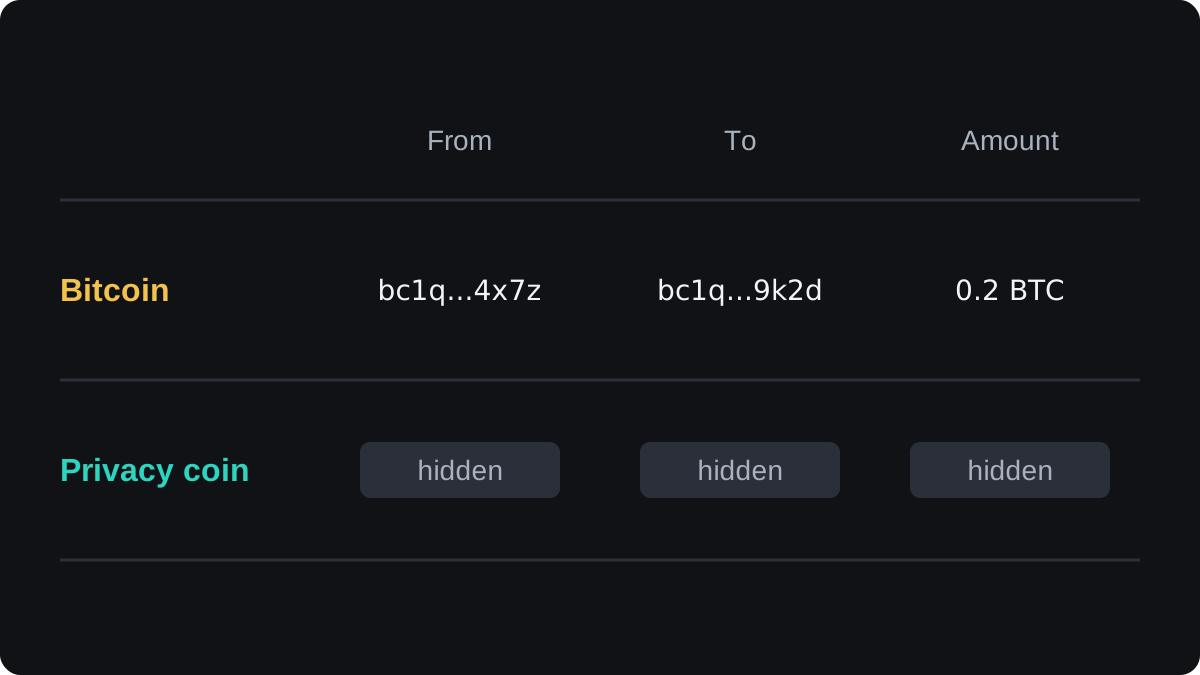
How privacy coins hide a payment
Each privacy coin uses its own mix of cryptography. Three techniques do most of the work.
Ring signatures
A ring signature lets you sign a payment as one member of a group, without showing which member you are. It builds on digital signatures, the same tool that proves you own a Bitcoin address.
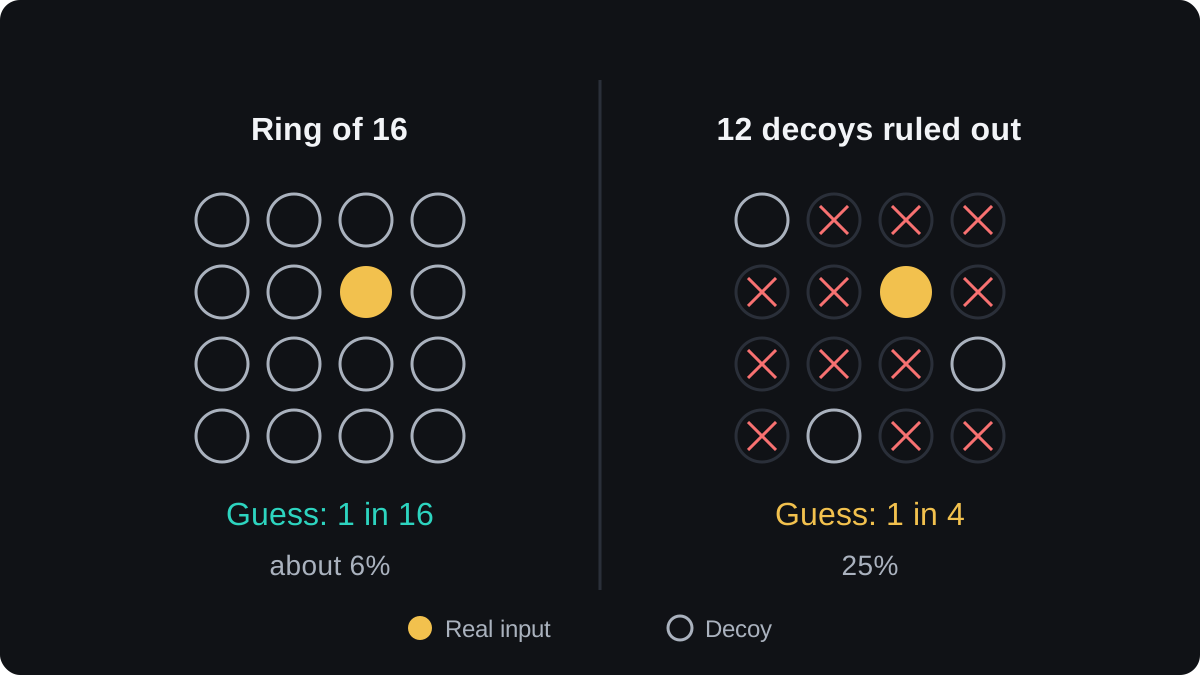
In Monero, the coin you spend, called the input, is listed next to decoys: older coins pulled from other payments on the chain. A 2022 upgrade set each ring at 16 members, the real input plus 15 decoys.
Here are the odds, with illustrative numbers. An observer with no other clues has a 1 in 16 chance of picking the real input, about 6%.
Now suppose outside data lets them rule out 12 of the 15 decoys. Only 4 candidates are left, so the odds jump to 1 in 4, or 25%.
Monero's developers are building an upgrade, called FCMP++, that would replace the ring with a proof hiding your input among every coin on the chain. Check Monero's own site to see whether it has gone live.
One-time addresses
A stealth address is a fresh one-time address that the sender's wallet creates for each payment.
You can share one public address, yet every payment to it lands at a different address on the chain. Outsiders cannot add up what you received.
Hidden amounts and zero-knowledge proofs
Monero also hides amounts. The network can still check that the coins going into a payment equal the coins coming out, without seeing the numbers.
Zcash uses zero-knowledge proofs, which prove a statement is true without revealing the data behind it. A shielded Zcash payment proves the coins exist and have not been spent before, while the sender, receiver and amount stay hidden.
Private by default or private by choice
Monero hides every payment. Zcash lets users choose between transparent addresses, which work much like Bitcoin's, and shielded addresses.
That choice matters, because privacy depends on the size of the crowd you hide in.
Suppose 1,000 payments go through in an hour. When every payment is private, yours hides among all 1,000. If only 20 of them are shielded, a shielded payment hides among just those 20.
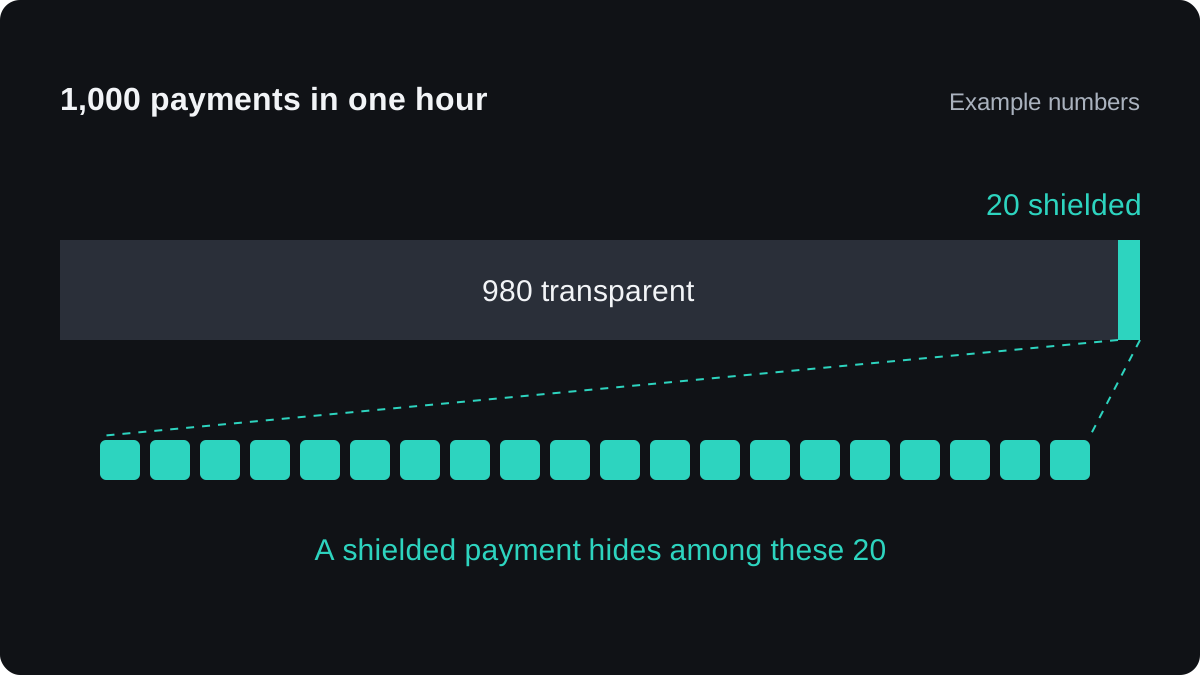
The small crowd makes other clues stronger. Coins that move into a shielded address and back out soon after, in a similar amount, are easier to match.
Why privacy coins are controversial
Privacy has ordinary uses. A business may not want rivals to see its suppliers and payroll. A person may not want strangers to see their savings because one payment revealed their address.
There is also fungibility, the idea that every unit of a currency is worth the same as every other.
On a public chain, coins with a suspicious history can be refused or frozen by an exchange. Hidden histories make every coin look alike.
Regulators worry that the same features help people launder money or dodge sanctions. Some exchanges have delisted privacy coins, or blocked them in certain countries, and the rules keep changing.
What it means if you want to trade one
- Fewer exchanges list privacy coins, so liquidity is thinner and spreads are wider.
- An exchange can delist a coin at short notice, leaving you a deadline to sell or withdraw.
- Privacy has limits. Exchange records, matching amounts and timing, and network data such as an IP address sit outside the coin's protection and can still link payments to a person.
- Whether you may own or trade one depends on where you live, so check local rules first.
Questions
Is Bitcoin anonymous?
No. Bitcoin is pseudonymous: addresses carry no names, but every payment is public, and an exchange that checked your ID can link an address to you.
Can privacy coin payments be traced?
They are much harder to trace than Bitcoin payments, though not impossible in every case. Analysts look for user mistakes, timing patterns and links to exchanges, and some early weaknesses in these protocols were later fixed.
Is it illegal to own a privacy coin?
It depends on the country. Some rules target exchanges instead: in the EU, a trading platform may not list a coin with built-in anonymity unless it can identify the holders. Check the rules where you live.
Why do exchanges delist privacy coins?
Regulated exchanges must follow anti-money-laundering rules that expect them to know where deposits came from. A coin that hides its history makes that check hard, so some exchanges drop it instead of carrying the risk.
Which coins are privacy coins?
Monero and Zcash are the best-known examples. Some other coins add optional mixing on top of otherwise public payments.
Keep learning
 Chapter 4What is an altcoin?An altcoin is any cryptocurrency other than Bitcoin. The name is short for alternative coin. Some altcoins run their own blockchain, like ether on Ethereum, while others are tokens issued on a chain that already exists. They range from large platforms to stablecoins and meme coins, and most trade in smaller, jumpier markets than Bitcoin.
 Chapter 4What is a stablecoin?A stablecoin is a crypto token designed to hold a steady price, usually one US dollar. Most are backed by reserves such as cash and short-term government debt, held by a company that swaps tokens for dollars at $1. Others lock up crypto as collateral or rely on supply rules. Every design can lose its peg under stress.
 Chapter 4What is a meme coin?A meme coin is a cryptocurrency built around a joke, a mascot or an internet meme, with no product, revenue or reserve behind it. Its price moves on attention and community. Dogecoin, launched in 2013, was the first well-known one. Meme coins can multiply in days and lose most of their value just as fast.

