What are fiat on-ramps and off-ramps?
A fiat on-ramp is any service that turns government money, such as dollars or euros, into crypto. An off-ramp does the reverse and pays the money back to your bank account. Exchanges, card payment providers and peer-to-peer markets all do this job, and each one charges its fees in different places.
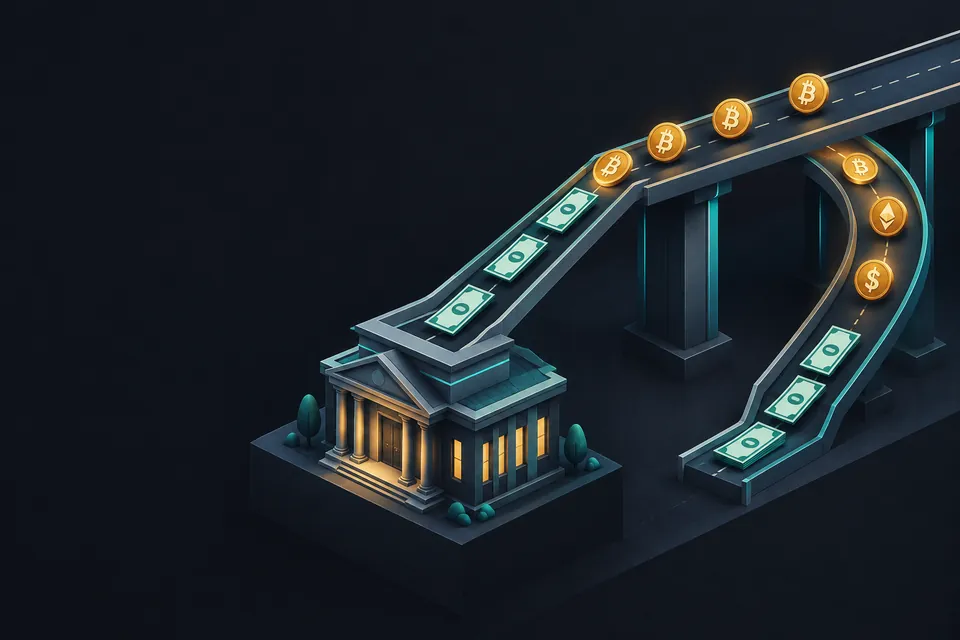
Your salary lands in a bank account in dollars, euros or another national currency. Crypto lives on blockchains. To get from one to the other, you need a service that deals with both.
Fiat money is currency issued by a government, such as the US dollar, the euro or the yen. A fiat on-ramp turns it into crypto, and a fiat off-ramp turns crypto back into fiat and pays it to your bank.
Ramps are where crypto meets the banking system, so they are where most identity checks (KYC), fees and delays sit. A decentralized exchange cannot do this job, because it only swaps tokens already on a blockchain.
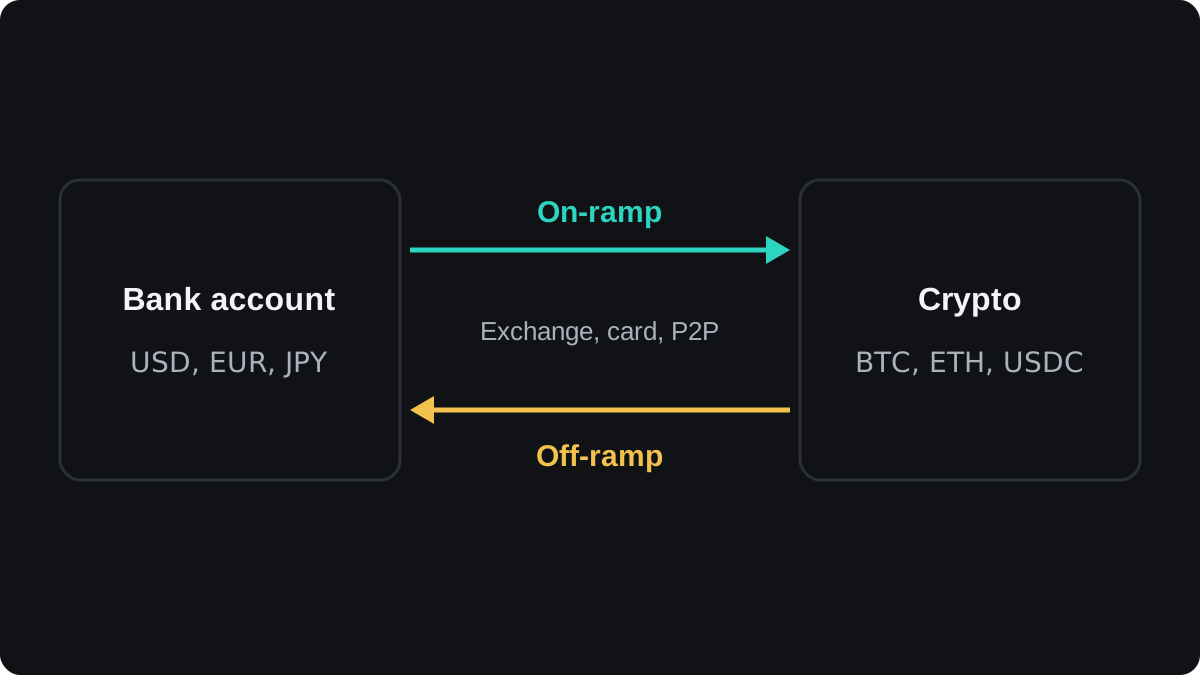
The common on-ramps
| Route | Speed | Typical cost | Watch for |
|---|---|---|---|
| Bank transfer to an exchange | Minutes to days | Low | The account must be in your own name |
| Debit or credit card | Instant | High | Card fees plus a markup in the price |
| Payment service inside a wallet app | Fast | Often high | Fees shown late at checkout |
| Peer-to-peer (P2P) market | Varies | Set by each seller | Requests to pay off the platform |
| Crypto ATM | Instant | Often high | Scammers send victims to ATMs |
A bank transfer is usually the cheapest route and the slowest. Cards are fast because the payment is approved within seconds. That speed costs money, and some card issuers treat crypto purchases as cash advances with extra charges.
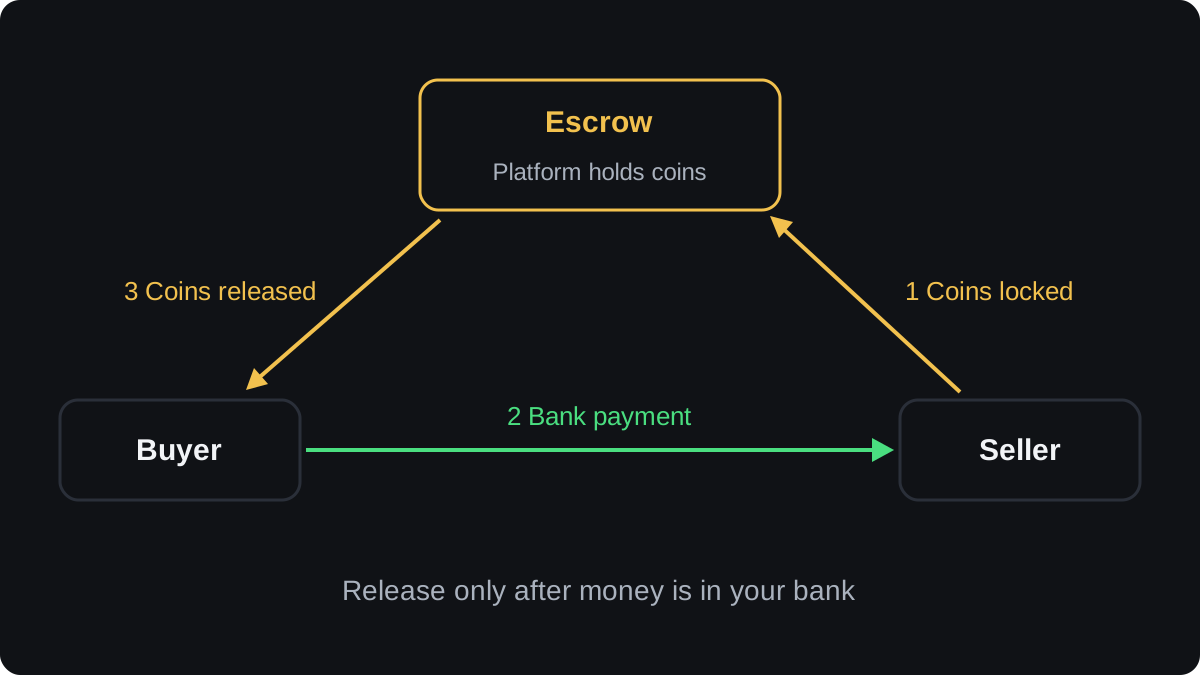
In a P2P market, people trade with each other and the platform holds the seller's coins in escrow.
You pay the seller directly by bank transfer or a payment app. When the seller confirms the money arrived, the platform releases the coins to you.
Off-ramps: getting back to your bank
Cashing out usually takes two steps: sell the crypto for fiat on an exchange, then withdraw the fiat to your bank. Coins in your own wallet first have to be sent to the exchange, for a network fee.
Selling into a stablecoin is a halfway point. Your money still sits on a blockchain and still depends on the stablecoin's issuer. It reaches the banking system only when you sell the stablecoin for currency and withdraw.
Expect checks on the way out. Exchanges set withdrawal limits, may review a first withdrawal, and can hold money from card purchases for some days because card payments can be reversed.
Your bank may also ask where a large deposit came from. Keep a record of every buy, sell and swap with the date, amount, price and fees.
In many countries, selling crypto counts as a taxable event, and some also tax swapping one coin for another. The rules vary and change, so check the ones where you live.
What a round trip costs
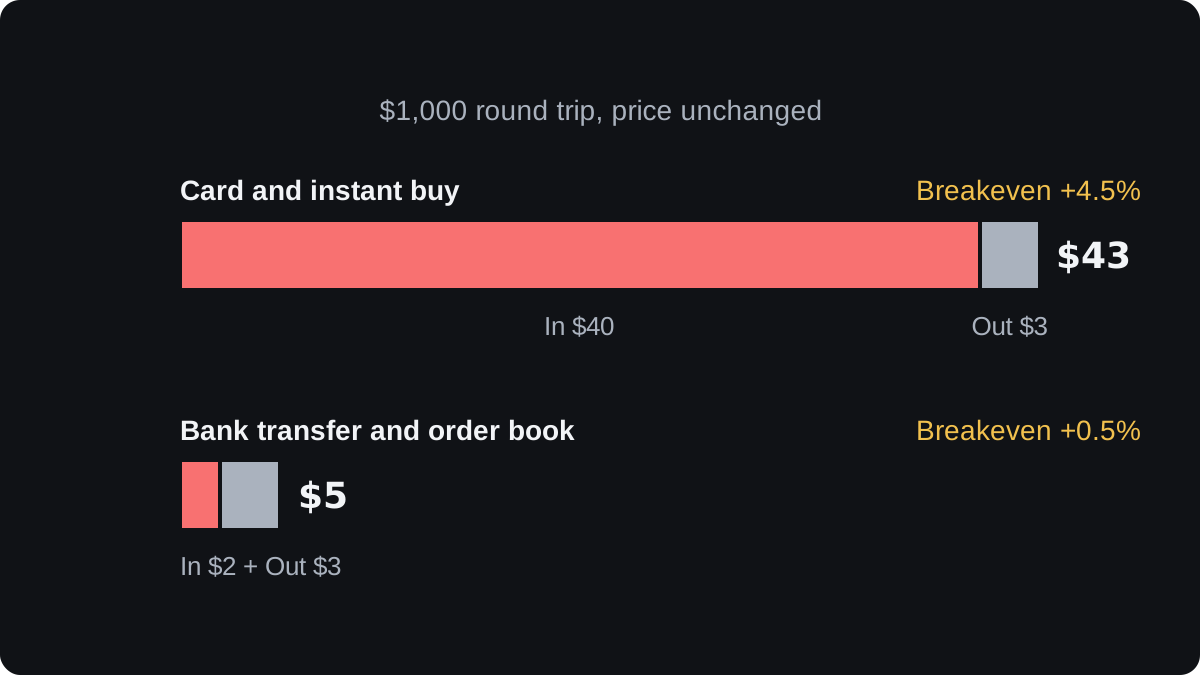
Put $1,000 in, buy a coin, sell it at the same price and take the money out. Compare two routes, with illustrative fees. Each fee is worked out on $1,000 to keep the arithmetic simple.
- Route A, card and instant buy: a 3% card fee is $30 and a 1% markup is $10, so $40 goes on the way in.
- Route B, bank transfer and order book: the transfer is free and a 0.2% trading fee is $2, so $2 goes on the way in.
- The way out is the same for both: a 0.2% fee to sell is $2 and a bank withdrawal fee is $1, so $3.
- Round trip: Route A costs $40 + $3 = $43. Route B costs $2 + $3 = $5.
Those costs set your breakeven, the price rise you need just to get your $1,000 back.
On Route A only $960 buys coin, and the sale must bring in $1,003 to cover the $3 way out. That takes a rise of 43 ÷ 960, about 4.5%.
That is more than 4.3%, the cost as a share of $1,000, because the fees shrank the amount that has to grow.
On Route B, $998 of coin has to grow to $1,003, a rise of 5 ÷ 998, about 0.5%.
Where ramps go wrong
Ramps tend to fail at the link to banks, or when someone pretends to be someone they are not.
- Payments from someone else's account are usually rejected, and the money can take days to bounce back.
- In P2P trades, a buyer may send a fake payment screenshot. Another trick is paying from a stolen bank account, which the bank later reverses, and your account can be frozen while it investigates.
- A caller may tell you to buy crypto at an ATM and send it to a "safe wallet", one of the common crypto scams. Real banks and public authorities do not phone you to ask for payment in crypto.
- Withdrawing a stablecoin on a network the receiving exchange does not support can lose it. Sending and receiving crypto explains how to match networks.
Questions
What is the cheapest way to buy crypto with fiat?
A bank transfer to an exchange followed by a buy on the order book is usually cheaper than a card or an instant buy screen. Compare the full round trip, including what it will cost to withdraw later.
How long does it take to cash out crypto to a bank?
The sale on an exchange is instant. The bank withdrawal can take from minutes to several working days, depending on the payment network and your bank, and first withdrawals or large amounts may face extra checks.
Is a stablecoin an off-ramp?
No. Selling to a stablecoin keeps your money on a blockchain, and it becomes bank money only when you sell the stablecoin for currency and withdraw.
Why did my bank block a payment to a crypto exchange?
Some banks and card issuers block or limit payments to crypto services under their own risk policies. Ask your bank which payment types it allows, or use a method both the bank and the exchange accept.
Keep learning
 Chapter 1What is a crypto exchange?A crypto exchange is a marketplace where you swap government money for coins, or one coin for another. It lists trading pairs, matches buy and sell orders, and charges a fee on each trade. Most exchanges also hold the coins you deposit, so the exchange is your custodian as well as your market.
 Chapter 1Centralized vs decentralized crypto exchanges.A centralized exchange (CEX) is a company that holds your deposits, checks your identity and matches orders on its own servers. A decentralized exchange (DEX) is a set of smart contracts that swaps tokens straight from your own wallet. With a CEX you trust a company; with a DEX you rely on the code and on your own care.
 Chapter 1How to choose a crypto exchange.Check five things in order: that the exchange is allowed to serve people where you live, how it holds customer funds, the full cost of buying and withdrawing under your own plan, whether its order books are deep enough for your trade size, and how a small test deposit and withdrawal go before you move larger sums.
 Chapter 1KYC and 2FA on crypto exchanges.KYC, short for know your customer, is the identity check an exchange runs before you can deposit, trade or withdraw, usually with an ID document and a selfie. 2FA, two-factor authentication, asks for a second proof at login and withdrawal, such as an app code or a hardware security key. KYC protects the financial system; 2FA protects your account.

