What is a crypto wallet?
A crypto wallet is an app or device that stores your private keys and uses them to sign transactions. Your coins never sit inside it: they are records on a blockchain, tied to addresses. The wallet reads those records to show your balance and signs the messages that move the coins.
เนื้อหานี้ยังมีเฉพาะภาษาอังกฤษ
Say you delete a wallet app by accident while it shows a balance of 0.50 BTC. The bitcoin does not vanish with it. Reinstall the app, restore it from your backup, and the same 0.50 BTC comes back.
That works because the coins live on the blockchain, a shared record copied across many computers. A crypto wallet is the app or device that holds the secret numbers which let you move them.
Where your coins actually are
A blockchain is a public record of every transaction on a network. It does not list names. It lists addresses, long strings of letters and numbers, and how much each one holds.
Say your wallet controls three Bitcoin addresses. The blockchain shows 0.20 BTC on the first, 0.25 BTC on the second and 0.05 BTC on the third. Your wallet reads those entries, adds them up and shows 0.50 BTC.
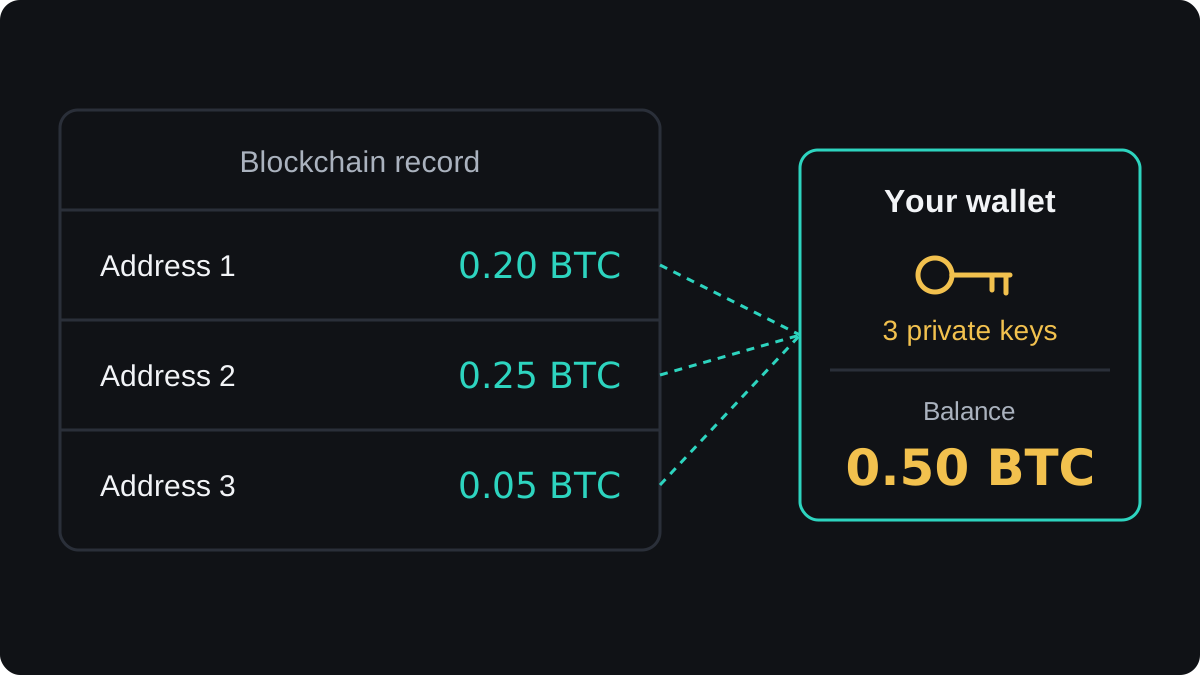
Anyone can look up those three balances. Only someone with the matching secrets can move them, and those secrets are what your wallet keeps.
Private keys, public keys and addresses
Each address starts from a private key, a very large random number that only you should know. From the private key, the wallet calculates a public key, and from the public key it calculates the address.
Each step works in one direction only. A computer turns a private key into an address in a split second, yet no one can run the maths backwards from an address to its private key.
The lesson on public and private keys covers that maths.
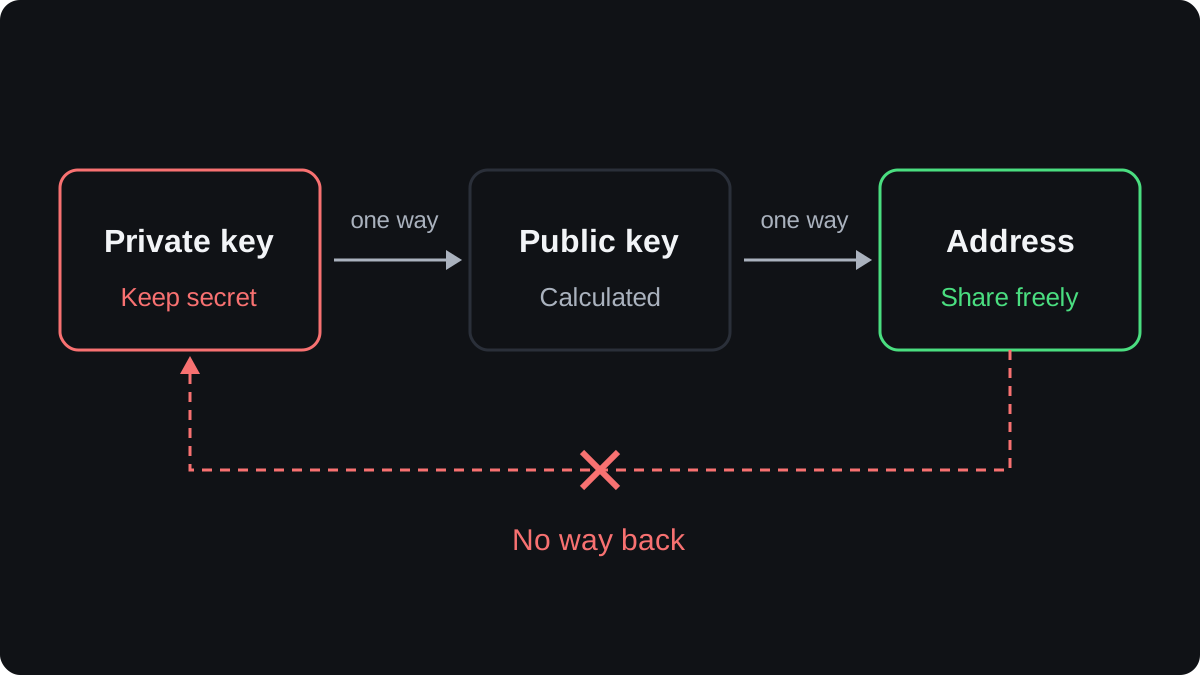
This is why you can share an address freely. It works like an account number for receiving money. The private key is closer to your signature and your PIN combined, and anyone who sees it can empty the address.
Modern wallets do not make you handle raw keys. They build all of them from one backup, the seed phrase, which is why typing 12 or 24 words into a new device brings every address back.
What happens when you press send
When you send coins, the wallet writes a short message: move this amount from my address to that address, and pay this fee. It then signs the message with your private key.
The signature proves that the owner of the key approved this exact message, without revealing the key. Digital signatures have a lesson of their own. The wallet then broadcasts the signed message to the network.
Computers on the network, called nodes, check the signature and the balance. If both are valid, the transaction waits to be added to a block. Once it is, both wallets show the new balances.
Worked example: spending part of a balance
Bitcoin wallets handle amounts in a way that surprises beginners. The numbers below are round figures for illustration.
- You hold 0.20, 0.25 and 0.05 BTC on three addresses, 0.50 BTC in total.
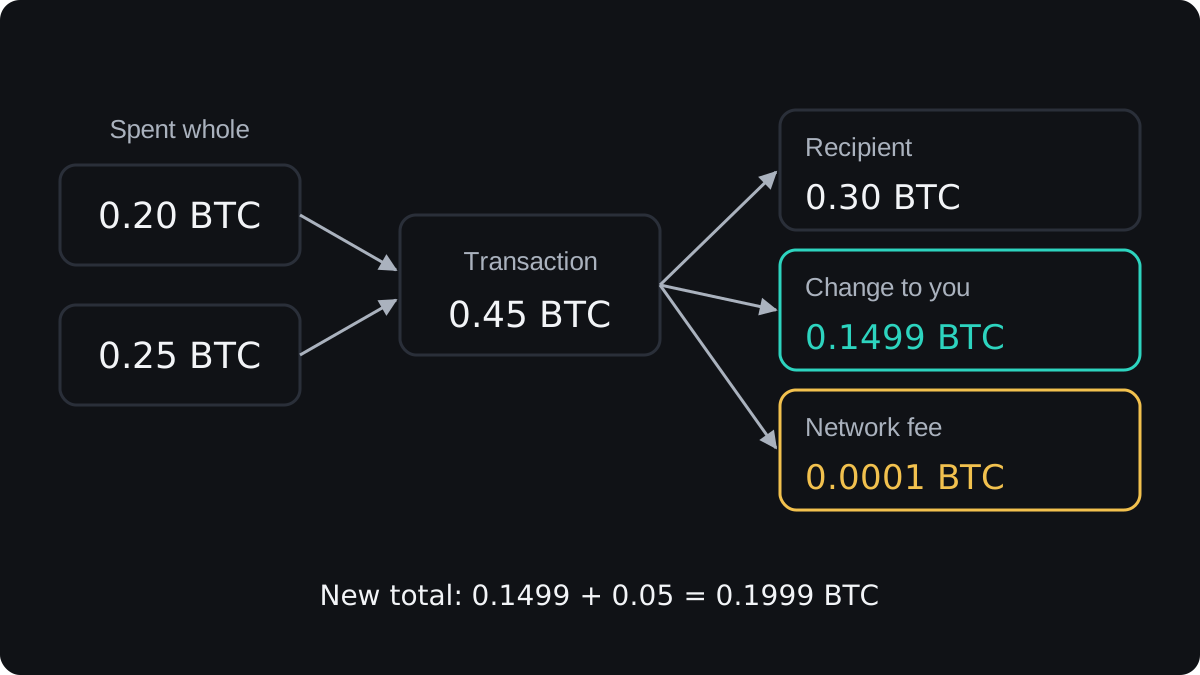
- You want to send 0.30 BTC. No single address has enough, so the wallet picks the 0.20 and the 0.25, which come to 0.45 BTC.
- Bitcoin spends each received amount whole, like a banknote. The full 0.45 BTC goes into the transaction.
- The recipient gets 0.30 BTC, and you pay a network fee of 0.0001 BTC.
- The rest, 0.45 minus 0.30 minus 0.0001, is 0.1499 BTC. It comes back to your own wallet, usually at a new address, and this is called change.
Your new total is 0.1499 + 0.05 = 0.1999 BTC. That matches the start: 0.50 minus the 0.30 you sent minus the 0.0001 fee.
Ethereum, and networks built like it, keep a single balance per address, so there is no change step. You still pay a network fee on top of the amount you send.
The Bitcoin transaction lesson walks through inputs and outputs in detail.
What a wallet cannot do for you
A wallet cannot reverse a payment. Once a transaction is in a block, there is no bank to call and no chargeback. A wrong address or a scam payment is final.
A wallet you control yourself also cannot reset a lost secret. If you lose both the device and the seed phrase, nobody can rebuild your keys, and the coins stay locked at their addresses for good.
Exchange accounts work differently. When you buy crypto on a crypto exchange and leave it there, the exchange holds the keys and you hold a login. The lesson on types of crypto wallet compares the two set-ups.
คำถามที่พบบ่อย
Does a crypto wallet store coins?
The coins are entries on the blockchain, tied to addresses. The wallet stores the private keys that control those addresses and reads the blockchain to show your balance.
Can I have more than one crypto wallet?
Yes. You can use as many wallets as you like, and one wallet usually manages many addresses. Each wallet has its own backup, so keep track of every seed phrase.
Is a crypto wallet free?
Most wallet apps are free to install. You still pay network fees when you send coins, and hardware wallets cost money to buy.
What happens if I lose my phone with my wallet on it?
If you have your seed phrase, restore it in a wallet app on a new device and your balances come back. Without the seed phrase, the coins in a wallet you control yourself cannot be recovered.
Is an exchange account a wallet?
It works like one, but the exchange holds the private keys for you. That makes it a custodial wallet: easy to use, and only as safe as the exchange behind it.
เรียนต่อ
 บทที่ 3What is a seed phrase?A seed phrase is a list of 12 or 24 ordinary words that encodes the master secret of a crypto wallet. Typed into a compatible wallet, it rebuilds every private key and address you had. Anyone who sees it can take your coins, so it belongs on paper or metal, kept offline.
 บทที่ 3Hot, cold, custodial: the types of crypto wallet.Crypto wallets split along two lines. In a custodial wallet, such as an exchange account, a company holds the keys; in a non-custodial wallet, you do. Hot wallets keep keys on an online device and suit small, frequent payments. Cold wallets keep keys offline, usually on a hardware device, and suit larger amounts you rarely move.
 บทที่ 3How to choose a crypto wallet.Choose a crypto wallet by working back from what you will do with your coins. Decide who should hold the keys, check that the wallet supports the exact networks you use, look at how it backs up and recovers, and add up what it costs. Then test it with a small amount before you move more.
 บทที่ 3How to send and receive crypto.To receive crypto, you share an address from your wallet for the right coin and network. To send, you paste the recipient's address, pick the same network, enter the amount, check the fee and sign. Transfers cannot be reversed, so check the whole address and test with a small amount first.

