How to send and receive crypto.
To receive crypto, you share an address from your wallet for the right coin and network. To send, you paste the recipient's address, pick the same network, enter the amount, check the fee and sign. Transfers cannot be reversed, so check the whole address and test with a small amount first.
เนื้อหานี้ยังมีเฉพาะภาษาอังกฤษ
Sending crypto feels like a bank transfer. You enter an address in place of an account number, type an amount and press confirm.
Two things are different. Nobody can pull a payment back once it goes through, and the same coin can travel on more than one network. Each step below exists because of those two facts.
How to receive crypto
- Open your crypto wallet and tap Receive.
- Choose the coin, then the network if the wallet asks.
- Copy the address, or show its QR code to the sender.
- Tell the sender which network to use.
Receiving needs no signature and no fee from you. An address only lets people pay you, so you can share it freely. Some wallets show a fresh address each time, and the old ones keep working.
Withdrawing from an exchange to your wallet works the same way from the other side. You paste your wallet's address into the exchange's withdrawal page and pick the network.
Why the network must match
USDT, a stablecoin, exists on several blockchain networks, including Ethereum and Tron. A balance on one network is invisible on another.
Sender and receiver must choose the same network. If they do not, the coins land somewhere the receiving wallet or exchange does not look.
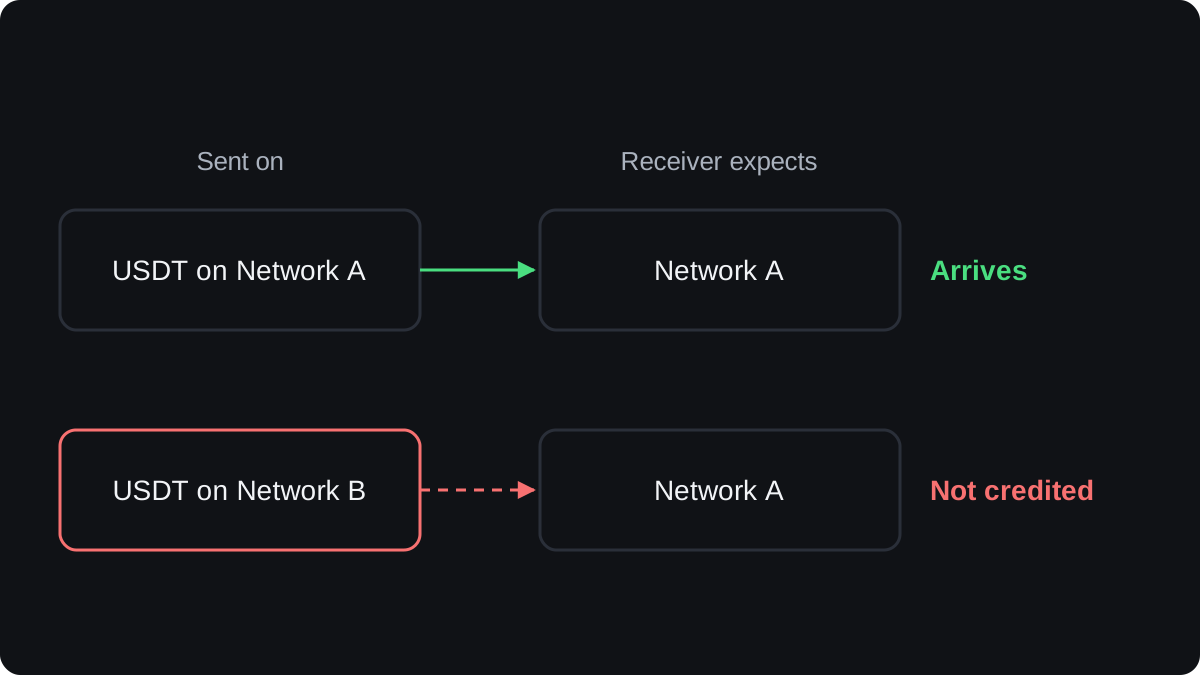
Depending on the two networks, mismatched coins may be recoverable with technical help, recoverable only by the exchange for a fee, or lost. Matching the network on both screens avoids the question.
Some exchanges also need a memo or tag, an extra code that tells them which customer a deposit belongs to. If the deposit page shows one, copy it along with the address.
Without the memo, the coins reach the exchange but not your account, and you depend on its support team to credit them.
How to send crypto step by step
- Get the address from the recipient's Receive screen or deposit page, with the network and any memo.
- In your wallet, tap Send and choose the coin and network.
- Paste the address, and never type it by hand.
- Compare the whole address with the source, including the middle characters.
- Enter the amount and review the fee.
- Confirm and sign. On a hardware wallet, check the address on the device screen.
Your wallet then broadcasts the transaction. It waits in the mempool, the queue of unconfirmed transactions, until a miner or validator puts it in a block.
Getting into a block counts as one confirmation, and each block added after it counts as one more. Exchanges credit a deposit after a set number of confirmations, which differs by network and by exchange.
Network fees and timing
The fee pays the network to include your transaction. It depends on how much space or computing work the transaction needs and how busy the network is.
Sending 0.01 BTC or 10 BTC in the same simple transaction costs the same fee. Two illustrations with round numbers follow.
On Bitcoin, a simple payment takes about 140 virtual bytes (vB). At 20 satoshis per vB, the fee is 140 × 20 = 2,800 satoshis. A bitcoin has 100,000,000 satoshis, so that is 0.000028 BTC.
On Ethereum, a plain ether transfer uses 21,000 units of gas. At a gas price of 10 gwei, the fee is 21,000 × 10 = 210,000 gwei. One ether is 1,000,000,000 gwei, so that is 0.00021 ETH.
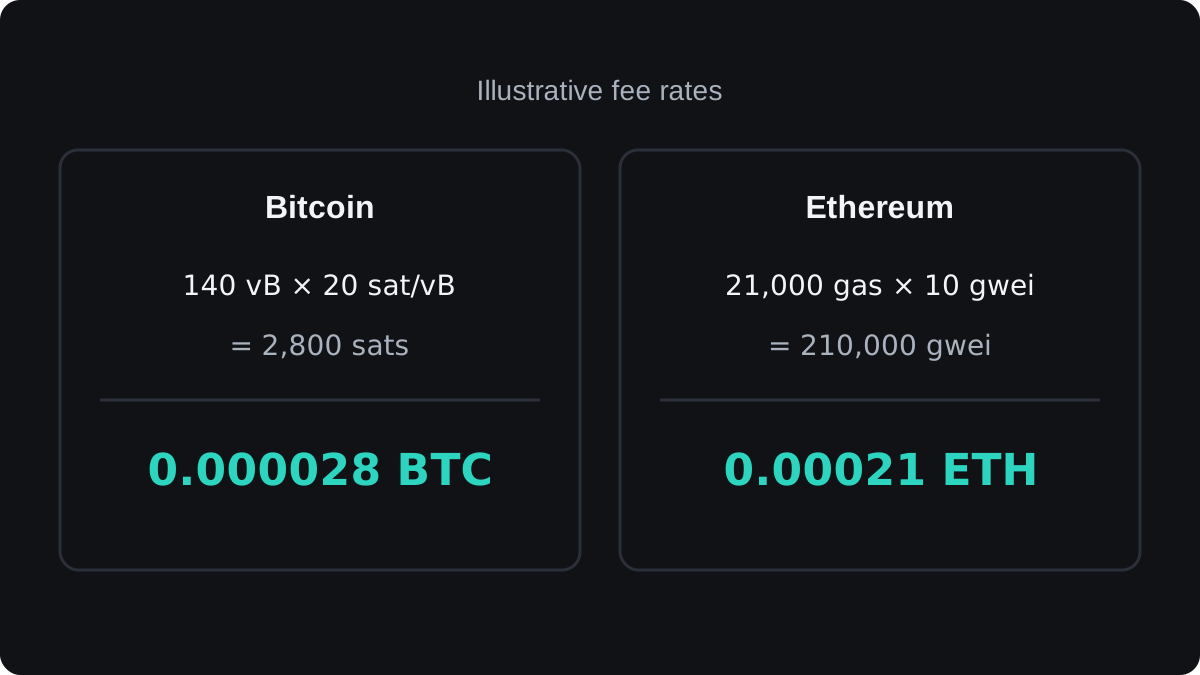
Sending a token such as USDT uses more gas than a plain ether transfer. The fee is normally paid in the network's own coin, so keep a little ether in the wallet to move tokens on Ethereum.
Real fee rates change with demand, sometimes minute to minute. When a network is busy, rates rise, and paying a higher rate usually gets you into a block sooner.
Bitcoin adds a block about every 10 minutes on average, while Ethereum adds one within seconds, so a transfer can take seconds or more than an hour.
Mistakes you cannot undo
A confirmed transfer is final. The lesson on how a Bitcoin transaction works follows a payment from wallet to block. Watch for these mistakes:
- a wrong network, or a missing memo on an exchange deposit
- an address copied from your own history that a scammer planted there
- malware that swaps the address on your clipboard for the attacker's after you copy it
- a QR code or address from someone you have not verified, such as a stranger claiming to be support
The second trick is address poisoning. A scammer sends a tiny or zero-value transfer to you from an address that starts and ends with the same characters as one you use. Later, you copy from your history and pick theirs.
Checking the whole address beats both poisoning and clipboard malware. The lesson on common crypto scams covers more of these tricks.
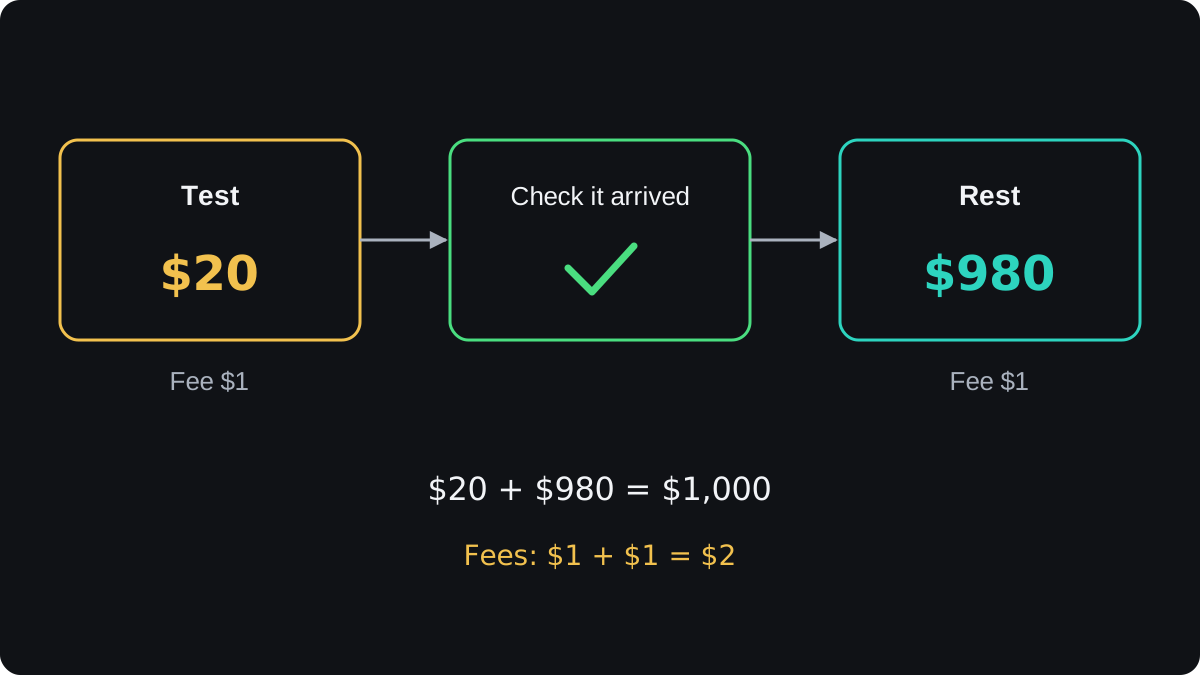
A test transaction catches a wrong address or network before it costs you the full amount. Here it is with round, illustrative numbers:
- You need to send $1,000 of USDT to a new address.
- You first send $20 and ask the recipient to confirm it arrived.
- You then send the remaining $980, so $20 + $980 = $1,000 in total.
- With a $1 network fee each time, you pay $1 + $1 = $2 in fees, one dollar more than a single transfer.
คำถามที่พบบ่อย
How long does a crypto transfer take?
It depends on the network and the fee you pay. Some networks confirm in seconds, Bitcoin adds a block about every 10 minutes, and an exchange may wait for several confirmations before it credits you.
Can a crypto transaction be reversed?
Once it is confirmed, only the recipient can send the coins back. If you sent to an exchange by mistake, its support team may be able to help. A stranger's private wallet has no support desk to ask.
What happens if I send crypto on the wrong network?
The coins arrive on a network the receiver does not watch. Whoever controls the keys for that address on the other network may be able to recover them, so contact the receiver or the exchange quickly.
Why do I need ether to send USDT?
On Ethereum, fees are paid in ether, including the fee for moving a token. Without a little ether in the same wallet, a standard wallet cannot send the USDT. Other networks work the same way with their own coin.
Is it safe to share my wallet address?
Yes. An address only lets people send to you and see that address's history on the blockchain. Never share your seed phrase or private keys.
เรียนต่อ
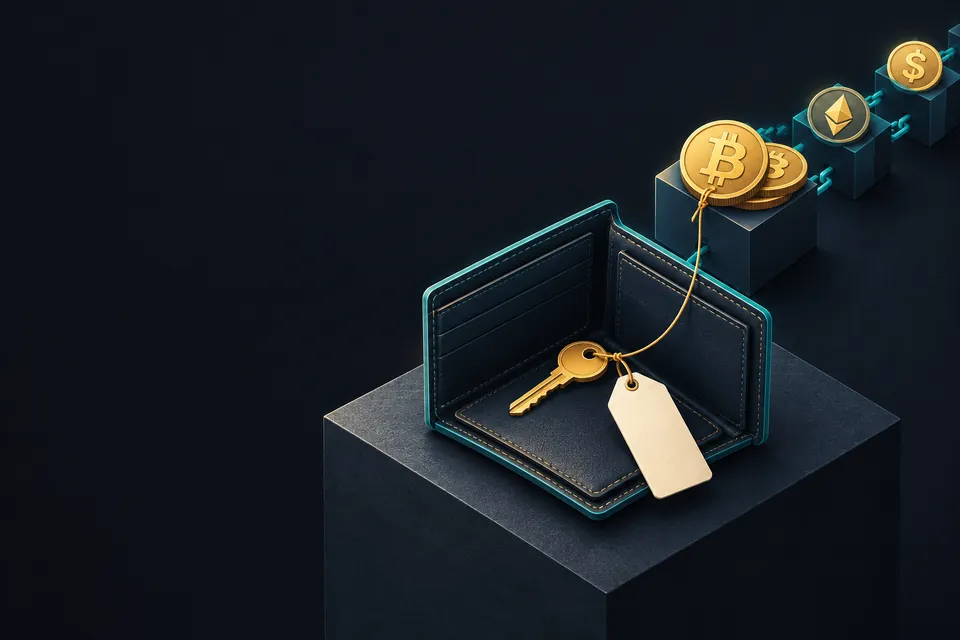 บทที่ 3What is a crypto wallet?A crypto wallet is an app or device that stores your private keys and uses them to sign transactions. Your coins never sit inside it: they are records on a blockchain, tied to addresses. The wallet reads those records to show your balance and signs the messages that move the coins.
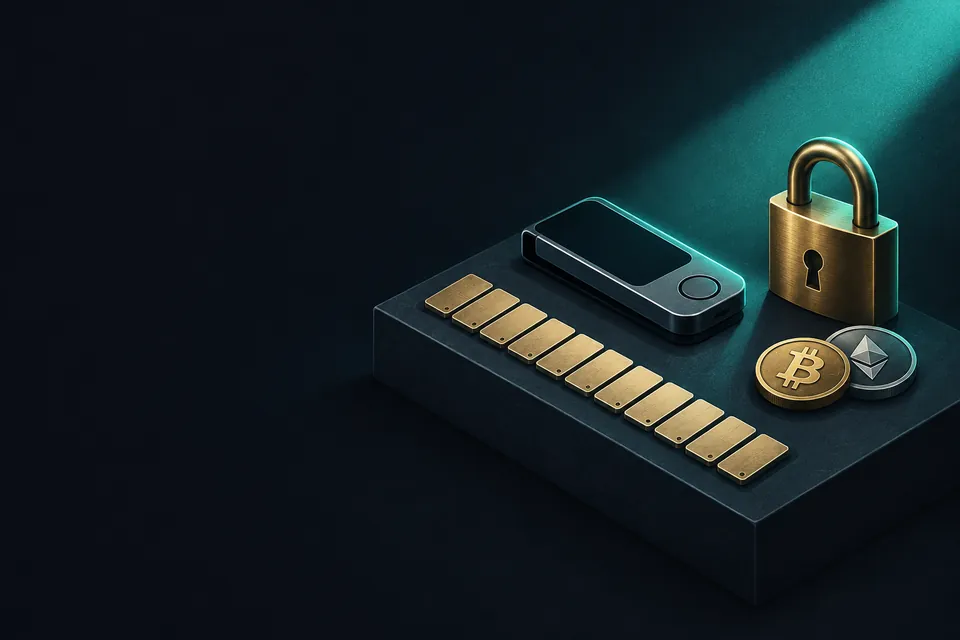 บทที่ 3What is a seed phrase?A seed phrase is a list of 12 or 24 ordinary words that encodes the master secret of a crypto wallet. Typed into a compatible wallet, it rebuilds every private key and address you had. Anyone who sees it can take your coins, so it belongs on paper or metal, kept offline.
 บทที่ 3Hot, cold, custodial: the types of crypto wallet.Crypto wallets split along two lines. In a custodial wallet, such as an exchange account, a company holds the keys; in a non-custodial wallet, you do. Hot wallets keep keys on an online device and suit small, frequent payments. Cold wallets keep keys offline, usually on a hardware device, and suit larger amounts you rarely move.
 บทที่ 3How to choose a crypto wallet.Choose a crypto wallet by working back from what you will do with your coins. Decide who should hold the keys, check that the wallet supports the exact networks you use, look at how it backs up and recovers, and add up what it costs. Then test it with a small amount before you move more.

