 อภิธานศัพท์ · ต้นทุนการเทรด
Raw spread account
เนื้อหานี้ยังมีเฉพาะภาษาอังกฤษ
A raw spread account has a near-market spread and charges a commission per lot instead. Brokers call these accounts Raw, Raw Spread, Zero or ECN. Whether one is cheaper depends on the symbol you trade.
Most brokers offer two families of account. A standard account folds its whole charge into the spread. A raw spread account shows a much thinner spread and bills a commission per lot on top.
The Standard vs Raw lesson compares the two with measured numbers.
How a raw spread account charges
The spread comes close to what the broker's liquidity providers quote, and on liquid pairs it sometimes reads 0.0 for a moment. The broker earns from the commission instead.
Total cost per lot = spread × pip value + commission. To compare with a standard account, put both in dollars per lot, or turn the commission into pips.
A worked example on gold
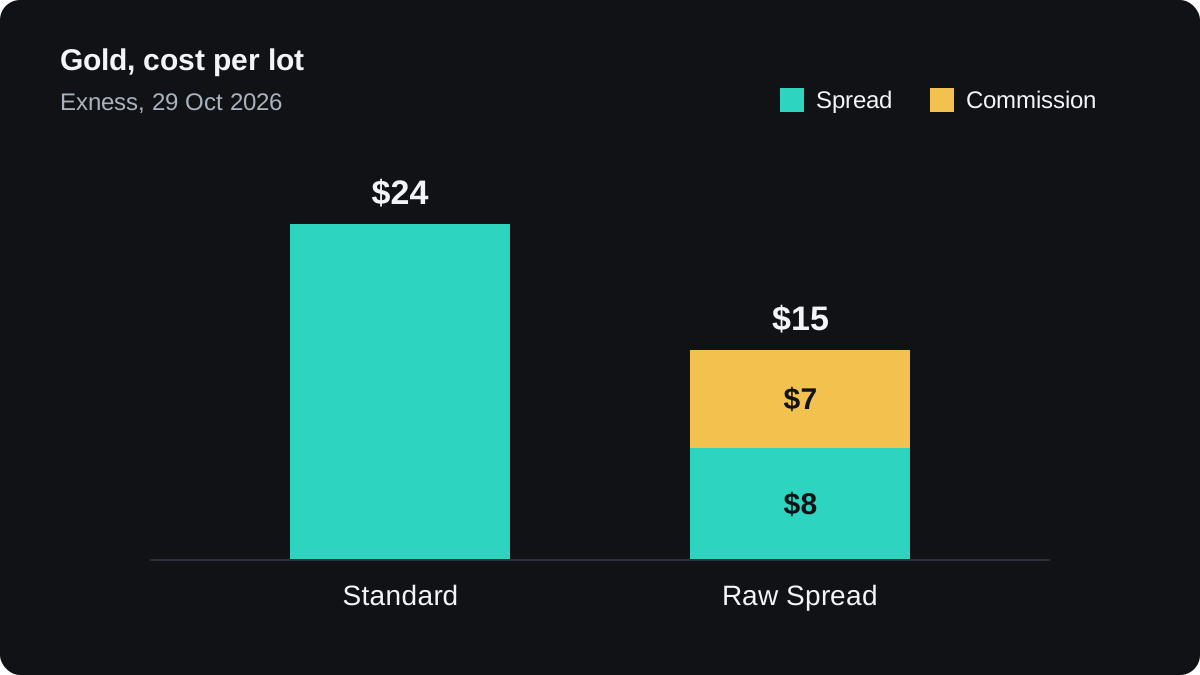
On 29 and 30 October 2026, AutoFXRebate listed these figures for one lot of gold (XAU/USD, 100 ounces) at Exness. Raw Spread had a $0.08 typical spread, worth 0.08 × 100 = $8, plus $7 commission: $15 per lot.
The Standard account had a $0.24 spread and no commission, so 0.24 × 100 = $24 per lot. On gold on those days, Raw Spread was $9 cheaper per lot.
On EUR/USD the race is closer. With a 0.0 pip raw spread and an illustrative $7 commission, a standard account is cheaper whenever its spread is below 0.7 pip.
The Spread Checker shows typical spreads for each account type side by side.
คำถามที่พบบ่อย
Is a raw spread account better for beginners?
Not automatically. It is often cheaper per lot, but every sum must include the commission, and a standard account is easier to read while you learn.
What is the difference between a raw spread account and an ECN account?
Often only the name. Both describe a thin spread plus a commission per lot; how the broker actually routes your orders is set out in its execution terms.
คำศัพท์อื่นในบทนี้
 Swap (overnight fee)Swap is the interest you pay or earn for holding a position past the daily rollover. Rollover falls at 17:00 New York time. The amount comes from the interest rate gap between the two currencies plus the broker's markup, and Wednesday usually counts three nights.
 SlippageSlippage is the gap between the price you asked for and the price you got. It happens when the market moves before execution, most often around news, the daily rollover and the weekly open, and it can go for or against you.
เรียนแบบละเอียด
คำที่เกี่ยวข้อง