Internalisation: how brokers net client orders.
Internalisation is when a broker offsets client buy orders against client sell orders inside its own books. Opposite trades cancel, so only the leftover net position is left to hedge or keep. This cuts the broker's outside costs and risk, while each client's contract stays with the broker, who remains the counterparty.
本頁目前僅提供英文版。

Picture two clients of the same broker pressing their buttons in the same second. One buys 2 lots of EUR/USD and the other sells 2 lots.
The broker does not need the wider market for either trade, because the two orders cancel each other out inside its own books. That is internalisation: a broker offsetting client orders against each other in-house, then dealing outside only for what is left over.
What does it mean to internalise an order?
In retail forex and CFD trading, your broker is usually the counterparty to your trade. When you buy, the broker sells to you. When another client sells, the broker buys from them.
Each trade is a separate contract between one client and the broker. The two clients never meet and never learn about each other.
Inside the broker, those contracts add up to one combined position per instrument. A client buy leaves the broker short and a client sell leaves it long, so opposite trades cancel. Adding them up this way is called netting.
Whatever survives netting is the net exposure, the amount on which the broker would gain or lose if the price moved.
The broker can then hedge that amount with a liquidity provider or keep some or all of it. The A-book and B-book lesson covers that choice.
Netting four orders: a worked example
Suppose four clients trade EUR/USD within a few seconds of each other. A standard lot is 100,000 euros, and every number here is illustrative.
| Client | Order | Lots | Broker's side |
|---|---|---|---|
| A | Buy | 3.0 | Short 3.0 |
| B | Sell | 2.0 | Long 2.0 |
| C | Buy | 1.0 | Short 1.0 |
| D | Sell | 0.5 | Long 0.5 |
Work through it one step at a time:
- Add the buys: 3.0 + 1.0 = 4.0 lots, or 400,000 euros.
- Add the sells: 2.0 + 0.5 = 2.5 lots, or 250,000 euros.
- Match them: 2.5 lots of buying cancel 2.5 lots of selling, so 5.0 lots of client volume offset each other.
- Find the rest: 4.0 minus 2.5 = 1.5 lots of client buying with nothing against it.
- Clients are net long 1.5 lots, so the broker is net short 1.5 lots, or 150,000 euros.
- A pip on one lot of EUR/USD is worth $10, so the broker's open risk is 1.5 × $10 = $15 per pip.
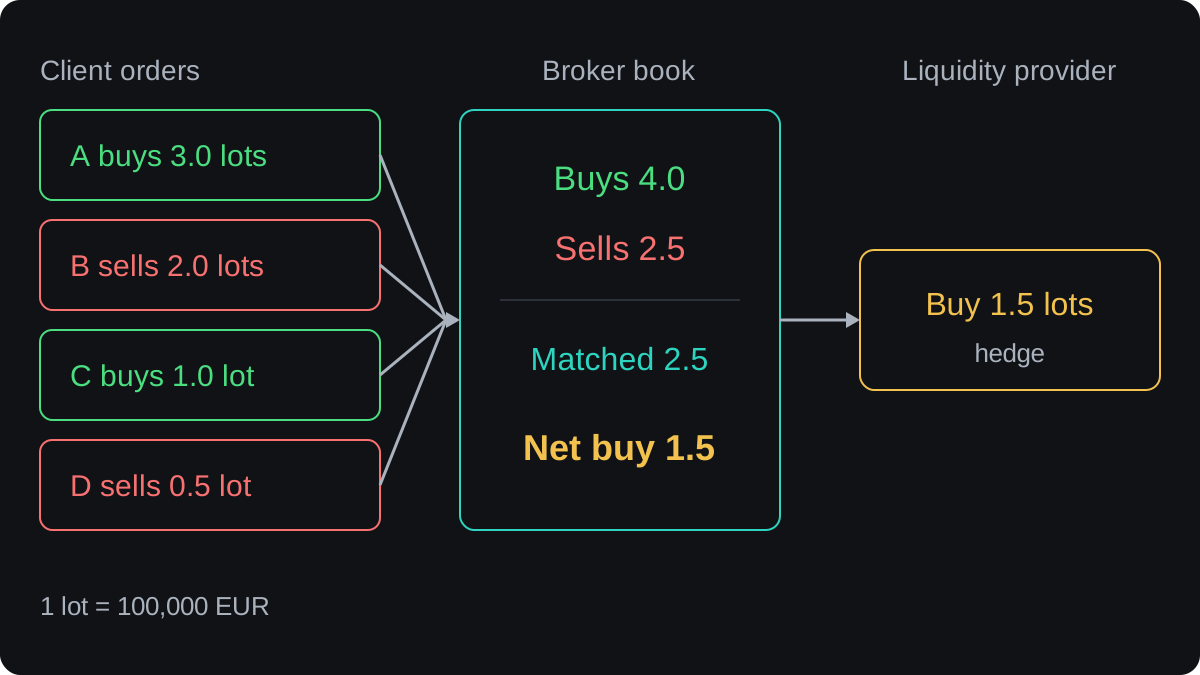
To remove that $15 per pip risk, the broker buys 1.5 lots from its liquidity provider, one outside trade in place of four.
Why the smaller hedge saves money
Every trade with a liquidity provider costs something: the provider's spread, a fee per lot, or both. Assume, purely for illustration, that each lot sent outside costs the broker $5.
Hedging every order on its own means 6.5 lots of outside trades: buy 4.0 and sell 2.5. At $5 a lot that is 6.5 × $5 = $32.50.
Hedging only the net means 1.5 lots, which costs 1.5 × $5 = $7.50. The broker ends with exactly the same position and saves $25.00 on this batch.
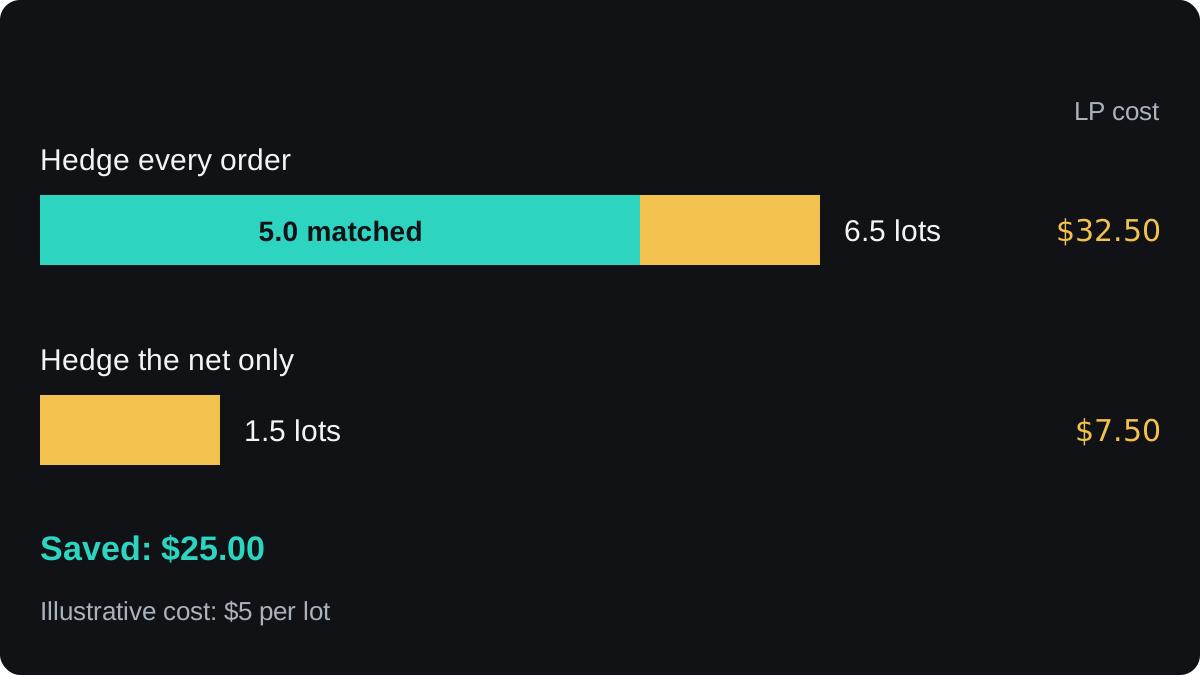
A broker with a steady stream of orders can repeat this all day, so the savings add up across thousands of trades.
How a matched pair earns the spread
Netting also explains how a broker can earn from client orders without taking a view on where the market goes.
Say the broker quotes EUR/USD at a bid of 1.10000 and an ask of 1.10010, a spread of 1.0 pip. In the same second, client E buys 2 lots at the ask and client F sells 2 lots at the bid.
- The broker is short 2 lots to E at 1.10010.
- The broker is long 2 lots from F at 1.10000.
- The gap is 1.10010 minus 1.10000 = 0.00010, which is 1.0 pip.
- On 2 lots, 200,000 euros × 0.00010 = $20.
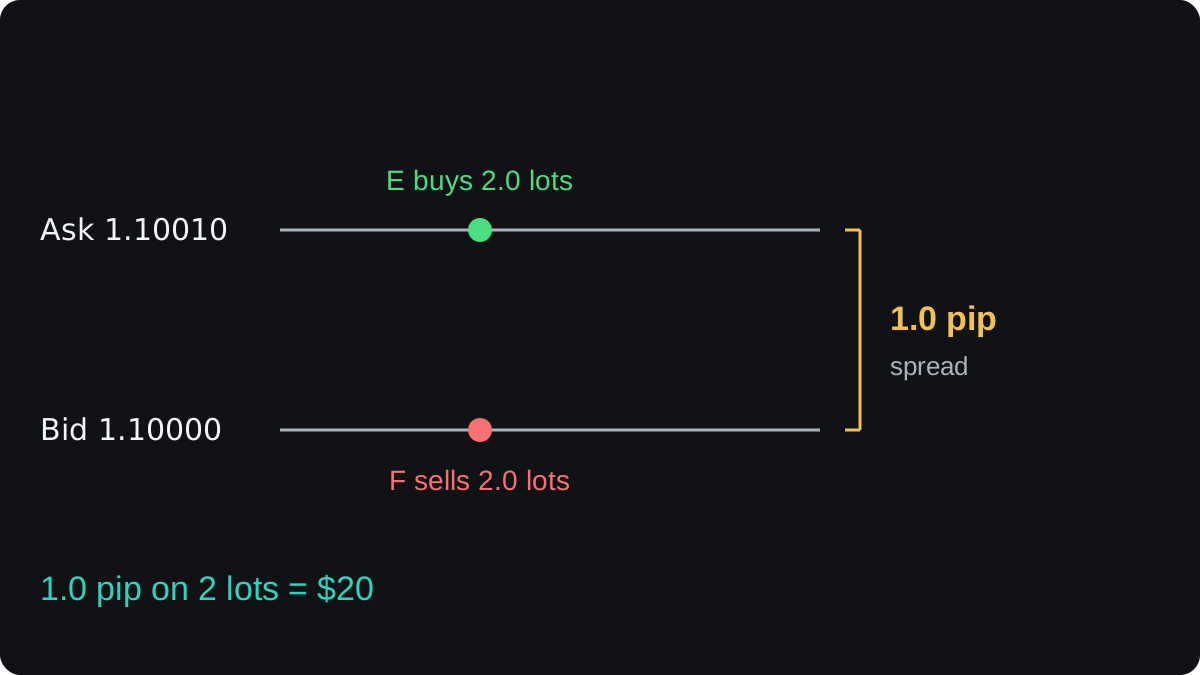
Wherever the price goes next, the short to E and the long from F move by equal and opposite amounts. While both trades stay open, the broker's book is $20 ahead on the pair.
E and F still each have their own profit or loss. Their results depend on the price and their own costs, whatever the broker does with its book.
Where netting stops working
A match lasts only as long as both trades do. If E closes after an hour while F stays open, the broker is long 2 lots again with nobody on the other side, and it must hedge that exposure or carry it.
Timing opens a similar gap. Say the buy fills at the ask of 1.10010 and the matching sell arrives a minute later at a bid of 1.10030, after the price has risen.
For that minute the broker was short and unhedged. It sold to the buyer at 1.10010 and bought from the seller at 1.10030, so on 2 lots it lost 0.00020 × 200,000 = $40, where a same-second match would have earned $20.
One-sided flow is another limit. Around a big news release, clients can pile into the same direction, so there is little to net and the residual grows quickly.
A broker can handle this with internal limits, such as a maximum net position per instrument, above which the residual is hedged. Those settings are private and differ from firm to firm.
What a broker does with the residual it chooses to keep is the subject of the hybrid and C-book lesson.
What internalisation means for your trades
Your contract is the same whether your order is netted or hedged. You trade at the broker's quoted price, and the broker is your counterparty either way.
On the matched part of the book, the broker has no stake in which way the price moves, because the two sides cancel. A conflict of interest can appear on the residual, if the broker keeps that exposure and gains when clients lose.
Netting lowers the broker's outside costs. Whether any of that saving reaches you through tighter spreads is the broker's decision, and you cannot measure it from outside.
To learn how your broker handles client flow, read the documents it publishes, often called an order execution policy and a conflicts of interest policy. Look for words such as principal, internalise or net.
The hedging policy lesson explains how to read those documents and which answers to ask for when they are vague.
常見問題
Do I trade against other clients when my broker internalises?
No. Your contract is with the broker, and another client's opposite trade only cancels part of the broker's own exposure. Neither client sees the other.
Is internalisation the same as B-booking?
No. Internalisation offsets client trades against each other, while B-booking usually means the broker keeps client exposure instead of hedging it. A broker can internalise and then hedge or keep the residual.
Does internalisation make my execution worse?
Not by itself, since your fill comes from the broker's quoted price either way. Execution depends on how the broker sets prices and handles slippage, which you can judge from its policies and your own fill records.
How is internalisation different from an ECN?
On an ECN venue, orders from many participants meet in a shared order book. Internalisation happens inside one broker that stays the counterparty to each client, as the STP and ECN lesson describes.
繼續學習
 第 1 章How to choose a forex broker.To choose a forex broker, check four things before you deposit. Confirm the licence on the regulator's own register, work out the full cost of a trade from spread, commission and swap, test how orders are filled, and make a small withdrawal to see how payouts work. A broker that fails the licence check needs no further study.
 第 1 章What does a forex broker actually do?A forex broker opens your trading account, streams buy and sell prices, accepts your orders and fills them, either with outside liquidity providers or by taking the other side itself. It also holds your deposit, sets aside margin while trades are open, applies leverage, charges or pays swap and closes positions at stop out.
 第 1 章Is your forex broker regulated? How to check a licence.A regulated forex broker holds a licence from a government authority such as the UK's FCA or Australia's ASIC. To check it, find the legal company name and licence number on the broker's site, then search them on the regulator's own register and confirm the website and contact details match.
 第 1 章Red flags of a fake or unsafe forex broker.A fake or unsafe forex broker usually shows itself in a few ways: no licence or a cloned one, promises of guaranteed profit, pressure to deposit, payments to personal or unrelated accounts, bonus terms that lock your money, and withdrawals that stall or need a fee paid first. Check the regulator's register and test a small withdrawal.
 第 1 章Who is on the other side of your forex trade?In retail forex, the other side of your trade is usually your broker. Spot forex has no central exchange, so deals are made over the counter, and your trade is most often a cash-settled CFD with the broker. The broker may keep that risk, hedge it with a liquidity provider, or match it against other clients.
 第 1 章How forex brokers make money.Forex brokers earn from the spread, the gap between the buy and sell price, often widened by a markup they keep. Many also charge commission per lot and add a margin to overnight swap. A broker that takes the other side of your trade can also profit when you lose.
 第 1 章A-book and B-book brokers explained.An A-book broker passes your trade to an outside liquidity provider and earns from a markup or commission, so your win or loss does not change its income. A B-book broker takes the other side itself, so it gains when you lose and pays when you win. Many brokers use both.
 第 1 章How A-book brokers earn, and what limits them.A pure A-book broker passes each client trade to a liquidity provider, so it earns nothing from your losses. Its income is a markup on the spread, a commission per lot, swap markups and fees. Income per lot is small after routing costs, so the broker needs high volume, and it can only offer the prices its providers quote.
 第 1 章STP and ECN execution explained.STP, straight-through processing, means your broker passes your order automatically to outside liquidity providers and usually earns by widening the spread. ECN, electronic communication network, means your order meets prices from many participants in a shared order book, usually with a raw spread plus a commission. Both are labels, so check how your broker actually routes orders.
 第 1 章Hybrid brokers and the C-book.A hybrid broker sends some client trades to liquidity providers (A-book) and keeps others in house, taking the other side itself (B-book). Routing usually depends on account results, trade size, style and total exposure. C-book has no fixed definition; it most often means splitting one trade, hedging part and keeping the rest.
 第 1 章Your broker's hedging policy and why it matters.A broker's hedging policy decides whether you can hold a buy and a sell on the same pair in one account, and how much margin that pair uses. Hedging accounts keep both positions open; netting accounts close or shrink the first one. Margin on a hedged pair can be full, one leg or zero.
 第 1 章Where your broker's prices come from.Your broker's prices start as quotes streamed by liquidity providers, mostly banks and non-bank trading firms. An aggregator keeps the highest bid and lowest ask from these streams, and the broker usually adds a markup before the price reaches your platform. Different providers, markups and timing mean two brokers can show different prices at the same moment.
 第 1 章How to judge a broker's order execution.Good order execution means your trades fill quickly, close to the price you asked for, with few requotes or rejections. To judge it, log the requested and filled price of every market order over dozens of trades. Slippage should run in both directions, with some fills better than requested, and news-time orders kept separate.

