What is a margin call?
A margin call is your broker's warning that your margin level, equity divided by used margin, has fallen to a set threshold such as 100%. You usually cannot open new trades from that point. The call closes nothing by itself. If losses continue, the broker's stop out level is where positions start to be closed for you.
本頁目前僅提供英文版。

Picture a $1,000 account with one open trade going the wrong way. As the loss grows, a number on your platform called margin level keeps falling. When it drops to the line your broker has set, you get a margin call.
A margin call is the broker's warning that your account has little room left to absorb losses. It tells you a forced close is getting near.
What triggers a margin call?
Everything depends on one ratio, your margin level:
Margin level = equity ÷ used margin × 100%
Equity is your balance plus or minus the profit or loss on open trades. Used margin is the deposit the broker holds while those trades stay open.
Your broker sets a threshold called the margin call level. When your margin level reaches it or falls below it, the margin call is triggered.
This lesson uses 100% as an illustration. Brokers and account types set different levels, so look up the figure in your own account terms.
The name dates from a time when a broker would phone a client and ask for more money.
Today the warning usually appears on the platform or arrives by email, and the form depends on the broker. Find out where yours shows it before you need it.
A margin call worked out step by step
Take round illustrative numbers. You have $1,000 in a US dollar account with leverage of 1:100, and you buy 0.40 lot of EUR/USD at 1.10000. To keep the sums clear, ignore the spread, commission and swap.
- Size. One standard lot is 100,000 units of the base currency, so 0.40 lot is 40,000 euros. At 1.10000 that is $44,000.
- Used margin. At 1:100 the broker holds one hundredth: $44,000 ÷ 100 = $440.
- Starting margin level. Equity is $1,000, so 1,000 ÷ 440 × 100% = 227%, rounded.
- Pip value. 40,000 × 0.0001 = $4 per pip.
- Margin call point. At 100%, equity equals used margin, $440. That allows a loss of 1,000 − 440 = $560.
- Distance. $560 ÷ $4 = 140 pips, so the margin call comes at 1.10000 − 0.01400 = 1.08600.
On the way down, at 1.09000 the trade is 100 pips behind, a loss of $400. Equity is $600 and margin level is 600 ÷ 440 × 100% = 136%, rounded.
Suppose this broker also had a stop out level of 50%. Forced closing would start when equity fell to $220, a loss of $780, which is 195 pips, at 1.08050.
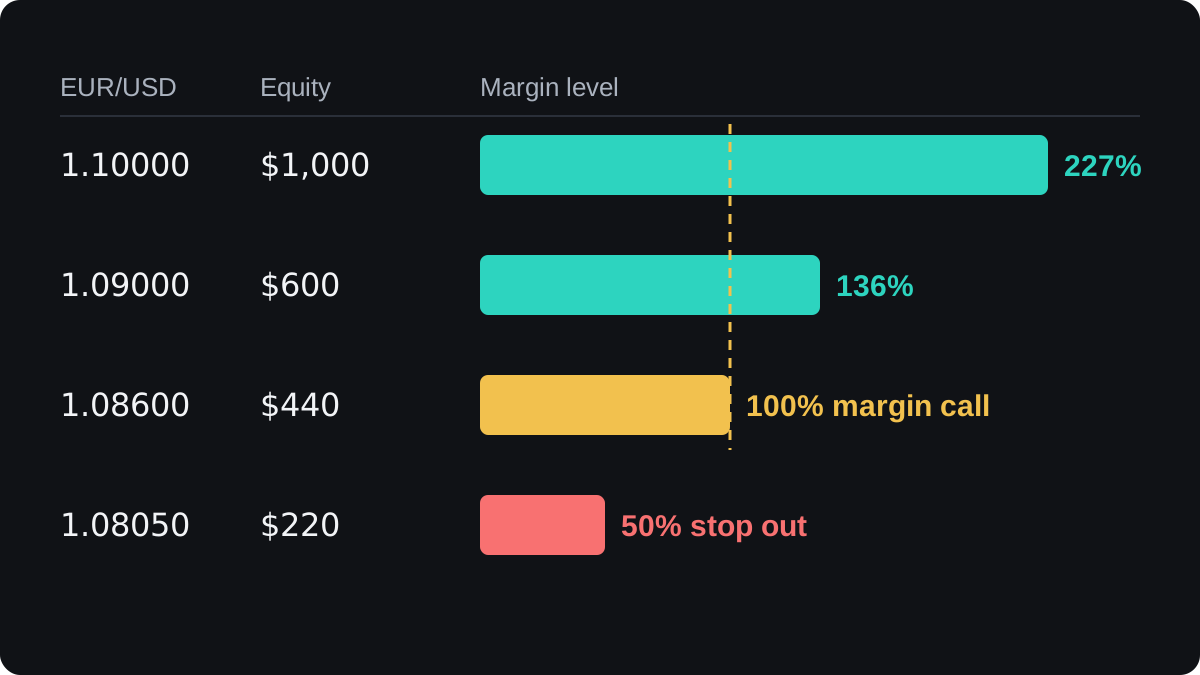
Some platforms recalculate used margin on a pair such as EUR/USD as the price moves, while others fix it at the opening rate. The example holds it at $440 so the steps stay easy to follow.
Why a margin call blocks new trades
Free margin is equity minus used margin. It is the money still available to back new positions.
At the start of the example, free margin is $1,000 − $440 = $560. At the margin call, equity and used margin are both $440, so free margin is zero.
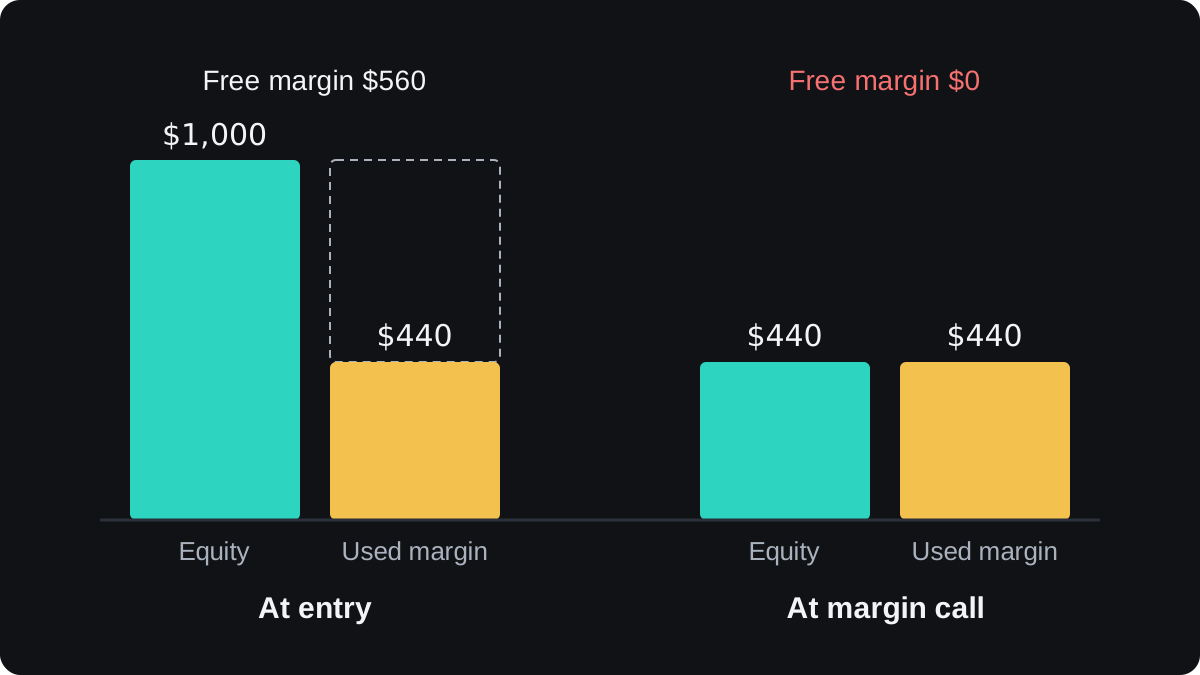
Below 100%, free margin turns negative. A new order that needs margin is normally rejected, because nothing is left to hold as its deposit. Closing trades still works.
That is why the 100% line matters even on accounts with a lower stop out. From there on, the account can reduce its exposure but cannot add to it.
What can you do after a margin call?
Two actions lift the margin level directly, and each changes one side of the ratio.
A deposit raises equity. Add $300 at 1.08600 and equity becomes $740, so margin level is 740 ÷ 440 × 100% = 168%, rounded. The trade is still 140 pips down, with more room to fall.
A partial close cuts used margin. Close 0.20 lot at 1.08600 and you lock in a loss of 140 × $2 = $280, so the balance drops to $720.
The remaining 0.20 lot still shows a floating loss of $280, so equity is $720 − $280 = $440, as before. Used margin halves to $220, and margin level becomes 440 ÷ 220 × 100% = 200%.
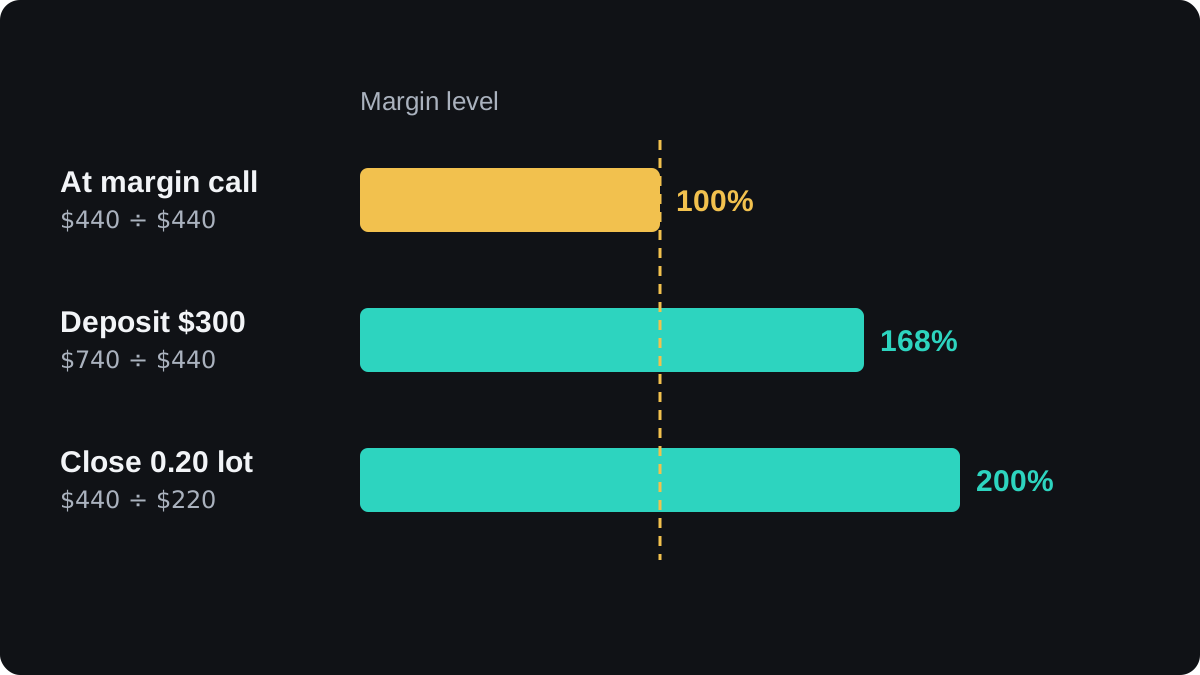
If you do neither and the price keeps falling, the account heads for the stop out level, where the broker closes positions for you. The stop out lesson covers that step.
Neither action tells you whether the trade idea still holds. Adding money to a losing position can turn a small mistake into a large one, so think through your response before a margin call ever arrives.
Where a margin call fails to protect you
A margin call only compares your margin level with a threshold. It cannot slow the price down.
Prices can gap over a weekend or on major news. One jump can carry margin level past 100% and past the stop out level, so the warning and the forced close arrive together, at a worse price than either level suggests.
Thresholds also vary between brokers, and some accounts set the margin call and stop out close together or at the same point. Why levels differ between brokers explains the reasons.
The warning comes late, too. Even with everything working as designed, the example account had lost $560, more than half its balance, before the margin call appeared.
A fast gap can even push equity below zero. Whether the broker absorbs that loss depends on its negative balance policy, so check the client agreement.
Position size decides how close the margin call sits. At 0.20 lot instead of 0.40, used margin is $220 and a pip is worth $2, so reaching 100% would take a loss of $780, or 390 pips.
You can test any size with the margin calculator, and the lesson on how to avoid a margin call builds on this.
常見問題
Does a margin call close my trades?
Usually not on its own. Positions are normally closed at the stop out level, but some brokers set the two at the same point, so check your account terms.
What margin level triggers a margin call?
The level your broker sets for your account type. This lesson uses 100% as an illustration; your broker's account specifications give the real figure.
Can I get a margin call while one trade is in profit?
Yes. Margin level uses the equity and used margin of the whole account, so other open trades can lose more than the winning one gains.
How do I get out of a margin call?
A deposit raises equity and a partial close lowers used margin, and either lifts the margin level. Smaller positions make a margin call less likely in the first place.
Is a margin call the same as a stop out?
No. The margin call is the warning level, and the stop out is the lower level where the broker starts closing your positions.
繼續學習
 第 6 章What is margin trading?Margin trading means opening a position worth more than the money in your account. The broker sets aside part of your balance, the margin, as a deposit while the trade is open. Profit and loss are counted on the full position size, so small price moves change your balance much faster than the margin suggests.
 第 6 章What is account balance in forex?Your account balance is the money in your trading account from deposits, withdrawals and closed trades, after booked costs such as commission and swap. It does not include open positions. While a trade is open the balance stays the same, and the floating profit or loss shows up in your equity instead.
 第 6 章What is floating (unrealized) profit and loss?Floating profit and loss is the result your open trades would show if you closed them at the current price. It changes with every tick and moves your equity, while your balance stays the same. It becomes realized, and is added to or taken from your balance, only when the trade closes.
 第 6 章外匯的保證金、保證金水平與強制平倉是什麼?保證金是槓桿交易未平倉期間,經紀商把您的資金鎖住、當作押金的部分。保證金水平等於淨值除以已用保證金,再乘以 100%。當它跌到經紀商的追繳保證金水平時,您的帳戶會被標記警示;跌到強制平倉水平時,經紀商就會開始自動平掉您的部位。
 第 6 章What is used margin?Used margin is the total amount your broker sets aside to keep all your open positions open. Each position's margin is its notional value divided by your leverage, and used margin adds them up. It is not a fee: the money returns to free margin when you close the trades.
 第 6 章What is equity in a trading account?Equity is your account balance plus or minus the floating profit or loss of your open trades. It shows what the account would be worth if you closed everything at current prices. With no trades open, equity equals balance. Brokers use it to work out free margin, margin level and stop outs.
 第 6 章What is free margin?Free margin is the money in your trading account that is not locked up as margin for open trades. It equals equity minus used margin. You need free margin to open new positions, and it falls as open trades lose and rises as they gain. At zero, your margin level is 100%.
 第 6 章What is margin level?Margin level is your equity divided by your used margin, multiplied by 100 and shown as a percentage. It tells you how much cushion your open trades have. At 100%, equity equals used margin and free margin is zero. Brokers set their margin call and stop out levels on this number, and the levels differ between brokers.
 第 6 章What is a stop out level?The stop out level is the margin level at which your broker starts closing your open positions automatically, often beginning with the largest loss. If your stop out level is 50%, closing begins when equity falls to half your used margin. It is meant to stop your account sinking further, though a price gap can still push it below zero.
 第 6 章Margin call example: margin call at 100% with no separate stop out.When a broker sets the margin call and the stop out both at 100%, the warning and the forced close happen at the same moment. In this example, a $1,000 account buys 0.50 lot of EUR/USD with $550 of margin at 1:100, and the trade is closed after a 90 pip fall, a $450 loss.
 第 6 章Margin call and stop out example: 100% and 50%.In this example a $2,000 account buys 1 lot of EUR/USD at 1.10000 with $1,100 of used margin. The margin call at 100% arrives when equity falls to $1,100, 90 pips lower at 1.09100. The stop out at 50% closes the trade when equity reaches $550, at 1.08550, a loss of $1,450.
 第 6 章What happens if you trade forex with $100?With $100 and 1:100 leverage, 0.01 lot of EUR/USD at 1.10000 uses $11 of margin and can move about 890 pips against you before a 100% margin call. At 0.05 lot the margin call comes after 90 pips, and 0.10 lot cannot be opened at all. Trade size decides how much room you have.
 第 6 章Why margin call and stop out levels differ between brokers.Margin call and stop out levels are set by each broker, often per account type, within any rules from the regulator that licenses the account. In this lesson's example, one trade is closed after 90 pips at one broker and after 178 pips at another, so look up your own levels before you trade.
 第 6 章外匯的槓桿是什麼?槓桿讓您能控制遠大於入金金額的部位。在 1:100 的槓桿下,每 $1 保證金可以持有 $100 的貨幣,所以 $110,000 的部位需要 $1,100。槓桿決定的是要佔用多少保證金,而不是每點值多少錢。您真正的風險,來自您選擇的部位大小。
 第 6 章Margin cheat sheet.Balance is the cash from deposits, withdrawals and closed trades. Equity is balance plus the floating profit or loss on open trades. Used margin is the deposit your open trades hold, and free margin is equity minus used margin. Margin level is equity divided by used margin, times 100. A margin call warns; a stop out closes trades.
 第 6 章How can you avoid a margin call?Margin level is your equity divided by your used margin, and a margin call comes when it falls to your broker's threshold. To stay clear, keep positions small compared with your equity, set stop losses that close losing trades long before that point, and leave plenty of free margin unused.

