What is floating (unrealized) profit and loss?
Floating profit and loss is the result your open trades would show if you closed them at the current price. It changes with every tick and moves your equity, while your balance stays the same. It becomes realized, and is added to or taken from your balance, only when the trade closes.
本頁目前僅提供英文版。

You buy EUR/USD and the price ticks up. Your platform shows +$25 next to the trade, yet your account balance has not moved.
That $25 is a floating profit. It changes with every price tick, and it only becomes part of your balance when you close the trade.
What does floating profit and loss mean?
Floating profit and loss is the result your open trades would show if you closed them at the current price. It is also called unrealized, open or running P/L, where P/L is short for profit and loss.
It floats because prices keep moving. A trade that shows +$25 now can show -$30 an hour later, and the number on screen follows each tick.
Realized profit and loss is the result of a trade you have closed. Once a trade is closed its result is fixed, and the broker adds it to or takes it from your account balance.
In MetaTrader, the Trade tab shows the floating result of each open position in its Profit column. When you have no open trades, your floating P/L is zero.
How is floating P/L worked out?
The platform values each trade at the price you could close it at right now. A long trade closes with a sell, so it is valued at the bid. A short trade closes with a buy, so it is valued at the ask.
The bid and ask lesson covers both prices. The sum is the same one you would use for a closed trade:
Floating P/L = price move in pips × pip value
Here is a long trade with round illustrative prices, in a US dollar account with a balance of $1,000:
- You buy 0.10 lot of EUR/USD at the ask, 1.10000. A standard lot is 100,000 euros, so 0.10 lot is 10,000 euros.
- One pip on this pair is 0.0001, so the pip value is 10,000 × 0.0001 = $1.00.
- The bid at that moment is 1.09990. The floating result is 1.09990 minus 1.10000 = -0.00010, which is -1 pip, or -$1.00.
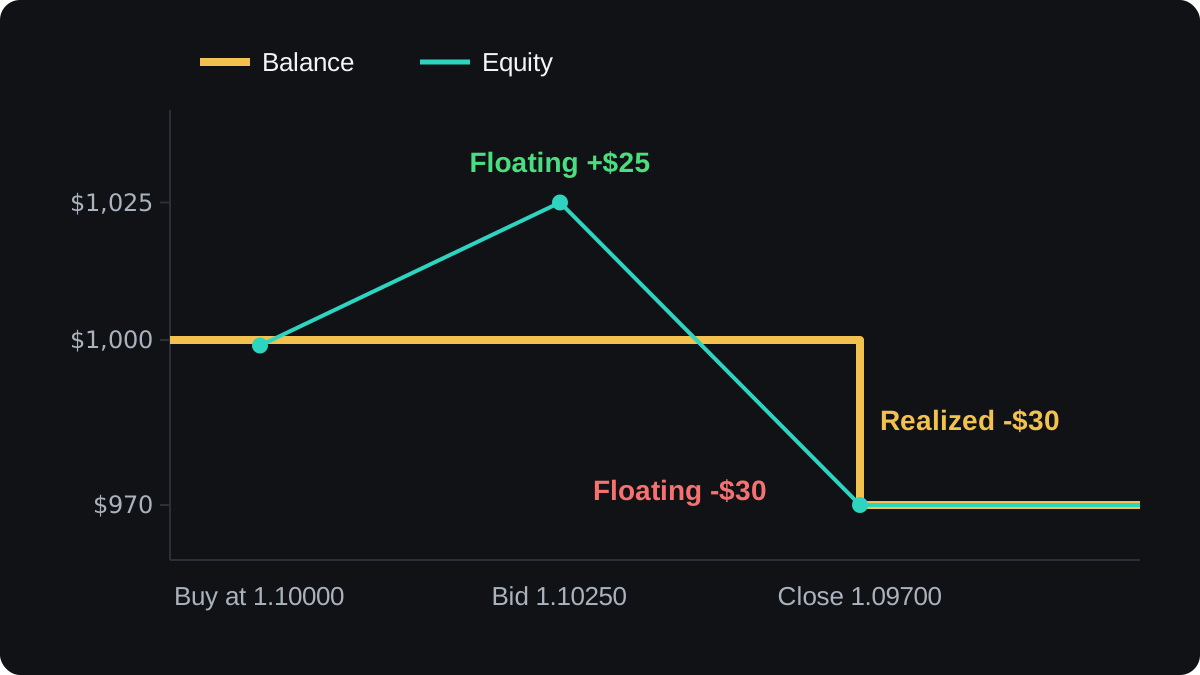
- Later the bid rises to 1.10250. The move is 1.10250 minus 1.10000 = 0.00250, which is 25 pips, so floating P/L is 25 × $1.00 = +$25.00.
- Later still the bid falls to 1.09700. The move is 1.09700 minus 1.10000 = -0.00300, which is -30 pips, so floating P/L is -$30.00.
Through all five steps your balance stays at $1,000, and only the floating number changes.
The -$1.00 in step 3 is the spread. You bought at the ask and can only sell at the bid, so every new trade opens with a small floating loss equal to the spread.
What does floating P/L change in your account?
Your balance counts closed trades only. Your equity is the balance plus the floating P/L of everything still open:
Equity = balance + floating P/L
In the example, equity was $999 just after the trade opened, $1,025 when the bid reached 1.10250 and $970 when it fell to 1.09700.
Now you close the trade at a bid of 1.09700. The -$30 becomes realized, your balance drops to $970, and equity and balance match again because nothing is left open.
Equity is the figure that shows how much room your account really has, which is why the equity lesson gets a page of its own. Free margin and margin level are both calculated from equity.
How do several open trades add up?
With more than one trade open, the platform adds the floating results together. A loss on one position can be offset by a gain on another, and the net total feeds into equity.
Go back to the moment before that close, with the EUR/USD long still open at a bid of 1.09700 and showing -$30.00. Say you have also sold 0.10 lot of USD/JPY at the bid of 150.00, and the ask is now 149.60.
- A JPY pair's pip is 0.01, so the pip value on 10,000 dollars is 10,000 × 0.01 = ¥100.
- You sold first, so the move is 150.00 minus 149.60 = 0.40, which is 40 pips in your favour.
- Floating P/L in yen is 40 × ¥100 = ¥4,000.
- Converted at the current rate, ¥4,000 ÷ 149.60 = $26.74.
The net floating P/L is -$30.00 + $26.74 = -$3.26, so equity is $1,000.00 - $3.26 = $996.74.
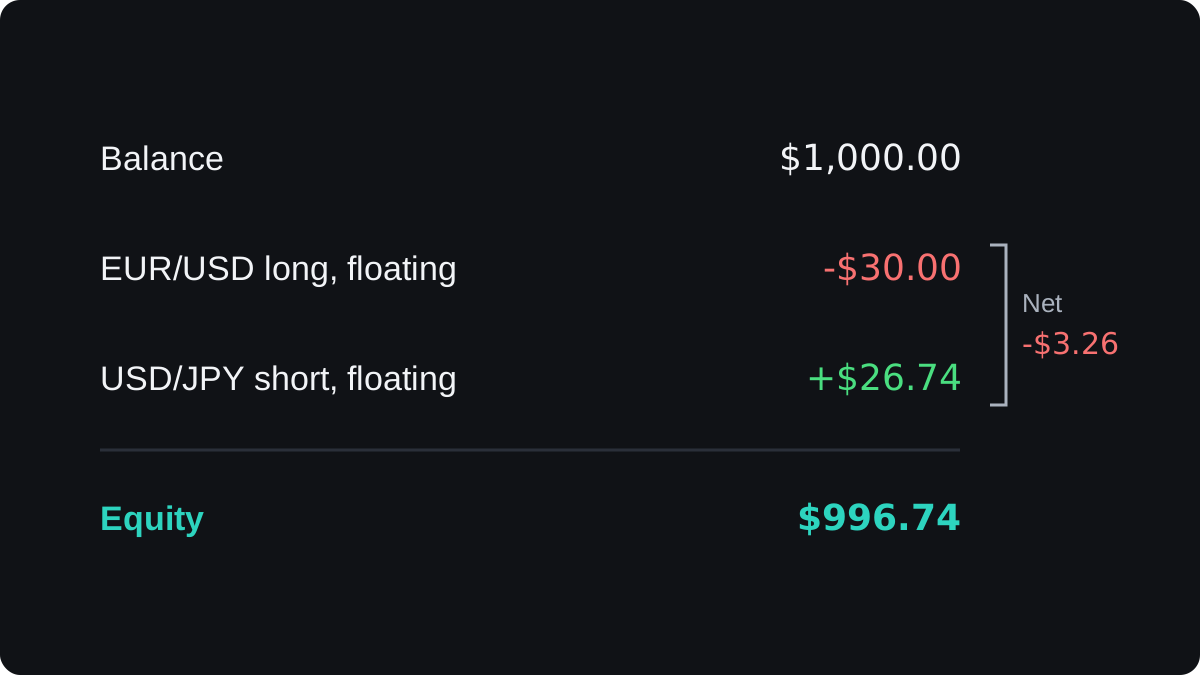
The ¥4,000 follows the price in pips. The $26.74 also depends on the USD/JPY rate used to convert it at that moment, so treat the dollar figure as an example.
When does floating P/L become realized?
Floating P/L turns into realized P/L the moment a position closes. You might close it yourself, a stop loss or take profit order might fill, or the broker might close it at a stop out.
You can also realize part of a position. Go back to the moment the EUR/USD bid stood at 1.10250 with +$25.00 floating and only that trade open, and close half of it:
- The pip value on 0.05 lot is 5,000 × 0.0001 = $0.50.
- The closed 0.05 lot realizes 25 × $0.50 = +$12.50, and your balance rises to $1,012.50.
- The 0.05 lot still open shows 25 × $0.50 = +$12.50 floating.
- Equity is $1,012.50 + $12.50 = $1,025.00, the same as before the partial close.
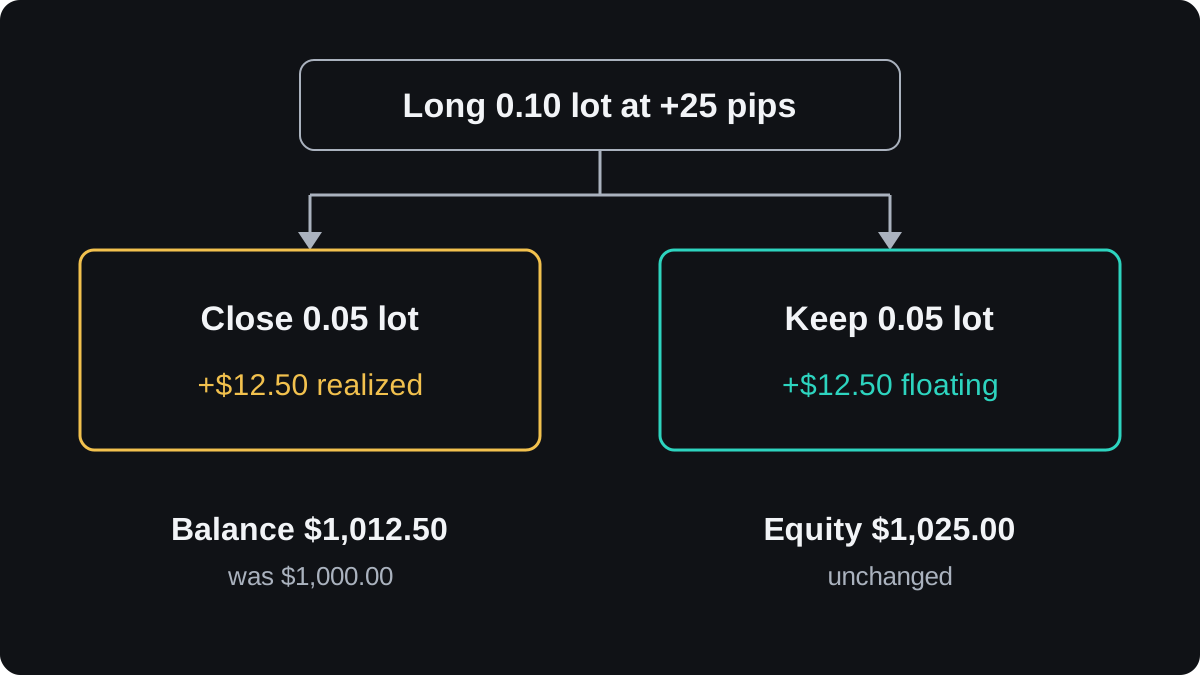
Closing moves a result from floating into the balance. The profit was already inside your equity, so closing locks it in without adding to it. On an account that charges commission, the fee on the closed part comes off as well.
You can test floating results for other pairs and sizes with the profit and loss calculator.
Why is a floating profit not yet yours?
A floating profit can shrink or vanish before you close. If you size a new trade on equity swollen by an open gain, a reversal can remove that cushion while the new position is still running.
Floating losses have their own trap. Leaving a losing trade open does not cancel the loss. It stays live and keeps pulling equity down while the price moves against you.
If equity falls far enough compared with the margin your trades use, the broker can close positions for you and realize the loss at that price. The next lesson, on margin, margin level and stop out, shows how that point is measured.
Prices can also jump. When the market reopens after a weekend or reacts to a big news release, floating P/L updates at the first available price, which can be far from the last one you saw.
Two costs also touch open trades. Swap, the overnight interest on positions held past the daily rollover, builds up while a trade stays open, and some accounts charge commission when you open. Platforms often list both beside the price result, and equity counts them.
常見問題
Is floating profit real money?
It counts toward your equity, but it can disappear if the price turns. It becomes part of your balance only when the position closes.
What is the difference between realized and unrealized profit?
Unrealized profit belongs to trades that are still open and changes with the price. Realized profit comes from closed trades, is fixed and has been added to your balance.
Why does my trade show a loss as soon as I open it?
The trade is valued at the price you would close at, which sits on the other side of the spread. On 0.10 lot of EUR/USD with a 1 pip spread, that is -$1.00 before the price moves.
Does a floating loss affect my margin?
Yes. A floating loss lowers equity, and free margin and margin level are calculated from equity, so a large floating loss can lead to a margin call or stop out.
Does a partial close change my equity?
Not by itself. It moves part of the floating result into your balance, so the balance changes and equity stays the same, apart from any commission on the closed part.
繼續學習
 第 6 章What is margin trading?Margin trading means opening a position worth more than the money in your account. The broker sets aside part of your balance, the margin, as a deposit while the trade is open. Profit and loss are counted on the full position size, so small price moves change your balance much faster than the margin suggests.
 第 6 章What is account balance in forex?Your account balance is the money in your trading account from deposits, withdrawals and closed trades, after booked costs such as commission and swap. It does not include open positions. While a trade is open the balance stays the same, and the floating profit or loss shows up in your equity instead.
 第 6 章外匯的保證金、保證金水平與強制平倉是什麼?保證金是槓桿交易未平倉期間,經紀商把您的資金鎖住、當作押金的部分。保證金水平等於淨值除以已用保證金,再乘以 100%。當它跌到經紀商的追繳保證金水平時,您的帳戶會被標記警示;跌到強制平倉水平時,經紀商就會開始自動平掉您的部位。
 第 6 章What is used margin?Used margin is the total amount your broker sets aside to keep all your open positions open. Each position's margin is its notional value divided by your leverage, and used margin adds them up. It is not a fee: the money returns to free margin when you close the trades.
 第 6 章What is equity in a trading account?Equity is your account balance plus or minus the floating profit or loss of your open trades. It shows what the account would be worth if you closed everything at current prices. With no trades open, equity equals balance. Brokers use it to work out free margin, margin level and stop outs.
 第 6 章What is free margin?Free margin is the money in your trading account that is not locked up as margin for open trades. It equals equity minus used margin. You need free margin to open new positions, and it falls as open trades lose and rises as they gain. At zero, your margin level is 100%.
 第 6 章What is margin level?Margin level is your equity divided by your used margin, multiplied by 100 and shown as a percentage. It tells you how much cushion your open trades have. At 100%, equity equals used margin and free margin is zero. Brokers set their margin call and stop out levels on this number, and the levels differ between brokers.
 第 6 章What is a margin call?A margin call is your broker's warning that your margin level, equity divided by used margin, has fallen to a set threshold such as 100%. You usually cannot open new trades from that point. The call closes nothing by itself. If losses continue, the broker's stop out level is where positions start to be closed for you.
 第 6 章What is a stop out level?The stop out level is the margin level at which your broker starts closing your open positions automatically, often beginning with the largest loss. If your stop out level is 50%, closing begins when equity falls to half your used margin. It is meant to stop your account sinking further, though a price gap can still push it below zero.
 第 6 章Margin call example: margin call at 100% with no separate stop out.When a broker sets the margin call and the stop out both at 100%, the warning and the forced close happen at the same moment. In this example, a $1,000 account buys 0.50 lot of EUR/USD with $550 of margin at 1:100, and the trade is closed after a 90 pip fall, a $450 loss.
 第 6 章Margin call and stop out example: 100% and 50%.In this example a $2,000 account buys 1 lot of EUR/USD at 1.10000 with $1,100 of used margin. The margin call at 100% arrives when equity falls to $1,100, 90 pips lower at 1.09100. The stop out at 50% closes the trade when equity reaches $550, at 1.08550, a loss of $1,450.
 第 6 章What happens if you trade forex with $100?With $100 and 1:100 leverage, 0.01 lot of EUR/USD at 1.10000 uses $11 of margin and can move about 890 pips against you before a 100% margin call. At 0.05 lot the margin call comes after 90 pips, and 0.10 lot cannot be opened at all. Trade size decides how much room you have.
 第 6 章Why margin call and stop out levels differ between brokers.Margin call and stop out levels are set by each broker, often per account type, within any rules from the regulator that licenses the account. In this lesson's example, one trade is closed after 90 pips at one broker and after 178 pips at another, so look up your own levels before you trade.
 第 6 章外匯的槓桿是什麼?槓桿讓您能控制遠大於入金金額的部位。在 1:100 的槓桿下,每 $1 保證金可以持有 $100 的貨幣,所以 $110,000 的部位需要 $1,100。槓桿決定的是要佔用多少保證金,而不是每點值多少錢。您真正的風險,來自您選擇的部位大小。
 第 6 章Margin cheat sheet.Balance is the cash from deposits, withdrawals and closed trades. Equity is balance plus the floating profit or loss on open trades. Used margin is the deposit your open trades hold, and free margin is equity minus used margin. Margin level is equity divided by used margin, times 100. A margin call warns; a stop out closes trades.
 第 6 章How can you avoid a margin call?Margin level is your equity divided by your used margin, and a margin call comes when it falls to your broker's threshold. To stay clear, keep positions small compared with your equity, set stop losses that close losing trades long before that point, and leave plenty of free margin unused.

